
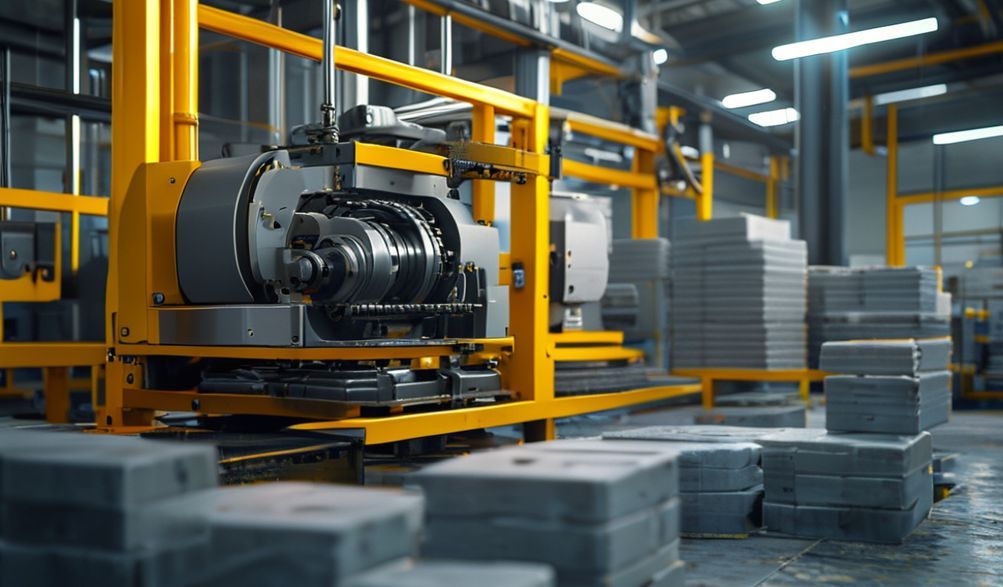
Your Ultimate Guide to Cement Concrete Block Making Machines in Gujarat (2026)
Introduction
Gujarat’s construction sector is booming, projected to grow at a CAGR of over 9%, fueled by massive infrastructure projects, industrial corridors, and urban development. For builders, contractors, and entrepreneurs, this growth presents a golden opportunity. However, it also brings a critical challenge: securing a consistent, high-quality, and cost-effective supply of construction blocks. Relying on external suppliers can lead to delays, cost volatility, and quality inconsistencies that derail project timelines and budgets.
The solution lies in taking control of production. A cement concrete block making machine is not just a piece of equipment; it’s a strategic asset that enables on-demand, scalable, and profitable manufacturing of one of construction’s most fundamental materials. For businesses in Gujarat, this is particularly advantageous given the state’s unique industrial ecosystem.
This guide is crafted from deep industry analysis, direct insights from machinery manufacturers in Gujarat’s industrial clusters, and practical market intelligence. Our goal is to provide you with a trustworthy, comprehensive resource that cuts through the noise. We will demystify the types of machines available, break down key specifications, navigate the landscape of local manufacturers, analyze investment returns, and arm you with essential buying tips—all tailored to the opportunities within Gujarat.
Why Gujarat is a Hub for Block Making Machinery
The Industrial Backbone of India
Gujarat isn’t just a state; it’s an economic powerhouse. Consistently ranked among India’s top industrial destinations, it boasts:
* World-class infrastructure with extensive road, rail, and port connectivity.
* A pro-business policy environment that actively supports manufacturing and MSMEs.
* A vast pool of skilled and semi-skilled engineers, technicians, and operators.
This ecosystem doesn’t just attract machine users; it naturally fosters the growth of machine makers. The culture of engineering excellence here is palpable.
Proximity to Raw Materials
The cost of a block isn’t just in its making; it’s heavily influenced by logistics. Gujarat offers a distinct advantage:
* It is a major producer of cement, with numerous plants across the state.
* Rivers and quarries provide easy access to quality sand and aggregates.
* This local availability drastically reduces the inbound logistics cost for raw materials, making block production significantly more economical for unit owners.
Cluster of Manufacturers
Innovation and competitive pricing thrive in clusters. Gujarat has developed specialized industrial zones that concentrate expertise:
* Ahmedabad & Vadodara: Often home to larger manufacturers specializing in high-end, fully automatic production lines and advanced R&D.
* Rajkot & Surendranagar: Known for robust, durable, and cost-effective semi-automatic and manual machines, often termed the “engineering workshop” of the region.
This concentration means buyers can compare multiple options, negotiate better, and benefit from localized after-sales support networks.
Types of Cement Concrete Block Making Machines
Choosing the right type is the first and most critical step. Your selection should align with your production goals, budget, and labor availability.
Manual Block Making Machines
- Description: These are hand-operated or lever-operated machines where material feeding, compaction, and block ejection are performed manually.
- Ideal For: Startups, very small-scale projects, rural areas with limited electricity, or entrepreneurs testing the market with minimal capital.
- Pros:
- Lowest initial investment.
- Simple to operate with minimal technical knowledge.
- Low maintenance and power costs.
- Cons:
- Highly labor-intensive and slow.
- Lower output (typically 300-500 blocks per 8-hour shift).
- Inconsistent quality if not operated carefully.
Semi-Automatic Block Making Machines
- Description: These machines automate the core vibration and compaction process using an electric motor and hydraulic system. Operators manually feed the raw material mix and remove finished blocks.
- Ideal For: Small to medium-sized businesses (SMBs), brick manufacturing units supplying local builders, and contractors undertaking projects with defined block needs.
- Pros:
- Excellent balance between cost, output, and automation.
- Significantly higher production (1,000 to 2,500 blocks per hour) than manual machines.
- Better quality consistency due to mechanized compaction.
- Reduced physical strain on labor.
- Cons:
- Requires a steady supply of 3-phase electricity.
- Needs some technical skill for operation and basic maintenance.
- Higher upfront cost than manual machines.
Fully Automatic Block Making Machines
- Description: These are complete production lines. They feature automatic material feeding (via conveyor or hopper), computerized control (PLC), automatic pallet circulation, and stackers. Human intervention is minimal, primarily for monitoring.
- Ideal For: Large-scale block manufacturers, industrial plants supplying to city-wide projects, and entrepreneurs targeting high-volume markets.
- Pros:
- Very high output (4,000 to 10,000+ blocks per hour).
- Superior and uniform quality of every block.
- Drastic reduction in direct labor costs.
- High efficiency and lower per-unit cost at scale.
- Cons:
- Substantial initial capital investment.
- Requires significant factory space and robust power supply.
- Complex maintenance requiring specialized technicians.
Mobile Block Making Machines
- Description: Mounted on a trailer or a movable platform, these are typically hydraulic machines designed for on-site production.
- Ideal For: Large infrastructure projects (dams, roads, remote buildings), where transporting finished blocks over long distances is prohibitively expensive.
- Key Advantage: Eliminates transport costs for finished goods by manufacturing directly where the blocks are needed, using locally sourced aggregates.
Key Features & Specifications to Consider
Beyond the type, drilling into these specifications will ensure your machine matches your operational reality.
Production Capacity (Blocks per Hour)
Don’t just look at the peak number. Consider:
* Sustainable Output: What can the machine produce consistently over an 8-hour shift?
* Future Growth: Does it allow for a 20-30% increase in demand without straining?
* Match to Market: A machine producing 5,000 blocks/hour is useless if your local daily demand is only 2,000 blocks.
Block Types and Sizes
Versatility equals revenue potential. Ensure the machine can produce:
* Hollow Blocks (4″, 6″, 8″) for load-bearing walls.
* Solid Blocks for foundations and paving.
* Paving Blocks & Interlocking Pavers for landscaping and hardscaping.
* Fly Ash Bricks (an eco-friendly and cost-effective alternative).
Check the mold-changing process—is it quick and tool-free?
Automation Level and Control System
- Hydraulic Systems: Provide powerful, consistent compaction. Look for reliable pump and valve brands.
- PLC Control (Programmable Logic Controller): The brain of automatic machines. It ensures precision, allows programming of different block cycles, and simplifies troubleshooting. A user-friendly HMI (Human-Machine Interface) screen is a major plus.
Power Requirement
This is a crucial operational cost. In Gujarat’s industrial areas:
* 3-Phase Power is standard for semi and fully automatic machines. Confirm the exact kW/HP rating.
* Hydraulic Power Pack efficiency affects electricity consumption. More efficient systems have lower running costs.
* Plan for voltage stabilizers if your area has fluctuations.
After-Sales Support
This is arguably the most critical feature when buying in Gujarat. A machine is a long-term investment. You must have:
* Local Service Engineers: Proximity ensures faster response times during breakdowns.
* Ready Availability of Spare Parts: Ask about the inventory of commonly wearing parts like molds, vibrator motors, and hydraulic seals.
* Comprehensive Warranty: Understand what is covered (parts, labor) and for what duration (typically 1 year on core components).
* Operator Training: Does the supplier provide hands-on training at your site?
Top Manufacturers and Suppliers of Block Machines in Gujarat
Navigating the manufacturer landscape requires a strategic approach.
How to Vet a Reliable Manufacturer
- Experience: Look for companies with a track record of 10+ years. They have likely seen and solved various operational challenges.
- Client Portfolio: Ask for a list of clients. A mix of long-standing and new customers is a good sign.
- Certifications: ISO certification indicates a commitment to standardized manufacturing processes.
- Physical Infrastructure: A company with its own fabrication and assembly unit has better control over quality than a mere trader.
Overview of Established Gujarat-Based Clusters
While we avoid naming specific brands, here’s what you’ll typically find:
* In Ahmedabad and Vadodara, you encounter manufacturers who often focus on fully automatic turnkey plants. They emphasize R&D, offer sophisticated PLC controls, and cater to large-scale national and export markets.
* The Rajkot belt is renowned for robust semi-automatic and manual machines. The focus here is on durability, mechanical simplicity, and providing exceptional value for money. They are masters of machines built to last in demanding conditions.
* Several suppliers across the state act as channel partners or dealers for national brands, offering you a wider range but ensure you clarify who handles the after-sales service.
The Importance of Factory Visits
Never skip this step. A factory visit allows you to:
* Assess build quality: Look at welding, painting, and assembly standards.
* Gauge scale: Is it a small workshop or an organized manufacturing facility?
* Witness testing: Ask to see a machine under test. Listen for unusual noises, observe vibration stability.
* Meet the team: Interact with the engineers who will handle your service requests.
Investment and ROI Analysis
A clear financial picture turns a purchase from an expense into an investment.
Understanding the Cost Structure
Your total investment includes:
1. Machine Cost: The ex-factory price.
2. Installation & Commissioning: Includes transportation, foundation work, and electrical connection.
3. Raw Material Inventory: Initial stockpile of cement, sand, and aggregate.
4. Labor: For operation, maintenance, and material handling.
5. Power & Utilities: Recurring monthly expense.
6. Space: Cost of the shed or factory space.
Calculating Your Return on Investment (ROI)
Use a simplified framework:
ROI Timeframe = (Total Initial Investment) / (Monthly Profit)
Example (Simplified):
* Machine + Setup Cost: ₹10,00,000
* Monthly Production: 1,00,000 blocks
* Sale Price per Block: ₹10
* Production Cost per Block: ₹7 (raw material + power + labor)
* Monthly Profit: 1,00,000 x (10-7) = ₹3,00,000
* Simple ROI: 10,00,000 / 3,00,000 ≈ 3.3 months
Note: This is a simplified model. Factor in market demand consistency, downtime, and other overheads for a more accurate projection.
Government Schemes and Financing
- Gujarat Government Schemes: Explore incentives for MSMEs under various industrial policies which may offer subsidies on capital investment, especially in designated zones.
- Financing: Most nationalized banks and NBFCs offer Term Loans for machinery purchase under the CGTMSE (Credit Guarantee Fund Trust for Micro and Small Enterprises) scheme, which can cover up to 85% of the machine cost without collateral.
Essential Buying Tips for Buyers in Gujarat
Arm yourself with these practical steps before signing any order.
Define Your Project Requirements Clearly
Write down non-negotiable parameters:
* Required daily output in blocks.
* Primary block types (e.g., 60% hollow blocks, 40% pavers).
* Available factory space dimensions and height.
* Total budget, including a 15-20% buffer for ancillary costs.
Insist on a Live Demonstration
- See it Run: Never buy based on a brochure or video call alone.
- Use Your Mix: If possible, provide a sample of the sand and aggregate you plan to use. See the quality of the block produced from your material.
- Test All Functions: Operate the machine through its full cycle, including mold change if applicable.
Scrutinize the Warranty and Service Contract
Get everything in writing. The document should specify:
* Warranty period for different components.
* Terms of warranty (what constitutes misuse).
* Service Response Time Commitment (e.g., “engineer dispatch within 24 hours for calls in Gujarat”).
* List of spare parts included in the initial supply.
Check for Customer References
A confident supplier will provide 2-3 references. When you call:
* Ask about machine performance and downtime.
* Inquire about the responsiveness of the service team.
* Ask if they would buy from the same supplier again.
Frequently Asked Questions (FAQ)
Q1: What is the approximate price range for a block making machine in Gujarat?
A: Prices vary dramatically. A basic manual machine can start from ₹1.5 – ₹3 Lakhs. A standard semi-automatic machine may range from ₹5 – ₹15 Lakhs. Fully automatic plants begin around ₹25 Lakhs and can go into crores, depending on capacity and sophistication. Always get detailed quotations based on your specific needs.
Q2: Can I get a machine customized for producing interlocking pavers or designer blocks?
A: Absolutely. Most reputable manufacturers in Gujarat offer custom mold fabrication. You can provide the design for specialty blocks, kerbstones, or textured pavers, and they will engineer the mold to fit their machine. This customization is a key advantage of dealing directly with manufacturers.
Q3: What kind of after-sales service can I expect from a local Gujarat supplier?
A: You should expect comprehensive support: installation supervision, thorough operator training, a clear warranty period (typically 12 months), and a dedicated service hotline. The major benefit of a local supplier is the promise of quick physical service visits and local stock of critical spare parts.
Q4: Are there any specific permissions or licenses needed to set up a block manufacturing unit in Gujarat?
A: Basic requirements include GST Registration, MSME/Udyam Registration, and a Factory License if you employ more than a certain number of workers. For larger units, a Consent to Operate from the Gujarat Pollution Control Board (GPCB) may be required. It’s best to consult with a local Chartered Accountant or a consultant familiar with Gujarat’s industrial regulations.
Q5: What raw material quality is crucial for producing strong blocks?
A: The strength starts with your inputs. Use well-graded, coarse sand (Zone-I or II) with minimal silt/clay content, fresh OPC 43 or 53 grade cement, and clean, potable water. The mix design (ratio of cement:sand:aggregate) is critical; many Gujarat-based suppliers can help you develop an optimal mix for your local materials.
Conclusion
Investing in a cement concrete block making machine in Gujarat is a strategic decision that leverages the state’s manufacturing prowess to build a more profitable and resilient business. The journey begins with a clear understanding of your own production needs, followed by a meticulous evaluation of machine types—from manual starters to fully automatic powerhouses.
The advantage of sourcing from Gujarat’s industrial clusters cannot be overstated. It provides access to competitive innovation, reduces logistical dependencies, and, most importantly, ensures that vital after-sales support is just a phone call away. Remember, you are not just buying a machine; you are entering a long-term partnership with the manufacturer.
As you move forward, keep an eye on industry trends shaping the future, such as the growing demand for fly ash-based eco-blocks and machines with energy-efficient drives and IoT-based monitoring. The right machine today will position you to capitalize on these trends tomorrow.
Take the next step with confidence. Define your specifications, shortlist manufacturers from the hubs we discussed, schedule factory visits, and insist on live demonstrations. Your path to becoming a leading block supplier in Gujarat’s dynamic construction story starts with this informed decision.