
The Ultimate Guide to Vibro Press Block Machines: Technology, Benefits & Selection
For any business owner, project manager, or engineer in the construction materials sector, the quest for a reliable, efficient, and profitable production solution is paramount. The core of a successful concrete product business lies in its ability to consistently produce high-quality blocks, pavers, and bricks that meet market demands and structural standards. Enter the vibro press block machine—the undisputed industry-standard technology that makes this possible.
This isn’t just another piece of factory equipment; it’s a precision-engineered system that defines the quality and viability of your output. But with various models and technical claims on the market, selecting the right machine can be daunting. This comprehensive guide, grounded in engineering principles and industry expertise, is designed to demystify the technology. We’ll dissect how it works, detail its concrete advantages over simpler methods, and provide you with a trusted, actionable framework for making a confident investment decision that will fuel your growth for years to come.
What is a Vibro Press Block Machine? Core Technology Explained
At its heart, a vibro press block machine is a synergistic manufacturing system designed to produce dense, dimensionally accurate concrete products. The key misconception to dispel is that it’s merely a vibrator or just a press. Its superior results come from the simultaneous application of two fundamental forces: high-frequency vibration and high-pressure hydraulic compaction. This dual-action principle is what separates it from lower-tech alternatives like manual or simple vibrating tables, which cannot achieve the same level of material consolidation.
The Dual-Action Principle: Vibration + Hydraulic Pressure
The magic—or rather, the precise engineering—of the vibro press happens in the mold during each cycle.
- High-Frequency Vibration: Before pressure is fully applied, the mold table is subjected to powerful vibration. This is typically generated by rotating eccentric weights. This vibration fluidizes the concrete mix, causing the granular particles (sand, aggregate) to settle into their densest possible arrangement. Critically, it drives out entrapped air bubbles, which are weak points in the final product. Think of gently tapping a jar of spices to settle the contents—this is that process, but at an industrial, scientifically optimized scale.
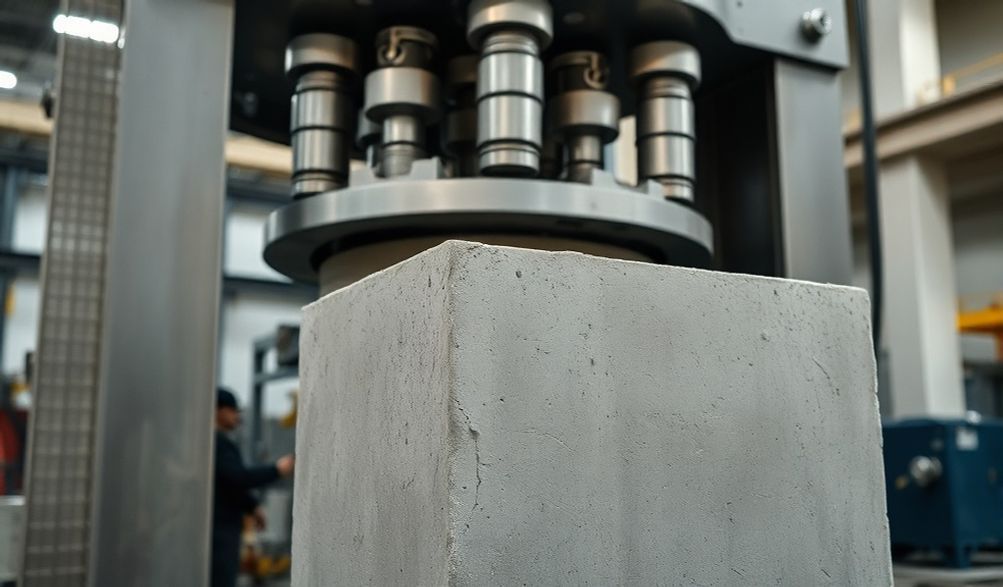
- Simultaneous High-Pressure Hydraulic Compaction: While the mix is in this fluidized, settled state, a hydraulic ram applies immense downward pressure—often measured in hundreds of tons. This force further compresses the particles, creating intimate contact between the cement paste and the aggregates. The result is a product of exceptional density and mechanical interlock, directly translating to high compressive strength and a low water absorption rate.
It is this combination that allows for the use of leaner concrete mixes (saving on cement costs) while still achieving strengths that meet or exceed standards like ASTM C90 for concrete masonry units.
Key Components and Their Functions
Understanding the main components demystifies the machine’s operation and highlights what to look for in a quality build.
- Mold & Pallet System: This is the heart of product shaping. The mold, or “mould box,” defines the block’s shape (hollow, solid, paver). It must be constructed from high-grade, wear-resistant steel to maintain dimensional accuracy over thousands of cycles. The pallet is the steel plate that forms the bottom of the mold during pressing and carries the fresh block to the curing area. A consistent, flat pallet is essential for a uniform block bottom.
- Vibration System: This subsystem consists of the vibration motors (housing the eccentric weights), their mounting assembly, and often isolation springs. Key specifications are frequency (measured in Hz or RPM) and amplitude (the magnitude of vibration). Different product types and mix designs may require different vibration profiles. A robust, balanced system ensures consistent vibration transfer to the mold for uniform product density.
- Hydraulic Press System: Comprising the hydraulic power pack, cylinders, valves, and piping, this system delivers the pressing force. The tonnage (e.g., 150-ton press force) is a critical specification directly correlated to the potential compressive strength of the block. A reliable, leak-free system with precise pressure control is non-negotiable for consistent quality and machine uptime.
- Control System: Modern machines are governed by a Programmable Logic Controller (PLC). This automated brain controls the sequence, timing, and force of every cycle. It ensures repeatability—every block is made with the exact same process parameters. Advanced panels allow operators to store recipes for different products and provide diagnostic information for troubleshooting.
Top Advantages of Using a Vibro Press Machine
Investing in a vibro press is a strategic decision with tangible, measurable returns. Here are the core benefits that drive profitability and market competitiveness.
Unmatched Product Quality & Strength
This is the primary advantage. The dual-action process yields products with superior physical properties:
* High Density & Compressive Strength: Essential for load-bearing applications. Blocks can routinely achieve strengths exceeding industry standards.
* Precise Dimensional Tolerances: Uniform block size simplifies and speeds up bricklaying, reducing mortar use and labor costs on construction sites.
* Excellent Surface Finish: A smooth, dense face improves aesthetics for pavers and facing blocks, often right out of the machine.
* Low Water Absorption: High density reduces porosity, making the blocks more durable against freeze-thaw cycles and weathering.
High Production Efficiency and Output
Vibro press machines are built for volume and reliability.
* Fast Cycle Times: A typical cycle (fill, vibrate, press, strip, return) can be as short as 10-20 seconds.
* Multiple Blocks Per Cycle: Machines can be configured with multi-cavity molds to produce several blocks (e.g., 4, 6, 10) simultaneously.
* 24/7 Operational Capability: With proper maintenance, these machines can run continuously, maximizing return on investment and meeting large order deadlines.
* Reduced Labor Dependency: Automation, from feeding to stacking, minimizes manual handling and associated costs and inconsistencies.
Remarkable Material Efficiency and Cost Savings
Quality doesn’t have to come at a high material cost. The efficient compaction process allows for:
* Optimized Mix Designs: You can often reduce the cement content—the most expensive raw material—while still meeting strength targets.
* Use of Alternative Materials: The process is excellent for incorporating industrial by-products like fly ash or slag, which can enhance certain properties and reduce both cost and environmental footprint.
* Minimal Waste: Precise filling and consistent production result in very little raw material waste compared to manual methods.
Versatility in Product Range
One machine can be the foundation for an entire product catalog. By changing the mold, the same press can produce:
* Solid and hollow concrete blocks of various thicknesses.
* Interlocking concrete pavers in numerous shapes and patterns.
* Kerbstones, edging, and retaining wall units.
* Specialized blocks for landscaping and erosion control.
This flexibility allows a business to adapt quickly to market trends and customer demands without major capital reinvestment.
Critical Applications and Industries
The vibro press is not a niche tool; it’s essential technology in several key sectors.
Construction and Building Material Production
This is the core application. Vibro press machines are the backbone of plants producing:
* Load-bearing concrete masonry units (CMUs) for structural walls.
* Non-load bearing blocks for partitions and infill.
* High-quality bricks for residential and commercial construction.
Infrastructure and Landscape Development
Beyond building blocks, this technology shapes our external environment:
* Interlocking Concrete Pavers: For durable, attractive, and permeable driveways, walkways, and public squares.
* Heavy-Duty Blocks: For retaining walls, sound barriers, and coastal defense systems.
* Slope Protection and Erosion Control Units: Specifically designed blocks for stabilizing embankments and channels.
Sustainable and Eco-Friendly Projects
The vibro press aligns perfectly with green construction initiatives:
* Production with Recycled Aggregates: Crushed concrete or other recycled materials can be successfully compacted into new, high-value products.
* Permeable Paving Systems: Special paver designs create surfaces that allow rainwater to infiltrate, reducing runoff and supporting Sustainable Urban Drainage Systems (SUDS).
* Energy-Efficient Buildings: Dense concrete blocks provide excellent thermal mass, contributing to energy-efficient building envelopes.
How to Choose the Right Vibro Press Machine: A Buyer’s Checklist
Navigating the market requires a structured approach. Use this checklist as a consultant’s guide to evaluate your options.
Assess Your Production Requirements
Start with your business plan. Ask yourself:
* What is my required output? (e.g., blocks per 8-hour shift, or annual volume).
* What specific products will I sell? (List block types, sizes, and thicknesses).
* What is the available space in my factory?
* What is my current and projected electrical power capacity?
Evaluate Technical Specifications
Compare models objectively using these key metrics:
* Pressing Force (Tonnage): Match this to the target compressive strength of your products. Heavier, denser blocks require more force.
* Vibration System: Inquire about the configuration, power, and adjustability of the vibration motors.
* Motor Power: The total installed power (KW/HP) indicates the machine’s overall capability and will impact your electricity costs.
* Automation Level: Semi-automatic (manual feeding/pallet handling) vs. Fully automatic (with automatic feeders, stackers, and pallet return systems). This is a major cost and efficiency driver.
* Pallet Size: Determines the maximum block footprint you can produce.
Consider Machine Build Quality and Durability
Look beyond the brochure. A robust build ensures longevity.
* Frame Construction: The main frame should be heavy-duty, welded steel, not light-gauge. It must withstand constant dynamic loads without deflection.
* Hydraulic Components: Reputable brands for pumps, valves, and cylinders are a sign of quality. Ask for specifications.
* Mold and Wear Parts: Insist on information about the steel grade and hardening processes used for molds, liners, and wear plates.
Factor in Supplier Reputation and Support
This is perhaps the most critical, yet often overlooked, factor. The best machine is only as good as the company behind it.
* Proven Experience: How long has the supplier been manufacturing these machines? Request a detailed client list.
* Site Visits: Always insist on visiting an existing installation, preferably one that has been running for a few years. Speak to the operators and managers about performance and support.
* After-Sales Service: Clarify what is included: Installation supervision? Comprehensive operator training? Availability of spare parts? What is the warranty period and what does it cover?
* Technical Documentation: Ensure you will receive clear electrical, hydraulic, and parts manuals in your language.
FAQ: Your Vibro Press Machine Questions Answered
1. What is the typical cost range for a vibro press block machine?
Costs vary dramatically based on capacity and automation. A basic semi-automatic machine may start in the tens of thousands of dollars, while a high-output, fully automatic production line can cost several hundred thousand. Focus on Total Cost of Ownership (TCO)—consider energy use, maintenance costs, and expected lifespan, not just the initial purchase price.
2. Can a vibro press machine use local raw materials?
Yes, and this is a major advantage. However, success depends entirely on mix design. The machine compacts what you feed it. It’s crucial to test your local sand and aggregates to develop a mix that works with your machine’s parameters. A good supplier should help with this.
3. What is the difference between stationary and mobile vibro press machines?
* Stationary Machines: Installed in a fixed factory setting. They are larger, more powerful, and designed for high-volume, continuous production of a variety of products.
* Mobile Machines: Mounted on a trailer for on-site production. They are ideal for very large, single-site projects (e.g., a housing development) where transporting finished blocks is costly. They typically offer less versatility and lower output than stationary plants.
4. How much maintenance does a vibro press require?
Preventive maintenance is key. Daily checks include lubricating moving parts and checking for loose bolts. Weekly tasks involve inspecting hydraulic hoses and fluid levels, and cleaning the mold and pallets. The vibration units and hydraulic seals will require periodic, scheduled servicing. A well-maintained machine can last for decades.
5. What after-sales support should I expect from a reputable supplier?
Expect a full partnership. This includes: Pre-delivery consultation on foundation and utilities, on-site installation and commissioning by a technician, comprehensive training for your operators and maintenance staff, a clear warranty (typically 12 months on major components), and most importantly, responsive technical support and a reliable supply of wear parts and spares.
Conclusion
A vibro press block machine is far more than a capital expense; it is the cornerstone investment for building a profitable, sustainable, and quality-driven concrete products business. Its proven technology delivers an unmatched combination of product strength, production efficiency, and operational versatility that simpler methods cannot rival.
The path to a successful purchase lies in diligent research and a focus on long-term partnership. Use the insights and structured checklist provided in this guide to move beyond specifications and evaluate the true value proposition of each option. Remember, you are investing in both a machine and a supplier. Prioritize manufacturers who demonstrate deep technical expertise, transparent communication, and a verifiable commitment to your success through robust after-sales support. With the right machine and the right partner, you lay the strongest possible foundation for your business’s future.