
The Ultimate Guide to Clay Brick Making Machines in Brazil: Technology, Suppliers & Market Insights
Introduction
Brazil’s skyline is a testament to growth. From the sprawling residential complexes of São Paulo to the ambitious public infrastructure projects shaping the nation, the construction industry is a powerhouse of the Brazilian economy. At the very heart of this progress lies a timeless building block: the clay brick. A symbol of durability and tradition, it remains the foundational element for much of the country’s architecture. However, behind this robust demand, local manufacturers face a pressing triad of challenges: scaling production to meet market needs, ensuring unwavering quality, and improving operational efficiency to remain profitable.
The solution to these modern challenges is found in modern technology. Today’s clay brick making machine in Brazil is not just a piece of equipment; it’s a transformative system for sustainable and profitable production. This guide is designed to be your definitive resource. Based on in-depth industry analysis, technical specifications, and nuanced insights into the Brazilian commercial landscape, we provide business owners, plant managers, and investors with the trustworthy information needed to make a critical investment decision. Let’s explore how the right machinery can build not just bricks, but a more resilient future for your business.
Understanding the Brazilian Clay Brick Market
To invest wisely in machinery, you must first understand the soil in which your business grows. The Brazilian clay brick market is dynamic, regionally diverse, and increasingly shaped by technology and regulation.
Regional Demand and Construction Trends
Demand is not uniform across this continental nation. The Southeast region, led by São Paulo, Minas Gerais, and Rio de Janeiro, is the epicenter of activity, driven by high-density residential projects, commercial real estate, and industrial facilities. The Northeast is experiencing significant growth fueled by federal housing programs (like Minha Casa Minha Vida) and tourism-related construction. Meanwhile, the agricultural boom in the Central-West spurs demand for warehouses and related infrastructure. Understanding these regional pulses is key to sizing your production capacity correctly.
The Shift Towards Automation and Efficiency
The era of relying solely on manual, labor-intensive methods is fading. Several powerful drivers are pushing manufacturers toward automation:
* Rising Labor Costs & Scarcity: Finding and retaining skilled labor for manual brick molding is increasingly difficult and expensive.
* Stringent Quality Standards: Large construction firms and government contracts demand bricks with consistent dimensions, compression strength, and finish—a standard nearly impossible to maintain manually at scale.
* Volume & Speed: To compete for large tenders and meet tight project deadlines, high, predictable output is non-negotiable.
Sustainability and Environmental Regulations in Brazil
Environmental consciousness is rising. Brazilian foundries and manufacturers are subject to regulations from state environmental agencies and national norms. Modern Machines à fabriquer des briques en argile are engineered to be allies in compliance:
* Efficacité énergétique : Advanced electric drives and optimized hydraulic systems consume less power per thousand bricks produced.
* Réduction des déchets : Precise extrusion and cutting minimize raw material spillage and defective output.
* Emissions Control: Efficient kilns, often integrated with automated plants, can be designed to lower emissions, aligning with broader goals for a greener construction sector.
Types of Clay Brick Making Machines for Brazilian Manufacturers
The term “brick making machine” encompasses a spectrum of technology. Choosing the right type is the first critical step.
Machines manuelles et semi-automatiques
These are the entry point into mechanized production.
* Idéal pour : Small-scale workshops, artisanal or specialty brick production (e.g., historical restoration), and businesses with very low capital for initial investment.
* Avantages :
* Lower upfront cost.
* Simpler operation and maintenance.
* Flexibility for custom, small-batch products.
* Inconvénients :
* Labor-intensive, leading to higher variable costs.
* Low output capacity (typically a few hundred to a few thousand bricks per day).
* Inconsistent product quality dependent on operator skill.
Usines de fabrication de briques entièrement automatiques
This is the solution for serious, scaled production. Think of it as an integrated production line.
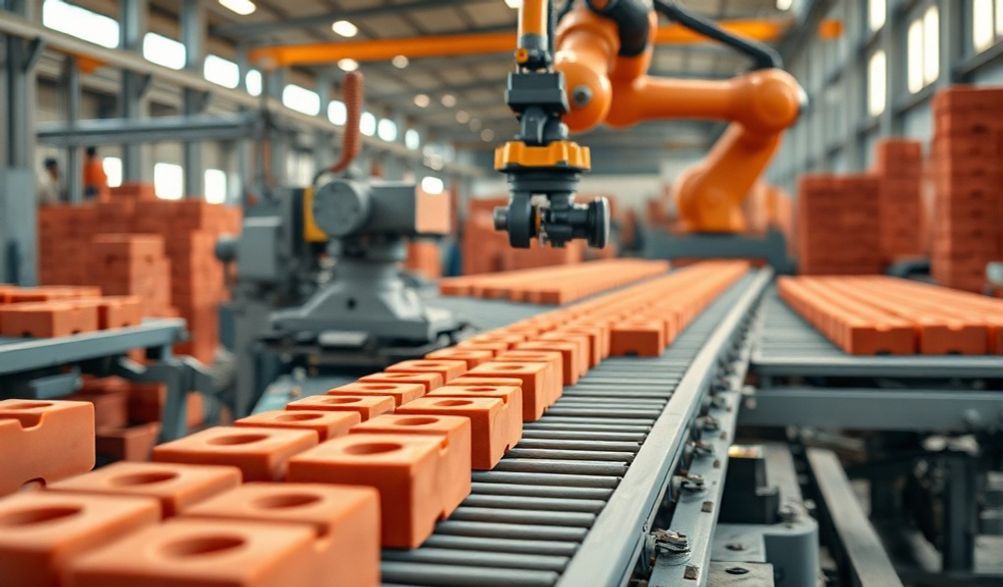
* The System: Raw clay is fed, automatically mixed and tempered, then extruded through a die into a continuous column. An automated cutter slices it into precise green bricks, which are then stacked onto kiln cars or pallets by robotic handlers—all with minimal human intervention.
* Principaux avantages :
* Rendement élevé : Capable of producing tens of thousands to hundreds of thousands of bricks per day.
* Cohérence inégalée : Every brick is identical in size, weight, and density.
* Coût unitaire inférieur : While the capital outlay is significant, the efficiency gains drastically reduce labor and waste costs per brick.
Key Machine Components and Technologies
Understanding the core parts demystifies the machine:
* Mixer & Pugmill: Ensures the clay mixture has uniform moisture and plasticity.
* Extruder: The heart of the machine. It compacts the clay and forces it through a die to form the brick column. The vacuum de-airing chamber is crucial for producing strong, dense bricks.
* Automatic Cutter: Uses wires or blades to slice the column into individual bricks with precision.
* Système de contrôle : The brain. Modern PLC (Programmable Logic Controller) panels allow for setting parameters, monitoring production, and diagnosing issues. The frontier now includes IoT (Internet of Things) sensors for predictive maintenance, alerting operators to potential failures before they cause downtime.
Key Considerations When Choosing a Machine in Brazil
Beyond the brochure specifications, these local factors will determine your long-term success.
Assessing Your Production Needs (Capacity, Brick Type)
Commencez par un plan d'affaires clair.
* Calculate Required Output: Analyze your current orders and projected growth. Do you need 20,000 or 200,000 bricks per day? Your machine’s capacity must match this.
* Define Your Product Mix: Will you produce standard solid bricks, energy-efficient hollow blocks, or interlocking paving blocks? The machine must be equipped with the appropriate extruder dies and cutter settings for your product portfolio.
Power Source and Local Utility Considerations
Reliable power is not a given in all regions.
* Electric vs. Hydraulic: Electric systems are generally more energy-efficient and precise, but a robust hydraulic system can be more tolerant of power fluctuations. The choice depends on your local grid stability.
* Options de carburant : For dryer or kiln systems, consider the availability and cost of natural gas, biomass, or other fuels prevalent in your area.
After-Sales Support, Parts, and Service Network
This is the most critical consideration for the Brazilian market.
Purchasing a sophisticated machine without local support is a high-risk venture. You must prioritize suppliers who offer:
* A dedicated technical support team based in Brazil.
* A readily available inventory of wear parts (like extrusion augers, cutter wires, seals).
* Certified technicians who can perform emergency repairs and routine maintenance.
* Comprehensive operator and mechanic training programs.
Always verify the supplier’s service infrastructure before signing any contract.
Total Cost of Ownership (TCO) Analysis
Look beyond the sticker price. The true cost includes:
* Purchase Price & Import Duties (if applicable)
* Installation & Commissioning Fees
* Energy Consumption (projected over 5-10 years)
* Cost of Spare Parts and Annual Maintenance Contracts
* Expected Lifespan and Residual Value
A machine with a slightly higher initial price but superior energy efficiency and a 20-year lifespan often has a far lower TCO than a cheaper, less robust alternative.
Navigating Suppliers of Clay Brick Machines in Brazil
The supplier you choose becomes a long-term partner in your productivity.
International Manufacturers vs. Local Distributors
- International Manufacturers: Often offer cutting-edge technology and global R&D expertise. The risk can be distance—ensure they have a strong, legally established subsidiary or partner in Brazil, not just a sales agent.
- Local Distributors/Integrators: They bring deep understanding of the Brazilian market, regulations (like NR-12 safety norms), and clay types. Their strength is localized service and quicker response times. Verify they are authorized partners for the brands they represent.
Evaluating Supplier Credentials and Track Record
Create a due diligence checklist:
* History in Brazil: How many years have they operated locally?
* Portefeuille client : Can they provide references from Brazilian clients, preferably in your region?
* Certifications : Do they have ISO quality management certifications? Can they ensure the machine complies with Brazilian safety standards?
* Physical Presence: Do they have an office, warehouse, and workshop in the country? Visit them.
The Importance of Factory Visits and Machine Trials
Never buy a machine “sight unseen.” If possible:
1. Visit the supplier’s facility in Brazil to assess their operations.
2. Crucially, ask to visit an existing client’s plant. Seeing the machine you are considering running in a real Brazilian factory, talking to its operators, and understanding its performance in local conditions is invaluable. A confident supplier will facilitate this.
The Future of Brick Manufacturing in Brazil
Staying competitive means looking ahead. The future is intelligent, automated, and sustainable.
Technological Innovations on the Horizon
- AI-Driven Quality Control: Cameras and sensors using artificial intelligence to inspect every brick for cracks or deformities in real-time, diverting rejects automatically.
- Advanced Energy Recovery: Systems that capture waste heat from kilns to pre-dry green bricks or generate auxiliary power, creating a near-closed-loop energy system.
- Hybrid & Flexible Automation: Plants that can easily switch between different brick types and sizes based on real-time market demand, managed from a digital dashboard.
The Role of Automation in Competitive Advantage
Automation is transitioning from a “competitive edge” to a baseline requirement for survival. It is the only way to reliably achieve the low cost-per-unit, high quality, and scalability needed to win major contracts and secure the business’s future.
Aligning with a Greener Construction Economy
Efficient machinery is a cornerstone of sustainable construction. By reducing energy use, minimizing waste, and enabling the production of thermally efficient hollow blocks, modern plants directly contribute to green building certifications like the Brazilian Processo AQUA-HQE. This alignment is increasingly important for appealing to environmentally conscious developers and accessing new markets.
Foire aux questions (FAQ)
Q1: What is the average price range for a clay brick making machine in Brazil?
A : Prices vary dramatically based on automation and capacity. A small semi-automatic machine may start around R$ 50,000, while a fully automatic production line can range from R$ 500,000 to several million Reais. Focus your analysis on the Total Cost of Ownership (TCO) and Return on Investment (ROI), not just the purchase price.
Q2: Are there financing options available for this machinery in Brazil?
A : Yes. Options include lines of credit from the BNDES (Brazilian Development Bank) for industrial modernization, financing plans offered directly by equipment suppliers through partner banks, and traditional commercial bank loans. Discuss financing possibilities early in your conversations with suppliers.
Q3: How do I ensure the machine meets Brazilian technical and safety standards?
A : The supplier must provide all necessary documentation proving compliance with NR-12 (Brazil’s mandatory machine safety standard) and other applicable technical norms. Insist that the machine is supplied with safety guards, emergency stops, and manuals in Portuguese. This is a legal and operational imperative.
Q4: What is the typical lead time for delivery and installation?
A : For machines in stock locally, delivery can take weeks. For custom or imported lines, lead times can extend from 3 to 9 months, including manufacturing, shipping, customs clearance, and installation. A professional supplier will provide a detailed project timeline with clear milestones.
Q5: Can these machines use different types of local clay?
A : Absolutely, and they should. Brazilian clay compositions vary widely. A reputable supplier will request a sample of your clay for laboratory testing. Based on the results, they can recommend the appropriate machine settings, moisture content, and even custom components to ensure optimal performance with your specific raw material.
Conclusion
Investing in a clay brick making machine in Brazil is a strategic decision that shapes the future of your manufacturing business. It begins with a clear understanding of the vibrant yet demanding local market, moves through the careful selection of the right machine type—balancing capacity with technology—and hinges on the non-negotiable priority of after-sales support and a credible supplier partnership.
This journey requires expertise, patience, and a focus on long-term value over short-term savings. As you move forward, conduct thorough due diligence, request detailed quotations that explicitly outline service level agreements, and insist on seeing machines in operation within Brazil. The goal is to build more than just a production facility; it’s to build a competitive, efficient, and sustainable enterprise that contributes to the very fabric of Brazil’s growth. By leveraging modern technology, Brazilian manufacturers are perfectly positioned to lay a stronger, smarter foundation for the nation’s construction industry.
<