
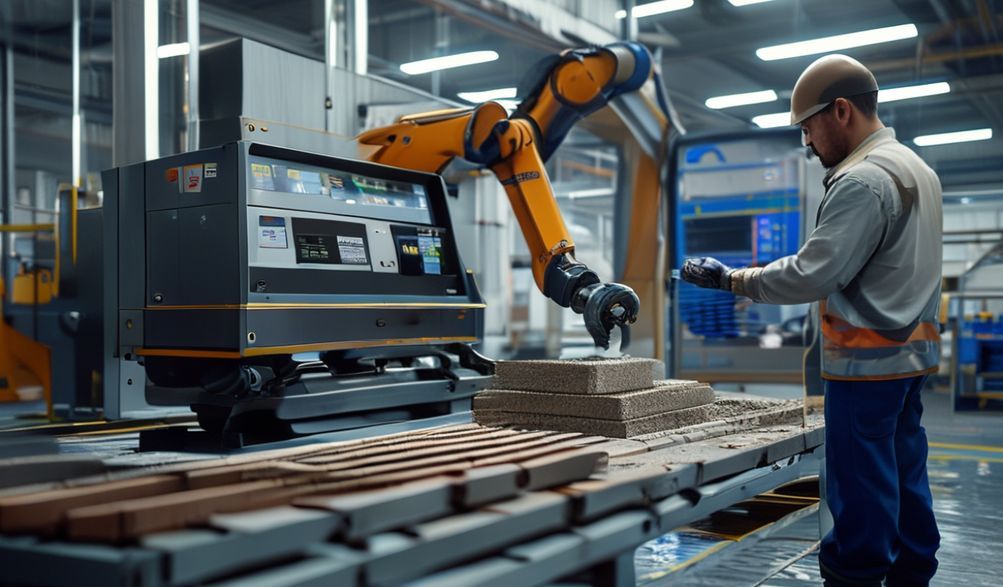
Le Guide Ultime des Machines à Blocs et Comment Trouver une Usine Fiable comme FUDA
Introduction
L'essor mondial de la construction ne montre aucun signe de ralentissement. De l'habitat urbain aux infrastructures essentielles, la demande de matériaux de construction durables, homogènes et abordables est immense. Au cœur de cette demande se trouve une technologie cruciale : la machine à fabriquer des blocs. Ces machines sont les moteurs de la production moderne de matériaux de construction, transformant des matières premières en blocs précis et solides avec une efficacité que le travail manuel ne pourra jamais égaler.
Cependant, pour un propriétaire d'entreprise ou un chef de projet, naviguer dans le monde des machines de fabrication de blocs peut être intimidant. Le marché est inondé d'options, et les enjeux sont élevés. Choisir la mauvaise machine ou s'associer à un fournisseur peu fiable peut entraîner des temps d'arrêt paralysants, une qualité de produit médiocre et un retour sur investissement dévastateur. Le défi principal est de discerner, au milieu de tout ce bruit, un fabricant qui privilégie la qualité, la durabilité et un partenariat à long terme plutôt que la simple réalisation d'une vente.
Lors des discussions dans l'industrie, des noms comme«Usine de fabrication de briques FUDA»font souvent surface comme des références. Ils représentent la norme de ce qu'un fabricant fiable et établi doit incarner : une ingénierie éprouvée, un soutien complet et un engagement envers la réussite des clients. Ce guide est votre ressource complète. Nous allons démystifier la technologie des machines à fabriquer des parpaings, décrire les facteurs critiques pour la sélection et fournir un cadre détaillé pour identifier une usine de premier ordre. Notre objectif est de vous doter de l'expertise — fondée sur les principes d'Expérience, d'Expertise, d'Autorité et de Fiabilité (E-E-A-T) — pour faire un investissement confiant et éclairé qui alimentera votre productivité pour les années à venir.
Comprendre les machines de fabrication de blocs : types et applications
Avant d’évaluer les usines, vous devez comprendre la machinerie elle-même. Cette connaissance fondamentale est essentielle pour communiquer vos besoins et évaluer l’expertise d’un fabricant.
Principes de fonctionnement de base : Comment fonctionnent les machines à fabriquer des blocs
Bien que les conceptions varient, la plupart des machines à fabriquer des blocs suivent un cycle de production de base :
- Mélange :Les matières premières (ciment, granulats, sable, eau) sont mélangées avec précision dans un malaxeur.
- Alimentation & Moulage : The mixed concrete is fed into a mold box on the machine.
- Compactage et Vibration : The machine applies high-pressure compaction and intense vibration. This force removes air pockets and ensures the concrete is densely packed into the mold, which is critical for the block’s final strength.
- Démoulage : The newly formed block is ejected from the mold onto a pallet or the plant floor.
- Guérison : The blocks are moved to a curing area (often a rack or chamber) where they gain strength under controlled temperature and humidity before being ready for use.
A key initial distinction is between statique (stationary) plants, which produce blocks in a fixed location for transport, and mobile machines, which can be moved around a site to produce blocks exactly where they are needed.
Une analyse des types de machines courants
-
Machines manuelles/semi-automatiques :
- Idéal pour : Startups, very small-scale projects, or regions with very low labor costs.
- Opération : Require significant manual labor for feeding, molding, and block removal. Output is low.
- Investissement : Lowest upfront cost, but higher long-term labor costs and inconsistent output quality.
-
Machines à fabriquer des blocs entièrement automatiques :
- Idéal pour : Medium to large-scale factories, high-volume production (like those operated by major suppliers).
- Opération : Entire process—from feeding and compaction to demolding and pallet stacking—is automated via PLC controls. They offer exceptional consistency, high output, and minimal manual intervention.
- Investissement : Higher initial cost, but superior efficiency, lower per-unit cost, and consistent quality. This is the category where factories like FUDA typically excel.
-
Machines à blocs mobiles :
- Idéal pour : Large construction sites, remote projects, or producing blocks directly where they will be used.
- Avantage : Eliminates transportation costs for finished blocks. They are self-contained, often with a small mixer and diesel engine.
-
Machines spécialisées :
- These are engineered for specific products beyond standard blocks, such as:
- Machines à pavés imbriqués : For producing paving stones that lock together without mortar.
- Machines à blocs creux : For creating lightweight blocks with high insulation properties.
- Curbstone & Kerb Machines: For heavy-duty landscape and road edging.
Principaux résultats : Que pouvez-vous produire ?
The right machine, with the correct molds, can produce a diverse product catalog:
* Blocs de béton pleins et creux :L'épine dorsale de la construction en maçonnerie.
* Pavés et dalles de béton pour aménagement paysager :Pour les entrées de garage, les allées et les espaces publics.
* Briques de cendre volante : An eco-friendly alternative using a industrial by-product.
* AAC Blocks: Autoclaved Aerated Concrete blocks, which are very light and offer excellent insulation (require a separate, specialized plant).
Critical Factors When Choosing a Block Making Machine
Selecting a machine is not about finding the most powerful one; it’s about finding the droite one for your specific operation.
Assessing Your Production Needs (The First Step)
Answer these questions before looking at any brochure:
* What is your required daily or hourly output in blocks/pavers?
* What specific block types and sizes will you produce most often?
* What is your available factory space and ceiling height?
* What is your realistic budget, including shipping, installation, and training?
* What is the skill level of your available operators?
Spécifications et qualité de fabrication de la machine
This is where engineering excellence becomes non-negotiable.
- Durabilité : The machine frame must be made from heavy-duty, reinforced steel to withstand years of constant vibration and pressure. Look for high-quality, wear-resistant steel molds.
- Système hydraulique : This is the powerhouse. A robust, reliable hydraulic system with stable pressure ensures consistent compaction and smooth operation. Ask about the brand of pumps and valves—reputable components are a good sign.
- Système de Vibration : The secret to a strong block. Systems can be single or dual-vibration (on the table and in the mold head). A powerful, well-balanced vibration system is essential for achieving high density and compressive strength.
- Système de contrôle : From basic PLCs to full-color touchscreen interfaces. A good control system allows for precise adjustment of vibration time, pressure, and cycle times, and provides diagnostic information.
Beyond the Machine: Support & Total Cost of Ownership
The machine’s price tag is just the entry fee. The real cost is in its operation over 5-10 years.
- Service après-vente : A factory’s commitment is tested après the sale. What is their warranty policy (e.g., 1 year on parts, 6 months on labor)? Do they offer remote troubleshooting? How quickly can they dispatch a technician or spare parts?
- Disponibilité des pièces de rechange : Ensure common wear parts (hydraulic seals, vibration motors, mold liners) are readily available and reasonably priced. A factory with a large installed base is often better at this.
- Coûts opérationnels : Consider energy consumption (electric vs. diesel), required maintenance schedules, and the need for operator training. A slightly more expensive but energy-efficient machine can save thousands in the long run.
How to Identify a Top-Tier Block Making Machine Factory
A great machine comes from a great factory. Here’s how to separate the market leaders from the rest.
Hallmarks of a Reputable Manufacturer
- Transparence : They provide clear, detailed specifications—not just output per hour, but cycle time, installed power, machine weight, and pressure figures. They are upfront about pricing structures and willing to share their company history.
- Experience & Portfolio: Longevity matters. A factory with 15+ years of experience has likely seen and solved countless operational challenges. Ask for a client portfolio with projects in various climates and markets.
- Expertise interne : The best factories control the entire process. They have their own R&D team for improvements, skilled welding and assembly lines, and stringent Quality Control (QC) that inspects components from sourcing to final testing.
The Factory Visit (Virtual or Physical): What to Look For
If possible, always visit. A virtual tour is a good alternative if travel isn’t feasible.
- Production Floor: Is it organized, clean, and safe? Look at the quality of welding on machine frames—it should be smooth, even, and robust.
- Contrôle de la qualité : Ask to see their QC checks. Are components inspected upon arrival? Is there a testing area where finished machines are run under load before shipment?
- Client Proof: Request to see videos of their machines in operation at a client’s site. Ask for contact information for 2-3 past clients in a region similar to yours and actually call them.
Evaluating Certifications and Standards
While not a guarantee, certifications indicate a structured approach to quality.
* ISO 9001 : Demonstrates a commitment to standardized quality management processes.
* Marquage CE : Essential for exporting to Europe, indicating the machine meets EU safety, health, and environmental requirements.
* Local Standards: Ensure the machine complies with the safety and performance regulations of your country.
Spotlight on Industry Standards: What a Factory Like FUDA Represents
When buyers reference a specific name like “FUDA brick making factory,” they are often pointing to an archetype of a reliable supplier. Let’s analyze what that represents in the broader market.
The Importance of Established Factories in the Supply Chain
Factories with a strong, long-standing reputation become pillars of the industry. They:
* Set Benchmarks for machine durability and performance that others follow.
* Drive Innovation by investing in R&D to improve efficiency and product range.
* Build Trust through transparency, which raises the standard for all suppliers.
Key Offerings of Leading Factories
These are the services that differentiate a true partner from a simple vendor:
* Personnalisation : Can they modify a standard machine to work perfectly with your local sand or aggregate? Can they engineer a unique mold for a special product design?
* Comprehensive Solutions: They don’t just sell a machine; they sell a production system. This includes plant layout design, raw material ratio consultancy, and mold design services.
* Training & Commissioning: They send engineers to your site to assemble the machine, calibrate it, and train your operators on its use, maintenance, and safety protocols.
Conducting Due Diligence on Any Supplier
It is crucial to state: “FUDA” is used here as an example of the qualities to seek. You must apply this rigorous checklist to every potential supplier you consider.
1. Online Deep Dive: Search beyond their website. Look for news, industry forum mentions, and video reviews.
2. Vérifier la légitimité de l'entreprise : Check their business license, export license (if applicable), and physical address.
3. Analyze Reviews Critically: Read customer reviews on B2B platforms like Alibaba, but also search for the company name on Google and YouTube for unfiltered perspectives.
4. Verify Export History: An established factory will have a history of shipping containers worldwide. They should be able to provide examples.
Foire aux questions (FAQ)
Q1: What is the average cost range for a block making machine?
A : Prices vary dramatically. A small manual machine can start at a few thousand dollars. A mid-range semi-automatic system may cost $25,000 – $50,000. Large, fully automatic production lines from top factories can range from $80,000 to over $300,000. Always get itemized quotes based on your specific requirements.
Q2: Can one machine produce different types of blocks and pavers?
A : Absolutely. This is achieved by changing the mold (the steel box that forms the block). Most factories offer a wide catalog of standard molds. However, factor in the cost of additional molds and the time required to change them over on the machine.
Q3: What are the most common after-sales services a good factory should provide?
A : At minimum: A clear warranty, detailed operation and maintenance manuals in your language, remote support via video call, and a reliable supply of spare parts. The best offer on-site installation, commissioning, and training.
Q4: How important is a local agent or support presence?
A : Extremely valuable. A local agent can facilitate communication, help with customs clearance, provide faster on-ground service, and understand local market conditions. It’s a strong indicator that the factory is invested in your region.
Q5: What raw materials can be used with these machines?
A : Standard machines use a mix of cement, sand (river or crushed), and aggregate (stone chips). Many modern machines are designed to efficiently use industrial by-products like fly ash or slag, which can reduce cost and environmental impact. Some specialized machines can process waste materials like construction debris.
Conclusion
Investing in a block making machine is a pivotal decision that will shape your business’s productivity and profitability for a decade or more. As we’ve explored, this decision hinges on two pillars: a deep understanding of your own technical needs and the crucial task of partnering with a factory you can trust.
Remember, the cheapest option is often the most expensive in the long run when faced with downtime and poor output. Prioritize factories that demonstrate tangible Expérience through a global portfolio, Expertise in their engineering and support, Autorité through industry recognition and standards compliance, and Fiabilité through transparent dealings and verifiable client testimonials.
Use this guide as your checklist. Before you request a single quotation, prepare a detailed project specification sheet outlining your output goals, product mix, and site conditions. Then, approach your shortlist of factories not just as a buyer, but as a partner seeking a long-term relationship. By doing so, you’ll secure more than just a machine; you’ll secure the foundation for your future growth.
<