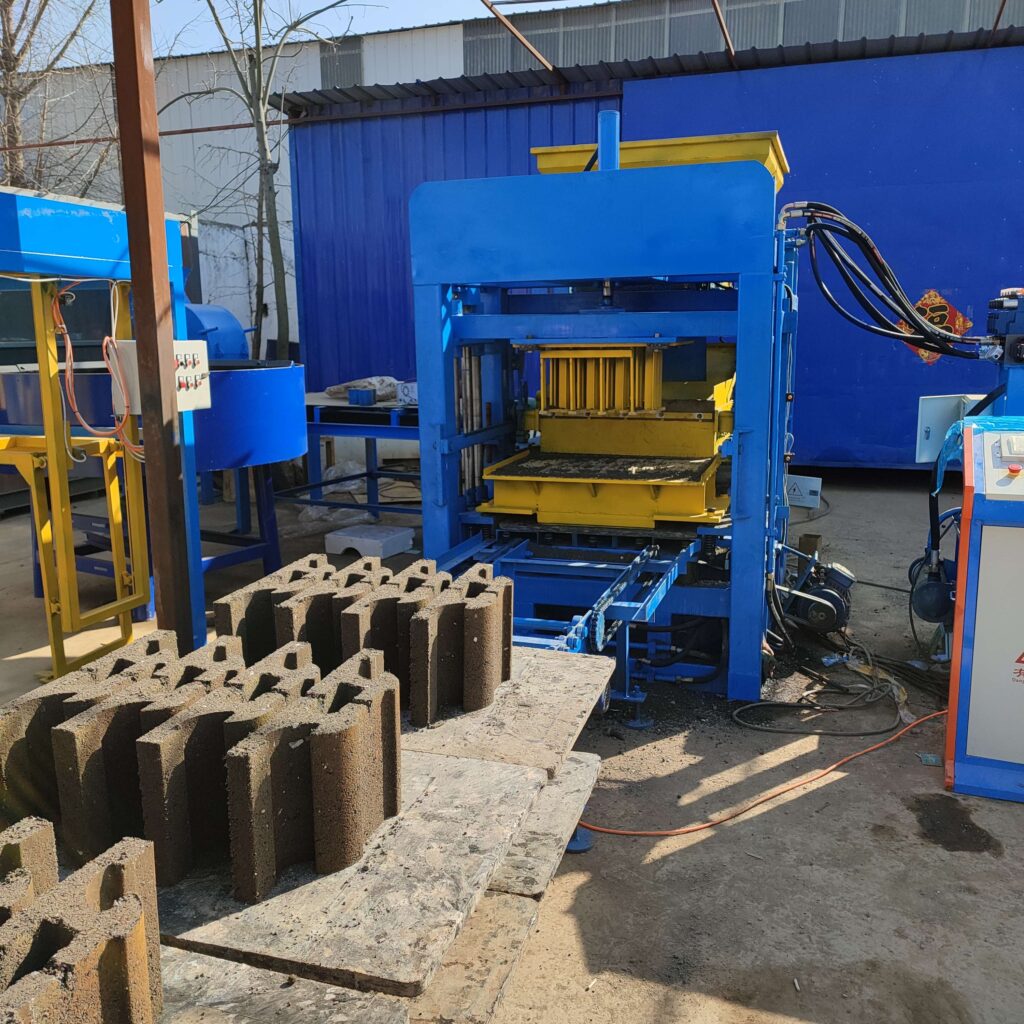
1: The Engineering Core of High-Pressure Brick Machines
1.1 Fundamental Operating Principle
At its essence, a high-pressure brick machine utilizes extreme compressive force—significantly exceeding that of standard vibration-based machines—to compact a precisely measured mix of raw materials (typically cement, aggregates, fly ash, and pigments) into a dense, homogeneous product. This process, often involving static pressure or a combination of high-frequency vibration and tremendous hydraulic pressure, fundamentally alters the material’s microstructure. The application of forces ranging from 150 to over 400 tons expels entrapped air, reduces the water-to-cement ratio, and forces particles into intimate contact, resulting in a brick or block of exceptional structural integrity from the moment of ejection.
1.2 Key System Components and Their Functions
- Robust Frame and Structure: Designed to withstand immense cyclic loading, the machine’s frame is the foundation of stability and precision, ensuring consistent product dimensions over years of operation.
- High-Pressure Hydraulic System: The heart of the machine. It comprises powerful pumps, accumulators, and precision valves that deliver and control the massive force applied to the mold. System reliability and pressure consistency are paramount for product quality.
- Precision Molding System: This includes the hardened steel mold box, core rods, and pressure heads. These components are engineered to micron-level tolerances to produce bricks with sharp edges, smooth surfaces, and consistent shape under extreme pressure.
- Intelligent Control System: Modern machines feature PLC (Programmable Logic Controller) or CNC-based systems. These allow for the storage of hundreds of product recipes, real-time monitoring of pressure, cycle times, and production counts, and diagnostics for preventive maintenance.
- Automated Material Handling Integration: From aggregate bins and cement silos with screw conveyors to automated batching systems and color feeders, integration is key for efficiency and mix consistency.
Section 2: Transformative Advantages for Production and Product Quality
2.1 Unmatched Product Characteristics
Products manufactured under ultra-high pressure exhibit properties that command premium market positioning:
- Exceptional Compressive Strength: Bricks and blocks achieve high structural strength early, often allowing for faster pallet handling and reduced curing time before shipment.
- Low Water Absorption: The dense matrix drastically reduces porosity, leading to superior freeze-thaw resistance, better weathering performance, and enhanced durability—a critical selling point in harsh climates.
- Superior Dimensional Accuracy and Surface Finish: The precision molding under high pressure yields products with consistent size, sharp corners, and a smooth, aesthetically pleasing finish that minimizes mortar use and appeals to architects and builders.
- Versatility in Design: The technology enables the production of complex, thin-walled, or large-format elements that would be impossible with low-pressure methods, opening niches in landscaping, retaining walls, and decorative masonry.
2.2 Operational and Economic Benefits for Manufacturers (Your End-Clients)
- High Production Output with Consistency: Machines are designed for rapid cycle times, producing vast quantities of sale-ready products with minimal variation, maximizing plant throughput.
- Reduced Curing Time and Energy Savings: The “green strength” of high-pressure bricks is significantly higher. This can shorten steam-curing cycles or, in some climates, allow for natural curing, slashing energy costs.
- Material Efficiency and Sustainability: The process can incorporate high percentages of industrial by-products like fly ash, slag, or quarry dust. The precise compaction also minimizes material waste, supporting eco-friendly production credentials that are increasingly marketable.
- Lower Labor Dependency and Operational Costs: High levels of automation, from batching to palletizing, reduce the workforce required for manual tasks and associated human error, leading to a more predictable and lower cost-per-unit over time.
Section 3: Strategic Considerations for Dealers and Procurement Professionals
3.1 Navigating the Market: Types and Configurations
Understanding the range of available machines is crucial for matching client needs:
- Fixed Production Machines: Ideal for high-volume, single-product-type production runs (e.g., standard solid blocks).
- Mobile Block Making Machines: Offer flexibility for on-site production, reducing transport costs for large projects. The high-pressure variant ensures on-site quality.
- Fully Automated Production Lines: Incorporate robotic handling, automatic pallet dispensers, and stackers. These turnkey solutions are for clients aiming to establish large-scale, “lights-out” manufacturing facilities with minimal manual intervention.
3.2 Critical Evaluation Criteria for Sourcing
When selecting machinery to supply or recommend, focus on these non-negotiable factors:
- Maximum Pressure Capacity and Stability: The core determinant of final product quality. Inquire about the system’s ability to maintain consistent pressure throughout the production cycle.
- Build Quality and Component Sourcing: Assess the provenance of critical parts like hydraulic pumps, PLCs, and mold steel. Superior components directly correlate with uptime and longevity.
- Automation Level and Integration Ease: Determine the machine’s compatibility with existing or planned batching and handling systems. The control system should be user-friendly and support remote connectivity for service.
- Technical Support and Service Infrastructure: The availability of comprehensive after-sales service, readily available spare parts, and skilled technical support is often more important than the initial purchase price in ensuring client satisfaction and repeat business.
3.3 Market Positioning and Sales Strategy
- Target Client Profile: Focus on established block manufacturers seeking to upgrade for quality, new entrepreneurs entering the premium building materials sector, or large construction firms considering vertical integration.
- Value Proposition Beyond Price: Shift the conversation from initial cost to Total Cost of Ownership (TCO) and Return on Investment (ROI). Emphasize the higher selling price achievable for premium products, reduced operational costs, and the machine’s role in future-proofing the client’s business against quality-conscious regulations.
- Demonstration and Evidence: Utilize product samples from existing installations to visually and physically demonstrate the superior density, strength, and finish. Provide case studies or data on production efficiency gains.
Conclusion
The advent of advanced high-pressure brick forming technology is redefining the standards of the masonry industry. For the astute distributor, dealer, or procurement expert, this machinery is not just another product line; it is a gateway to serving a high-growth segment focused on quality, sustainability, and profitability. By mastering the technical nuances, compelling advantages, and strategic application of these powerful systems, you position yourself as a vital partner to your clients’ success. The ability to supply and support this technology equips your clients to produce building materials that stand the test of time, while equipping your business to build a durable and prosperous future in the evolving construction supply ecosystem. Investing in this knowledge and product portfolio today is an investment in the foundational infrastructure of tomorrow.
Frequently Asked Questions (FAQ)
Q1: How does the production output of a high-pressure machine compare to a standard vibratory machine?
A: While cycle times may be similar, the output in terms of quality saleable units is often higher for high-pressure machines. This is due to significantly lower rejection rates, faster early handling strength (reducing damage during palletizing), and the ability to run complex products without speed penalties. Over a month or year, the net output of premium-grade product is substantially greater.
Q2: Are the raw material requirements different for high-pressure machines?
A: The core materials (cement, aggregates) remain the same. However, the mix design is optimized. Typically, it requires a well-graded aggregate with controlled moisture content and can effectively utilize finer materials like fly ash. Suppliers often provide expert mix formulation support to ensure clients achieve optimal results.
Q3: Is the maintenance for these machines more complex and costly due to the high-pressure hydraulics?
A: Not necessarily. While the hydraulic systems are robust, they are designed for industrial durability. Preventive maintenance schedules are key. The higher initial component quality often translates to longer service intervals and greater reliability. The intelligence built into modern control systems also provides early warnings for maintenance needs, preventing costly downtime.
Q4: Can these machines produce a wide variety of products, or are they specialized?
A: Modern high-pressure machines are highly versatile. By simply changing the mold and adjusting the pressure/cycle parameters on the control panel, a single machine can produce a vast range of products—from standard hollow blocks and solid bricks to interlocking pavers, kerbstones, and decorative landscaping items. This flexibility is a major asset for manufacturers looking to serve multiple market segments.
Q5: What is the typical lead time and installation process for such a machine?
A: Lead times vary based on configuration and automation level, generally ranging from several weeks to a few months after order confirmation. Installation requires proper foundation preparation (which we provide detailed specs for), connection to power, and, for automated lines, integration with material supply systems. Comprehensive installation supervision and operator training are critical services that should be part of the supply package.