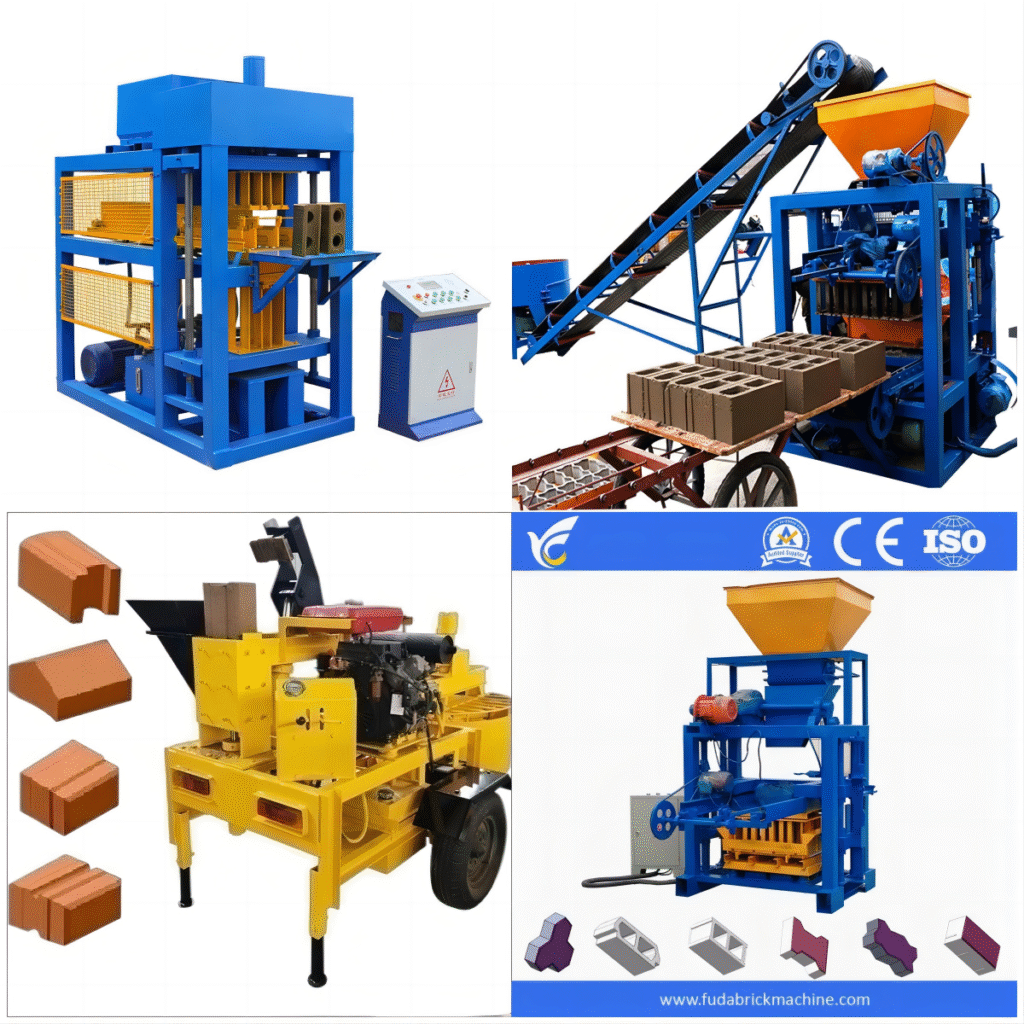
Defining the Product: Beyond the Basic Brick
Machine-made moulded bricks are precision-engineered masonry units produced through automated processes of material preparation, high-pressure moulding, and controlled curing or firing. Their defining characteristic is consistency.
A. The Manufacturing Pedigree: Process Defines Product
The production method is the primary differentiator, creating two principal branches in the market:
- Hydraulically Pressed & Cured Bricks (Non-Fired):
- Process: A mixture of soil, sand, and a low percentage of stabilizer (e.g., 5-10% cement) is hydraulically compressed in a steel mould at high pressure, then moisture-cured.
- Key Product Traits: Extremely high and uniform dimensional accuracy, high compressive strength from compaction, lower water absorption than fired clay, and a range of earthy, natural colors. Includes interlocking varieties.
- Extruded & Fired Bricks (Clay-Based):
- Process: A plastic clay body is forced through a die to form a continuous column, which is then wire-cut into individual units before being dried and fired in a kiln.
- Key Product Traits: Classic brick aesthetic, a wide range of colors (dependent on clay and firing), high durability, and excellent weathering properties. Can be solid, perforated, or hollow.
B. The Hallmarks of Machine-Made Quality
Regardless of the process, machine-made bricks offer a suite of advantages over their handmade counterparts:
- Dimensional Uniformity: Tolerances within ±1-2 mm, enabling faster laying with thinner mortar joints, reduced material waste, and improved structural alignment.
- Consistent Physical Properties: Predictable compressive strength, water absorption, and density across every batch, allowing for accurate engineering calculations.
- Superior Surface Finish and Aesthetics: Smooth faces, sharp arrises (edges), and uniform color or texture, suitable for exposed masonry work.
- Controlled Porosity and Density: Engineered for optimal balance between strength, thermal performance, and moisture resistance.
II. Market Segmentation and Application-Specific Demand
Understanding the end-use is critical for effective inventory planning and client advisory.
A. High-Volume Infrastructure and Commercial Projects
This segment prioritizes logistics, specification compliance, and cost-per-unit.
- Demand Drivers: Large-scale housing developments, warehouse construction, school complexes, and perimeter walling.
- Product Requirements: Standard sizes (e.g., 230x110x75 mm), high compressive strength (≥15 MPa), consistent supply in bulk quantities (millions of units), and palletized delivery. Color consistency within a single project is crucial.
- Procurement Dynamics: Tendering processes, certified test reports, and just-in-time delivery scheduling are standard.
B. Architectural and Premium Residential Markets
This segment values aesthetics, uniqueness, and technical performance.
- Demand Drivers: High-end villas, boutique hotels, corporate façades, and heritage-style renovations.
- Product Requirements: Special sizes, textures (raked, sandblasted, glazed), specialized colors, and high durability ratings (freeze-thaw resistance). Thin-brick veneers are a growing sub-category.
- Procurement Dynamics: Smaller batch orders, sample approvals, and a focus on technical support from supplier to architect or builder.
C. Sustainable and Green Building Projects
This is a rapidly growing, value-driven segment.
- Demand Drivers: Projects targeting LEED, BREEAM, or Green Star certification; use of local materials; and low embodied carbon goals.
- Product Requirements: Bricks made with high recycled content (fly ash, slag), produced via energy-efficient methods, or sourced locally to reduce transport emissions. High thermal mass properties are a plus.
- Procurement Dynamics: Requires full transparency on material sourcing, manufacturing energy use, and Life Cycle Assessment (LCA) data.
III. The B2B Commercial Ecosystem: Sourcing, Logistics, and Value Addition
Successfully trading in machine-made bricks requires mastering a complex supply chain.
A. Sourcing Strategy: Evaluating a Manufacturer
- Production Capacity and Stability: Can the plant meet a sudden large order without quality compromise? What is their historical production consistency?
- Quality Assurance and Certification: Does the factory have an in-house lab? Are products regularly tested and certified to relevant national or international standards (e.g., ASTM, EN, IS)? Can they provide batch-wise test certificates?
- Technical and Development Capability: Can they develop custom blends, colors, or sizes? This is key for serving the architectural market.
B. The Critical Role of Logistics and Handling
The product’s value is easily destroyed post-production.
- Packaging: Bricks must be securely strapped on sturdy, weather-resistant pallets. Shrink-wrapping is essential for ocean freight or outdoor storage.
- Transportation: Container loading must be planned to minimize breakage. For land transport, air-ride suspension trucks prevent vibration damage.
- Stockyard Management: Distributors must have hardstanding, level ground for storage. Pallets should not be stacked more than three high to prevent crushing. First-In-First-Out (FIFO) inventory management is critical.
C. Value-Added Services for Distributors
Moving beyond box-moving to become a solutions provider:
- Technical Specification Support: Assist contractors and architects in selecting the correct brick grade and type for their specific structural and climatic conditions.
- Supply Chain Financing: Offer flexible payment terms to large contractors.
- Just-in-Time Delivery Management: Coordinate direct deliveries from port or factory to multiple construction sites, acting as a logistics hub.
IV. Pricing Structures and Market Competitiveness
Price is a function of multiple variables, and understanding them is key to negotiation and margin management.
A. Primary Cost Drivers
- Raw Material Cost and Availability: The price of clay, shale, sand, and stabilizers. Local scarcity can inflate costs.
- Energy Intensity: Firing in a kiln is a major cost component. Gas or electricity price volatility directly impacts extruded brick prices. Cured bricks have a significant energy advantage.
- Labor and Automation: Highly automated plants have higher capex but lower and more predictable per-unit labor costs.
- Transportation Distance: Freight costs from factory to port and destination market can equal or exceed the factory gate price for long-distance exports.
B. Pricing Models in the Market
- FOB (Free On Board) / EXW (Ex-Works): The base price at the factory gate. The buyer assumes all freight, insurance, and risk thereafter.
- CIF (Cost, Insurance, and Freight): Price includes delivery to a port in the destination country. Simplifies procurement but includes less transparent freight costs.
- Landed Cost: The total cost per brick stacked at your warehouse, including all duties, taxes, port fees, and inland freight. This is the only figure that matters for profitability calculation.
C. Competing in a Globalized Market
Distributors must navigate competition from:
- Local Producers: Advantages include lower transport costs, faster delivery, and understanding of local preferences.
- International Mass-Producers: Often compete on price for standard commodities due to scale, but may lack flexibility.
- Specialist Niche Producers: Command premium prices for unique or high-performance products.
Conclusion
The market for machine-made moulded bricks is a sophisticated, multi-tiered global industry that mirrors the evolution of construction itself—towards greater efficiency, performance, and accountability. For the B2B professional, success hinges on the ability to act as a knowledgeable intermediary who does more than connect buyer and seller. It requires the technical acumen to specify products, the logistical prowess to deliver them intact, and the commercial insight to build a portfolio that serves diverse market segments from bulk infrastructure to bespoke architecture. The future belongs to distributors who can guarantee not just supply, but specification-compliant, reliably delivered, and technically supported supply. By building partnerships with quality-conscious manufacturers, investing in robust logistics, and developing deep market intelligence, dealers and procurement specialists can transform a basic building material into a foundation for durable business growth.
FAQ (Frequently Asked Questions)
Q1: What are the key documents we should request from a manufacturer when sourcing machine-made bricks?
A: Essential documents include:
- Product Data Sheet: Listing all standard sizes, colors, compressive strength, water absorption, density, and thermal properties.
- Independent Test Certificates: Recent reports (within 6-12 months) from a recognized third-party laboratory, verifying compliance with stated standards.
- Factory Audit Reports: Such as ISO 9001 certification, which indicates a systematic quality management process.
- Sample Batch: Physical samples for your own evaluation and to provide to potential end-clients.
Q2: How do we assess the durability of bricks for different climatic conditions, such as freeze-thaw cycles or heavy rainfall?
A: Durability is proven through specific tests:
- Freeze-Thaw Resistance: Bricks are saturated, frozen, and thawed repeatedly. High-quality, low-absorption bricks (typically <7% for severe conditions) will withstand many cycles without deterioration. Request test data for the relevant standard (e.g., ASTM C67).
- Efflorescence Rating: Indicates the likelihood of white salt deposits. A rating of “not effloresced” or “slight” is desirable for all climates.
- Initial Rate of Absorption (IRA): Measures how quickly a brick sucks moisture from mortar. An IRA within an optimal range (e.g., 5-30 g/min/30in²) is critical for proper bond strength, especially in hot, dry climates.
Q3: What is the minimum viable order quantity (MOQ) typically expected by manufacturers?
A: MOQs vary dramatically:
- Standard Commodity Bricks: For large plants, a container load (approx. 22-24 pallets, holding ~11,000-13,000 bricks) is often the minimum.
- Special or Architectural Bricks: MOQs can be as low as 2-5 pallets for a custom color or texture, but at a significantly higher unit price. For a completely new size or shape, a full production run (which could be 50,000+ bricks) may be required.
Q4: What are the most common causes of damage in transit, and how can they be mitigated?
A: Common damage includes chipped edges (arrises) and cracked bricks due to:
- Poor Palletization: Loose strapping or uneven stacking.
- Rough Handling: Forklift impacts during loading/unloading.
- Road Vibration: During long-distance trucking.
- Mitigation: Source from manufacturers with a reputation for excellent packaging (tight strapping, corner protectors, sturdy pallets). Insist on professional loading and use experienced freight handlers. Insurance covering “breakage” is essential.
Q5: How significant is the lead time from order to delivery, and what factors influence it?
A: Lead times can range from 4 to 16 weeks.
- Standard Stock Items: Shorter lead time (4-6 weeks) if the color/size is in regular production.
- Made-to-Order Items: Longer lead time (8-12+ weeks) for custom products.
- Key Factors: Factory production schedule, availability of raw materials, shipping line schedules, and port congestion at both origin and destination. Always build buffer time into project schedules.
Q6: Is there a secondary market for overstock or slightly off-spec bricks?
A: Yes, a viable secondary market exists, often referred to as “cull” or “seconds.” These bricks may have minor color variations, slight chips, or be from a discontinued line. They are sold at a steep discount (30-60% less) and are perfectly suitable for non-visible applications like internal leaf of cavity walls, backing layers, or garden landscaping. This can be a profitable niche for distributors.
Q7: How do changing environmental regulations impact the brick manufacturing industry and supply?
A: Regulations are a major driver of change:
- Emissions Controls: Stricter limits on kiln emissions (SOx, NOx, particulates) are forcing older clay brick plants to invest in cleaner technology or close, potentially tightening supply.
- Resource Extraction: Regulations on clay quarrying can limit raw material access.
- Circular Economy Policies: Incentives for using industrial waste (like fly ash) are boosting the production and market acceptance of non-fired, pressed bricks. Distributors must stay informed on these trends as they affect long-term product availability and client preferences.