
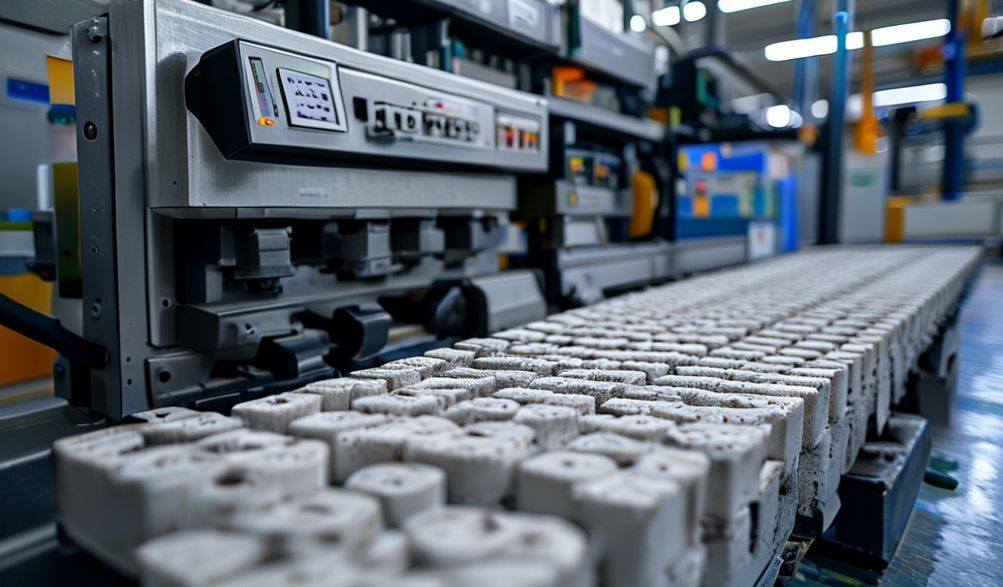
The Ultimate Guide to China’s Custom QT12-15 Concrete Block Making Machine
Муқаддима
The global construction industry is in a perpetual race—a race to build faster, smarter, and more affordably. At the heart of this race lies the humble concrete block, a fundamental building material whose efficient production can make or break project timelines and profitability. For businesses worldwide looking to scale their production, China has emerged not just as a source of cheap machinery, but as the epicenter for innovative, customized manufacturing solutions. Among the myriad of options, one model consistently stands out for its robust performance and adaptability: the QT12-15 concrete block making machine.
The QT12-15 represents a sweet spot in the market. It’s a fully automatic, stationary block machine known for delivering substantial output—typically thousands of blocks per shift—without the colossal footprint or investment of larger industrial systems. But the term “QT12-15” is just the starting point. The real transformative power for your business lies in the prefix that’s changing the game: “Custom.”
Moving beyond a one-size-fits-all approach, customization allows you to tailor this proven machine to the unique DNA of your business. Whether you’re grappling with specific local raw materials, aiming to produce a proprietary block design, or needing to integrate seamlessly into a semi-automated production line, a custom-configured QT12-15 can be your competitive edge.
This guide is designed to be your comprehensive roadmap. Built on over a decade of industry experience in machinery procurement and international trade, we cut through the noise to provide authoritative, trustworthy, and practical advice. If you are a construction business owner, a plant manager overseeing production, or an entrepreneur entering the building materials sector, this resource will equip you to navigate the process of sourcing your ideal custom QT12-15 machine—intelligently, safely, and successfully.
Understanding the QT12-15 Concrete Block Machine: Specifications & Capabilities
Before diving into customization, it’s crucial to understand the robust foundation of the standard QT12-15 machine. This knowledge forms the basis for any meaningful modification discussion with a manufacturer.
Спецификатсияҳои техникии асосӣ
The “QT12-15” nomenclature itself is informative. While interpretations can vary slightly by manufacturer, it generally signifies a machine that can produce standard blocks (like 400x200x200mm) with a theoretical output in the range of 12-15 blocks per mold cycle. Here are the typical core specifications:
- Натиҷаҳои истеҳсолӣ: Approximately 1,920 – 2,880 solid blocks (400x200x200mm) per 8-hour shift, depending on cycle time optimization. Output for hollow blocks or pavers will be higher due to their smaller material volume.
- Вақти даврӣ кардани қолиб: Typically between 15-25 seconds, controlled by a Programmable Logic Controller (PLC).
- Талабҳои барқ: A robust machine, it usually requires a total installed power of around 30-35 kW, operating on a standard industrial 3-phase power supply.
- Андозаҳо ва ҷойгиршавӣ: Expect a machine weight of 5-6 tons, requiring an operational space of roughly 8m x 5m, excluding area for raw material storage and block curing.
Қисмҳои асосӣ ва вазифаҳои онҳо
The reliability of a QT12-15 hinges on the quality of its core systems:
- Системаи гидравликӣ: The muscle of the machine. A high-quality, stable hydraulic system ensures consistent pressure during compaction, which is critical for block density and strength. Look for reputable brand components like Parker or Yuken.
- Системаи Ларзишӣ: The heart of consolidation. Powerful, vertically-mounted vibration motors (often 2 x 7.5 kW) housed within the vibration table work in tandem with hydraulic pressure to remove air pockets and create a dense, uniform block.
- Панели идоракунии PLC: The brain. A user-friendly, waterproof panel allows operators to set cycle times, vibration duration, and other parameters. It also provides fault diagnostics, which are invaluable for maintenance.
- Таркиби қолиб: The defining tool. This is the most common point of customization. The standard mold can be swapped out to produce different block types, but the mold frame, clamping mechanisms, and liner quality are vital for precision and longevity.
Standard vs. Custom Output: What Can You Produce?
A standard QT12-15 is incredibly versatile right out of the box. By simply changing the mold, it can produce:
* Solid and hollow blocks in various thicknesses.
* Interlocking blocks for retaining walls.
* Paving stones and curb stones.
* Grass planting blocks.
This is where customization begins. The standard capabilities are broad, but what if your market demands a block size not covered by “standard” molds? What if your local fly ash has unique setting properties? Customization allows you to modify the machine’s parameters and hardware to answer these specific questions, transforming it from a general-purpose tool into a specialized asset for your business.
Why Choose a Customized QT12-15 Machine from China?
Choosing a standard machine is a transaction. Investing in a customized solution is a strategic partnership with your manufacturer to build a tool for your specific future. Here’s why this approach from Chinese manufacturers is so compelling.
Tailoring to Your Local Materials
Perhaps the most critical reason for customization. Concrete mix designs vary dramatically across the globe.
* Aggregate Size & Shape: Crushed stone, river gravel, or recycled aggregate all behave differently. The vibration frequency, amplitude, and duration can be fine-tuned to optimally compact your specific aggregate mix.
* Cement & Fly Ash: Variations in setting time and workability can affect how long a block must be pressed before ejection. Machine parameters can be adjusted to compensate.
* Миқдори намӣ Local sand moisture levels can impact mix fluidity. A customized system can be calibrated to ensure consistent block weight and strength despite these variations.
Meeting Specific Project & Product Requirements
Customization unlocks new business opportunities:
* Unique Product Designs: Create proprietary interlocking patterns, special textures for architectural facades, or blocks with integrated insulation. This requires custom mold design and fabrication.
* Dimensional Specifics: Need a block that meets a precise local metric or imperial standard? Custom molds ensure exact dimensional accuracy.
* Enhanced Automation: Beyond the core machine, you can integrate custom solutions like automatic pallet feeders, robotic stackers, or conveyor belt systems tailored to your factory layout, significantly reducing labor costs.
The Cost-Benefit Analysis of Customization
Is customization always worth it? A honest analysis is key.
* Value-Adding Customization: Modifications that solve a material problem, enable a premium product, or drastically reduce operational labor have a clear, calculable ROI. They directly address a bottleneck or create a market advantage.
* When Standard May Suffice: If your local materials are well-understood and align with standard mixes, and your target products are common in the catalog, a high-quality standard machine with good after-sales support might be the most efficient and cost-effective choice.
The investment in customization should be viewed through the lens of long-term strategic fit, not just upfront cost. A machine that perfectly matches your process will maximize uptime, minimize waste, and produce a superior, more consistent product.
Navigating the Chinese Manufacturing Landscape: A Buyer’s Guide
The potential of customization is immense, but realizing it requires navigating the supplier landscape with diligence. Here is a step-by-step guide based on practical experience.
How to Identify Reputable Manufacturers
Separating credible partners from trading companies or unreliable workshops is the first and most critical step.
* Verification is Non-Negotiable: Use platforms like Alibaba’s “Verified Supplier” status as a starting filter, but go further. Request a copy of their official Иҷозатномаи тиҷоратӣ and check their Factory Registration Number.
* Assess Technical Communication: Can you speak directly with an engineer? The ability to discuss vibration harmonics, hydraulic pressure curves, and PLC logic in clear English (or your language via a competent translator) is a strong indicator of a serious manufacturer.
* Request Evidence of Experience: Ask for factory audit reports (from firms like SGS or BV) and, crucially, video evidence of production and testing. A genuine manufacturer will proudly show their workshop and machines under test.
The Customization Process: From Inquiry to Delivery
A transparent process looks like this:
1. Initial Technical Discussion: You present your detailed requirements: block designs (CAD drawings if possible), raw material analysis, desired automation level, and site conditions.
2. Formal Quotation & Proposal: The supplier provides a detailed proforma invoice (PI) specifying the base machine, all custom modifications, mold costs, spare parts list, terms of trade (e.g., FOB Shanghai), payment terms, and delivery timeline.
3. Design Confirmation: For custom molds, you should approve engineering drawings before fabrication begins.
4. Secure Payment: Use secure methods. A common structure is 30% deposit, 60% against pre-shipment photos/videos, and 10% after satisfactory receipt. Always use bank transfers to company accounts, not personal accounts.
5. Production & Factory Acceptance Test (FAT): Insist on a live video FAT where you see your actual machine producing sample blocks with your mix.
6. Интиқол ва логистика The supplier handles export formalities to the port. You or your freight forwarder arrange sea freight, insurance, and import clearance.
Critical Questions to Ask Your Supplier
Arm yourself with this checklist:
* “Can you provide contactable customer references from my region or a region with similar materials?”
* “What is the exact scope and duration of your warranty? Does it cover parts, labor, and international shipping for defective parts?”
* “Who will provide software updates and PLC support? Do you offer remote desktop assistance?”
* “What is the lead time for critical spare parts (like a vibration motor or hydraulic pump) to my port?”
* “Do you provide installation and commissioning guidance, and if so, in what format (manual, video, online)? What are the costs for sending an engineer to my site?”
Ensuring Quality & Performance of Your Custom Machine
Your due diligence doesn’t end with the purchase order. Proactive steps ensure the machine performs as promised for years to come.
Pre-Shipment Inspection & Factory Acceptance Tests (FAT)
Never skip the FAT. This is your last, best chance to verify quality before the machine leaves the factory.
* Hire a Third-Party Inspector: For significant investments, consider hiring a local inspection company. Their checklist should include:
* Verification of all components against the agreed specification.
* Hydraulic system pressure and leakage tests.
* Vibration table frequency and amplitude measurement.
* Electrical safety and compliance checks.
A*trial run producing at least 50 blocks using a mix simulant of your materials. Measure the blocks for dimensional accuracy, weight consistency, and immediate crushing strength (if a test press is available).
Understanding Warranty, After-Sales, and Technical Support
The warranty document is a key part of your contract. Understand it fully.
* Standard Terms: Typically 12 months for parts, excluding wear-and-tear items like mold liners. Clarify if the warranty starts from shipment date or commissioning date.
* After-Sales Structure: The best suppliers offer a multi-tiered system: 1) Online/Phone Support for immediate troubleshooting, 2) Remote Diagnostics via internet-connected PLCs, and 3) On-Site Engineer Dispatch for major issues (costs for travel and labor are usually negotiable upfront).
* Documentation: Ensure you receive comprehensive, clear manuals in your language for operation, maintenance, and troubleshooting.
Sourcing and Managing Spare Parts
Plan for maintenance from day one.
* Комплекти дастгоҳҳои ибтидоӣ: Negotiate a recommended starter kit into your initial purchase. This should include seals, gaskets, relays, sensors, and perhaps a set of commonly worn mold liners.
* OEM vs. Local Parts: While generic hydraulic seals might be sourced locally, critical components like proprietary PLC boards or specially balanced vibration motors should come from the OEM to avoid voiding warranties and causing machine damage.
Cost Breakdown & Investment Considerations
Transparency in costing prevents frustrating surprises and allows for accurate financial planning.
What’s Included in the Quotation?
A detailed quotation should clearly separate:
* Machine FOB Price: The cost of the custom machine at the Chinese port.
* Custom Mold Costs: Itemized by each block type.
* Spare Parts Package Price.
* Фиристодан ва бимокуни: Freight to your nearest port.
* Ҳуқуқҳои гумрукӣ ва андозҳо: Your responsibility. These vary by country and can be significant (e.g., 5-20% of CIF value). Factor them in.
* Local Agent & Installation Fees: Costs for a local agent to clear customs and transport the machine to your site, plus any hired installation labor.
Hidden Costs to Watch Out For
Stay vigilant for:
* Last-Minute “Engineering Fees”: All customization costs should be in the initial PI.
* Shipping Term Ambiguity: Ensure “FOB” is clearly defined. Unclear terms can lead to unexpected port handling fees at origin.
* Inadequate Spare Parts: Not buying a basic kit can lead to expensive emergency air freight later.
* Non-Standard Components: Machines built with obscure, proprietary components lock you into a single, potentially expensive source for future parts.
Financing and ROI Projections
- Financing: Some larger manufacturers offer financing partnerships with Chinese banks, though this can be complex for international buyers. Local equipment financing in your country is often simpler.
- Calculating ROI: Use a simple formula:
(Monthly Block Output × Local Selling Price per Block) - (Material + Labor + Utility + Depreciation Costs)
A custom machine that increases output, improves quality (commanding a higher price), or reduces labor will show a faster payback period, justifying the initial investment.
Frequently Asked Questions (FAQ)
Q1: What is the typical lead time for a custom QT12-15 machine from China?
A: For a machine with custom molds, expect a total timeline of 45-60 days. This includes 30-40 days for production and testing, plus 15-25 days for sea shipping to most global ports. Highly complex modifications will extend this.
Q2: How do I ensure the machine meets international safety and quality standards (CE, ISO, etc.)?
A: Explicitly request the relevant certification documents (CE Certificate, ISO 9001 Certificate of the factory) during your supplier evaluation. Be aware that a “CE Self-Declaration” is less robust than a certificate from a notified body. For absolute certainty, you can mandate compliance as a contract condition and hire a third-party to verify.
Q3: Can the supplier provide installation and training services in my country?
A: Yes, most reputable suppliers offer this service. It is a negotiable line item. Typically, you cover the international flight, local accommodation, and daily allowance for their engineer, while they provide the labor. Clear scope (e.g., “5 days installation, 2 days training”) should be in the contract.
Q4: What is the most common issue with these machines, and how is it resolved?
A: One common issue is inconsistent block height or density. This is often traced to incorrect hydraulic pressure settings, worn mold liners, or variations in raw material moisture. Resolution involves systematic troubleshooting: checking pressure gauges, inspecting the mold, and adjusting the mix formula or machine cycle parameters—a process where good remote technical support is invaluable.
Q5: Is it better to buy a standard model or invest in a custom QT12-15?
A: The answer depends on your business strategy. A standard model is ideal for entering a market with common materials and products, prioritizing speed and lower initial cost. A custom QT12-15 is a strategic investment for businesses facing unique material challenges, targeting a niche premium market, or seeking to optimize production efficiency through automation for long-term labor savings and superior product consistency.
Conclusion
Sourcing a custom QT12-15 concrete block making machine from China is more than a purchase; it’s a capital investment in the future efficiency and uniqueness of your construction business. It represents the powerful convergence of proven mechanical design with the flexibility to meet your specific operational and market demands.
The journey to a successful outcome is paved with diligent research, meticulous communication, and unwavering attention to quality assurance. By prioritizing a partnership with a verified, technically proficient manufacturer, insisting on rigorous factory acceptance tests, and securing a clear, robust after-sales agreement, you mitigate risk and lay the foundation for years of productive operation.
Remember, the goal is not merely to find the lowest price, but to secure the highest long-term value. A well-chosen, custom-configured QT12-15 machine becomes a reliable, profit-generating asset, perfectly aligned with your business goals. Let this guide be your first step. Begin by meticulously compiling your project requirements, then start shortlisting manufacturers whose expertise and transparency match your ambition.
This guide was compiled based on over a decade of industry experience in construction machinery procurement and international trade. Our insights are drawn from direct engagement with manufacturers, technical specialists, and global clients to ensure information is both practical and authoritative.
<