
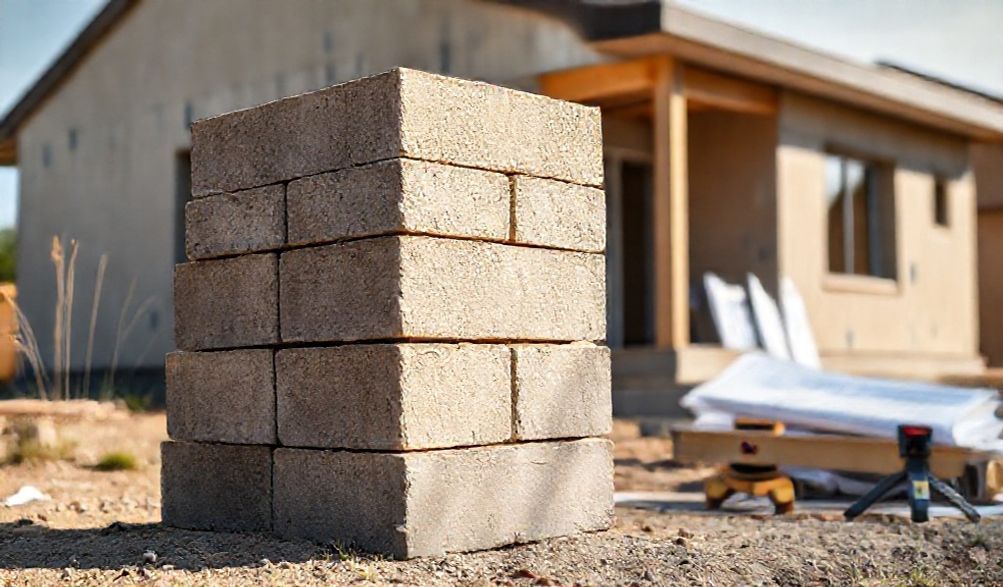
Compressed Concrete Blocks: A Complete Guide to Benefits, Uses, and Installation
In an era where the construction industry is responsible for nearly 40% of global carbon emissions, the search for sustainable, durable, and cost-effective building materials has never been more urgent. Amidst this shift, one age-old material is being re-engineered for the modern world: compressed concrete blocks.
Often referred to as Compressed Stabilized Earth Blocks (CSEBs), these are not your standard concrete masonry units (CMUs). They represent a fusion of ancient earth-building techniques and contemporary engineering. This comprehensive guide is designed for homeowners, self-builders, architects, and developers seeking an expert-backed, clear-eyed view of this innovative material. We’ll dissect its true advantages, walk through its manufacturing and applications, and provide practical guidance to help you determine if compressed concrete blocks are the right foundation for your next project.
What Are Compressed Concrete Blocks? Understanding the Basics
At its core, a compressed concrete block is a building unit made from a damp mix of soil, a small percentage of a stabilizer (like cement or lime), and water. This mixture is subjected to extreme mechanical pressure in a block press, creating a dense, high-strength block that cures through hydration rather than high-temperature firing.
This fundamental difference in production sets it apart from its cousins:
* Traditional Fired Clay Bricks: Require immense energy from kilns, releasing significant CO2.
* Standard Concrete Blocks (CMUs): Use a high proportion of cement (a major carbon emitter) and aggregates, and are often cured in steam chambers.
The Manufacturing Process: More Than Just Concrete
The magic of CSEBs lies in the process, not just the ingredients.
- Material Selection & Preparation: The primary ingredient is soil, ideally with a balanced mix of sand, silt, and a small amount of clay. This soil is sieved to remove debris. A low percentage stabilizer—typically 5-10% Portland cement or lime—is added.
- Meng: Water is added to achieve optimal moisture content, creating a homogeneous, damp mix.
- Kompression: The mix is fed into a manual, mechanical, or hydraulic press. The machine compresses it under high pressure (often hundreds of PSI), mechanically bonding the particles and drastically reducing voids. This immediate compaction gives the block its “green strength.”
- Kuuring: The freshly pressed blocks are stacked and kept moist under plastic sheeting for 14-28 days. The stabilizer (cement) hydrates, bonding the soil particles into a solid, durable mass. No firing is needed.
Key Characteristics and Properties
The compression process yields blocks with distinctive physical properties:
* High Density & Compressive Strength: Ranging from 3 MPa to over 10 MPa (435 to 1450 PSI), suitable for load-bearing walls in multi-story buildings when engineered correctly.
* Dimensional Stability: They are uniform and precise, simplifying construction and reducing mortar use.
* Termiese Massa: Their high density allows them to absorb, store, and slowly release heat, smoothing out daily temperature swings.
* Vuurweerstand: Being mineral-based, they are inherently non-combustible and provide excellent fire ratings.
* Sound Insulation: The mass effectively dampens sound transmission.
Top Advantages of Building with Compressed Concrete Blocks
Choosing CSEBs isn’t just a material choice; it’s a philosophical one with tangible, practical benefits.
Exceptional Sustainability and Eco-Friendliness
This is the most compelling advantage for many builders.
* Low Embodied Energy: The process requires no firing and minimal processing. The energy input is a fraction of that needed for fired bricks or standard concrete.
* Local & Abundant Materials: Up to 90-95% of the block can be sourced directly from the build site or locally, slashing transportation emissions and costs.
* Minimal Waste & Recyclability: Production creates almost no waste. At end-of-life, the blocks can be crushed and re-used as aggregate or returned to the earth without toxicity.
* Breathability: When using lime-based stabilizers or renders, walls can regulate indoor humidity, contributing to healthier indoor air quality.
Cost-Effectiveness and Economic Benefits
Sustainability and economy often go hand-in-hand with CSEBs.
* Lower Material Costs: The primary ingredient—soil—is often free or very low-cost. The reduced cement content also cuts costs.
* Potential for On-Site Production: For large projects, setting up an on-site press can eliminate transport costs for finished blocks and create local employment.
* Reduced Life-Cycle Costs: The durability leads to low maintenance, and the thermal mass can significantly reduce annual heating and cooling expenses.
Durability and Structural Performance
A properly made and protected CSEB is remarkably durable.
* Weather & Erosion Resistance: When stabilized correctly and protected with a proper render, they withstand weathering excellently. Their resistance to salt attack can be superior to some fired bricks.
* Pest Proof: They offer no nutritional value to termites or rodents, unlike some organic insulation materials or timber.
* Proven Load-Bearing Capacity: Used for centuries in various forms, modern engineered CSEBs are code-approved in many regions for structural walls in residential and commercial buildings.
Comfort and Energy Efficiency
This is where occupants feel the difference daily.
* Thermal Mass in Action: In climates with diurnal (day-night) temperature swings, the walls absorb heat during the day, preventing interior overheating. At night, they slowly release that heat, stabilizing indoor temperatures. This passive climate control reduces reliance on mechanical systems.
* Passive House Potential: When combined with external insulation, CSEB walls form a high-mass core that is ideal for achieving the stringent energy efficiency standards of Passive House design.
Common Applications and Uses in Modern Construction
The versatility of compressed concrete blocks allows them to move beyond niche projects into mainstream construction.
Residential Construction Projects
- Draende Mure: The primary use for single and multi-story homes, villas, and apartment buildings.
- Internal Partitions & Feature Walls: Their aesthetic, textured finish (when left exposed with a sealant) is popular for interior accent walls.
- Boundary and Compound Walls: A durable and cost-effective solution for perimeter security and privacy.
Commercial and Community Buildings
- Schools & Clinics: Ideal where budget constraints meet a need for healthy, durable, and low-maintenance buildings.
- Office Buildings & Workshops: The thermal mass helps manage temperatures in large spaces, and the acoustic insulation is beneficial.
- Bekostigbare Behuisingsprojekte: Scalability and cost-effectiveness make CSEBs a cornerstone material for large-scale sustainable housing developments.
Landscaping and Outdoor Features
- Retaining Walls: Their mass and strength are perfectly suited for earth-retaining structures.
- Garden Walls, Planters, and Outdoor Kitchens: Provide a natural, rustic aesthetic that blends seamlessly with outdoor environments.
A Step-by-Step Guide to Installing Compressed Concrete Blocks
Proper installation is critical to realizing all the benefits of CSEBs. Cutting corners here can lead to failures, particularly with moisture.
Pre-Installation: Planning and Foundation
- Foundation is Paramount: A continuous, level, and strong concrete strip footing or reinforced concrete plinth is non-negotiable. It must extend above ground level to prevent splash-back. In practice, builders often aim for a minimum of 150mm (6 inches) above finished exterior grade.
- Mortar Selection: For best results, use a mortar compatible with the block. A soil-cement mortar (similar to the block mix) minimizes differential movement and improves bond strength. Standard cement-sand mortar can also be used.
Laying the Blocks: Best Practices
- Dampen Blocks: Lightly dampen blocks before laying to prevent them from sucking moisture out of the mortar too quickly.
- First Course: Lay the first course on a full bed of mortar on your foundation. Use a spirit level constantly to ensure perfect level and alignment. This course sets the stage for the entire wall.
- Running Bond: Stagger vertical joints in a classic running bond pattern (like traditional brickwork). This distributes loads evenly and increases wall stability.
- Butter Joints: Apply mortar to the vertical ends (“buttering”) of each block before placing it.
- Check & Adjust: Use a string line as a guide for straightness and a level after placing every few blocks. Adjust while the mortar is still plastic.
Curing and Protective Rendering
- Curing the Mortar: Keep the newly built wall lightly moist and protected from direct sun and wind for at least 3-7 days to allow the mortar to cure fully and gain strength.
- The Critical Render: This is the most important step for long-term durability in most climates. CSEBs must be protected from direct, driving rain. Apply a breathable, weather-resistant plaster or render (e.g., lime-based or a proprietary earth plaster). Ensure adequate roof overhangs (eaves) to further shield the walls. The render is the weatherproof jacket for the block’s durable core.
Frequently Asked Questions (FAQ) About Compressed Concrete Blocks
Q: Are compressed concrete blocks as strong as traditional concrete blocks?
A: It’s a nuanced comparison. High-quality, professionally produced CSEBs can achieve compressive strengths (7-10+ MPa) that are entirely sufficient for load-bearing walls in 2-3 story buildings, which covers most residential projects. Standard commercial CMUs often have higher ultimate strengths (15-20+ MPa), but that extra capacity is frequently not needed in low-rise construction. The key is specifying and sourcing blocks with a tested strength appropriate for your structural engineer’s requirements.
Q: How do they handle moisture and rain?
A: Honestly, the unrendered blocks are susceptible to erosion from prolonged, direct water exposure—think of them like a dense sandcastle. This is not a flaw but a characteristic that dictates the building strategy. A protective render or plaster coat and proper roof overhangs are nie-onderhandelbaar, especially in wet or freeze-thaw climates. With these protections, they perform exceptionally well for decades.
Q: Can I make compressed concrete blocks myself?
A: Yes, DIY production is possible with manual or motorized presses, and it’s a rewarding process for owner-builders. However, it requires rigorous attention to consistent soil quality, precise mix ratios (water is critical), and proper curing. Strength and durability can vary wildly with amateur production. We strongly recommend starting with a training workshop, getting your soil tested, and perhaps producing blocks for a non-critical structure like a garden wall first.
Q: What is the typical cost compared to fired bricks?
A: Generally, CSEBs can be 20-40% cheaper than fired clay bricks, primarily due to the massive savings on energy (no kiln) and lower material input costs. However, the final cost is highly local. It depends on the price of soil, cement, labor, and whether you produce on-site or purchase from a manufacturer. Always get local, project-specific quotations.
Q: Do they require special insulation?
A: This confuses two key concepts: thermal mass (which CSEBs have) and thermal insulation* (R-value, which they lack). Their mass stabilizes temperatures but does not inherently resist heat flow. In very cold climates, to meet modern energy codes, CSEB walls will typically need an additional insulating layer, such as an external insulated render system (EIRS) or a battened-out internal wall with mineral wool. This creates a high-performance “mass-insulation” assembly.
Conclusion
Compressed concrete blocks stand out as a compelling, viable building material that successfully bridges the gap between ecological responsibility and practical construction needs. Their benefits—profound sustainability, significant cost savings, inherent durability, and occupant comfort through thermal mass—make them a serious contender for a wide range of projects.
As a final, trust-building recommendation: if you are considering CSEBs, take these steps:
1. Source Responsibly: Purchase from reputable manufacturers who can provide independent test reports for compressive strength and absorption.
2. Consult Experts: Engage an architect, engineer, or builder with proven experience in earth-based construction. Their knowledge is invaluable for detailing and specification.
3. See and Test: Request samples. Test their strength, see their finish, and understand how they work with mortars and renders.
The future of construction is leaning heavily into materials that are kinder to the planet without compromising on performance. With their low-tech ingenuity and high-performance results, compressed concrete blocks are poised to play a central role in building that future.
<