
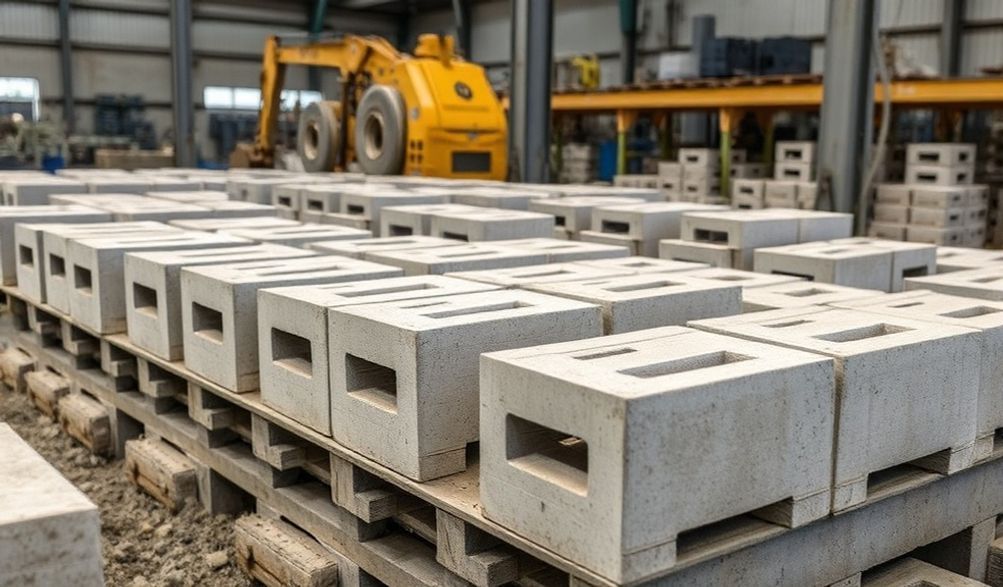
The Complete Guide to Cement Block Manufacturing: Process, Machines & Business Insights
Look around any city, town, or village. The skeleton of our modern built environment—from humble garden walls to towering skyscrapers—relies on a fundamental component: the cement block. Known technically as Concrete Masonry Units (CMUs), these ubiquitous rectangles are the unsung heroes of construction, prized for their strength, durability, and versatility.
This comprehensive guide is distilled from industry standards, established manufacturing principles, and practical operational knowledge. Whether you’re an aspiring entrepreneur evaluating a block manufacturing business, a construction professional seeking deeper insight into your materials, or a student of civil engineering, this resource is designed for you. We will walk you through the step-by-step manufacturing process, demystify the essential machinery, delve into critical quality control measures, and explore the key considerations for starting a successful operation. Our focus is on trustworthy, actionable information, referencing standard industry practices and emphasizing the safety and sustainability that underpin modern manufacturing.
What Are Cement Blocks? Types and Applications
Voordat jy in duikhoe they’re made, let’s clarify wat they are and why they’re so widely used.
Defining CMUs: Composition and Key Properties
At its core, a cement block is a precast building material made from a mixture of:
* Sement: Usually Ordinary Portland Cement (OPC) or Portland Pozzolana Cement (PPC), acting as the binding agent.
* Aggregate: Typically fine aggregates like sand, stone dust, or industrial by-products such as fly ash. These provide bulk and strength.
* Water: Initiates the chemical reaction of hydration, which gives the block its strength.
The precise ratio of these materials determines the block’s key properties:
* Druksterkte: The primary measure of a block’s ability to bear load, expressed in N/mm² or psi. Standard blocks range from 3.5N/mm² to over 15N/mm².
* Duursaamheid: Resistance to weathering, moisture, and temperature fluctuations.
* Termiese en Klank Isolasie: Especially true for hollow and lightweight blocks, which can improve a building’s energy efficiency and acoustic comfort.
Common Types of Cement Blocks
Not all blocks are created equal. The right type is chosen based on structural and functional needs.
- Solid vs. Hollow Blocks: Hollow blocks have one or more large cavities, reducing weight and material cost while improving insulation. They are commonly used for non-load-bearing walls. Solid blocks are denser and used for load-bearing applications.
- Standard Shapes:
- Stretcher Block: The standard block used in the body of a wall.
- Corner Block: Used at the ends or corners of a wall.
- Pillar/Column Block: For constructing pillars and columns.
- Jamb Block: Used around window and door openings.
- Partition Block: Thinner, lightweight blocks for interior walls.
- Spesialiteitsblokke:
- Ligte Blokke: Made with expanded clay, shale, or slate aggregates.
- Aerated Autoclaved Concrete (AAC) Blocks: Cured with steam under pressure, very light and insulative.
- Plaatstene: Dense, high-strength blocks for driveways and walkways.
Why Choose Cement Blocks? Advantages in Construction
The popularity of CMUs is no accident. Their benefits are substantial:
* Vuurweerstand: Concrete is inherently non-combustible, providing excellent fire ratings.
* Koste-effektiwiteit: Raw materials are often locally available, and the manufacturing process can be highly efficient.
* Spoed van Konstruksie: Large block sizes allow for faster wall assembly compared to brick.
* Lae Instandhouding: Once laid, they require minimal upkeep.
* Veelsydigheid: They can be plastered, painted, or left exposed for an aesthetic finish.
The Cement Block Manufacturing Process: A Step-by-Step Breakdown
Transforming raw powder and aggregate into a robust building unit is a precise science. Here’s how it’s done on the production floor.
Stage 1: Raw Material Selection and Preparation
Quality in equals quality out. This stage sets the foundation.
* Sement: Must be fresh, stored off the ground in a dry place, and used within its shelf life. The grade (e.g., OPC 43 or 53) is selected based on the target block strength.
* Aggregate: Should be clean, hard, and free of organic matter. Proper grading (particle size distribution) is crucial for a dense mix. In practice, many manufacturers use a blend of coarse and fine sand or incorporate fly ash, which can improve workability and create a greener product.
* Water: Should be potable, free from oils, acids, and excessive impurities. Poor water quality can severely hinder strength development.
Stage 2: Proportioning and Mixing
Consistency is king. A haphazard mix leads to weak, variable blocks.
* Mix Design: Common volume ratios like 1:6 (cement:aggregate) or 1:8 are starting points, but weight batching is far more accurate and recommended. The desired compressive strength dictates the precise mix.
* Mixing Process: A pan mixer is often preferred for block production as it creates a stiff, zero-slump concrete mix essential for holding its shape immediately after molding. Mixing continues until a uniform color and consistency are achieved—typically 3-5 minutes. On-site, operators learn to judge the “right” mix by its cohesion; it should ball in the hand without dripping water.
Stage 3: Molding and Compaction
This is where the block takes shape. The mixed concrete is fed into the block-making machine.
* The mixture is poured or conveyed into the mold box, which defines the block’s shape and size.
* The machine then employs high-frequency vibrasie and mechanical verdichting (often a press head). This dual action is critical: it removes entrapped air, consolidates the material, and ensures the block is dense and solid throughout. Insufficient compaction is a common cause of weak, crumbly blocks.
Stage 4: Curing – The Critical Strength Development Phase
Freshly molded blocks are “green” and have very little strength. Genees is the controlled process of maintaining adequate moisture and temperature to allow the cement to fully hydrate and gain strength.
* Methods:
* Water Curing: The most common method. Blocks are stacked and regularly sprinkled with water or stored in a curing pond for 7-14 days. They must be kept constantly moist.
* Steam Curing: Used in larger, automated plants. Blocks are moved into a curing chamber and exposed to steam at elevated temperatures. This accelerates strength gain, allowing demolding and handling in hours instead of days.
* Duration: While blocks can often be handled after 24 hours, proper moist curing should continue for a minimum of 7 days to achieve sufficient strength. The full design strength is typically reached at 28 days.
Stage 5: Drying, Cubing, and Storage
After curing, blocks contain significant moisture.
* They are allowed to air-dry in a shaded area to reduce moisture content before delivery.
* Once dry, they are stacked neatly into cubes (e.g., 72 or 96 blocks per cube) using forklifts for efficient storageentransport.
* Proper storage involves keeping blocks on a level, dry surface and protecting them from direct rain and contamination.
Essential Machinery for a Block Manufacturing Plant
The right equipment is an investment in quality and productivity.
Core Machine: The Block Making Machine
This is the heart of the plant. Choices depend on scale and budget:
* Manual Machine: Operated by hand lever, low output (200-500 blocks/day). Suitable for very small-scale or on-site production.
* Halfoutomatiese Masjien: Electrically powered vibration and compaction. An operator feeds material and removes blocks. Good for small to medium businesses (1000-3000 blocks/day).
* Volledige Outomatiese Masjien: Computer-controlled with automatic feeding, molding, and block ejection. High output (5000+ blocks/day) with minimal labor. Requires significant investment.
* Mobile Block Machine: Can be moved to different job sites, producing blocks directly where they are needed.
Supporting Equipment
A smooth operation requires a supporting cast:
* Betonmenger: A robust pan mixer is standard for producing the dry, stiff concrete mix.
* Materiaalhantering: Wheelbarrows, conveyor belts, and hoppers to move raw materials and fresh concrete.
* Curing & Storage: Curing racks, trolleys, water tanks, and sprinkler systems. A forklift is essential for medium and large plants.
* Laboratory Equipment: For quality control, a basic lab needs a slump cone, cube molds, and access to a compression testing machine.
Choosing the Right Setup: Project Scale and Investment
- Small Scale (Startup): Manual or semi-automatic machine, small pan mixer, basic curing area. Focus on local demand.
- Medium Scale: Semi-automatic or entry-level automatic machine, conveyor system, forklift. Allows for a wider product range and supply to contractors.
- Large Scale: Fully automatic production line with batching plant, robotic handling, steam curing chambers, and full QC lab. Serves large construction projects and distributors.
Quality Control in Cement Block Production
In this business, quality isn’t just a goal—it’s your reputation and a non-negotiable safety requirement. Consistent quality builds unshakeable customer trust.
Key Tests for Cement Blocks
Reputable manufacturers test regularly, often following standards like ASTM C90 (US) or IS 2185 (India).
1. Compressive Strength Test: The definitive test. Sample blocks or concrete cubes are crushed in a compression machine to measure failure load.
2. Dimensional Tolerance Check: Using calipers to ensure length, width, and height are within allowable limits (usually ±3mm).
3. Water Absorption Test: Blocks are dried, weighed, immersed in water, then weighed again. Lower absorption indicates a denser, more durable block.
4. Visual Inspection: Checking for face shell and web cracks, chips, or poor surface finish before dispatch.
Maintaining Consistent Quality
- Calibrate Equipment: Regularly check mixer timers, weighing scales, and the compression tester.
- Train Operators: Ensure staff understand the impact of each step, from batching to curing.
- Keep Records: Document every batch’s mix design, production date, and test results. This traceability is crucial for troubleshooting and proving quality to clients.
Starting a Cement Block Manufacturing Business: Key Considerations
Venturing into block manufacturing requires more than just technical know-how. It demands strategic business planning.
Market Research and Business Plan
- Analyze Demand: Study local construction activity. Are residential, commercial, or infrastructure projects booming?
- Know Your Competition: Identify existing manufacturers, their pricing, and product quality.
- Define Your Niche: Will you focus on standard hollow blocks, specialty paving blocks, or lightweight varieties? Your target could be contractors, retail building supply stores, or direct government contracts.
Location, Layout, and Licenses
- Site: Secure a location with ample space for production, curing, storage, and raw material stockpiles. Good road access for trucks is vital. Reliable water and power (often 3-phase for machines) are non-negotiable.
- Licenses: Requirements vary but typically include a factory license, trade license, pollution control board consent, and GST registration.
Financial Planning: Cost and Profitability
- Capital Investment: Land, shed/warehouse, machinery, and installation.
- Bedryfskoste: Raw materials (the largest recurring cost), labor, electricity, fuel, maintenance, and transportation.
- Pricing & ROI: Price your blocks to cover costs, remain competitive, and provide a healthy margin. A detailed business plan should project break-even point and return on investment, which can be attractive given the consistent demand in growing markets.
Challenges and How to Overcome Them
- Seasonal Demand: Construction slows during monsoons. Plan finances accordingly and consider producing paving blocks or other products for the off-season.
- Raw Material Price Fluctuation: Build good relationships with multiple suppliers and buy in bulk when prices are favorable.
- Labor Skill Gaps: Invest in hands-on training to create a skilled, reliable workforce.
Sustainability and the Future of Block Manufacturing
The industry is evolving towards greater efficiency and environmental responsibility.
Eco-Friendly Practices
- Using By-Products: Incorporating fly ash (from coal plants) or slag (from steel plants) reduces cement consumption, lowers the carbon footprint, and utilizes waste.
- Water Recycling: Implementing systems to collect and reuse water from the curing process.
- Afvalvermindering: Optimizing mix designs to use less material and recycling broken or leftover blocks as aggregate.
Innovations in Block Technology
- Insulated Concrete Forms (ICFs): Hollow blocks made of expanded polystyrene (EPS) that are filled with concrete, creating highly insulated walls.
- Inmekaar-sluitende Blokke: Designed to fit together without mortar, enabling faster, “dry-stack” construction.
- Architectural Finishes: Blocks with textured, split-face, or glazed finishes that serve as both structure and aesthetic facade.
Frequently Asked Questions (FAQ)
Q1: What is the ideal cement-to-sand ratio for making strong blocks?
A: While common volume ratios are 1:6 for non-load-bearing blocks and 1:4 for load-bearing blocks, this is a simplification. The ideal “mix design” depends on the desired compressive strength, the specific properties of your sand and cement, and should be developed through testing. Always refer to relevant local building codes for guidance.
Q2: How long do cement blocks need to cure before they can be used?
A: For moist-cured blocks, they develop enough strength to be handled and transported after about 7 days. However, they should not be subjected to full design load until they reach their 28-day strength. Steam-cured blocks achieve handling strength in a matter of hours.
Q3: What is the difference between concrete blocks and cement blocks?
A: The terms are used interchangeably in everyday language, but “concrete block” is technically more accurate. Cement is just one ingredient (the binder) in concrete, which also includes aggregates and water. A “cement block” would be made purely of cement, which is not practical or economical.
Q4: Can I start a small-scale block manufacturing business at home?
A: It is possible on a very small scale with a manual machine, provided you have sufficient open space (like a backyard), access to materials, and comply with local zoning regulations. Your market would be limited to immediate neighbors or very small local projects. It’s an excellent way to learn the process before scaling up.
Q5: How do I test the quality of cement blocks I purchase?
A: As a buyer, you can:
* Perform a visual check for cracks, chips, or uneven coloring.
* Measure dimensions for consistency.
* Compare weight—two blocks of the same size; the denser, heavier one is generally stronger.
* Strike two blocks together; a clear, ringing sound indicates good compaction, while a dull thud may suggest poor quality.
* Always ask the supplier for compressive strength test certificates from a reputable lab.
Conclusion
The journey from raw, separate materials to a solid, reliable building block is a fascinating interplay of chemistry, physics, and mechanical engineering. Successful cement block manufacturing hinges on a deep respect for this process: selecting quality inputs, executing each step—from precise batching to thorough curing—with consistency, and never compromising on rigorous quality control.
For the aspiring entrepreneur, this foundation of knowledge is your first and most important block. Conduct thorough research, start with a scale that matches your market, and prioritize quality from day one. For builders and contractors, your project’s integrity depends on the materials you use. Partner with manufacturers who are transparent about their processes and can provide proof of their product’s performance.
The humble cement block is far more than just a piece of concrete; it’s a testament to standardized, reliable construction. By understanding how it’s made, we can build better, safer, and more sustainably.
METADATA_START—
DISPLAY_TITLE: The Complete Guide to Cement Block Manufacturing: Process, Machines & Business Insights
SEO_TITLE: Cement Block Manufacturing Process & Business Guide
META_DESC: A complete guide to cement block manufacturing. Learn the step-by-step process, essential machinery, quality control, and how to start your own block making business.
IMG_PROMPT: A hyper-realistic, detailed close-up of a stack of fresh, grey concrete blocks with a textured surface, sitting in an industrial manufacturing plant with soft light from a high window. In the background, out of focus, is the sturdy metal frame of a block making machine.
—METADATA_END—