
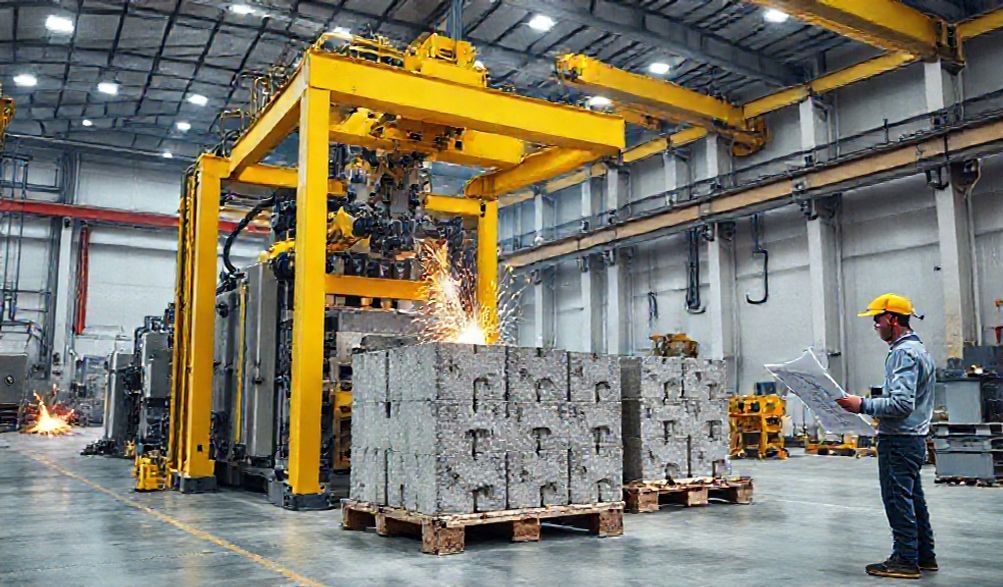
A Comprehensive Guide to Block Concrete Machine Factories: Spotlight on FUDA Block Making Machine Factory
Inleiding
For construction businesses, developers, and ambitious startups, the quest for the right block making machinery is a pivotal decision that can define project timelines, budget adherence, and long-term profitability. The market is saturated with options, making it a daunting challenge to identify a reliable factory that delivers not just a machine, but a robust production solution balancing performance, durability, and true value.
This guide serves as an authoritative resource, distilled from industry analysis and technical evaluation. We aim to demystify the landscape of block concrete machine factories, providing you with the critical framework needed to make an informed investment. While we will explore universal evaluation criteria, we will place a specific focus on the FUDA block making machine factory as a detailed case study. This approach will translate abstract features into tangible analysis, illustrating exactly what to look for—and what questions to ask—when sourcing equipment that will become the backbone of your operation.
Understanding Block Concrete Machine Factories: The Engine of Modern Construction
At its core, the construction industry relies on consistent, high-quality materials. Block concrete machine factories are the often-overlooked powerhouses that make this consistency possible on a massive scale. They are the birthplaces of the equipment that produces the building blocks—quite literally—of our infrastructure, from residential homes to commercial complexes.
What is a Block Making Machine Factory?
A block making machine factory is far more than an assembly plant. It is a specialized industrial hub where mechanical engineering, hydraulic systems, electrical automation, and material science converge. These facilities are responsible for the research and development (R&D), precision manufacturing, and quality assurance of machines designed to compress concrete mix into precise, durable shapes. Their product lines typically encompass:
* Stationary block making machines (for fixed plant setups).
* Mobile block making machines (for on-site production).
* A range of ancillary equipment like mixers, pallet feeders, and brick stackers.
Key Types of Machines Produced
Understanding a factory’s product portfolio reveals its market specialization and capability.
- Handmatige & Semi-outomatiese Masjiene: Ideal for small-scale operations, community projects, or startups with limited capital. They require more manual labor for feeding and stacking but offer a lower entry cost.
- Ten vol outomatiese Blokvervaardigingsmasjiene: These are the high-output powerhouses for large-scale commercial production. They integrate automated material feeding, compression, curing, and stacking via Programmable Logic Controller (PLC) systems. Factories like FUDA often emphasize these lines for clients seeking maximum output and labor efficiency.
- Mobiele Blokmasjiene: A game-changer for large construction sites. Producing blocks directly where they are needed slashes transportation costs and logistical complexity, ensuring a just-in-time supply of materials.
The Importance of Choosing the Right Factory
Your choice of factory is a long-term strategic partnership with direct implications for:
* Machine Longevity: Quality manufacturing translates to years of reliable service.
* Uitsetkwaliteit: Precision engineering ensures blocks with consistent dimensional accuracy, superior compressive strength, and excellent surface finish.
* Totale Eienaarskyskoste: A cheaper machine can become expensive with frequent downtime, high maintenance costs, and poor energy efficiency.
* Operational Success: Comprehensive after-sales support, training, and spare parts availability are crucial for smooth day-to-day running.
With this foundation, let’s build a practical checklist to evaluate any block machine factory.
Evaluating a Block Machine Factory: A Buyer’s Checklist
This checklist transforms you from a passive buyer into an informed evaluator. Use it to dissect factory claims and uncover real capability.
Manufacturing Expertise and Technical Capability
Look beyond glossy brochures to the engineering bedrock of the factory.
- Navorsing en Ontwikkeling Investering: Inquire about their engineering team and development process. Do they adapt to new technologies and block designs?
- Production Depth: A key differentiator is whether a factory manufactures core components like molds and vibration systems in-house. This allows for stricter quality control and better technical support compared to factories that merely assemble outsourced parts.
- Kwaliteit Sertifisering: While not a guarantee, international standards like ISO 9001 for quality management systems indicate a structured approach to production and process control.
Machine Performance and Specifications
Specifications are your quantitative evidence. Demand detailed, written specs for any model you consider.
- Core Metrics:
- Siklustyd: The time to produce one complete set of blocks (e.g., 15-20 seconds). Faster cycles mean higher output.
- Uitsetvermoë: Calculated in blocks per 8-hour shift (e.g., 15,000-30,000 standard blocks).
- Druk Krag: Measured in tons or kilonewtons (kN). Higher pressure yields denser, stronger blocks.
- Vibrasie Stelsel: The power and configuration of vibration motors are critical for proper material compaction.
- Versatility & Customization: Can the machine produce multiple block types (hollow, solid, paver, interlock) by simply changing the mold? A flexible machine protects your investment against changing market demands.
- Outomatiseringsvlak: Evaluate the control system (brand of PLC), presence of automatic pallet feeders, brick stackers, and curing systems. True automation reduces labor costs and human error.
Build Quality and Core Components
The brands of key components are a telltale sign of build philosophy.
- Strukturele Raamwerk: It should be constructed from heavy-duty, reinforced steel to withstand constant vibration and stress.
- Kritiese Komponente:
- Hidrouliese Stelsel: The heart of the machine. Reputable brands ensure reliability and precise control.
- Elektriese Stelsels: Look for known brands like Siemens or Schneider Electric for PLCs and switches.
- Vormkwaliteit: Molds should be made from high-grade, hardened steel with precise machining. They are a wear item, but quality ones last exponentially longer.
Case Study: An In-Depth Look at FUDA Block Making Machine Factory
Applying our framework, let’s analyze the FUDA block making machine factory as a specific example to illustrate the evaluation process in action.
Maatskappyprofiel en Markposisie
Based on available public information, FUDA positions itself as a professional manufacturer in the block machine industry. Typically, such factories are located within major industrial hubs, offering a range from semi-automatic to fully automatic production lines. Their product catalog often includes:
* Concrete block making machines.
* Paver block machines.
* Interlocking brick machines.
* Related concrete mixing and handling equipment.
Their market positioning often emphasizes a balance between advanced automation and competitive pricing, targeting growing construction markets globally.
Analyzing FUDA’s Reported Strengths
From common specifications and client-facing materials, potential strengths of a factory like FUDA might include:
- Focus on Automation: They likely promote fully automatic lines with PLC control as a core offering, aiming for high efficiency and reduced manual intervention.
- Aanpassingsvermoë: Emphasis on designing and manufacturing custom molds for special block shapes and sizes is a common value proposition.
- Geïntegreerde Produksielyne: The ability to supply not just the block machine, but the complete production line (mixer, conveyor, stacker) can be a significant advantage for turnkey project buyers.
Critical Considerations for Prospective Buyers
This is where due diligence is non-negotiable. If considering FUDA or any similar factory, you must:
- Verifying Claims: Request unedited, time-stamped videos of the exact machine model in operation at a client’s site. Ask for a detailed list of component brands used. Require copies of quality certificates and ask for 2-3 past client references in a region similar to yours.
- Na-Verkope Diens Struktuur: Get a written outline of their support. What does it include?
- On-site installation and commissioning by factory engineers?
- Comprehensive operator training programs?
- Spare parts inventory and guaranteed supply timeline (e.g., 72-hour dispatch for critical parts)?
- Remote technical support availability (e.g., via video call)?
- The Imperative of Direct Communication & Visits: A factory visit is the single most revealing step. It allows you to inspect build quality, talk to engineers, and feel the company’s professionalism. Always insist on communicating directly with the technical sales or engineering team, not just a generic sales agent.
Beyond the Purchase: Installation, Operation, and Support
Your relationship with the factory truly begins once the purchase order is signed.
Navigating Installation and Commissioning
- Foundation & Utilities: The factory must provide precise civil engineering drawings for the machine foundation and clear requirements for power and water supply.
- Timeline & Support: Clarify if the price includes supervision by factory technicians. The typical commissioning process takes 1-2 weeks with expert guidance, which is invaluable for proper setup.
Ensuring Optimal Operation and Maintenance
- Opleiding: Ensure your operators are fully trained on daily procedures, safety protocols, and basic troubleshooting.
- Voorkomende Instandhouding: Adhere strictly to the factory’s maintenance schedule for lubrication, hydraulic fluid checks, and bolt tightening. This prevents 80% of major breakdowns.
The Lifeline: Reliable After-Sales Service
A comprehensive service agreement is your safety net. It should explicitly detail:
* Warranty period and coverage for different components.
* Response time guarantees for technical queries.
* Pricing structure for spare parts post-warranty.
* Availability of service manuals and circuit diagrams in your language.
FAQ: Your Questions on Block Machine Factories & FUDA Answered
Q1: What is the average price range for a fully automatic block making machine from a factory like FUDA?
A: There is no single “average price.” A basic automatic machine might start around $50,000, while a high-output, fully integrated production line with robots can exceed $250,000. The only meaningful quote is one based on your specific output target, block types, and automation level.
Q2: How can I verify the quality of a factory’s machines without traveling there?
A: You can request: 1) Live video calls from their workshop floor, 2) Detailed, high-resolution photos of component labels and welding, 3) Third-party inspection reports from agencies like SGS or BV, and 4) Direct contact information for existing international clients.
Q3: What are the most common mistakes when choosing a block machine factory?
A: The top mistakes are: choosing based on the lowest price alone; not verifying the brands of core components; failing to plan for foundation and utility costs; and accepting vague warranty terms instead of a detailed, written service agreement.
Q4: Does FUDA (or similar factories) provide custom mold design?
A: Most reputable factories do. It’s a critical question to ask. A “yes” should be followed by requesting a portfolio of past custom mold designs and understanding the lead time and cost for new ones.
Q5: What is the typical lead time from order to delivery for a complete block production line?
A: For a standard configured line, expect 45 to 75 days from receipt of deposit. Highly customized lines can take 90-120 days. This timeline should be a binding clause in your contract, linked to payment milestones.
Conclusion
Selecting a block concrete machine factory is a decision that reverberates through your business for years. It requires moving beyond price comparisons to a thorough evaluation of technical capability, verifiable build quality, and—most importantly—the long-term trust built on after-sales support. As our case study on the FUDA block making machine factory illustrates, the principles of diligent research, direct verification, and clear communication are universal.
Your next step is to transform this knowledge into action. Prepare a detailed Request for Quotation (RFQ) outlining your project’s specific needs: desired output, block types, site conditions, and automation goals. Use this document to start technical discussions with shortlisted factories. Remember, the most successful investments are built on the solid foundation of due diligence and a partnership approach with your chosen manufacturer.
<