
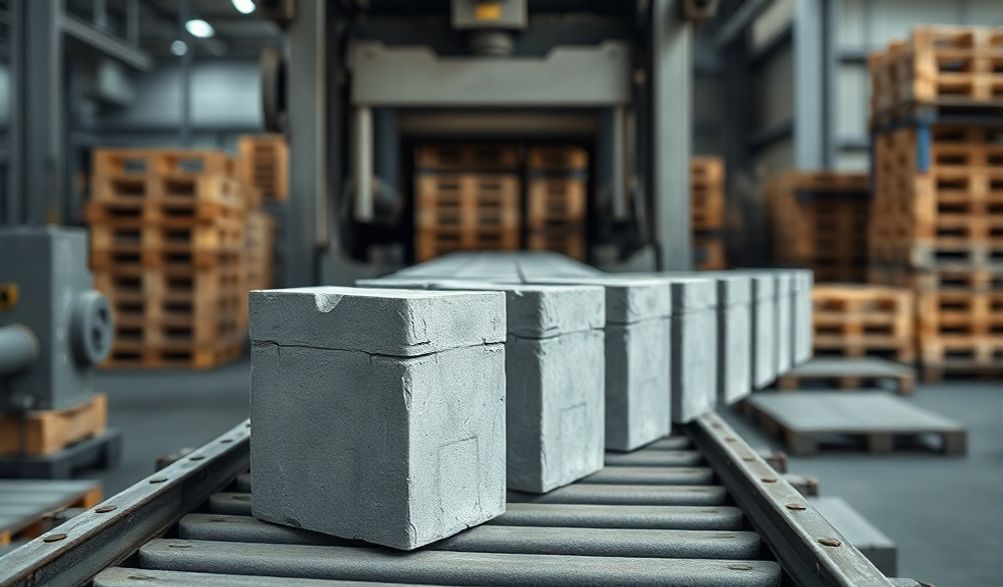
How to Make Cinder Blocks: A Step-by-Step Guide from FUDA Brick Making Factory
ভূমিকা
You’ve finally decided to build that garden wall, workshop foundation, or backyard fire pit. You’ve sketched the plans, and your material of choice is the humble, versatile cinder block. But as you prepare for the project, a question arises: what exactly goes into these ubiquitous gray rectangles? How are they made, and what separates a high-quality block from a subpar one?
For the DIY enthusiast, homesteader, or small-scale builder, understanding the journey from raw material to finished block is more than just trivia—it’s key to making informed decisions that affect the safety, durability, and success of your build. This guide demystifies that journey.
Drawing directly from the industrial expertise of ফুদা ইট তৈরির কারখানা, this post serves as your authoritative, behind-the-scenes look at professional block manufacturing. We’ll move beyond basic DIY tutorials to explore the precise science, controlled processes, and rigorous quality control that define how to make cinder blocks at scale. By the end, you’ll not only understand the steps but also appreciate the critical factors that ensure every block can reliably bear the load you place on it.
আমরা যা আলোচনা করব:
* The true composition and advantages of modern cinder blocks.
* The exact raw materials that form their foundation.
* A detailed, step-by-step walkthrough of the industrial manufacturing process.
* The non-negotiable quality control checks that separate professional-grade blocks.
* Practical advice on when a DIY approach might suffice and when sourcing from a professional factory is essential.
আসুন আপনার জ্ঞানকে মৌলিক স্তর থেকে গড়ে তুলি।
সিন্ডার ব্লক বোঝা: কেবল কংক্রিটের চেয়েও বেশি
Before we dive into the কেমন, it’s crucial to understand the কী. The term “cinder block” is often used interchangeably with “concrete block,” but there are important distinctions rooted in history and composition.
What Are Cinder Blocks (CMUs)?
Technically, the correct industry term is কংক্রিট ম্যাসনরি ইউনিট (সিএমইউ). A CMU is a precast building block made primarily from Portland cement, water, and aggregates like sand and gravel.
- Cinder Block (Historical): Historically, “cinder blocks” used industrial by-products like coal cinders or ash as the primary aggregate. These blocks were lighter and provided better insulation but were generally weaker in compressive strength.
- Concrete Block (Modern): Today, the blocks commonly used for structural foundations, walls, and paving are concrete blocks. They use dense mineral aggregates (sand, gravel, crushed stone) for maximum strength. The term “cinder block” has persisted in common language, but most products you buy are, in fact, high-strength concrete blocks.
These blocks are a cornerstone of construction due to their modularity, coming in standard sizes (like the classic 8″x8″x16″) that allow for efficient, strong, and fire-resistant structures.
Key Advantages of Using Quality Cinder Blocks
Why choose cinder blocks (CMUs) for your project? The benefits are substantial:
- Exceptional Durability & Longevity: Properly manufactured blocks resist weathering, rot, and insect damage, lasting for decades with minimal maintenance.
- উচ্চতর অগ্নি প্রতিরোধ ক্ষমতা: Concrete is non-combustible. Walls built with CMUs provide excellent fire ratings, a critical safety feature.
- গাঠনিক শক্তি: High-quality blocks have significant compressive strength, making them ideal for load-bearing walls, foundations, and retaining structures.
- Thermal Mass & Insulation: Concrete blocks absorb and store heat, helping to regulate indoor temperatures. When combined with insulation cores, they enhance a building’s energy efficiency.
- খরচ-কার্যকারিতা: Compared to many other structural materials, CMUs offer a very favorable cost-to-strength ratio, especially for larger projects.
- বহুমুখিতা: They can be left exposed, painted, stuccoed, or veneered, offering great design flexibility.
The Raw Materials: Foundation of a Strong Block
The quality of a cinder block is determined at its very beginning—in the selection and proportioning of its raw materials. At FUDA, this stage is governed by precise recipes and strict quality checks.
Portland Cement: The Essential Binder
Portland cement is the “glue” that holds the block together. When mixed with water, it undergoes a chemical reaction called hydration, forming a hard matrix that binds the aggregates into a solid mass.
* Type I/II Cement: This general-purpose cement is most commonly used in block manufacturing. Type II offers moderate resistance to sulfates, which can be beneficial in certain environments.
* Consistency is Key: Factories source cement from trusted suppliers with consistent chemical properties to ensure every batch of blocks cures predictably and achieves its target strength.
Aggregates: Sand, Gravel, and More
Aggregates give the block its body, volume, and structural characteristics. The choice and gradation (particle size distribution) are critical.
* সূক্ষ্ম সমষ্টি: Typically sand, which fills the voids between larger particles, creating a denser, stronger mix.
* মোটা সমষ্টি: Gravel or crushed stone (usually between 3/8″ and 1/4″ in size) provides the primary skeletal structure and compressive strength.
* Modern vs. Historical: As noted, modern structural blocks use these dense mineral aggregates. The old “cinder” aggregate is rarely used today for load-bearing applications due to its lower strength.
Water: The Catalyst for Strength
Water is not just an ingredient; it’s the catalyst for the cement hydration process.
* গুণমান: It must be clean and free from impurities like oils, acids, or organic matter that could interfere with the chemical reaction or weaken the final product.
* Water-Cement Ratio: This is one of the most critical factors in concrete technology. Too little water, and the mix won’t hydrate fully. Too much water weakens the concrete matrix by creating excessive pores and voids as it evaporates. Professional factories calculate this ratio with precision.
Admixtures (Optional): Enhancing Performance
For specific applications, chemical admixtures are introduced in small quantities to modify the properties of the concrete mix:
* Water-Reducers/Plasticizers: Allow for a lower water content while maintaining workability, resulting in higher strength.
* Accelerators: Speed up the initial set time, which can be useful in cooler weather or for faster production cycles.
* পিগমেন্টস: Iron oxide pigments are used to produce colored blocks (e.g., brown, red, black) for architectural purposes.
* Air-Entraining Agents: Introduce microscopic air bubbles that improve resistance to freeze-thaw cycles in colder climates.
The Industrial Manufacturing Process at FUDA
Now, let’s step onto the factory floor. This is where science, engineering, and scale converge. The process at a professional facility like FUDA is highly automated and controlled, ensuring consistency, efficiency, and quality that manual methods cannot match.
Step 1: Batching and Mixing
The process begins with batching—the precise, computerized measurement of each raw material. Cement, aggregates, and water are weighed to exact specifications according to the mix design.
These materials are then fed into an industrial mixer—often a large pan mixer or drum mixer. The goal is homogeneity: a completely uniform distribution of every particle of cement, aggregate, and water throughout the mix. This consistent “batch” of fresh concrete is the starting point for every block.
Step 2: Molding and Compaction
The wet concrete mix is fed into the hopper of a block-making machine. This machine uses a mold box containing several cavity molds in the shape of the desired block (e.g., standard stretcher, corner, half-block).
- ভর্তি The cavities are filled with the concrete mix.
- কম্প্যাকশন: This is the most critical mechanical step. The machine subjects the mix in the molds to intense vibration and pressure. This action consolidates the concrete, forcing out entrapped air and packing the aggregates tightly together. The result is a dense, void-free “green” block with sharp edges and a smooth surface. The level of compaction directly correlates to the final strength and durability of the block.
Step 3: Curing – The Strength Development Phase
Here is where professional manufacturing truly diverges from amateur attempts. “Green” blocks have zero structural strength. নিরাময় is the controlled process of maintaining adequate moisture and temperature to allow the cement hydration to proceed fully.
- The FUDA Method: Blocks are typically moved on pallets into a curing chamber or kiln. The environment is controlled, often using low-pressure steam (at around 140-180°F or 60-80°C) and high humidity.
- এটি গুরুত্বপূর্ণ কেন: This accelerated, controlled curing:
- Drives the rapid development of early strength.
- Ensures uniform strength gain across all blocks in the batch.
- Prevents moisture loss that can stop hydration and lead to weak, crumbly blocks.
- Within 24 hours, blocks can gain over 70% of their potential strength, allowing for safe handling and palletizing.
Step 4: Cubing and Palletizing
Once cured, the hardened blocks are depalletized from the curing racks.
* Cubing: They are automatically stacked into a stable cube (e.g., 10 blocks high by 4 blocks wide).
* Strapping: Steel or plastic straps are applied tightly around the cube to secure it for transport.
* Storage & Shipping: These cubes are then moved to the storage yard or directly loaded onto trucks for delivery. The blocks are now ready to become part of your project.
Quality Control: What Separates Professional-Grade Blocks
A reputable factory doesn’t just make blocks; it verifies their performance. Quality control is an ongoing, non-negotiable part of the process.
Dimensional Tolerance Checks
Blocks are routinely sampled and measured to ensure they conform to strict dimensional standards (e.g., ASTM C90). Consistent length, height, and width are vital for:
* Straight, plumb walls.
* Uniform mortar joints.
* Ease and speed of installation.
Compressive Strength Testing
This is the ultimate test of a block’s integrity. Sample blocks from a production run are crushed in a hydraulic press to measure the force they can withstand before failing.
* Standard Requirements: For example, in the U.S., ASTM standards often require a minimum average compressive strength of 1,900 psi (13.1 MPa) for load-bearing units. High-strength blocks can exceed 3,000 psi.
* FUDA’s Practice: Regular destructive testing ensures every batch meets or exceeds the relevant standards for its designated use.
Absorption and Density Tests
These tests provide insight into the block’s durability and resistance to the elements.
* Absorption: Measures how much water a block can soak up. Lower absorption generally indicates a denser, more durable block that is less susceptible to freeze-thaw damage and efflorescence (white salt deposits).
* ঘনত্ব: The weight per unit volume, which correlates with strength and insulation properties.
FUDA’s Commitment to Standards
Trust is built on consistency and proof. A professional factory like FUDA operates with a commitment to documented standards (ASTM, ISO, or local equivalents). They maintain detailed records of mix designs, production data, and test reports, providing traceability and accountability for every pallet shipped.
DIY vs. Professional Manufacturing: Key Considerations
Understanding the industrial process naturally leads to the question: can I make these myself?
The Challenges of Homemade Cinder Blocks
For very small, non-structural projects (like a single planter), using a simple plastic or wooden mold is possible. However, significant compromises include:
* Inconsistent Mix Ratios: Achieving the precise water-cement ratio by hand is difficult, leading to weak or porous blocks.
* Inadequate Compaction: Without industrial vibration and pressure, blocks will have high void content, drastically reducing strength and durability.
* Improper Curing: Air-drying blocks leads to rapid moisture loss, halting hydration and resulting in a chalky, weak final product that may crumble under load.
* No Quality Verification: There is no way to test the compressive strength or absorption of your homemade blocks, creating an unknown—and potentially unsafe—variable in your project.
When to Source from a Factory Like FUDA
For any project where the following factors matter, professional blocks are the only sensible choice:
* গঠনগত অখণ্ডতা: Foundations, load-bearing walls, retaining walls, or any structure supporting weight.
* Building Code Compliance: Most jurisdictions require manufactured CMUs that meet specific standards for permitted construction.
* Volume & Efficiency: Producing hundreds of consistent blocks by hand is incredibly time and labor-intensive.
* Long-Term Durability & Weather Resistance: You need the assurance that your structure will last.
* Professional Finish: Factory-made blocks have clean, sharp edges and consistent dimensions for a professional build appearance.
FAQ Section
Q1: What is the difference between a cinder block and a concrete block?
এ This is primarily a historical vs. modern material difference. True “cinder blocks” used coal cinders as aggregate and are now uncommon. The term is often used colloquially to refer to standard concrete blocks, which use sand and gravel aggregate for much higher strength. When purchasing, you are almost always buying concrete masonry units (CMUs).
Q2: How long does it take to make a cinder block in a factory?
এ The machine cycle—from filling the mold to ejecting a “green” block—can take just 15-30 seconds. However, the কিউরিং প্রক্রিয়া to develop sufficient handling strength typically takes 12-24 hours in a controlled kiln. Full curing to reach the block’s specified design strength continues over 28 days under proper conditions.
Q3: Can you make cinder blocks without a machine?
এ Yes, but with major limitations. Simple single-cavity molds can be used for small, decorative, or non-structural projects. The blocks will lack the density and strength of machine-made blocks due to the absence of high-pressure compaction and controlled curing. They are not suitable for any load-bearing application.
Q4: What are the standard sizes of cinder blocks?
এ The most common নামমাত্র size in the U.S. is 8 inches in height by 8 inches in depth by 16 inches in length. The প্রকৃত dimensions are typically 7 5/8″ x 7 5/8″ x 15 5/8″ to account for a 3/8″ mortar joint. Many other sizes exist, including 4″, 6″, 10″, and 12″ nominal widths, as well as half-blocks and corner blocks.
Q5: How do I choose a reliable cinder block supplier?
এ
* Ask About Standards: Ensure they produce blocks to recognized standards (e.g., ASTM C90).
* সম্ভব হলে পরিদর্শন করুন: A clean, organized factory like FUDA with modern equipment is a good sign.
* Check Consistency: Look at blocks on a pallet. They should be uniform in color, size, and have sharp, chip-free edges.
* Request Information: A trustworthy supplier should be able to provide data on compressive strength and absorption rates.
উপসংহার
The process of how to make cinder blocks is a fascinating blend of material science, mechanical engineering, and precise process control. From the meticulous batching of raw materials to the intense vibration in the mold and the critical steam curing phase, each step is designed to transform simple ingredients into a product of remarkable and reliable strength.
For the DIYer or professional builder, this knowledge is power. It underscores why quality materials matter and why the controlled environment of a professional ইট তৈরির কারখানা is indispensable for structural applications. While the allure of making your own blocks is understandable, the assurance of safety, consistency, and durability that comes from a reputable manufacturer like FUDA is invaluable for any serious project.
Ready to build with confidence? For your next foundation, wall, or landscaping project, choose blocks manufactured to professional standards. If you have specific project requirements or questions about the right block for your needs, reaching out to an expert manufacturer is the best first step toward a successful, long-lasting build.
<