
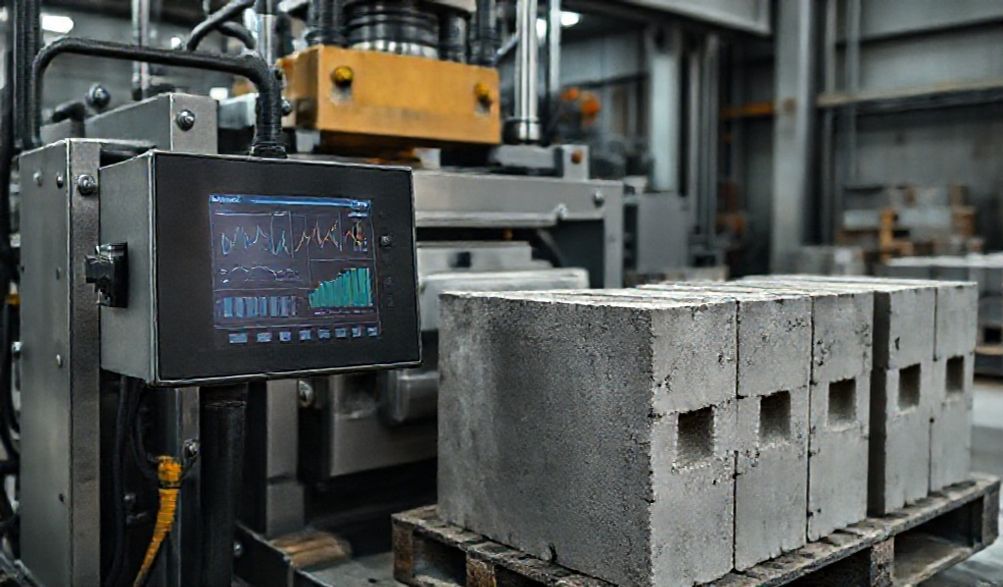
পিএলসি ব্লক মেশিনের চূড়ান্ত গাইড: আধুনিক নির্মাণের জন্য স্বয়ংক্রিয়করণ
নির্মাণ শিল্প একটি নীরব বিপ্লবের মধ্য দিয়ে যাচ্ছে। এর কেন্দ্রে রয়েছে নির্মাণ সামগ্রীতে উচ্চতর মান, অধিকতর সূক্ষ্মতা এবং অটুট সামঞ্জস্যের এক নিরন্তর চাহিদা। বৃহৎ পরিসরের অবকাঠামো হোক বা আবাসিক প্রকল্প, নিম্নমানের বা অসামঞ্জস্যপূর্ণ কংক্রিট ব্লকের প্রতি সহনশীলতা বিলুপ্ত হয়ে গেছে। তবুও, অনেক নির্মাতা এখনও পুরানো সরঞ্জামের সাথে আবদ্ধ রয়েছেন—ম্যানুয়াল বা রিলে-ভিত্তিক ব্লক তৈরির মেশিন, যা মানুষের ভুলের প্রতি সংবেদনশীল, যান্ত্রিক ক্ষয়জনিত অসামঞ্জস্যতার শিকার, এবং উচ্চ শ্রম খরচ ও অপরিকল্পিত ডাউনটাইমের মাধ্যমে উল্লেখযোগ্য কার্যক্রমগত প্রতিবন্ধকতা সৃষ্টি করে।
এই আধুনিক চ্যালেঞ্জগুলোর সমাধান শুধুমাত্র একটি শক্তিশালী যান্ত্রিক কাঠামো নয়, বরং একটি বুদ্ধিমান ডিজিটাল মস্তিষ্ক। প্রবেশ করুন প্রোগ্রামেবল লজিক কন্ট্রোলার (পিএলসি), সেই প্রযুক্তিগত ভিত্তিপ্রস্তর যা ব্লক উৎপাদনকে একটি কারুশিল্প থেকে একটি নির্ভুল, স্বয়ংক্রিয় বিজ্ঞানে রূপান্তরিত করছে। একটি পিএলসি ব্লক মেশিন নির্মাণ সামগ্রী উৎপাদনের পদ্ধতিতে একটি মৌলিক উল্লম্ফন উপস্থাপন করে, যা মজবুত যান্ত্রিক প্রকৌশলকে বুদ্ধিমান ডিজিটাল নিয়ন্ত্রণের সাথে একীভূত করে।
এই ব্যাপক নির্দেশিকা আপনার চূড়ান্ত সম্পদ হিসেবে তৈরি করা হয়েছে। আমরা কিভাবে পিএলসি ব্লক মেশিন কাজ করে তা স্পষ্ট করব, তাদের বাস্তব সুবিধাগুলো পরিমাপ করব এবং আপনার কার্যক্রমের জন্য সঠিক সিস্টেম নির্বাচন ও রক্ষণাবেক্ষণের একটি স্পষ্ট কাঠামো প্রদান করব। এখানে উপস্থাপিত অন্তর্দৃষ্টিগুলো সরাসরি শিল্প প্রকৌশল মান, নির্মাতার নির্দিষ্টকরণ এবং দশকজুড়ে সংগৃহীত কার্যকরী সর্বোত্তম অনুশীলন থেকে সংশ্লেষিত হয়েছে, যা নিশ্চিত করে যে আপনার ব্যবসাকে ভবিষ্যতের জন্য প্রস্তুত করতে আপনি নির্ভরযোগ্য, কর্তৃত্বপূর্ণ এবং কার্যকরী তথ্য পাবেন।
পিএলসি ব্লক মেশিন কী? মূল প্রযুক্তির ব্যাখ্যা
প্রথম নজরে, একটি পিএলসি ব্লক মেশিন তার ঐতিহ্যবাহী সমকক্ষগুলির মতোই দেখতে হতে পারে। পার্থক্য—এবং এর উচ্চতর কর্মক্ষমতার উৎস—নিহিত রয়েছে এর কেন্দ্রীয় স্নায়ুতন্ত্রে: প্রোগ্রামেবল লজিক কন্ট্রোলারে।
পিএলসি (প্রোগ্রামেবল লজিক কন্ট্রোলার)-এর ভূমিকা
A PLC is an industrial-grade digital computer built to withstand the harsh conditions of a manufacturing floor—dust, vibration, and temperature fluctuations. Its primary function is to monitor inputs from sensors, make decisions based on a custom logic program, and control outputs to machinery.
- Contrast with Relay Systems: Older machines used complex networks of physical electromechanical relays, timers, and sequencers. These systems were:
- Inflexible: Changing a production parameter meant physically rewiring.
- Prone to Failure: Mechanical contacts would wear out, causing downtime.
- Difficult to Troubleshoot: Diagnosing faults was a time-consuming process of checking each relay.
A PLC replaces this physical labyrinth with solid-state electronics and software, offering unparalleled reliability, reprogrammability, and diagnostic capability.
System Integration: More Than Just a Controller
The PLC is the conductor, but it requires an orchestra of components to perform. A modern PLC block machine is a fully integrated system:
- Inputs (The Senses): Sensors constantly feed data to the PLC. This includes proximity sensors detecting mold position, pressure transducers monitoring hydraulic force, and level sensors in the raw material hopper.
- The PLC (The Brain): It processes this input data against its programmed logic—the sequence of operations for making a block. It decides “what to do next” in milliseconds.
- Outputs (The Muscles): The PLC sends command signals to actuators. This includes solenoid valves directing hydraulic fluid, variable-frequency drives controlling motor speed for vibration, and servo motors for precise positioning.
Simple Data Flow: Inputs (Sensor Data) -> PLC (Logic & Commands) -> Outputs (Actuators, Motors)
The Automated Block Production Cycle
Let’s walk through a single, perfectly synchronized production cycle controlled by the PLC:
- Mix Feeding: The PLC activates a conveyor or feeder, precisely measuring the amount of raw concrete into the mold cavity. A level sensor confirms the fill.
- Mold Filling & Compression: The PLC initiates the compression head. It controls the precise pressure (in tons) and the duration/intensity of vibration to remove air pockets and ensure optimal density.
- বহিষ্কার: Once the block is formed, the PLC commands the mold to lift or the pallet to rise, ejecting the green block without damage.
- Curing Stack Placement: A robotic arm or stacker, guided by the PLC, picks up the block and places it onto a curing rack with exact alignment, maximizing space utilization.
At every stage, the PLC ensures timing, pressure, and movement are identical from cycle to cycle, block to block.
Key Advantages of Using a PLC-Based Block Making Machine
The integration of a PLC delivers transformative benefits that directly impact your bottom line and product reputation.
Unmatched Precision and Consistent Product Quality
This is the most significant advantage. Manual adjustments and decaying mechanical parts lead to variance. A PLC eliminates this.
* মাত্রিক নির্ভুলতা: Every block is identical in length, width, and height, ensuring seamless bricklaying and structural integrity.
* Uniform Density & Strength: Precise control over vibration frequency and compression force guarantees consistent compaction. This translates to reliable compressive strength, meeting or exceeding ASTM or ISO standards batch after batch.
* পৃষ্ঠের সমাপ্তি: Consistent pressure and ejection result in blocks with uniform texture and sharp edges, enhancing aesthetic appeal.
Dramatically Increased Production Efficiency & Output
Automation unlocks new levels of productivity.
* Faster Cycle Times: The PLC optimizes the sequence, eliminating pauses and synchronizing movements for the fastest possible cycle.
* ২৪/৭ কার্যক্রম The machine can run continuously with minimal supervision, enabling multi-shift production without fatigue-related slowdowns.
* কম বর্জ্য: Precise material dosing and consistent processes minimize overfilling and the production of off-spec blocks.
Enhanced Operational Safety and Reduced Labor Dependency
The PLC creates a safer work environment and changes the role of personnel.
* Safety Interlocks: The system can be programmed with safety gates, two-hand operation modes, and emergency stop overrides that immediately halt all motion.
* Reduced Manual Intervention: Workers are removed from hazardous areas involving heavy moving parts, high pressure, and repetitive strain tasks.
* Labor Re-allocation: Staff can be upskilled to roles in machine supervision, quality control, and logistics, adding more value to the operation.
Flexibility and Ease of Use
Changing production requirements becomes a software task, not a mechanical overhaul.
* Quick Changeovers: To produce a different block type (e.g., switching from hollow to paving blocks), an operator typically selects a pre-loaded recipe on the touchscreen HMI. The PLC adjusts stroke lengths, pressure, and timing automatically.
* Advanced Diagnostics: When a fault occurs, the HMI doesn’t just signal an alarm; it displays a clear message (e.g., “Hydraulic Pressure Low – Check Pump Filter”). This slashes mean-time-to-repair (MTTR).
Critical Components of a High-Performance PLC Block Machine
The PLC is the star, but its performance depends on the quality of the supporting cast. Here’s what to scrutinize.
PLC Hardware & Software Considerations
- I/O Count: Ensure the PLC has enough Input/Output modules to handle all your sensors and actuators, with 15-20% spare capacity for future upgrades.
- Processor & Memory: A faster processor handles complex logic and high-speed counting (e.g., for encoder feedback) seamlessly. Ample memory is needed for extensive recipe storage and data logging.
- Brand Reliability: Industry leaders like Siemens (S7 series), Allen-Bradley (Rockwell Automation), and Mitsubishi offer proven reliability, global support networks, and robust programming environments compliant with IEC 61131-3 standards (the international standard for PLC programming languages).
The Human-Machine Interface (HMI)
The HMI is the communication portal between the operator and the machine.
* Role: It allows for starting/stopping cycles, entering production parameters, monitoring real-time status (pressures, temperatures, counts), and viewing alarm histories.
* Quality Indicator: A modern, color touchscreen with intuitive, well-designed graphics is a sign of a thoughtful manufacturer.
Sensors and Actuators: The Eyes and Hands of the System
- Critical Sensors:
- প্রক্সিমিটি সেন্সর: Detect the position of molds, pallets, and pushers.
- Pressure Transducers: Monitor hydraulic system pressure for consistent compaction force.
- Level Sensors: Ensure consistent raw material feed in the hopper.
- Actuators:
- Servo Motors & Drives: Provide precise control over vibration table frequency and amplitude.
- Proportional Hydraulic Valves: Enable fine, software-controlled adjustment of oil flow and pressure for smooth, accurate movements.
Mechanical Frame and Hydraulic System
The most advanced PLC cannot compensate for poor mechanical design. This is non-negotiable.
* ফ্রেম Must be constructed from high-grade steel with superior welding to withstand constant, high-cycle stress without deflection.
* হাইড্রলিক্স: A robust, efficient hydraulic system with quality pumps, valves, and accumulators is essential. The PLC controls it, but this system provides the raw power. Look for systems with good filtration and cooling.
How to Choose the Right PLC Block Machine for Your Business
Selecting a machine is a strategic decision. Follow this structured approach.
Assessing Your Production Requirements
Begin with a clear internal analysis:
* Output Needed: Calculate blocks per hour and per 8-hour shift. Factor in your current demand and projected 3-5 year growth.
* Block Portfolio: List all block types you produce or plan to produce (solid, hollow, interlocking paving, etc.). Note the required dimensions and strengths.
* কাঁচামাল: Understand the characteristics of your local aggregates, as this can influence machine pressure and vibration requirements.
Key Specifications to Compare
Create a comparison matrix for shortlisted models. Essential specs include:
| Specification | What It Means | Why It Matters |
| :— | :— | :— |
| Pressure Force (Ton) | Maximum compression force. | Determines block density and strength capability. |
| Cycle Time (Seconds) | Time to produce one block. | Directly impacts maximum hourly output. |
| Mold Station Capacity | Number of blocks per cycle. | A multi-station mold dramatically increases output. |
| PLC/HMI Brand | Manufacturer of the control system. | Indicates support availability and ecosystem. |
| Main Motor Power (kW/HP) | Power of the drive motor. | Relates to energy consumption and system capability. |
| স্বয়ংক্রিয়তার মাত্রা | Semi-auto, fully-auto with robot stacker. | Impacts labor requirements and final output speed. |
The Importance of After-Sales Support and Training
The machine’s quality is only half the equation. The supplier’s support is the other.
* টেকনিক্যাল সাপোর্ট Is 24/7 phone support available? What is the average response time for a field service engineer?
* স্পেয়ার পার্টস: Is there a local parts depot? Are critical components (PLC modules, specialized sensors) kept in stock?
* প্রশিক্ষণ: Does the purchase include comprehensive, hands-on training for both operators (HMI use, daily checks) and maintenance technicians (basic troubleshooting, preventative maintenance)? This is critical for long-term success.
Budgeting: Initial Investment vs. Total Cost of Ownership (TCO)
While the upfront cost of a PLC machine is higher, true cost analysis looks at the TCO over 5-10 years.
* প্রাথমিক বিনিয়োগ Machine price, shipping, installation.
* TCO Savings: Factor in reduced labor costs, lower energy consumption (efficient cycles), minimized waste (material savings), and less unplanned downtime. A reliable PLC machine often pays for its premium through these operational savings within a few years.
Maintenance and Troubleshooting Best Practices
Proactive care ensures longevity and maximizes uptime.
Preventative Maintenance Schedule
Stick to a disciplined schedule. Here’s a sample framework:
* দৈনিক Clean optical and proximity sensors of dust. Check hydraulic oil levels and for visible leaks. Listen for unusual noises.
* সাপ্তাহিক Inspect mold liners and wear parts. Check and tighten electrical connections. Verify safety interlock function.
* Monthly: Perform a full hydraulic system check (filters, fluid condition). Back up the PLC program to a secure USB drive. Check and calibrate pressure sensors if needed. Tighten all major mechanical bolts.
Common PLC-Related Issues and Diagnostics
Most issues are peripheral, not the PLC core itself.
* “Sensor Fault” Alarm: Often due to misalignment, dirt, or a failed sensor. The HMI will usually indicate which sensor (e.g., “Mold Home Sensor”). Visually inspect and clean it.
* “Output Device Fault” Alarm: An actuator (e.g., a solenoid valve) isn’t responding. Check the wiring connection and the device itself.
* Checking I/O Status: All PLCs have a diagnostic mode where you can see, in real-time, which inputs are active (ON/OFF) and which outputs are being commanded. This is the first step in tracing any logic fault.
Critical Safety Disclaimer: While basic diagnostics are operator-level, always de-energize and lock out/tag out (LOTO) the machine before performing any physical inspection or repair. For complex electrical issues, program modifications, or hydraulic system repairs, consult a qualified technician.
Ensuring Long-Term System Health
- Environment: Keep the control cabinet clean, cool, and dry. Dust and heat are the primary enemies of electronics.
- ক্ষমতা: Use a stable power supply. Consider a line conditioner or uninterruptible power supply (UPS) for the control system to protect against surges and brownouts.
- Software: Keep firmware for the PLC and HMI updated as recommended by the manufacturer to benefit from performance and security improvements.
Frequently Asked Questions (FAQ) About PLC Block Machines
Q1: Is a PLC block machine difficult to operate for someone with no programming experience?
A: Not at all. Modern machines are designed for simplicity. Operators interact with intuitive, menu-driven touchscreen HMIs to select recipes, start cycles, and monitor production. The actual ladder logic programming is done by the machine builder or a systems integrator during commissioning.
Q2: How much does a PLC block machine cost compared to a traditional one?
A: Expect a 20-40% higher initial capital investment. However, this must be evaluated against the Return on Investment (ROI). The savings from higher output, typically 1-2 fewer operators per shift, and drastically reduced waste and downtime mean the PLC machine often has a lower মোট মালিকানার খরচ (টিসিও) and a faster payback period.
Q3: Can I retrofit a PLC system onto my existing manual block machine?
A: Retrofitting is technically feasible but often economically and practically challenging. It requires extensive mechanical compatibility analysis, sensor mounting, and actuator replacement. The integration is rarely as seamless or reliable as a machine designed from the ground up as a PLC-based system. A new machine is generally the recommended path.
Q4: What kind of maintenance does the PLC itself require?
A: The PLC hardware is highly reliable with no moving parts. Primary maintenance is preventative: ensuring it is kept clean, dust-free, and in a climate-controlled cabinet. The only periodic part replacement is the PLC memory backup battery (every 3-5 years) to prevent program loss during a power failure.
Q5: Are PLC block machines suitable for small-scale businesses?
A: Absolutely. The market offers scalable solutions. A small business might start with a semi-automatic PLC model where feeding is manual but compression and ejection are automated. This provides a significant quality and consistency boost at a lower entry point, with a clear upgrade path to full automation as the business grows.
উপসংহার
The PLC block machine is more than an equipment upgrade; it is a strategic pivot towards the future of construction material manufacturing. It represents a commitment to smart, efficient, and quality-driven production that builds a formidable competitive advantage. By delivering unmatched consistency, boosting output, enhancing safety, and providing operational flexibility, it transforms a cost center into a value-generating asset.
Investing in a PLC system is an investment in control—control over your product quality, your production schedule, and your operational costs. As you move forward, we strongly encourage you to consult directly with reputable, established manufacturers. Request live demonstrations using materials similar to yours, scrutinize their after-sales support contracts, and review detailed technical specifications. Choose a partner whose expertise, experience, and authoritativeness in the field are beyond question.
Looking ahead, the PLC is the foundational platform for the next industrial leap: Industry 4.0. With IoT connectivity, these machines will enable remote monitoring, predictive maintenance alerts, and production data analytics, further optimizing your plant’s performance. The journey to smarter manufacturing starts with the decision to automate, and it is led by the programmable logic controller.
<