
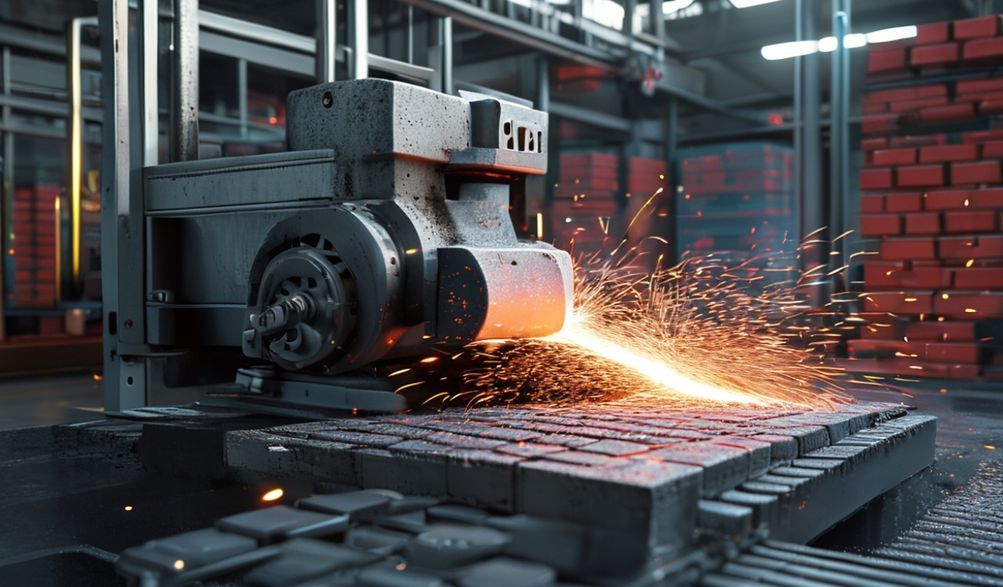
কংক্রিট ইন্টারলকিং ব্লক তৈরির মেশিন কারখানা নির্বাচনের জন্য আপনার চূড়ান্ত গাইড
ভূমিকা
বিশ্বব্যাপী নির্মাণ পরিস্থিতি পরিবর্তনশীল। নগর অবকাঠামো প্রকল্প থেকে শুরু করে টেকসই আবাসন উদ্যোগ পর্যন্ত, স্থায়ী, সাশ্রয়ী এবং পরিবেশ-সচেতন নির্মাণ সামগ্রীর চাহিদা আজ সর্বকালের সর্বোচ্চ পর্যায়ে রয়েছে। এই পরিবর্তনের অগ্রভাগে রয়েছে আন্তঃলকিং কংক্রিট ব্লক—বহুমুখী, মজবুত এবং পাকা রাস্তা, ধারক দেয়াল, এমনকি দুর্যোগ-প্রতিরোধী কাঠামোর জন্য আদর্শ। কিন্তু প্রতিটি সফল ব্লক উৎপাদন কারখানার পেছনে রয়েছে একটি একক, অত্যন্ত গুরুত্বপূর্ণ সিদ্ধান্ত: আপনার কংক্রিট আন্তঃলকিং ব্লক তৈরির মেশিনের কারখানার পছন্দ।
এই সিদ্ধান্তটিই যেখানে অনেক ব্যবসা এবং উদ্যোক্তা হোঁচট খায়। বাজারে বিশ্বের সবচেয়ে কম দামে সবকিছু দেওয়ার প্রতিশ্রুতি দিচ্ছে এমন সরবরাহকারীদের ভিড়। বাস্তবতা হলো? ভুল কারখানা নির্বাচন করতে পারে বিপর্যয়কর ডাউনটাইম, অসামঞ্জস্যপূর্ণ ব্লকের মান, অত্যধিক মেরামত খরচ এবং শেষ পর্যন্ত, একটি ব্যর্থ বিনিয়োগের দিকে। মেশিনটি আপনার কার্যক্রমের হৃদয়; এর উৎস অবশ্যই ত্রুটিহীন হতে হবে।
তিন দশকেরও বেশি সময় ধরে নির্মাণ যন্ত্রপাতি উৎপাদন ও প্রকৌশল ক্ষেত্রে অভিজ্ঞতার আলোকে, আমি সঠিক তথ্যের ভিত্তিতে কেনার সাফল্য এবং তাড়াহুড়ো সিদ্ধান্তের বেদনাদায়ক শিক্ষা প্রত্যক্ষ করেছি। এই নির্দেশিকা সেই হাতে-কলমে অর্জিত দক্ষতার উপর ভিত্তি করে তৈরি। এটি আপনাকে কোন নির্দিষ্ট ব্র্যান্ড বিক্রি করার জন্য নয়, বরং একজন অভিজ্ঞ পেশাদারের মতো যেকোনো কারখানা মূল্যায়নের গুরুত্বপূর্ণ জ্ঞান দিয়ে সজ্জিত করার জন্য তৈরি।
আপনি যদি ক্রমবর্ধমান কার্যক্রম পরিচালনা করা একটি নির্মাণ কোম্পানি, একটি ব্লক ইয়ার্ড চালু করা একজন উদ্যোক্তা, অথবা একটি ক্রয় প্রক্রিয়া তত্ত্বাবধান করা একজন সরকারি কর্মকর্তা হন, এটি আপনার রোডম্যাপ। আমরা বিশ্লেষণ করব কিভাবে একটি বিশ্বস্ত কারখানা চিহ্নিত করতে হয়, অপরিহার্য মেশিনের বৈশিষ্ট্যগুলো বুঝতে হয়, ক্রয় প্রক্রিয়া পরিচালনা করতে হয় এবং এমন একটি অংশীদারিত্ব গড়ে তুলতে হয় যা বছরের পর বছর আপনার লাভজনকতা নিশ্চিত করে।
Why Your Choice of Factory is the Most Critical Decision
Purchasing an interlocking block machine isn’t a simple transaction; it’s forming a strategic alliance. The factory you choose becomes an extension of your business, directly influencing your daily operations and long-term viability. Let’s break down why this choice carries such immense weight.
The Direct Impact on Your Business Profitability
Your machine’s performance translates directly to your bottom line.
* Reliability = Uptime: A machine that breaks down frequently halts all production. Lost production days mean missed orders, contract penalties, and idle labor costs.
* Block Quality Consistency: A poorly calibrated or weakly constructed machine produces blocks with dimensional inaccuracies or low compressive strength. This leads to rejected batches, wasted raw materials, and damage to your reputation.
* Production Speed & Efficiency: The designed output (blocks per hour) must be achievable in real-world conditions. An over-specified machine you can’t maintain or an under-powered one that can’t meet demand both strangle your growth and ROI.
Beyond the Machine: The Value of Technical Support & Training
The best machine is only as good as the support behind it. A factory that disappears after payment is a liability.
* Proper Installation & Commissioning: Incorrect setup can cause immediate damage and chronic performance issues. Expert guidance is non-negotiable.
* বিস্তৃত অপারেটর প্রশিক্ষণ: Well-trained operators maximize output, minimize waste, and perform essential preventative maintenance, extending the machine’s life.
* Accessible Maintenance Guidance: When a hydraulic hose bursts or a sensor fails, you need clear manuals, troubleshooting guides, and responsive technical advice to get back online fast.
Navigating the Global Market: Challenges and Opportunities
Factories are spread worldwide—from industrial hubs in China, India, and Turkey to specialized manufacturers in Europe and North America. This variety presents both opportunity and risk.
* The Price Spectrum: Prices can vary wildly. Understanding what justifies a higher price (superior components, engineering, service) is key.
* Quality Disparity: Two machines may look identical in a photo, but the quality of steel, welding, and internal components can be worlds apart.
* Cultural & Communication Barriers: Clear, consistent, and transparent communication is essential for specifying needs, resolving issues, and ensuring smooth logistics.
Key Indicators of a Trustworthy and Expert Factory
Separating market leaders from mere assemblers requires a disciplined evaluation. Use these concrete indicators to assess any potential supplier.
Manufacturing Experience and Proven Track Record
Longevity and a proven portfolio are your first filters.
* ব্যবসায় বর্ষসমূহ: Look for a minimum of 10-15 years of dedicated machinery manufacturing. This indicates resilience and accumulated knowledge.
* গ্রাহক পোর্টফোলিও ও কেস স্টাডিজ: A reputable factory will proudly share examples of successful installations, often with photos, videos, and testimonials. Look for projects in environments similar to yours.
* Industry Presence: Do they participate in major international construction or machinery trade fairs? This shows investment in their brand and industry engagement.
In-House Engineering and R&D Capability
This is what separates a true manufacturer from a parts assembler.
* কাস্টমাইজেশন ক্ষমতা: Can they modify a standard design to fit your unique raw materials, block design, or space constraints? This flexibility is invaluable.
* Problem-Solving Partnership: When you encounter a production challenge, an in-house engineering team can diagnose and offer solutions, not just sell you a spare part.
* অবিরাম উন্নয়ন: Factories invested in R&D release updated models with better efficiency, user interfaces, and energy savings, protecting your investment from rapid obsolescence.
Quality Control Processes from Raw Material to Shipment
Quality isn’t an accident; it’s a documented process. Ask for theirs.
* উপাদান সংগ্রহ: What grade of steel is used for the frame and mold? ISO-certified suppliers for major components (hydraulics, PLCs) are a positive sign.
* Production Standards: Inquire about welding procedures (e.g., submerged arc welding for critical joints), stress-relieving treatments, and anti-corrosion painting processes (like sandblasting and epoxy coating).
* পূর্ব-প্রেরণ পরীক্ষণ: A rigorous factory will run a FAT (Factory Acceptance Test) with you (or via video), producing sample blocks with your specified mix to prove machine functionality before it leaves their floor.
Transparency and Communication
Trust is built on clarity. Gauge this from your very first interaction.
* নথিপত্র: They should readily provide detailed technical specifications, foundation drawings, electrical schematics, and parts manuals.
* Responsiveness: Consistent, clear, and timely replies to technical questions are a strong indicator of future support quality.
* Open-Door Policy: Will they arrange a live video tour of their workshop? Can they provide a third-party factory audit report? Transparency dispels doubt.
Essential Machine Specifications to Discuss with Any Factory
Armed with an understanding of factory credibility, you must now drill into the machine itself. These are the technical parameters that will define your production reality.
Core Production Specifications: Capacity, Pressure, and Automation
- উৎপাদন আউটপুট: Never rely on theoretical maximums. Discuss sustainable 8-hour or 24-hour output for the specific block type you need (e.g., 10,000 pavers/day). Factor in mold change and maintenance time.
- Hydraulic System Pressure: Measured in tons (e.g., 150-ton, 300-ton). Higher pressure generally means higher block density and strength. Ensure it’s matched to your target block quality and size.
- স্বয়ংক্রিয়তার স্তর:
- ম্যানুয়াল: Labor-intensive, low output, suitable for very small-scale startups.
- সেমি-অটোমেটিক: Operator loads mix, machine cycles automatically. Best balance of cost and output for many businesses.
- Fully Automatic (with PLC): Automated material feeding, mixing, molding, and stacking. Requires higher investment but offers maximum output, consistency, and labor savings.
Block Mold Versatility and Customization
Your ability to adapt to market demands hinges on your molds.
* Standard Mold Library: A good factory offers dozens of proven designs: grass pavers, hollow blocks, retaining wall systems, and interlocking bricks.
* Custom Mold Service: They should have CAD/CAM capability to design and manufacture molds based on your unique drawing or sample. Ask for their design lead time and cost structure.
* Mold Changing Mechanism: How long does it take to change molds? Quick-change systems (within 30 minutes) significantly increase operational flexibility and profitability.
Machine Durability and Ease of Maintenance
This is where build quality becomes operational reality.
* Key Component Brands: While reputable factories may use high-quality local components, recognized international brands (e.g., Siemens or Mitsubishi PLCs, Schneider electrics, Rexroth or Yuken hydraulics) often signal a commitment to reliability and easier global parts sourcing.
* ফ্রেম নির্মাণ: The frame should be made from heavy-duty, reinforced steel plates, not lightweight sections. Welds should be clean, even, and certified.
* Service Accessibility: Panels should open easily, and key components like hydraulic valves and sensors should be reachable without major disassembly. This reduces maintenance time and costs.
The Step-by-Step Process of Working with a Factory
A smooth procurement process is a precursor to a successful partnership. Here’s the ideal journey from inquiry to production.
1. Initial Inquiry and Needs Assessment
Provide a clear brief: desired block types and dimensions, target daily output, available factory space/power, and budget range. The more detailed you are, the more accurate the proposal.
2. Quotation Analysis: Reading Between the Lines
Don’t just look at the bottom line. Scrutinize:
* Itemization: Is the quote detailed (machine, molds, spare parts, training cost)?
* Warranty Terms: Exactly what is covered and for how long?
* Delivery Time: From deposit to shipment.
* INCOTERMS: Understand responsibilities (FOB, CIF, etc.). এফওবি (ফ্রি অন বোর্ড) is common, where you own the goods and assume risk/cost once loaded on the ship.
3. Factory Visit and Machine Inspection (Virtual or On-Site)
If possible, visit. If not, insist on a live video inspection.
* Checklist: Observe workshop organization, quality of work-in-progress machines, and testing areas. Request to see the FAT for a machine similar to yours.
4. Negotiation, Contract, and Payment Terms
- Contract: Ensure it includes all agreed specifications, warranty, delivery timeline, and payment schedule.
- Payment: A standard, protective schedule is 30% deposit, 40% upon pre-shipment inspection, 30% before shipment. Never pay 100% upfront.
5. Shipping, Installation, and Commissioning
The factory should assist with shipping arrangements. Upon arrival, they should provide (or send a technician for) installation supervision, calibration, and on-site training to produce your first commercial-quality blocks.
Common Pitfalls to Avoid When Sourcing Your Machine
Learning from others’ mistakes is the cheapest form of due diligence.
Choosing Based on Price Alone
The cheapest machine has the highest lifetime cost. Savings on the purchase price will be consumed many times over by repair costs, low output, and poor block quality that loses clients.
Overlooking Local Agent or After-Sales Service Network
Is there a service contact in your region or timezone? How quickly can you get critical spare parts? A factory with no local support network leaves you stranded.
Ignoring Electrical and Power Requirements
A 380V/50Hz machine is useless in a 440V/60Hz region without a transformer. Confirm voltage, phase, and total power consumption (KVA) to prepare your site.
Underestimating Foundation and Site Preparation Needs
These machines are heavy and require a perfectly level, reinforced concrete foundation. The factory অবশ্যই provide detailed foundation drawings. Ignoring this causes vibration, misalignment, and premature failure.
সচরাচর জিজ্ঞাসিত প্রশ্নাবলী (এফএকিউ)
Q1: What is the average lead time from order to delivery for a standard machine?
এ This varies significantly. For a standard semi-automatic machine, expect 30-45 days after deposit confirmation. For a fully automatic production line with customization, lead times can extend to 60-90 days. Always get the confirmed timeline in your sales contract.
Q2: What is a standard warranty period, and what does it typically cover?
এ A reputable factory typically offers 12-18 months for the main frame and critical structures, and 6-12 months for electrical and hydraulic components. Crucially, the warranty covers manufacturing and material defects, not wear parts or damage from improper operation, maintenance, or force majeure. Clarify exclusions explicitly.
Q3: Can the factory help with raw material mix design for the blocks?
এ An expert factory should. They will provide a basic, proven mix design (ratios of cement, sand, aggregates, and water) as a starting point. This should be adaptable based on the quality and properties of your locally available materials.
Q4: How do I ensure I get genuine spare parts in the future?
এ Choose a factory that maintains a comprehensive spare parts inventory. Ensure they provide a detailed parts manual with codes and diagrams. Establish a direct channel for ordering parts and confirm their policy on parts availability for older machine models.
Q5: What training is typically provided for our operators?
এ Standard packages include 3-5 days of on-site training after installation. This should cover safe operation, daily maintenance routines, basic troubleshooting for common alarms, and mold changing procedures. Verify that this training is explicitly included in your quotation and contract.
উপসংহার
Selecting the right concrete interlocking block making machine factory is a strategic investment that will echo through the life of your business. It is a decision that hinges not on a glossy brochure or the lowest price, but on demonstrable expertise, unwavering commitment to quality, and a genuine partnership ethos.
As an industry veteran, my final recommendation is this: be thorough, be skeptical, and be demanding. Use the criteria in this guide as your due diligence checklist. Ask the hard questions about engineering, quality control, and long-term support. Prioritize factories that welcome your scrutiny and demonstrate a transparent commitment to your success.
Let this guide empower you to move forward with confidence. Before you sign any contract, review your shortlisted factories one last time against the key indicators we’ve outlined. Your future productivity, profitability, and peace of mind depend on the foundation you lay today with this critical choice.
<