
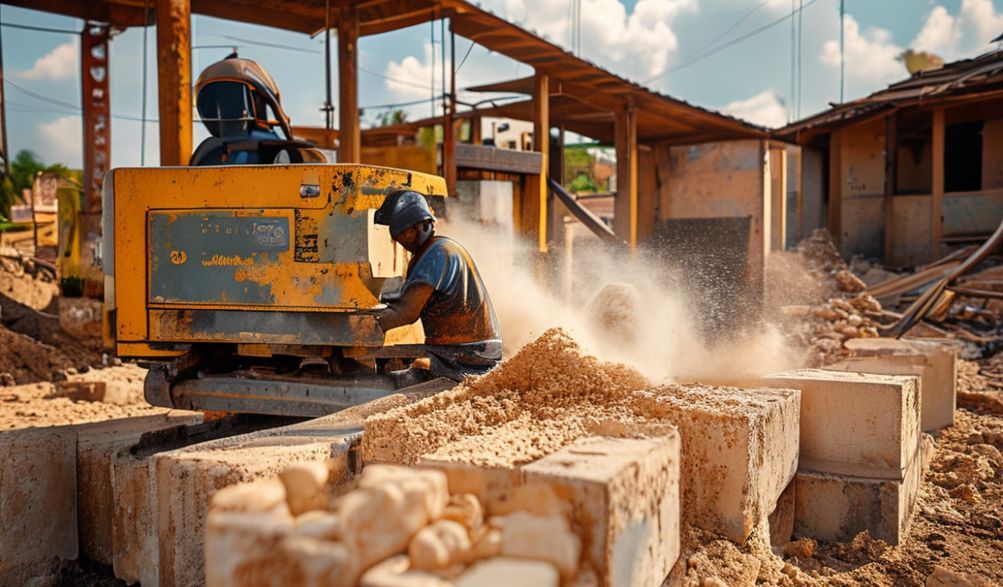
Your Ultimate Guide to Finding the Best Block Moulding Machine for Sale in Ghana (2026 Buyer’s Guide)
Introducción
Ghana’s construction sector is not just growing; it’s booming. With an annual growth rate consistently outpacing the broader economy and a national deficit of over 2 million housing units, the demand for building materials has never been higher. At the heart of this activity is the humble concrete block—the fundamental building block of the nation’s infrastructure. For savvy entrepreneurs and construction firms, this presents a monumental opportunity.
Having supplied and advised on construction machinery for projects from the bustling sites of Accra to the expanding suburbs of Kumasi for over a decade, we’ve witnessed firsthand the transformative power of the right equipment. We’ve also seen the pitfalls. The market for a block moulding machine for sale in Ghana is vibrant but can be a maze of confusing specifications, wildly varying prices, and, unfortunately, unreliable suppliers.
The core challenge for any buyer is clear: How do you cut through the noise to find a machine that is durable, efficient, and offers genuine value for money, all while ensuring you have the critical after-sales support to keep your business running?
This guide is designed to be your definitive resource. We’re not here to sell you a specific brand; we’re here to empower you with the industry knowledge, local insights, and practical checklist you need to make an informed, confident, and profitable investment. Consider this your step-by-step framework for navigating the purchase of a block moulding machine in Ghana.
Understanding Block Moulding Machines: Types and How They Work
Before diving into prices and suppliers, it’s crucial to understand what you’re buying. The right type of machine for your neighbor’s large-scale estate project might be a terrible fit for your startup venture. Let’s break down the main categories.
Máquinas Manuales para Moldear Bloques
These are the foundational entry point into block production.
* Descripción: Operated entirely by human labor. You manually fill the mould with concrete mix, compact it (often with a lever), and then demould the block by lifting the machine.
* Caso de Uso Ideal: Perfect for very small-scale projects, individual home builds, or as a low-risk test for a business idea. They are commonly used by artisans and micro-enterprises.
* Pros:
* Extremely low initial investment cost.
* Minimal maintenance with no complex parts.
* Zero dependency on electricity or fuel.
* Contras:
* Highly labor-intensive and physically demanding.
* Very low output (typically 200-500 blocks per day).
* Inconsistent block quality and finish.
* Not scalable for commercial ventures.
Máquinas Semiautomáticas para Moldear Bloques
This category represents the “sweet spot” for the majority of growing block manufacturing businesses in Ghana.
* Descripción: These machines use a mechanical or hydraulic system to provide vibration for compaction and often a hydraulic press for demoulding. The operator still feeds the mix and may control the cycle, but the core strength and consistency come from the machine.
* Caso de Uso Ideal: Small to medium-sized block factories, contractors supplying multiple projects, and entrepreneurs seeking a balance between cost and professional output.
* Pros:
* Excellent balance of affordability and productivity.
* Significantly higher and more consistent output than manual machines (1,000 – 3,000+ blocks per 8-hour shift).
* Produces dense, high-quality blocks suitable for commercial sale.
* Can be configured for different block types (hollow, solid, interlocking).
* Contras:
* Requires a power source (electric or diesel).
* Higher upfront cost than manual machines.
* Needs basic maintenance and occasional spare parts.
Máquinas de Moldeo de Bloques Completamente Automáticas
These are the powerhouses of block production, designed for maximum output with minimal manual intervention.
* Descripción: Fully automated systems with conveyor belts, automatic mix feeding, programmed vibration cycles, and block palletizing. Often controlled via a PLC (Programmable Logic Controller) panel.
* Caso de Uso Ideal: Large-scale commercial block yards supplying major construction firms, government projects, or for export. They represent a serious industrial investment.
* Pros:
* Extremely high output (5,000 – 20,000+ blocks per day).
* Unmatched consistency and precision in every block.
* Drastically reduced labor requirements per block produced.
* Contras:
* Very high capital investment.
* Complex installation and operation requiring skilled technicians.
* High power consumption and sophisticated maintenance needs.
* Absolute dependency on reliable after-sales support.
Key Components and Operation Process
Regardless of type, most machines share core components:
1. Hopper: The chamber where the raw concrete mix (cement, sand, aggregate) is loaded.
2. Mould/Cavity: The shaped container that defines the block’s size and form (e.g., 6-inch hollow block).
3. Vibrator: A motor that creates high-frequency vibrations to compact the mix in the mould, removing air pockets and creating a dense, strong block.
4. Hydraulic System (in semi & auto): Uses pressurized fluid to power the press for compaction and the ram for ejecting the finished block.
5. Panel de Control: Manages the machine’s operations, especially in semi- and fully-automatic models.
The basic process is: Fill → Compact/Vibrate → Demould/Eject → Cure.
Key Factors to Consider Before You Buy in Ghana
Your local context in Ghana is the most important filter for your decision. What works in theory must work in practice under Ghanaian conditions.
Production Capacity and Output Requirements
Don’t guess—calculate. Overestimating leads to wasted capital; underestimating leaves money on the table.
* Assess Your Market: Are you supplying your own housing project? Selling to local builders? Tender for a school construction?
* Do the Math: A typical 3-bedroom house may require 4,500+ blocks. How many such projects can you secure per month? Your machine’s daily output must meet this peak demand.
* Planificación de Crecimiento: Buy for your needs in the next 2-3 years. A slightly larger semi-automatic machine is smarter than outgrowing a tiny one in 6 months.
Block Type and Size Versatility
The Ghanaian market uses more than just standard blocks. Versatility opens more revenue streams.
* Bloques Huecos Estándar: The market staple for walls.
* Bloques Sólidos: For pillars, foundations, and heavy-duty applications.
* Interlocking Paving Stones: High-demand for driveways, walkways, and commercial landscapes.
* Kerbs and Decorative Stones: For road and aesthetic projects.
* Pregunta Clave: Can the machine you’re considering easily switch moulds to produce these different types? Mould changeover time and cost are critical.
Power Source: Electric, Diesel, or Hybrid?
This is perhaps the most critical consideration for operational resilience in Ghana.
* Electric Machines: Cleaner, quieter, and often cheaper to run when power is stable. However, “dumsor” (power fluctuations/outages) can bring your production to a halt.
* Diesel Machines: Offer complete independence from the grid. Essential for locations with poor electricity or for ensuring uninterrupted production. Factor in the cost and availability of diesel.
* Hybrid Machines: The best of both worlds. These can run on either grid electricity or an integrated diesel generator. While the initial cost is higher, the operational flexibility and insurance against power cuts are invaluable for serious businesses.
Machine Durability and After-Sales Support
A machine is a long-term partner, not a disposable item.
* Durabilidad: The machine must be built to handle Ghana’s climate, dust, and the abrasive nature of concrete mix. Look for robust steel frames, high-quality vibrator motors, and protected hydraulic lines.
* After-Sales Support (Non-Negotiable): This is your safety net. Before paying a cedi, verify:
* Refacciones: Are common wear parts (moulds, vibrator motors, hydraulic seals) available in stock in Ghana? Waiting 8 weeks for a part from China kills your business.
* Technical Service: Does the supplier have trained technicians who can travel to your site for repairs, maintenance, or installation?
* Garantía: What is covered, for how long, and what are the response time guarantees?
Where to Find Reliable Block Moulding Machines for Sale in Ghana
Knowing where to look is half the battle. Each source has its own advantages and risks.
Established Local Equipment Dealers and Showrooms
This is often the most secure route for first-time buyers.
* Where: Visit showrooms and offices in industrial areas of Accra (e.g., Industrial Area, Tema), Kumasi (Suame Magazine), and Takoradi.
* Verification Checklist:
* Business Registration: Ask for their certificate to incorporate and GRA tax documents.
* Physical Address: A permanent, reputable location is a strong positive sign.
* Historial de Resultados: How many years have they been operating? Can they show you a portfolio of installed machines?
* Referencias de Clientes: A confident dealer will connect you with past customers for a testimonial.
Direct Importation: Pros, Cons, and Crucial Steps
Importing yourself can seem cheaper but is fraught with complexity.
* Pros: Potentially lower FOB (Free on Board) price from the manufacturer.
* Contras:
* Costos Ocultos: Shipping, insurance, port charges, customs clearance fees, and VAT can add 40-60% to the initial price.
* Logistical Nightmare: Navigating GCNet, customs classification, and clearing agents requires expertise.
* Zero Local Support: You are the importer, technician, and spare parts manager. Any problem is yours alone to solve.
* If You Must Import: Hire a reputable clearing agent, get a comprehensive CIF (Cost, Insurance, Freight) quote, and ensure the manufacturer at least provides detailed manuals and online support.
Online Marketplaces and Verified Suppliers
Platforms like Tonaton, Jiji, and Facebook Marketplace are popular but require extreme caution.
* Use Them for Research: To gauge price ranges and see what’s advertised.
* Red Flags to Avoid:
* Prices that seem too good to be true (they almost always are).
* Sellers who refuse to meet at a physical business location or show the machine working.
* Pressure to make a quick deposit via mobile money.
* Stock photos only, with no actual photos of the machine in Ghana.
* Best Practice: Use online listings to identify sellers, but then insist on all the verification steps outlined for local dealers.
Navigating Costs and Getting Value for Money
Thinking only about the purchase price is the fastest way to erode your profits. Consider the Costo Total de Propiedad.
Price Range Breakdown for Different Machine Types
Prices are estimated ranges in Ghana Cedis (GHS) as of 2026 and vary massively based on brand, capacity, and features.
* Máquinas Manuales para Moldear Bloques: GHS 1,500 – GHS 5,000
* Máquinas Semiautomáticas para Moldear Bloques: GHS 15,000 – GHS 80,000
* Máquinas Automáticas Completas para Moldear Bloques: GHS 100,000 – GHS 500,000+
Beyond the Sticker Price: Hidden Costs to Budget For
Failing to budget for these can stall your project before you make a single block.
* Transportation: Cost to deliver the machine from the seller to your site.
* Site Preparation: A level, solid concrete foundation is mandatory for semi- and fully-auto machines.
* Instalación y Puesta en Marcha: Professional setup by the supplier’s technician.
* Initial Raw Material Stock: Your first batches of cement, sand, and aggregate.
* Capacitación de Operadores: Factor this in if not included.
* Import Duties & VAT: If importing, as discussed.
Financing and Investment Return (ROI) Considerations
- Financing: Some major dealers offer installment payment plans. Also, explore SME loans from banks like ADB, GCB, or NIB.
- Simple ROI Framework:
- Daily Revenue: (Number of Blocks Produced per Day) x (Selling Price per Block, e.g., GHS 4-6).
- Daily Cost: (Cost of Cement, Sand, Aggregate) + (Labor) + (Fuel/Electricity) + (Machine Depreciation/Maintenance).
- Daily Profit: Daily Revenue – Daily Cost.
Use this to estimate how long it will take to recoup your initial investment. A well-run semi-automatic machine can often see ROI within 12-18 months.
Ensuring a Safe and Smart Purchase
This is your final pre-purchase checklist to avoid costly mistakes.
Essential Pre-Purchase Checks and Inspections
Never buy a machine unseen. Insist on a test run with concrete mix.
* Physical Inspection: Check welding points for quality, look for rust or patches, inspect hydraulic hoses for cracks.
* Operational Test: Run the machine. Is the vibration strong and even? Does the hydraulic system move smoothly without jerking or leaks? Is the block ejection clean?
* Safety: Are moving parts guarded? Are electrical connections properly insulated?
Must-Have Documentation and Warranty Terms
Protect your investment with paper.
* Official Invoice: Clearly stating the machine model, serial number, price, and seller details.
* Warranty Card/Contract: Specifying exactly what parts and labor are covered, the warranty period (e.g., 12 months), and the process for making a claim.
* User Manual: In English, with parts diagrams and troubleshooting guides.
Questions You Must Ask the Seller
Write these down and get clear answers.
1. “What is included in the delivery price? (Installation? Training? First set of moulds?)”
2. “Where is your nearest service center, and what is your guaranteed response time for a breakdown?”
3. “Can you provide contact information for 2-3 customers in my region who have bought this same model?”
4. “What are the most common spare parts I should keep in stock, and what is their cost and availability?”
FAQ Section
Q1: What is the average price of a good quality block moulding machine in Ghana?
A: “Good quality” depends on your scale. For a serious small business, a reliable semi-automatic machine typically starts around GHS 25,000. Manual machines can be found for under GHS 5,000, while large fully automatic lines run into hundreds of thousands of Cedis. Focus on the total value, not just the ticket price.
Q2: Which brand of block moulding machine is most reliable for Ghanaian conditions?
A: Rather than a specific brand, prioritize brands that have a proven and active service network in Ghana. A “global top brand” with no local technicians is often a worse choice than a robust brand with dedicated local support, available parts, and technicians who understand local conditions.
Q3: Can I get training on how to operate and maintain the machine?
A: Any reputable seller must provide basic operational and safety training. This is a standard part of the service package for semi- and fully-automatic machines. Confirm this is included in your purchase agreement.
Q4: What is the typical lead time from order to delivery within Ghana?
A: For machines in a dealer’s local stock, delivery can be within 1-2 weeks. For machines needing to be imported to order, lead times can range from 4 to 12 weeks, depending on shipping and customs. Always get a written delivery estimate.
Q5: How do I calculate the daily profit potential from a block moulding machine?
A: Use this simplified template:
Daily Profit = (Blocks Produced per Day x Selling Price per Block) - (Cost of Materials + Labor + Fuel/Power + Maintenance Reserve). For example: (1,500 blocks x GHS 5) – (GHS 3,000 materials + GHS 200 labor + GHS 150 power + GHS 100 maintenance) = GHS 7,500 – GHS 3,450 = GHS 4,050 daily gross profit.
Conclusión
Choosing the right block moulding machine for sale in Ghana is a significant decision that hinges on understanding your own production needs, respecting the realities of the local operating environment, and prioritizing long-term partnership over a short-term price tag. Remember the key pillars: select the appropriate machine type (manual, semi-, or fully-auto), insist on demonstrable after-sales support, and budget for the total cost of ownership.
Your goal is not just to buy a machine, but to invest in a reliable asset that will produce quality blocks and generate profit for years to come. Let this guide serve as your checklist and confidence-builder as you evaluate suppliers and options.
We hope this resource empowers you to move forward with clarity. If you have further questions as you navigate your purchase, seeking impartial, experience-based advice is always a smart next step.
<