
I. Comprensión de la Tecnología: Principios y Mecanismos
A. El Concepto Central de los Ladrillos de Encaje
Los ladrillos entrelazados, también conocidos como bloques de tierra comprimida (BTC) o bloques estabilizados entrelazados, son unidades de mampostería diseñadas con un sistema de ranuras y protuberancias. A diferencia de los ladrillos convencionales que dependen completamente del mortero para unirse, estos ladrillos se acoplan mecánicamente entre sí, creando una estructura estable y entrelazada. Este diseño cambia fundamentalmente el proceso de colocación de ladrillos, ofreciendo mayor integridad estructural y rapidez.
B. El Papel de los Sistemas Hidráulicos en la Producción
El prefijo "hidráulico" es clave para la eficiencia y la calidad del producto de la máquina. Estas máquinas utilizan un sistema hidráulico de alta presión para comprimir materias primas en un bloque denso y uniforme.
- El Proceso de Compresión:Una prensa hidráulica aplica una presión inmensa y controlada (que típicamente varía de 20 a más de 50 toneladas) a una mezcla dosificada de suelo, cemento y otros estabilizadores contenida dentro de un molde.
- Ventajas de la Fuerza Hidráulica:Este método garantiza una densidad uniforme del ladrillo, alta resistencia a la compresión y una precisión dimensional exacta en cada unidad. El sistema hidráulico permite una presión ajustable, lo que posibilita a los operadores producir ladrillos de diferentes resistencias con la misma máquina, simplemente modificando los ajustes de presión.
C. Componentes Claves de la Máquina y Sus Funciones
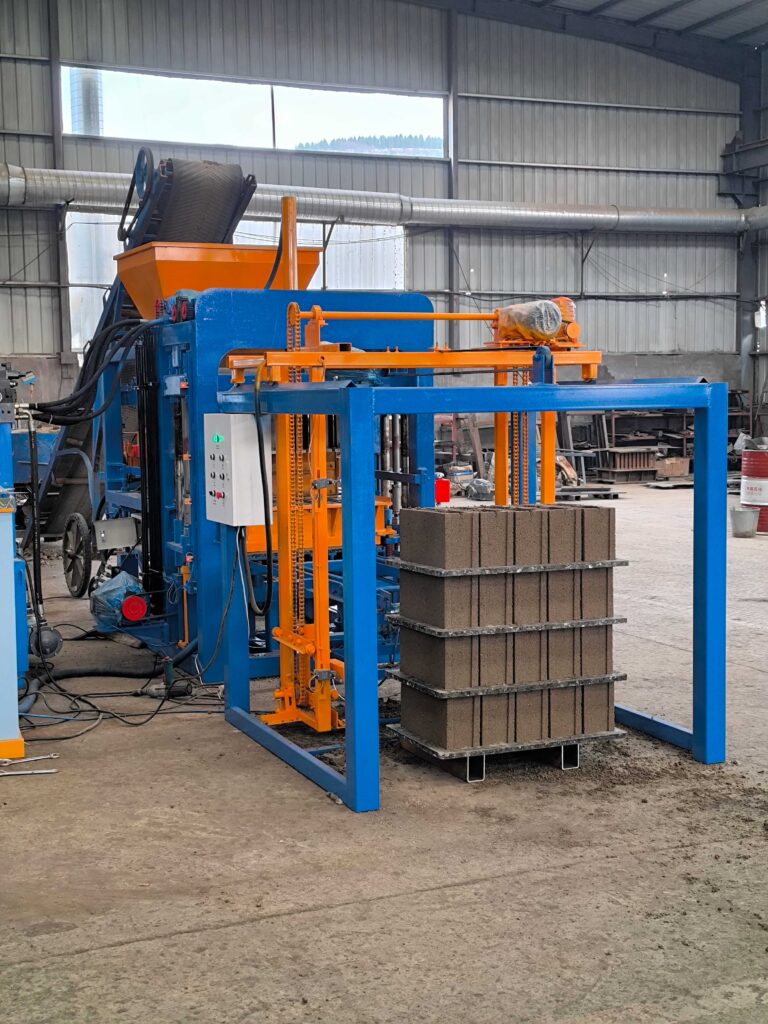
Una máquina estándar comprende varios subsistemas críticos:
- Unidad de Potencia Hidráulica (HPU):El corazón de la máquina, compuesto por un motor eléctrico, una bomba hidráulica, válvulas y un depósito de fluido, genera la fuerza necesaria.
- Estructura Principal y MarcoUn marco de acero robusto y resistente a las vibraciones que soporta operación continua de alta presión.
- Sistema de Moldeo:Cajas de molde intercambiables que definen la forma, el tamaño y el patrón de ensamblaje (por ejemplo, panal, rombo) del ladrillo.
- Tolva de Alimentación y Sistema de Entrega de Material:Asegura un flujo constante y medido de material crudo hacia la cavidad del molde.
- Panel de Control:Alberga los controles eléctricos, que pueden variar desde sistemas manuales simples con palancas hasta Controladores Lógicos Programables (PLC) avanzados para el control automatizado de ciclos.
II. Flujo Operativo: De Materia Prima a Producto Terminado
A. Selección y Preparación de Materias Primas
La calidad del producto final depende en gran medida de los materiales de entrada. Los suelos adecuados (laterita, franco arenoso) se tamizan y se mezclan con un pequeño porcentaje (5-10%) de estabilizadores como cemento Portland o cal. El contenido de humedad se controla críticamente para lograr una compactación óptima.
B. El Ciclo de Producción
- Alimentación:La mezcla preparada se carga en la tolva.
- Relleno:Un mecanismo transfiere un volumen preciso de material al molde.
- Compactación:El ariete hidráulico desciende, aplicando alta presión para comprimir el material dentro del molde.
- Eyección:El ladrillo sólido recién formado se empuja fuera del molde hacia una tarima o una banda transportadora.
- Curado:Los ladrillos se apilan y se mantienen húmedos durante 14-28 días para permitir que el estabilizador (cemento) se hidrate por completo y alcance su resistencia diseñada. Este proceso es más simple que el de los ladrillos tradicionales, ya que no se requiere cocción en horno.
C. Versatilidad en la salida
Las máquinas modernas ofrecen una versatilidad notable gracias a moldes de cambio rápido. Una sola máquina puede producir una amplia variedad de productos.
- Ladrillos estándar de interconexión para paredes
- Adoquines entrelazados para paisajismo y entradas de vehículos
- Specialty blocks for curves, corners, and columns
- Solid blocks for high-load applications
III. Compelling Advantages for the Market and End-Users
A. Economic and Construction Efficiency
- Reduced Construction Time: The interlocking system eliminates the need for wet mortar in the main joints, speeding up wall erection by 30-50%. This translates to faster project completion and lower labor costs.
- Lower Skilled Labor Dependency: While skilled operators are needed for the machine, the actual laying process is simpler and can be performed by semi-skilled workers after basic training.
- Significant Material Savings: Elimination of mortar saves approximately 15-20% on overall material costs. Furthermore, the use of locally available soil reduces dependence on costly, transported materials like fired clay.
B. Structural and Environmental Benefits
- Fuerza y Durabilidad Superiores: Hydraulically pressed bricks have very high compressive strength and density, resulting in walls that are resistant to weathering, erosion, and, crucially, seismic activity due to their interlocking nature.
- Sustainability Credentials: The production process is energy-efficient (no firing), uses local materials, minimizes waste, and creates structures with excellent thermal mass, reducing energy needs for heating and cooling. This is a powerful selling point in green building markets.
- Disaster Resilience: Structures built with interlocking bricks have demonstrated excellent performance in earthquakes and hurricanes, making them highly relevant for disaster-prone regions and post-disaster reconstruction projects.
C. Business and Investment Merits
- Alto Potencial de Rentabilidad: The low production cost per brick versus its market value offers attractive profit margins for block yards and construction firms.
- Oportunidad Empresarial: The technology enables the setup of small to medium-sized brick production businesses, creating local employment.
- Meeting Regulatory Trends: As building codes increasingly emphasize sustainability and resilience, this product is well-positioned to comply with and benefit from such regulations.
IV. Critical Considerations for Dealers and Procurement Professionals
A. Machine Selection Criteria
When evaluating machines for inventory or project use, consider:
- Capacidad de Producción: Cycle time and output per hour (e.g., 500-2000 bricks per 8-hour shift).
- Clasificación de Presión: Higher tonnage generally produces stronger bricks suitable for multi-story buildings.
- Grado de Automatización: Manual, semi-automatic, or fully automatic models, balancing upfront cost with labor requirements and output consistency.
- Build Quality and After-Sales Support: Robustness of components, availability of spare parts, and the manufacturer’s technical support and training provisions are paramount.
B. Market Analysis and Application Segmentation
Successful distribution requires understanding key application segments:
- Vivienda Residencial: Low-cost housing projects, individual homeowner construction.
- Commercial and Institutional Buildings: Schools, clinics, offices.
- Infrastructure and Landscaping: Retaining walls, compound walls, pavements, and parks.
- Humanitarian and Development Projects: A major sector driven by NGOs and government agencies focused on sustainable community development.
C. Developing a Winning Sales and Support Strategy
- Demonstration and Proof: Maintain a demonstration unit and sample walls to showcase the product’s strength and ease of use.
- Programas de Capacitación: Offer training for both machine operation and bricklaying techniques to clients, adding immense value.
- Comprehensive Marketing: Highlight the triple-bottom-line benefits: economic savings, social good (job creation, housing), and environmental stewardship.
Conclusión
The hydraulic interlocking brick making machine represents a paradigm shift in construction technology. It is more than just a piece of manufacturing equipment; it is a catalyst for sustainable development, economic opportunity, and resilient building practices. For dealers and distributors, this product line offers a compelling value proposition with strong growth potential across diverse markets, from urban development to rural entrepreneurship and international aid projects. By becoming experts in this technology—understanding its mechanics, advantages, and optimal applications—B2B stakeholders can position themselves as leaders in providing innovative construction solutions. Investing in this technology and its ecosystem is an investment in the future of building, aligning profitability with positive social and environmental impact. The market is ripe for adoption, and the time to build expertise and inventory in this sector is now.
FAQ (Frequently Asked Questions)
Q1: What is the typical compressive strength of bricks produced by these machines?
A: With proper soil mix and cement stabilization (5-10%), hydraulic interlocking bricks routinely achieve compressive strengths between 7 MPa and 15 MPa, often exceeding the strength of conventional fired clay bricks and hollow blocks. Strength can be calibrated by adjusting the hydraulic pressure and stabilizer ratio.
Q2: Can these bricks be used for load-bearing walls in multi-story buildings?
A: Yes, absolutely. The high compressive strength and interlocking design make them entirely suitable for load-bearing construction. It is crucial, however, to follow engineered design specifications for the block mix and wall construction, especially for structures beyond two stories. Many multi-story buildings have been successfully constructed using this technology.
Q3: What kind of soil is NOT suitable for this process?
A: Purely organic topsoil, highly expansive clay (which cracks), and uniformly graded sand are not suitable. The ideal soil has a blend of sand, silt, and a small amount of clay. Most locally available soils can be used, often with simple modification or the addition of correctives like sand or crusher dust.
Q4: Is a foundation different for a building made with interlocking bricks?
A: The foundation principles remain the same: it must be level, stable, and able to carry the building load. A standard concrete strip footing or raft slab is commonly used. The key difference is that the first course of interlocking bricks is typically laid on a bed of mortar on top of the damp-proof course to ensure a perfectly level starting layer.
Q5: How does the cost of setting up a production yard compare to a traditional brick kiln?
A: The capital investment for a hydraulic brick machine and auxiliary equipment is generally significantly lower than establishing a fixed chimney bull’s trench kiln or a modern tunnel kiln. The operational costs are also lower due to minimal energy consumption (only electricity for the machine) and the use of local raw materials. The business model is more decentralized and scalable.
Q6: What is the maintenance requirement for these hydraulic machines?
A: Maintenance is straightforward but essential. It involves regular checks and changes of hydraulic oil, cleaning of filters, lubrication of moving parts, and inspection of hoses and seals. Following the manufacturer’s scheduled maintenance plan ensures long machine life and consistent production quality. Operator training on basic daily checks is highly recommended.
Q7: How do we address customer concerns about the aesthetic of “earth” bricks?
A: Interlocking bricks offer a distinctive, modern aesthetic that is increasingly popular. For clients preferring a different finish, the bricks can be easily plastered, painted, or clad just like any other wall. Additionally, pigments can be integrated into the soil mix during production to create colored bricks, and textured molds can provide surface patterns.
