1. Foundational Divergence: Purpose and Product Architecture
The core distinction originates from the intended function of the final masonry unit, which dictates its internal geometry and, consequently, the machine’s forming process.
1.1. The Hollow Block Machine: Engineering for Structural Systems
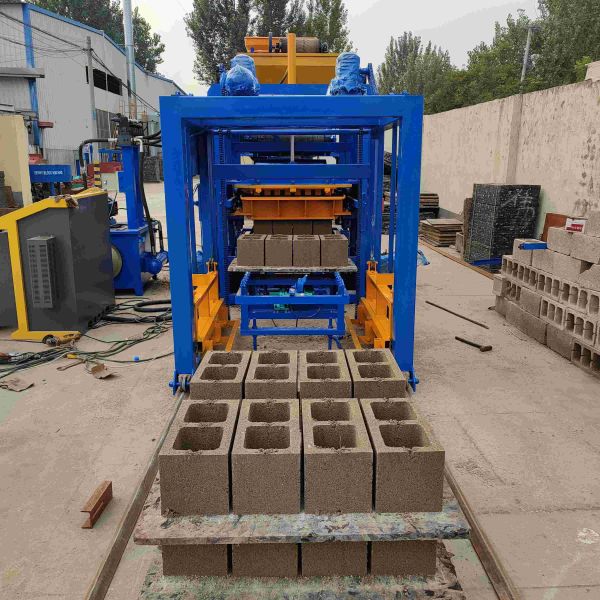
This machine is designed to produce Concrete Masonry Units (CMUs) with internal voids or cores. These hollow cores are not merely space; they are functional design elements that:
- Reduce weight for easier handling.
- Provide cavities for vertical reinforcement (rebar) and grout, enabling the creation of reinforced masonry shear walls.
- Improve thermal and acoustic insulation properties.
- Allow for the routing of electrical and plumbing conduits.
The machine’s primary challenge is to form these intricate internal voids consistently while ensuring the thin webs and faces between them are fully compacted and robust.
1.2. The Solid Block Machine: Optimizing for Density and Mass
This machine produces units with no designed internal voids. Solid blocks are used for:
- Applications requiring higher compressive strength per unit area.
- Solidity in foundations, paving, and heavy-duty flooring.
- Sound barrier walls and fire walls where mass is crucial.
- As a veneer or facing unit where the back may be webbed, but the face is solid.
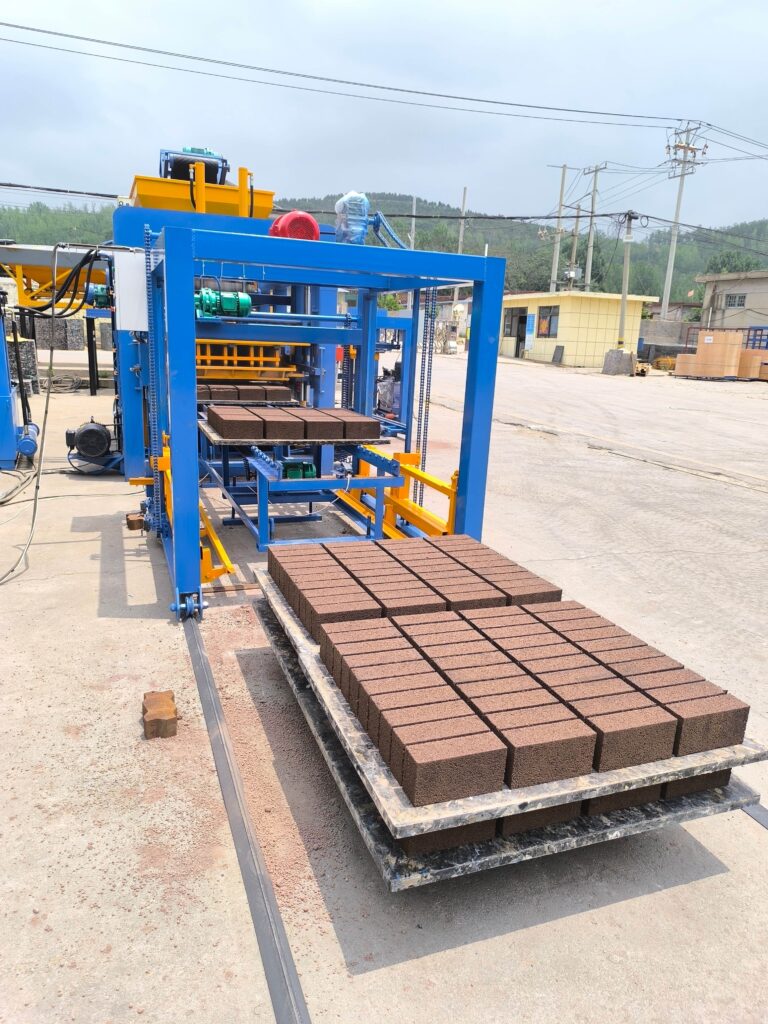
The machine’s focus is on achieving maximum, uniform density throughout the entire volume of the block.
2. Critical Differences in Machine Design and Molding Technology
The need to form internal cavities versus a solid mass necessitates specific engineering solutions.
2.1. The Mold and Core-Bar Assembly
This is the most significant point of differentiation.
- Hollow Block Machine Mold: The mold box contains a set of fixed or retractable core-bars. These are steel projections that create the hollow cavities within the block. They must be precisely positioned, extremely robust to withstand compaction pressure without bending, and often tapered to facilitate the stripping of the block after compaction. The design of these cores—their number, shape, and placement—is complex and product-specific.
- Solid Block Machine Mold: The mold is essentially a cavity without internal projections. It is a simpler, single-volume container. Its design complexity lies in surface textures (split-face, ribbed) or special shapes for landscaping units, but it lacks the intricate internal geometry of a hollow block mold.
2.2. Compaction Force and Vibration Dynamics
The flow of concrete mix around obstacles requires different optimization.
- Hollow Block Machine: The presence of core-bars obstructs the free flow and settlement of the concrete mix. Therefore, these machines often employ more powerful or high-frequency vibration systems to fluidize the mix, ensuring it completely fills the mold and densely packs around the core-bars and into the thin webs. The hydraulic pressure must be sufficient to consolidate these narrow sections.
- Solid Block Machine: With an unobstructed mold, the vibration energy is focused on consolidating a homogeneous mass. The challenge is less about filling complex geometry and more about eliminating stratified layers and achieving even density from top to bottom. Pressure can be applied more uniformly across the entire surface.
2.3. Stripping and Ejection Mechanisms
Demolding a block with internal projections is a more delicate operation.
- Hollow Block Machine: The stripping process must clear the core-bars. In many designs, the mold lifts while the core-bars remain stationary or retract slightly first. The green strength of the block must be sufficient to hold its shape as it is pulled off the cores. Precise alignment and smooth operation are critical to prevent “web drag” or cracking.
- Solid Block Machine: Stripping is more straightforward. The mold lifts, and the solid block, with its greater cross-sectional area and no internal obstructions, is ejected. There is less risk of deformation during this phase, allowing for potentially faster cycle times.
3. Material Considerations and Production Parameters
The choice of machine influences and is influenced by the concrete mix design and production goals.
3.1. Mix Design and Aggregate Gradation
- Hollow Block Mix: Typically uses a well-graded aggregate with a maximum size controlled to ensure it flows around core-bars and does not jam. The mix must have excellent workability and cohesion to form thin, strong webs without segregating.
- Solid Block Mix: Can accommodate a wider range of aggregate sizes, including larger stone, as there are no thin sections to fill. The focus is on achieving a dense, interlocking particle structure.
3.2. Production Speed and Efficiency
- Tiempo de Ciclo: All else being equal, a solid block machine may achieve slightly faster cycle times due to the simpler filling and stripping sequence. However, the overall output in terms of volume of concrete processed or square meters of wall produced may differ based on the size and number of cavities in the mold.
- Raw Material Consumption: A hollow block machine uses less concrete per unit of wall area, as the cores represent void space. This makes production more material-efficient, though not necessarily faster.
4. End-Product Characteristics and Market Implications
The machinery directly defines the performance profile and commercial application of its output.
4.1. Structural and Physical Properties
- Weight and Handling: Hollow blocks are significantly lighter, reducing labor for masons and transportation costs per unit. Solid blocks are heavier, offering greater mass for sound and fire walls.
- Resistencia a la Compresión: Strength is measured differently. Hollow block strength is measured on the net area (excluding the cores), while solid block strength is on the gross area. A high-quality hollow block can have a very high net area compressive strength suitable for multi-story load-bearing construction.
- Thermal and Acoustic Performance: The air pockets in hollow blocks provide inherent insulation. Solid blocks rely on their mass for sound attenuation and have higher thermal mass but lower insulation value.
4.2. Commercial and Supply Chain Considerations
- Inventory and Logistics: The lighter weight of hollow blocks means more units can be loaded onto a truck before reaching weight limits, improving transportation efficiency for distributors. Solid blocks hit volume limits faster.
- Client Advisory Role: Distributors must guide contractors on the correct application. Recommending a solid block for a reinforced shear wall would be incorrect, just as specifying a hollow block for a dense paving application would be unsuitable. This advisory capability builds trust and authority.
- Manufacturer Specialization: Some plants specialize in high-volume hollow block production for the structural market, while others might focus on solid bricks, pavers, and landscaping units. Understanding a supplier’s machine type indicates their core competency.
Conclusión
The divergence between a hollow block machine and a solid block machine is a definitive example of form following function in industrial manufacturing. One is engineered to create intricate, voided structures for systemic, reinforced masonry, optimizing for material efficiency and multifunctional performance. The other is engineered to deliver maximum density and mass in a monolithic form, prioritizing sheer structural presence and durability for specific applications. For the distribution and procurement professional, this distinction is a vital lens for supplier evaluation, product selection, and market strategy. It enables intelligent conversations about production capabilities, informed comparisons of product value beyond simple unit price, and accurate guidance to end-users. Recognizing that these are not interchangeable technologies, but specialized tools for distinct purposes, is key to building a sophisticated, responsive, and technically credible supply chain in the competitive world of construction materials.
FAQ (Frequently Asked Questions)
Q1: Can one machine be converted to produce both hollow and solid blocks?
A: It is possible but not simple or instantaneous. Converting a hollow block machine to make solid blocks is theoretically easier (by removing or disabling the core-bars and using a solid mold), but the machine’s vibration and pressure systems are tuned for hollow block production, which may not be optimal. Converting a solid block machine to make hollow blocks is far more complex and often impractical, as it requires installing a core-bar system, modifying the stripping mechanism, and potentially upgrading the hydraulic system. For consistent, high-quality production of both types, dedicated machines or highly modular, expensive industrial systems are typically used.
Q2: Which type of block is generally more cost-effective to produce?
A: The cost dynamics are nuanced. Bloques huecos use less concrete, reducing raw material costs. However, the machines are more complex and expensive, and production might be slightly slower. Bloques sólidos use more material but can be produced on slightly simpler, faster machines. The final cost per unit is often similar, with hollow blocks sometimes having a slight edge due to material savings. The true cost-effectiveness is determined by the application: hollow blocks are more efficient for load-bearing walls, while solid blocks are necessary for applications requiring their specific properties.
Q3: Are there differences in the curing process for hollow versus solid blocks?
A: The principles are the same, but the thermal mass and drying characteristics differ. Solid blocks, with their greater mass of concrete, may retain heat differently in a steam-curing kiln and can have slower moisture migration during drying. Hollow blocks, with their thinner webs and faces, may cure and dry more uniformly and rapidly. Modern curing kilns are designed to manage these profiles, but it is a factor in process control.
Q4: How does block selection impact construction labor and speed on site?
A: Bloques huecos, being lighter, are faster for masons to handle and lay, speeding up wall construction. Their standardized cores also simplify the placement of rebar and grouting. Bloques sólidos are heavier to handle, potentially slowing labor, but they may require less precision in some laying applications (e.g., dry-stack retaining walls) and can be laid with different techniques. The net impact on project timeline depends on the specific trade-off between handling speed and laying method.
Q5: As a distributor, how should I position these two product lines to my clients?
A: Frame them as complementary solutions for different challenges, not as competitors.
- Market Hollow Blocks as the “Structural System Solution”: Emphasize their role in reinforced load-bearing walls, their insulation benefits, lighter weight, and material efficiency. Target general contractors, structural engineers, and architects designing commercial and multi-family residential buildings.
- Market Solid Blocks as the “Mass and Durability Solution”: Highlight their high compressive strength, sound damping, fire resistance, and suitability for foundations, paving, security walls, and noise barriers. Target civil engineers, landscape contractors, and industrial clients.
Clear, application-based positioning prevents confusion and establishes your expertise.