1. Foundational Definitions and Product Outputs
The primary distinction originates from the final product’s dimensional and functional class.
1.1. The Block Machine: Engineered for Structural Scale
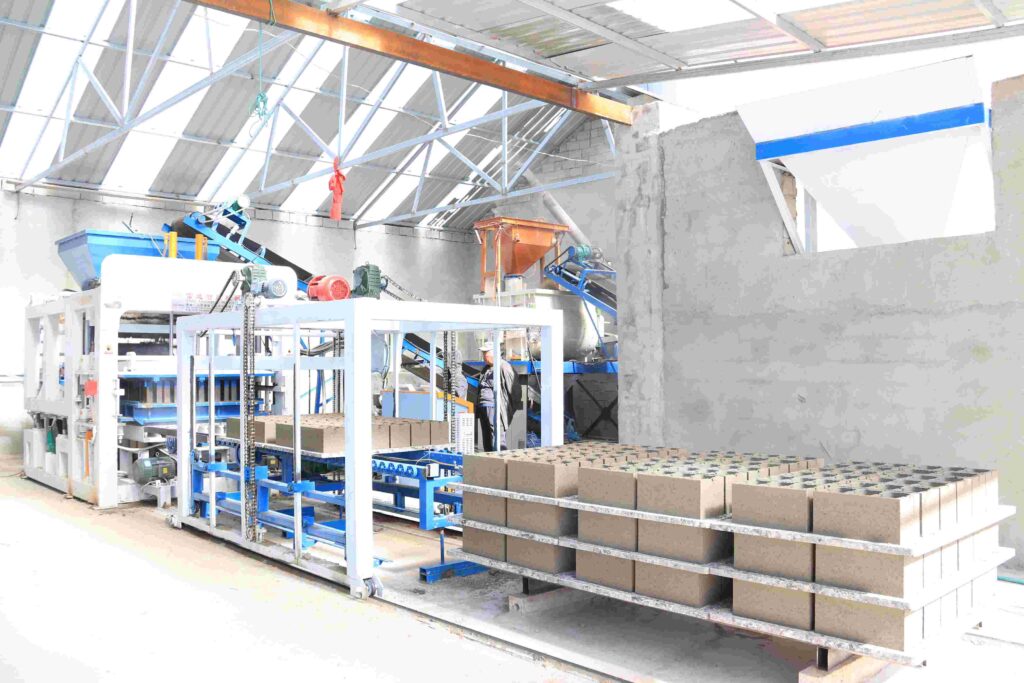
A block machine is designed to produce Concrete Masonry Units (CMUs), commonly called concrete blocks. These are large-format, predominantly hollow units.
- Typical Dimensions: A standard full block measures 8 inches in height, 8 inches in depth, and 16 inches in length (nominal dimensions, incorporating a mortar joint). Machines also produce a range of smaller units like half-blocks and partition blocks.
- Función Principal: Structural building. Blocks are used for load-bearing walls, foundation walls, partitions, and retaining structures. Their size and hollow-core design provide strength, allow for vertical rebar and grout reinforcement, and offer inherent fire resistance and thermal mass.
1.2. The Brick Machine: Precision for Surfacing and Aesthetic Masonry
A brick machine manufactures solid or cored clay or concrete bricks. These are smaller, denser units.
- Typical Dimensions: A standard modular brick measures approximately 2 ¼ inches in height, 3 ⅝ inches in depth, and 7 ⅝ inches in length (nominal). There are numerous other size standards.
- Función Principal: Surfacing and aesthetic finish. Bricks are primarily used as a facing material (veneer) over a structural backing, for interior feature walls, and in non-load-bearing partitions. Their value is derived from color consistency, surface texture, and architectural appeal.
2. Core Mechanical and Operational Divergences
The machines themselves are engineered differently to meet the specific demands of their product lines.
2.1. Machine Scale and Molding Pressure
- Block Machines: These are heavy-duty industrial systems. They must apply enormous hydraulic pressure—often ranging from 500 to over 2,000 tons—to consolidate a large volume of low-slump concrete mix. The mold boxes (pallets) are large, and the entire frame is built to withstand this immense, cyclical stress. The vibration systems are high-amplitude to settle coarse aggregate in the sizable mold cavity.
- Brick Machines: While still robust, they operate at significantly lower pressure ranges, typically from 50 to 400 tons, sufficient to densify the finer, more plastic material mix. The focus is on precision and surface finish at a smaller scale. Vibration is often of higher frequency and lower amplitude to achieve a very tight, smooth surface texture without pushing aggregate away from the face.
2.2. Material Feedstock and Mix Design
- Block Machine Mix: Utilizes a “dry-cast” or “no-slump” concrete. The aggregate is coarse (e.g., 3/8″ pea gravel or crushed stone), and the water-to-cement ratio is very low—just enough for hydration. The mix must be cohesive enough to hold its shape immediately after the high-pressure mold is removed, relying on “green strength.” Supplementary materials like fly ash are common.
- Brick Machine Mix (Concrete): For concrete pavers and bricks, the mix is a “wet-cast” or semi-dry mix with finer sand aggregates and slightly higher moisture content to achieve a denser, less porous finish. For clay bricks, the machine processes plastic, extrudable clay with controlled moisture, which is then wire-cut and fired in a kiln—a fundamentally different process from concrete consolidation.
2.3. The Molding and Curing Process
- Block Molding Cycle: The process is one of compactación a alta presión. Concrete is fed into a mold, subjected to simultaneous vibration and massive downward pressure from a hydraulic head, and then the mold rises to eject the block onto a pallet. Curing is achieved through controlled, low-pressure steam curing in kilns for 18-24 hours to accelerate strength gain.
- Brick Molding Cycle (Concrete): The process emphasizes precision filling and surface finishing. For pavers, a “press and lift” action is common, where the mold cavities are filled, compressed, and then the product is stripped. For clay, an extruder forces the plastic clay through a die, and a wire cutter slices it to size, followed by drying and high-temperature firing (over 1,000°C) in a kiln for several days.
3. Resulting Product Characteristics and Performance Metrics
The machinery differences manifest directly in the performance profile of the end product.
3.1. Structural Properties and Application
- Block Output: High compressive strength (e.g., 1,500 – 3,000+ psi) but lower tensile strength. Engineered as a system with grout and rebar for composite structural performance. Its large format builds wall area quickly.
- Brick Output: High compressive and tensile strength, especially for fired clay bricks. However, bricks are used as a veneer or finish layer. Their structural role in modern construction is typically limited to low-rise, non-load-bearing applications unless part of a reinforced brick masonry system.
3.2. Physical and Aesthetic Properties
- Density and Weight: Blocks are lighter per unit volume due to their hollow cores. A standard CMU weighs 28-35 lbs. Solid concrete or clay bricks are significantly denser and heavier per unit.
- Absorción de Agua: High-quality fired clay bricks have very low absorption (<5%). Concrete blocks have higher absorption (though controlled by mix design) but are often used in conjunction with surface sealants or as a backup wall behind a veneer.
- Surface Finish and Variety: Brick machines, especially for clay, offer an immense variety of colors, textures (rustic, smooth, sand-struck), and finishes (glazed, unglazed). Block machines focus on functional textures (split-face, ribbed, smooth) but with less chromatic variation unless pigments are added to the concrete mix.
4. Commercial and Supply Chain Implications
Understanding these differences guides critical business decisions for distributors and buyers.
4.1. Market Segmentation and Client Advisory
A distributor must guide clients based on project needs:
- Recommend Block Machine Products For: Foundation walls, structural partitions, sound barrier walls, fire-rated assemblies, and large-scale commercial/infrastructure projects where speed of erection and structural integration are key.
- Recommend Brick Machine Products For: Architectural facades, residential exteriors, interior accent walls, pedestrian paving, landscaping features, and any application where aesthetic permanence, color fidelity, and traditional craftsmanship are the primary drivers.
4.2. Inventory, Logistics, and Supplier Partnerships
- Inventory Strategy: Blocks are bulky but lighter per piece and often sold in large, strapped cubes. Bricks are dense, heavy per piece, and require careful handling to avoid chipping. Storage and handling solutions differ.
- Supplier Specialization: Manufacturers often specialize in one domain. A block plant is a capital-intensive concrete operation. A brick plant (especially clay) is a ceramics operation with expertise in kiln firing and glaze chemistry. Partnering with the right specialist is crucial for product quality.
- Servicios de Valor Agregado: For bricks, distributors may need to manage complex samples for color approval. For blocks, technical support may revolve on structural data, reinforcing details, and fire rating specifications.
Conclusión
The block machine and the brick machine are not interchangeable; they are complementary pillars of the masonry supply chain, each optimized for a distinct segment of the built environment. The block machine is the workhorse of structural efficiency, delivering large-format, engineered units through immense force and process control. The brick machine is the artisan of architectural expression, delivering smaller, denser units where surface aesthetics, color, and detail are paramount. For the astute distributor or procurement professional, this distinction is a strategic lens. It informs product knowledge, shapes marketing narratives, and dictates partnership strategies. By clearly articulating the “why” behind each machine’s design and output, you move beyond selling commodities to providing expert material solutions, ensuring that every project is built on a foundation of both strength and beauty, with the right machine-made component for the task.
FAQ (Frequently Asked Questions)
Q1: Can one machine ever produce both high-quality bricks and blocks?
A: While some multi-purpose machines exist, they are typically compromises. A machine powerful enough to properly compact a block lacks the finesse for a perfect brick surface finish, and vice-versa. For commercial-scale production requiring consistent, specification-grade quality, dedicated machinery is the industry standard. A “combo” machine might suit a niche, small-batch market but is unlikely to meet the volume or quality demands of major distribution.
Q2: Which product type generally has a higher production cost per unit area of wall?
A: Direct cost comparison is complex. While an individual block costs more than an individual brick, it covers far more wall area. Installed cost depends on material price, laying speed, and labor. Block walls can be erected faster due to the larger unit size but may require finishing. Brick veneer has a lower material cost per unit but higher installation labor due to the number of units and precision required. The true cost is project-specific, factoring in structural needs, aesthetics, and local labor rates.
Q3: How do sustainability profiles compare between machine-made blocks and bricks?
A: Both have strong sustainable attributes, but differently. Block Machines excel at incorporating industrial by-products (fly ash, slag) and recycled concrete aggregate, reducing embodied carbon. Their thermal mass also contributes to building energy efficiency. Brick Machines (Clay): Clay is a natural, abundant material. Fired clay bricks are incredibly durable (100+ year lifespan), require minimal maintenance, and are fully recyclable. The energy intensity of the kiln firing is the primary environmental focus, with manufacturers increasingly using alternative fuels and heat recovery.
Q4: From a procurement perspective, what key specifications should I request from a block supplier vs. a brick supplier?
A:
- For Block Suppliers: Request Resistencia a la Compresión (ASTM C90), Moisture Absorption (ASTM C140), Fire Rating (UL/ULC listing), Dimensions (ASTM C90), and Weight. Also inquire about mix design (e.g., % of SCMs like fly ash).
- For Brick Suppliers: Request Resistencia a la Compresión (ASTM C67), Water Absorption and Saturation Coefficient (for freeze-thaw durability), Efflorescence Potential, Size Variation tolerances, and Color Consistency data (from production runs). For clay brick, the Tipo (SW, MW, NW for weathering) is critical.
Q5: Are there hybrid products that blur the line between block and brick?
A: Yes, and they represent growing market segments. Thin Brick Veneer Units are brick faces produced by brick machinery but used as a cladding. Autoclaved Aerated Concrete (AAC) Blocks are lightweight, insulating blocks produced in a chemical process, not by a standard block machine. Large-Format Clay Masonry Units are essentially clay blocks. When dealing with these hybrids, it is essential to focus on the performance specification (structural, thermal, aesthetic) rather than the generic name to ensure correct application.