
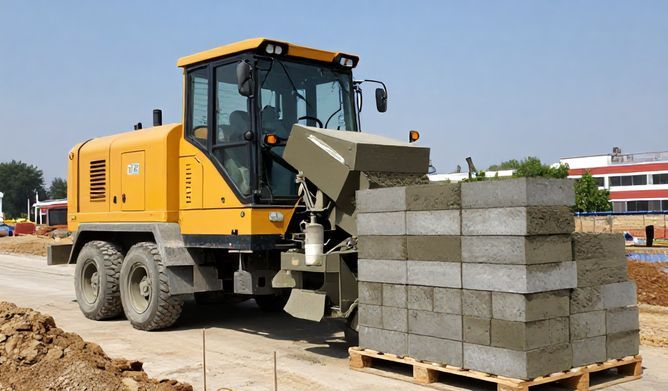
La Guía Definitiva de Máquinas Móviles para Fabricar Ladrillos: Eficiencia en el Sitio y Ahorro de Costos
Introducción
Picture this: your construction project is ready to begin, but the budget is being consumed before a single foundation is poured. A significant portion? The staggering cost of transporting thousands of bricks from a distant factory, compounded by logistical delays, damaged materials, and the frustration of being at the mercy of a supplier’s schedule. For contractors, developers, and entrepreneurs in the building materials space, this is a daily reality that erodes profits and hampers timelines.
Enter the game-changing solution: the mobile brick making machine. This innovative piece of equipment is revolutionizing how bricks, blocks, and pavers are produced by bringing the factory directly to the source. A mobile brick making machine is a compact, portable unit—often mounted on a trailer—designed to manufacture high-quality construction materials on-site, using locally available raw materials like soil, sand, and cement.
In an era emphasizing decentralized production, sustainable practices, and empowering small-to-medium enterprises (SMEs), this technology is more relevant than ever. This comprehensive guide synthesizes detailed industry specifications, operational best practices, and clear economic analysis to provide you with an authoritative resource. We will explore how these machines work, their undeniable advantages, the critical factors for choosing the right one, and how they are shaping the future of efficient, localized construction. By the end, you’ll understand how a mobile brick plant can transform your cost structure, flexibility, and project control.
What is a Mobile Brick Making Machine? Core Concepts & How It Works
At its core, a mobile brick making machine is a self-contained production unit designed for portability and on-site operation. Unlike massive stationary plants that require materials to be transported to them, the mobile unit is transported to the materials and the project site. This fundamental shift in logistics is the source of its greatest benefits.
Key Components and Design Philosophy
The design of a mobile brick machine prioritizes robustness, simplicity, and ease of movement. While models vary, most share these key components:
- Mobility Frame/Trailer: The foundation is a heavy-duty chassis, often with a tow hitch and wheels, allowing it to be moved by a truck or tractor.
- Unidad de Mezcla: A pan or drum mixer where raw materials (soil, sand, cement, water) are combined to form a homogeneous blend.
- Sistema de Compactación: This is the heart of the machine. It employs either:
- Vibración: High-frequency vibration to consolidate the mixture in the mold.
- Presión Hidráulica: A hydraulic ram applies intense, controlled pressure.
- Manual Leverage: In basic models, a lever system is used for compaction.
- Mold or Mould Box: Interchangeable steel molds that define the shape and size of the final product—be it solid, hollow, or interlocking blocks.
- Fuente de alimentación: Varies by model and includes electric motors, diesel engines, or purely manual operation.
- Sistema de Control: Ranges from simple levers and switches to more advanced PLC panels on automated models.
The On-Site Production Process: Step-by-Step
The workflow of a mobile brick machine is straightforward, enabling rapid setup and production:
- Material Preparation & Loading: Locally sourced soil is sieved to remove debris. It’s then combined with stabilizers (like 5-10% cement or lime) and sand in the mixer. Water is added to achieve the optimal moisture content.
- Mezcla: The mixer runs for several minutes to create a uniform, workable mixture.
- Alimentación y Compactación: The mixture is fed into the mold chamber. The compaction system (vibration or hydraulic pressure) is activated, compressing the material to a high density.
- Expulsión: The freshly formed, “green” brick or block is ejected from the mold onto a pallet or curing area.
- Curado: The bricks are stacked and kept moist (often by covering with plastic sheeting) for 7-14 days to gain strength through hydration. This is done on-site.
The “mobile” advantage is clear: set up next to your soil pile and within meters of where the bricks will be laid, slashing handling and transport at every stage.
Top Advantages of Using a Mobile Brick Making Plant
Adopting a mobile brick making plant isn’t just about buying a machine; it’s about adopting a smarter, more resilient business model for construction and production.
Drastic Reduction in Logistics and Transportation Costs
This is the most compelling financial benefit. Traditional brick supply chains involve multiple transport legs: raw materials to the factory, finished bricks to a yard, then to the site. A mobile unit eliminates most of this.
* Eliminate Middleman Margins: You produce directly, cutting out the brick supplier’s markup.
* Slash Freight Costs: Transporting one machine is infinitely cheaper than transporting thousands of heavy bricks. For remote projects, these savings can be astronomical.
* Reduce Material Wastage: On-site production means no bricks broken in transit from handling and long-distance travel.
Unmatched Flexibility and Project Adaptability
A mobile plant is your versatile production partner.
* Serve Multiple Sites: Easily move the machine between different project locations.
* Tackle Remote Projects: Ideal for rural housing, infrastructure in underserved areas, or mining camps where traditional brick delivery is cost-prohibitive.
* Disaster Relief & Rapid Construction: Quickly deploy to produce shelter materials post-disaster using available earth.
* Custom Production: Easily switch molds to produce specific blocks for landscaping (pavers), fencing, or unique architectural features.
Promoting Sustainable and Local Construction
Sustainability is a powerful driver, and mobile brick machines excel here.
* Hyper-Local Sourcing: Use the subsoil from your excavation site, turning a “waste” product into your primary building material.
* Menor Huella de Carbono: Dramatically reduce CO2 emissions associated with long-haul trucking of bricks.
* Utilize Industrial By-Products: Many machines can incorporate recycled materials like fly ash or crushed construction waste into the mix.
Improved Cost Control and Faster Project Timelines
Regain control over your project’s most critical variable: the supply of materials.
* Producción Bajo Demanda: Never face project delays because a brick shipment is late. Produce what you need, when you need it.
* Reduce Inventory Costs: You don’t need to finance and store large brick inventories. Your inventory is the raw soil on-site.
* Predictable Cash Flow: Capital is invested in an asset (the machine) rather than constantly flowing out for material purchases.
Key Types of Mobile Brick Making Machines
Understanding the different types is crucial for matching the right equipment to your specific needs.
By Power Source: Manual, Electric, and Diesel-Powered Models
- Máquinas Manuales: Operated by hand levers. They are the most affordable and require no fuel or electricity.
- Mejor para: Ultra-low-budget startups, very small-scale projects (e.g., homesteading), NGOs in off-grid communities.
- Limitation: Low output (300-800 bricks per day) and physically demanding labor.
- Máquinas Eléctricas: Powered by a standard electric motor (single or three-phase).
- Mejor para: Urban or semi-urban sites with reliable grid power, indoor production, and where low noise and zero exhaust emissions are priorities.
- Limitation: Tied to the availability of a power connection or a large generator.
- Diesel-Powered Machines: Equipped with a diesel engine.
- Mejor para: True off-grid, remote locations. They offer high power and independence. They are typically the choice for higher-capacity, commercial mobile units.
- Limitation: Higher fuel costs, exhaust fumes, and more noise.
By Output Product: Interlocking, Hollow, Solid, and Paver Machines
The mold defines the product. Many mobile units offer quick-change mold systems.
* Interlocking Block Machines: Produce bricks with designed ridges and grooves that lock together without mortar. This allows for faster, often cheaper construction with enhanced seismic resistance in some designs.
* Máquinas para Bloques Huecos: Produce standard hollow concrete blocks used in load-bearing and partition walls. The hollow cores reduce weight and allow for rebar and concrete filling.
* Máquinas para Ladrillos Sólidos: Produce dense, solid bricks or blocks for maximum strength, commonly used in foundations and heavy-duty paving.
* Paver Machines: Produce concrete paving stones for driveways, walkways, and landscaping. These often have higher aesthetic finish requirements.
By Production Capacity: Small, Medium, and High-Capacity Mobile Units
Capacity is typically measured in bricks per hour or per 8-hour shift.
* Small Capacity (500 – 2,000 bricks/day): Often manual or basic electric models. Suitable for individual homes, small shops, and community projects.
* Medium Capacity (2,000 – 8,000 bricks/day): Usually electric or diesel-powered vibrating machines. Ideal for small-to-medium construction companies, housing developments, and block-making SMEs.
* High Capacity (8,000+ bricks/day): Larger, often fully hydraulic or highly automated diesel-powered units on substantial trailers. Used for larger commercial projects and dedicated block supply businesses.
Factores Críticos a Considerar Antes de Comprar
A common mistake is buying based on price or promises alone. Success depends on thorough due diligence.
Assessing Your Raw Material Availability and Quality
The machine is only half the equation; your local soil is the other. Not all soil is perfect.
* Conduct Simple Tests: Perform a “ribbon test” (how well moist soil forms a ribbon) and a “drop test” (how well a formed ball holds together) to gauge clay/silt content.
* Understand Stabilization: Sandy soil may require more cement (8-10%). Clay-heavy soil may require sand and less cement (5-7%). Lime can be an alternative stabilizer.
* Get a Lab Test (For Large Projects): For major investments, a simple soil geotechnical analysis is cheap insurance to determine optimal mix ratios.
Matching Machine Specifications to Your Project Needs
Create a checklist:
* Required Daily Output: Be realistic about your labor and market demand.
* Tipo y Tamaño del Ladrillo: What does your local market or project specs demand?
* Available Power Source: Is three-phase electricity available? Is diesel fuel accessible and affordable?
* Presupuesto: Include not just the machine cost, but also transport, foundation for curing, and initial raw materials.
* Mobility Needs: How often will you move it? Do you have the right vehicle to tow it?
Evaluating Build Quality, Supplier Reputation, and After-Sales Support
Aquí es dondeE-E-A-T is paramount. Choosing a reputable supplier is more important than saving 10% on the purchase price.
* Calidad de Construcción: Look for heavy-duty steel frames, branded hydraulic components (like Bosch Rexroth), and thick, precision-cut mold steel. Avoid flimsy, poorly welded units.
* Supplier Reputation: Research the manufacturer. How long have they been in business? Do they have verifiable customer testimonials or case studies? Can they provide references?
* Soporte Postventa: This is critical. What is the warranty period? Are spare parts (like mold liners, vibration motors) readily available? Do they offer installation supervision or operator training? A supplier with a strong service network will protect your investment for years.
Operating and Maintaining Your Mobile Brick Machine for Longevity
Proper operation and maintenance are what separate a profitable, long-lasting asset from a broken-down piece of scrap metal.
Best Practices for Efficient and Safe Operation
- Safety First: Always wear safety glasses and gloves. Ensure all guards are in place. Never clear a jam or perform maintenance while the machine is powered on.
- Master the Mix: Consistent brick quality starts with a consistent mix. Measure your materials (soil, sand, cement) by volume or weight every time. The moisture content is crucial—too wet leads to deformation, too dry leads to poor compaction.
- Level Setup: Always set up the machine on a hard, level surface to ensure even compaction and prevent frame stress.
Essential Daily and Periodic Maintenance Routines
A simple, disciplined routine prevents major breakdowns.
* Daily: Clean all mixture residue from the mixer, hopper, and mold after each shift. Check and tighten any loose bolts.
* Weekly: Lubricate all moving parts (pivots, bearings) as per the manual. Inspect the mold for wear or damage.
* Monthly: Check hydraulic fluid levels and hose condition. Inspect vibration mounts and motors. Clean the power source (air filter for diesel engines).
Troubleshooting Common Issues
| Problem | Probable Cause | Solution |
| :— | :— | :— |
| Poor Compaction, Weak Bricks | Incorrect mix (too dry/sandy), insufficient compaction time/force, worn mold. | Adjust mix ratios, ensure proper cycle time, check hydraulic pressure/vibration, inspect mold. |
| Bricks Sticking in Mold | Mix is too wet, mold is dirty or damaged, insufficient release agent. | Reduce water, thoroughly clean and inspect mold, apply a recommended release agent (like diesel). |
| Uneven Brick Height | Machine not level, uneven feeding of mix into mold, worn mold components. | Re-level the machine, ensure consistent feeding, replace worn mold liners or shoes. |
| Excessive Vibration/Noise | Loose bolts or components, damaged vibration motor mounts. | Stop machine immediately. Check and tighten all bolts, inspect and replace worn rubber mounts. |
Frequently Asked Questions (FAQ) About Mobile Brick Machines
Q1: What is the average price range for a mobile brick making machine?
A: Prices vary widely based on capacity and automation. Basic manual presses can start from $1,500 – $3,000. Mid-range electric or diesel vibrating machines typically range from $8,000 – $25,000. High-capacity, fully hydraulic mobile plants can cost $30,000 – $70,000+. Always factor in shipping, import duties, and initial spare parts.
Q2: Can I really use the soil from my site to make bricks?
A: In most cases, yes. However, soil suitability is key. Loamy or clayey soils often work best. Very sandy or organic (topsoil) soils will require more stabilizer (cement/lime). Simple field tests (ribbon test, drop test) give a good indication, and small test batches are always recommended before full production.
Q3: How many bricks can a standard mobile machine produce per day?
A: “Standard” varies. A manual machine with a 2-person crew might produce 500-1,000 bricks in an 8-hour day. A popular single-phase electric vibrating model can produce 2,000-3,500. A high-output diesel hydraulic machine can achieve 5,000-8,000+ bricks per day with an efficient crew.
Q4: Is special training required to operate these machines?
A: While designed for relative simplicity, professional training is highly recommended. Reputable suppliers should provide basic operational, safety, and mix design training. This investment dramatically reduces startup errors, improves brick quality, and ensures operator safety, leading to a faster return on investment.
Q5: What are the main differences between a mobile plant and a stationary brick plant?
A: The core differences are:
* Portabilidad: Mobile plants move to materials/sites; stationary plants are fixed installations.
* Inversión: Mobile plants have a much lower capital cost and setup time.
* Automation & Output: Stationary plants are typically highly automated with vastly higher output (tens of thousands per day).
* Modelo de Negocio: Mobile = flexibility, lower risk, project-based. Stationary = high-volume, fixed-location manufacturing.
Conclusión
The mobile brick making machine represents a paradigm shift in construction material production. It empowers builders, developers, and entrepreneurs to take control by transforming locally available resources into valuable building blocks right where they are needed. The benefits are clear and substantial: drastic cost savings from eliminated logistics, unparalleled project flexibility, a strong sustainability profile, and tighter control over budgets and timelines.
As we’ve outlined, success with this technology hinges on a thoughtful approach. It requires an honest assessment of your local materials, a careful matching of machine specifications to your project goals, and, most critically, partnering with a reputable supplier known for quality and unwavering after-sales support. When these elements align, a mobile brick plant ceases to be just a piece of equipment and becomes a cornerstone for a more efficient, resilient, and profitable building operation.
Ready to explore specific models and take the next step? We strongly advise contacting several reputable manufacturers or suppliers. Prepare your project details—desired output, brick type, power availability, and soil information—and request a tailored quote and a discussion about training and support. For those still researching, start by testing your local soil and speaking with other mobile brick machine owners to gain invaluable real-world insights.
<