
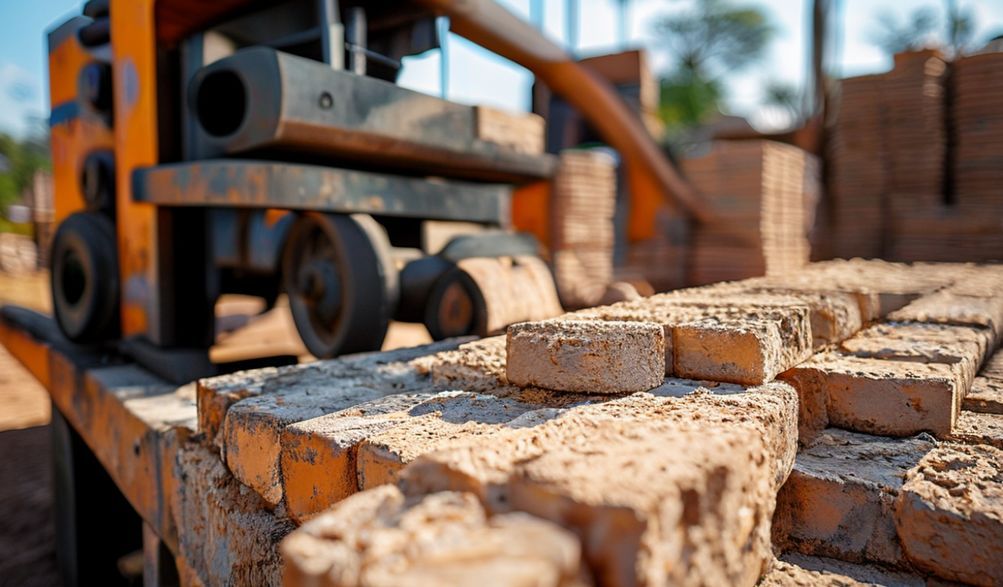
Votre guide ultime pour acheter une machine à fabriquer des briques en vente au Kenya (2026)
Introduction
Le paysage urbain du Kenya se transforme. Portée par le programme gouvernemental ambitieux de logements abordables, un secteur immobilier privé florissant et d'importants projets d'infrastructure, la demande de matériaux de construction de qualité n'a jamais été aussi élevée. Saviez-vous que les estimations suggèrent que le Kenya a besoin de plus de 250 000 nouvelles unités de logement chaque année pour suivre le rythme de l'urbanisation ? Ce boom de la construction représente une opportunité en or. Cherchez-vous à capitaliser sur cette croissance en démarrant une entreprise de fabrication de briques rentable ou en améliorant vos capacités de construction pour mieux contrôler les coûts, la qualité et les délais ?
Naviguer sur le marché pour une machine de fabrication de briques peut être accablant. Avec des options allant de simples presses manuelles à des usines entièrement automatisées, et des prix variant considérablement, prendre une décision éclairée est crucial pour votre succès et votre retour sur investissement. Ce guide est conçu pour être votre ressource complète et impartiale. Nous avons condensé une connaissance approfondie de l'industrie et une analyse actuelle du marché pour couper à travers le bruit. Notre objectif est simple : vous équiper, vous l'entrepreneur, entrepreneur ou promoteur kenyan, des informations nécessaires pour effectuer un achat confiant et rentable.
Que votre objectif principal soit de comparer les prix, de comprendre les différents types de machines, de trouver un vendeur fiable ou de calculer votre retour sur investissement potentiel, cet article couvre tout. Nous vous guiderons à travers :
- Dynamique du marché de la brique au Kenya et avantages d'investir.
- Une ventilation détaillée des machines manuelles, semi-automatiques et entièrement automatiques.
- Les caractéristiques clés que vous devez considérer avant de dépenser un sou.
- Where to find reputable sellers and red flags to avoid.
- A realistic cost analysis and investment framework for Kenya.
Bâtissons une base solide pour votre décision.
Understanding the Kenyan Brick Making Market
The Demand for Bricks in Kenya’s Construction Sector
The engine behind the brick demand is multi-faceted. The Government’s Affordable Housing Agenda is a primary driver, aiming to deliver hundreds of thousands of units across the country. This public initiative, coupled with relentless private real estate development in urban and peri-urban areas, creates a massive, sustained need for building blocks.
De plus,large-scale infrastructure projects like roads, railways, and commercial hubs require durable materials. A key trend underpinning all this is the decisive shift from manual, on-site mud brick production to mechanized, standardized block making. Why? Because modern construction demands consistency, speed, and compliance with quality standards like the KEBS (Kenya Bureau of Standards) specifications. Mechanization is no longer a luxury; it’s a necessity for competitiveness and scale.
Avantages d'investir dans une machine à fabriquer des briques
Investing in your own brick production is more than just buying a piece of equipment; it’s investing in autonomy and efficiency. Here’s how:
- Économies de coûts importantes à long terme : While there’s an upfront cost, producing your own bricks eliminates the middleman and transport markups from external suppliers. For construction companies, this dramatically reduces project costs over time.
- Guaranteed Quality and Strength: You control the raw material mix (cement, sand, aggregate), ensuring every brick meets the required compressive strength (e.g., for load-bearing walls). This minimizes structural issues and rejects on-site.
- A Tangible Business Opportunity: Beyond personal use, the machine can become a revenue center. You can supply high-quality bricks to other builders, contractors, and hardware shops, tapping directly into the market demand we’ve outlined.
- Polyvalence inégalée : Modern machines allow you to change molds easily, enabling production of various block types:
- Solid blocks for heavy-duty construction.
- Hollow blocks for lighter walls and cost-saving.
- Interlocking blocks for faster, mortar-less construction.
- Paving stones for landscaping and hardscaping.
Types of Brick Making Machines Available in Kenya
Choosing the right type of machine is the most critical first step. Your choice should align with your budget, required output, and business model.
Machines à fabriquer des briques manuelles
- Description et fonctionnement : These are non-motorized machines that rely on human labor to compress the concrete mix into a mold using a lever or hand-operated press. Examples include the popular Makiga and other similar manual presses.
- Capacité de sortie : Typically between 100 to 500 blocks per day, depending on the operator’s speed.
- Idéal pour : Individuals or startups for very small-scale projects (e.g., building a single home), community groups, or those with extremely limited capital wanting to test the market.
- Avantages :
- Very low initial investment and operating cost.
- Aucune électricité ni carburant nécessaire.
- Facile à utiliser et à entretenir.
- Inconvénients :
- À forte intensité de main-d'œuvre et lent.
- Lower production consistency.
- Physical strain on operators.
Machines à fabriquer des briques semi-automatiques
- Description : These machines use an electric motor or diesel engine to power a hydraulic or mechanical press. While the compression is powered, operations like feeding raw material and removing finished blocks are often manual.
- Capacité de sortie : Can range from 500 to 2,500+ blocks per 8-hour shift, a significant jump from manual models.
- Idéal pour : Small to medium-sized businesses (SMEs) aiming for commercial production, growing construction firms, and cooperative societies.
- Avantages :
- Excellent balance between cost and productivity.
- Higher consistency and block strength than manual machines.
- More feasible for a sustainable business.
- Inconvénients :
- Higher upfront cost than manual machines.
- Requires a power source (electricity or fuel).
- Still requires a small team for operation.
Machines à fabriquer des briques entièrement automatiques
- Description : These are complete production lines. They feature automated systems for mixing, conveying, pressing, curing, and sometimes even stacking. They often have programmable logic controllers (PLC) for precision.
- Capacité de sortie : Can produce several thousand to tens of thousands of blocks per day.
- Idéal pour : Large-scale commercial block yards, industrial plants supplying major contractors, and investors targeting high-volume markets.
- Avantages :
- Extremely high output with minimal manual labor.
- Maximum consistency and efficiency.
- Lowest cost-per-block at high volumes.
- Inconvénients :
- Very high capital investment required.
- Needs significant space, stable three-phase power, and technical know-how.
- Complex maintenance that requires specialist support.
Machines à briques mobiles vs stationnaires
- Machines à briques mobiles : Mounted on a trailer, these can be towed directly to a construction site. They are ideal for producing bricks on-demand for a specific project, eliminating transport costs for finished blocks. Best for contractors with large, fixed-site projects.
- Stationary Brick Machines: Set up in a fixed location or factory. They are the foundation of a dedicated block-making business that supplies a wider area. They allow for more permanent infrastructure like curing sheds and storage.
Key Features to Consider Before You Buy
Look beyond the basic type. These features determine long-term performance and value.
Capacité de production (Blocs par heure/jour)
- Don’t just buy the biggest machine you can afford. Match the output to your realistic demand.
- Demandez-vous : Are you supplying one project, or do you have multiple clients? What is your target monthly sales volume? A machine that runs at 10% capacity is as poor an investment as one that can’t keep up with orders.
- Manufacturer ratings are for ideal conditions. Factor in downtime for maintenance, mold changes, and material loading.
Polyvalence des types et tailles de briques
- Market demand changes. A machine that can only produce one block size limits your business.
- Prioritize machines with interchangeable molds. Check the availability and cost of additional molds (e.g., for 4″, 5″, 6″, interlocking, and paving stones).
- This flexibility allows you to pivot based on customer requests and market trends.
Power Source: Electric, Diesel, or Manual
- Électrique : Cleaner, quieter, and generally cheaper to run per hour. Essential: Requires a reliable grid connection or a powerful generator. Three-phase motors are common for larger machines.
- Diesel: Offers independence from the grid, crucial in areas with unstable power. Higher fuel costs and more noise/pollution.
- Manuel : No running power costs, but limited to very low-output machines.
- Facteur de décision : Your location’s power stability and the operational cost model.
Machine Durability and Build Quality
This is where you must not compromise. A cheap machine made from poor-quality steel will bend, crack, and fail quickly.
- Inspect: The frame should be made of thick, reinforced steel. Hydraulic systems should be from reputable brands. Welds should be clean and robust.
- Ask for the brand of critical components (hydraulic pumps, valves, motors). Recognizable brands often mean better spare part availability.
After-Sales Support: The Most Critical Factor
This is arguably the most important section. A machine is a long-term asset.
- Insist on local technical support. Can the supplier send a technician to your site in Kisumu, Nakuru, or Mombasa if something breaks?
- Verify spare parts availability. Are common wear parts (seals, molds, hydraulic hoses) stocked in a warehouse in Kenya, or must they be shipped from abroad causing weeks of downtime?
- What does the warranty cover and for how long? A one-year warranty on parts and labor is a good minimum standard.
- Do they offer installation and basic training? This is a hallmark of a reputable supplier.
Where to Find Brick Making Machines for Sale in Kenya
Authorized Dealers and Direct Suppliers
- This is the most recommended route. Purchase from the authorized Kenyan dealer or agent for international brands (e.g., agents for Hydraform, Hanlon, Masa, etc.) or reputable local manufacturers.
- Comment vérifier : Ask for their dealership certificate, visit their physical showroom, and request contact details of previous customers for references.
Industrial Equipment Showrooms (Nairobi, Mombasa, Kisumu)
- Nairobi’s Industrial Area, Mombasa RoadetAthi River are hubs for machinery and equipment sellers. In Mombasa, check areas like MiritinietChangamwe. In Kisumu, industrial zones along the highways are key.
- Visiting a showroom allows you to see the machine, feel its build quality, and sometimes see a live demonstration.
Reputable Online Marketplaces
- Platforms like Jiji.co.ke, Cheki.co.keetFacebook Marketplace have numerous listings.
- Exercise Extreme Caution: Use these platforms to identify sellers, but never transact fully online without a physical verification.
- Red Flags: Prices that seem too good to be true, sellers who refuse to meet at a business premises, and requests for full payment before delivery.
The Pitfalls of Extremely Cheap (Often Used) Imports
- Consider this a serious warning. There is a flood of very cheap, often used or refurbished machines imported from Asia with no local support.
- The Risks:
- Zero After-Sales Support: When it breaks, you are on your own.
- Coûts cachés : The “bargain” price is quickly erased by costly repairs, custom delays for spare parts, and lost production time.
- Poor Quality: Inferior materials lead to frequent breakdowns and unsafe operation.
- Protect Your Investment: The peace of mind that comes with buying from an established local supplier with a service network is worth the potentially higher initial price.
Cost Analysis and Investment Guide
Price Ranges in Kenya Shillings (Estimate)
Prices vary widely based on brand, capacity, automation level, and supplier. Use this as a 2026 guide:
| Machine Type | Estimated Price Range (KES) | Key Determinants |
| :— | :— | :— |
| Manuel | KES 15,000 – 80,000 | Brand, build quality, number of molds included. |
| Semi-Automatique | KES 100,000 – 800,000 | Production capacity, power source, level of automation, brand. |
| Entièrement Automatique | KES 1 Million – 5 Million+ | Output level, degree of automation (with mixer, stacker), brand prestige. |
Beyond the Machine: Total Investment Costs
Your budget must account for the entire setup:
* Land/Premises: Rental or purchase of space for the machine and block curing.
* Matériaux bruts : Initial stockpile of cement, sand, and quarry dust/blast furnace slag.
* Main-d'œuvre : Wages for machine operators and general laborers.
* Utilities: Power connection costs or generator fuel.
* Transport Vehicle for delivering finished blocks or fetching raw materials.
* Curing Area: Shelter or shed for blocks to gain strength.
Calculating Your Return on Investment (ROI)
A simplified framework to gauge profitability:
- Monthly Production: Estimate how many blocks you can realistically produce and sell in a month (e.g., 20,000 blocks).
- Revenue: Multiply by your selling price (e.g., KES 50 per block). Revenue = 20,000 x 50 = KES 1,000,000.
- Monthly Operational Costs: Sum of raw materials, labor, power, rent, transport, and machine depreciation.
- Exemple : Raw Materials (KES 600,000) + Labor (KES 150,000) + Other (KES 100,000) = KES 850,000.
- Monthly Gross Profit: Revenue – Operational Costs = 1,000,000 – 850,000 = KES 150,000.
- ROI Timeframe: Divide the total initial investment (machine + setup) by your monthly gross profit. This gives you the number of months to recover your capital.
This is a basic model. Always factor in market fluctuations and initial slower sales.
FAQ: Brick Making Machine Kenya
Q1: What is the best type of brick making machine for a beginner in Kenya?
A : For a true beginner, a manual or a small semi-automatic machine is often the best entry point. It allows you to learn the process, understand the market, and build capital with lower risk before scaling up.
Q2: Can I get a loan or financing for a brick making machine in Kenya?
A : Yes. Many reputable suppliers offer in-house financing plans. Additionally, explore business loans from commercial banks, SACCOs, or government funds like the Youth Enterprise Development Fund, Women Enterprise FundouUwezo Fund. A solid business plan will be required.
Q3: What raw materials are needed, and where do I get them?
A : The standard mix is cement, sand, and quarry dust or crushed stone aggregate. You can buy cement from distributors like Bamburi, Mombasa Cement, etc. Sand and quarry dust are sourced from licensed quarries near you for the best transport rates.
Q4: How do I maintain my brick making machine?
A : Follow the manufacturer’s manual strictly. Key routines include:
* Cleaning the machine thoroughly after each use.
* Lubricating all moving parts as specified.
* Checking and maintaining proper hydraulic oil levels and quality.
* Storing the machine under shelter to prevent rust.
Q5: Are there training opportunities for operating these machines?
A : Yes. A good supplier will provide basic hands-on training upon installation. For deeper technical skills, institutions like the National Industrial Training Authority (NITA) and some polytechnics offer courses in plant operation and maintenance.
Conclusion and Final Recommendations
Your journey to acquiring a brick making machine involves understanding a dynamic market, carefully selecting the right machine type, scrutinizing critical features like durability and support, choosing a trustworthy seller, and planning your finances meticulously.
Let us reinforce a core principle: Due diligence is your most valuable tool. The allure of a cheap price tag is strong, but the security of local after-sales support is what protects your investment for years to come. We strongly encourage you to move from online research to physical verification. Visit showrooms in Industrial Area, ask for live demonstrations, and most importantly, talk to other brick machine owners about their experiences with different suppliers and models.
Ready to take the next step? Use the insights from this guide as your checklist. Contact two or three of the most reputable suppliers you have identified. Present them with your specific production goals and request detailed quotations that include warranty, support, and delivery terms. Compare these proposals not just on price, but on the total value and security they offer.
By making an informed choice, you’re not just buying a machine; you’re laying the foundation for a profitable enterprise and contributing to the very fabric of Kenya’s growing built environment. Your venture starts with a single block. Make sure it’s a strong one.
<