
Le Guide Ultime des Machines à Fabriquer des Briques Manuelles : Types, Utilisations et Comment Choisir
Imaginez que vous soyez un propriétaire bricoleur rêvant d'un mur de jardin, un petit constructeur dans une région éloignée, ou un entrepreneur à la recherche d'une solution de construction durable et économique. Vous avez besoin de briques, mais les options commerciales sont coûteuses, néfastes pour l'environnement, ou tout simplement indisponibles. La solution n'est peut-être pas une grande usine, mais un outil simple et ingénieux : la machine à fabriquer des briques manuelle.
Ce guide complet est conçu pour aller à l'essentiel. En s'appuyant sur des principes mécaniques, les expériences répandues des utilisateurs et des connaissances pratiques en construction, nous offrons une analyse approfondie, objective et éducative du monde des presses à briques manuelles. Notre objectif n'est pas de vous vendre une marque spécifique, mais de vous outiller avec les informations nécessaires pour comprendre les différents types de machines, leurs applications idéales et les facteurs cruciaux pour en choisir et en utiliser une avec succès. Bâtissons vos connaissances à partir des fondations.
Qu'est-ce qu'une machine à fabriquer des briques manuelle ? Comprendre les bases
Au cœur de son fonctionnement, une machine à fabriquer des briques manuelle témoigne de la puissance de la mécanique simple. C'est un appareil qui transforme des matériaux bruts et meubles—comme la terre, l'argile ou un mélange de ciment—en blocs de construction denses et uniformes, en utilisant principalement la force humaine.
Définition et principe fondamental
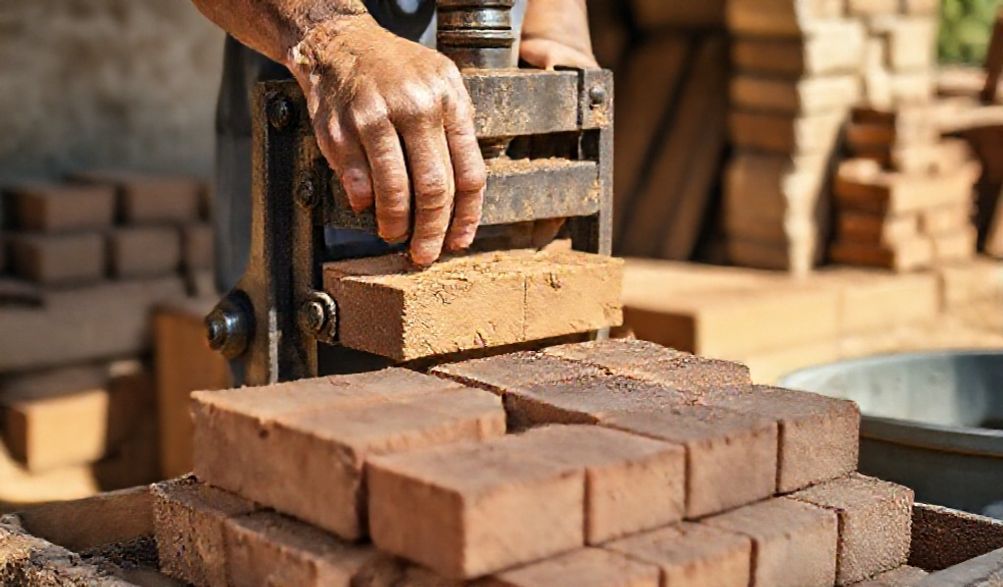
Une machine à fabriquer des briques manuelle est une presse actionnée manuellement ou par levier. Elle fonctionne sur le principe fondamental du compactage. En appliquant une force mécanique concentrée à un volume de matière première contenue dans un moule, elle élimine les vides d'air et lie les particules entre elles, formant ainsi une brique solide et cohésive. Contrairement aux briques cuites, beaucoup de celles fabriquées avec ces machines acquièrent leur résistance par compactage et durcissement, et non par cuisson au four.
Contexte historique bref et pertinence moderne
Le concept est ancien, évoluant à partir de simples moules en bois pour briques d'argile séchées au soleil. La conception moderne de la presse à levier représente un bond en avant significatif en matière d'efficacité. Aujourd'hui, sa pertinence a considérablement augmenté en raison de :
* Durabilité :Il favorise l'utilisation de terre locale, souvent sur place, réduisant ainsi l'empreinte carbone liée au transport.
* Abordabilité :Cela nécessite un investissement en capital très faible comparé aux usines de briques automatisées.
* Autonomisation :Il permet la construction hors réseau et soutient l'autonomie dans les projets de logement et communautaires.
Composants clés et leur fonctionnement
Bien que les conceptions varient, la plupart des machines partagent trois composants fondamentaux :
1. Chambre de saut/mouleC'est ici que la matière première préparée est chargée. Elle définit la forme et la taille de la brique.
2. Mécanisme de compressionIl s'agit du système de transmission de force, généralement un long levier ou un vérin hydraulique, qui amplifie l'effort de l'utilisateur pour créer une haute pression.
3. Système d'éjection :Après compression, un mécanisme (souvent un levier ou une plaque séparé) pousse la brique fraîchement formée hors du moule intacte et prête pour la cure.
Types de machines à fabriquer des briques manuelles
Toutes les machines à briques ne sont pas créées égales. Choisir le bon type dépend de l'échelle de votre projet, de la main-d'œuvre disponible et du style de brique souhaité.
Machines à presser manuelles (actionnées par levier)
Ce sont les formes les plus pures de machines à fabriquer des briques manuelles, dépendant entièrement de la force humaine.
* Opération : A long lever is pulled or pushed to drive a piston or plate that compresses the material.
* Sortie : A skilled operator or a two-person team can produce 200-400 bricks in an 8-hour day.
* Idéal pour : Small-scale projects, DIY enthusiasts, NGOs in low-resource settings, and educational purposes. Their simplicity, portability, and zero energy requirement are key advantages.
Semi-Automatic Machines (Mechanized Assistance)
These models incorporate a mechanism to reduce physical effort and increase output.
* Opération : They may use a flywheel for momentum, a hydraulic jack for greater pressure with less force, or a small electric or diesel engine to power the compression cycle.
* Sortie : Significantly higher than manual presses, potentially reaching 500-1000+ bricks per day.
* Idéal pour : Small business startups, community housing projects, or any application where higher, more consistent production is needed with less operator fatigue.
By Brick Type: Interlocking vs. Standard Solid Bricks
The mold design determines the brick’s final shape and building method.
* Machines à briques imbriquées : These produce bricks with designed ridges and grooves. They lock together horizontally and sometimes vertically, constructing walls with little to no mortar. Benefits include faster construction, potential for earthquake resistance in engineered designs, and material savings.
* Standard Solid Brick Machines: These produce traditional, rectangular solid blocks. They are used with standard mortar joints and are familiar to all masons. They are highly versatile for all types of construction.
By Material Process: Soil/Cement vs. Clay Brick Machines
The raw material dictates the machine design and process.
* Stabilized Earth (Soil/Cement) Machines: These are the most common. They are designed to compress a mixture of local soil (with the right sand, silt, clay ratio) stabilized with a small amount (5-10%) of cement or lime. The bricks gain strength through compaction and curing.
* Traditional Clay Brick Machines: These are designed for moist clay. The process often involves higher moisture content and sometimes requires subsequent firing in a kiln to achieve maximum strength, though some are made for unfired (Adobe-style) use.
Primary Applications and Benefits
The hand brick machine is a tool of empowerment, turning local resources into building solutions. Its benefits extend beyond mere cost.
Ideal Use Cases
- DIY & Home Projects: Garden walls, patios, landscaping features, sheds, and small home extensions.
- Low-Cost & Social Housing: A cornerstone for NGOs and community-led affordable housing initiatives.
- Agricultural Buildings: Constructing storage sheds, animal shelters, and boundary walls on farms.
- Disaster Relief & Reconstruction: Quickly deploying on-site to produce building materials after natural disasters.
- Ateliers éducatifs : Teaching sustainable construction, engineering principles, and vocational skills.
Avantages économiques
- Low Startup Cost: The initial machine investment is a fraction of the cost of industrial equipment.
- Minimal Operational Expense: Manual models require no electricity or fuel. Raw materials (soil) are often free or very cheap.
- Potentiel commercial Enables micro-enterprises with low barriers to entry, creating local jobs and materials.
Avantages environnementaux et de durabilité
- Matériaux locaux : Drastically reduces the environmental cost of transporting heavy building materials.
- Faible énergie intrinsèque : Especially for unfired bricks, the energy input is minimal (mostly human labor).
- Thermal Performance: Compressed earth bricks have excellent thermal mass, helping to regulate indoor temperatures naturally.
- Minimal Waste: Production creates little to no waste, and the bricks are often fully recyclable back into earth.
How to Choose the Right Machine: A Buyer’s Checklist
Making an informed purchase decision requires honest assessment and research. Use this checklist as your guide.
Assess Your Project Scale and Brick Requirements
Start by quantifying your needs.
* How many bricks are needed for the entire project?
* What is your desired production rate (bricks per day/week)?
* Is this a one-off project or continuous production?
Your answers will steer you toward a manual lever press for a single garden wall or a semi-automatic model for a small house.
Evaluate Available Raw Materials
This is the most critical, and often overlooked, step. The machine is just a press; the brick quality depends on the material you feed it.
* Test Your Soil: Perform simple field tests (ribbon test, jar sedimentation test) to understand your soil’s clay, silt, and sand composition.
* Compatibility: Ensure the machine you’re considering is designed for your primary material (e.g., soil-cement mix vs. pure clay).
Key Machine Specifications to Compare
When comparing models, look at these technical details:
* Brick Dimensions & Output/Hour: Does the brick size suit your design? Is the claimed output realistic for manual operation?
* Construction Material & Durability: Look for high-quality steel, especially in the mold and compression parts. Thicker steel resists wear and deformation.
* Compression Force & Brick Strength: Higher pressure (measured in PSI or MPa the machine can apply) generally leads to a denser, stronger brick. Ask for typical compressive strength results for bricks made with the machine.
* Ease of Operation & Labor: Consider the physical effort required. Can one person operate it comfortably, or is a two-person team needed? How easy is the brick ejection process?
Setting a Realistic Budget
Your total startup cost includes more than just the machine.
* Machine Purchase Price
* Material Processing Tools: Sieve/shaker, mixing trough or pan, measuring buckets.
* Safety Equipment: Gloves, sturdy boots, eye protection.
* Curing Supplies: Plastic sheeting or tarps to protect bricks while curing.
Operating Your Machine: A Step-by-Step Guide
Success lies in the process. Proper material preparation and technique are more important than the machine itself.
Material Preparation is Key
A perfect brick is made in the mix, not just the press.
1. Tamisage : Remove stones, roots, and large debris from your soil.
2. Mélange : Combine soil with the correct percentage of stabilizer (e.g., Portland cement). Aim for a homogeneous, dry mix.
3. Moistening: Add water gradually. The ideal moisture content is critical—the mixture should hold its shape when squeezed in your fist without crumbling or dripping water (similar to the “proctor test” standard).
The Brick Making Cycle
A consistent, rhythmic process maximizes output and quality.
1. Remplissez : Place the prepared mix into the machine’s hopper, often using a scoop.
2. Compresser : Apply steady, full force using the lever or mechanism. Hold pressure for a moment.
3. Éjecter : Activate the ejection system to release the green brick onto a pallet or level surface.
4. Repeat: Develop a smooth cycle to maintain efficiency.
Essential Curing and Drying Practices
Curing is not just drying; it’s a chemical process that develops strength.
* For Soil-Cement Bricks: Keep the bricks damp under plastic sheeting or by lightly spraying with water for 7-14 days. This allows the cement to hydrate fully. After curing, allow them to dry in the shade for several weeks before use.
* For Clay Bricks: Drying must be slow and even to prevent cracking. Protect from sun and rain initially, then air dry thoroughly. Firing, if required, is a separate skilled process.
Common Troubleshooting Tips
- Brick Breaks on Ejection: The mix is too dry or lacks sufficient binder (clay/cement). Adjust moisture and mix ratios.
- Brick Sticks in Mold: The mix is too wet, or the mold needs cleaning and light lubrication (use a fine dusting of dry sand, not oil).
- Bricks Lack Strength: Likely causes are insufficient compression force, incorrect soil mix, inadequate cement content, or poor curing. Review each step.
Foire aux questions (FAQ)
Q: How many bricks can I make in a day with a hand-operated machine?
A : A realistic range for a skilled individual or two-person team using a manual lever press is 200 to 500 bricks in an 8-hour day. Variables include machine design, brick size, operator stamina, and workflow efficiency.
Q: What is the compressive strength of bricks made with these machines?
A : With a proper soil-cement mix and good compression, strengths typically range from 2 to 10 MPa (Megapascals). For context, many building codes require a minimum of ~3-4 MPa for single-story load-bearing walls. Strength is highly dependent on material quality and curing.
Q: Can I use any type of soil?
A : Not all soils are ideal. The best is a “loam” with a balanced mix of clay (as the binder), silt, and sand. Pure sand lacks cohesion; pure clay shrinks and cracks. Simple field tests are essential to determine suitability.
Q: What maintenance does a hand brick machine require?
A : Maintenance is simple but crucial:
* Clean the mold thoroughly after each use.
* Regularly check for loose bolts and nuts.
* Lubricate pivot points with grease.
* Store under cover to prevent rust.
* Inspect the mold for wear over time.
Q: Is this a viable option for starting a small brick-making business?
A : Yes, it can be an excellent low-capital entry point. However, viability depends on:
* Local demand and competition.
* Your ability to produce consistent, high-quality bricks.
* Efficient production and business management skills.
* Understanding of local building codes and material standards.
Conclusion
Hand brick making machines are more than just tools; they are enablers of self-reliance, sustainability, and practical innovation. They democratize the production of building materials, turning local earth into lasting structures.
The journey from soil to solid wall begins with knowledge. We encourage you to clearly define your project goals, invest time in researching and testing your materials, and, if possible, seek hands-on training or witness a machine demonstration before purchasing. Always prioritize safe operating practices and consult local building regulations to ensure your creations are not only beautiful but also sound.
In a world seeking sustainable and resilient solutions, the hand brick making machine stands as a timeless bridge between human ingenuity and the very earth we build upon.
<