
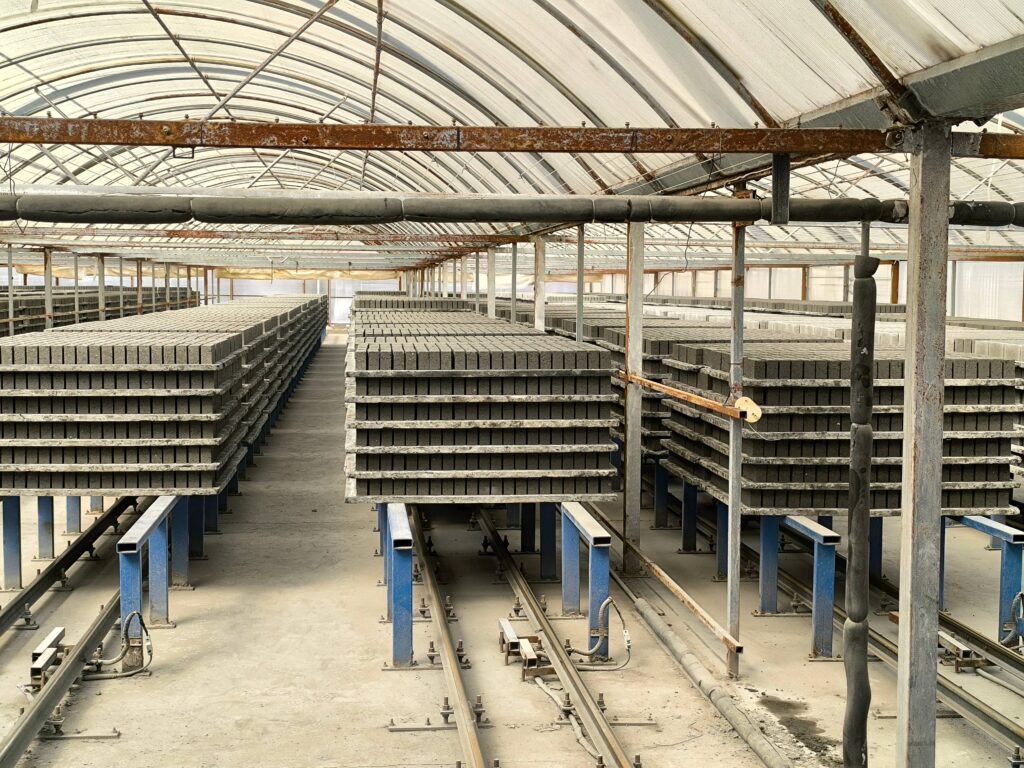
Les exigences de la maçonnerie commerciale : au-delà de la construction de base
Les bâtiments commerciaux—tels que les bureaux, les hôpitaux, les écoles, les centres de vente au détail et les logements multifamiliaux—imposent un ensemble d'exigences dépassant largement celles des travaux résidentiels typiques. Ces demandes dictent tous les aspects de la production de blocs.
- 1.1. Conformité stricte aux normes codifiées
Les projets commerciaux sont régis par des codes du bâtiment rigoureux (CBI, normes nationales) et font l'objet d'inspections par des tiers. Les blocs doivent démontrer leur conformité à des normes spécifiques de l'ASTM International, notamment :- ASTM C90 :Pour les blocs de maçonnerie en béton porteurs. Cette norme impose des épaisseurs minimales de la paroi et de l'âme, une résistance à la compression (généralement 2 000 psi ou plus, selon les spécifications), des limites d'absorption d'humidité et des tolérances dimensionnelles.
- Autres normes applicables :Cela peut inclure la norme ASTM C129 pour les éléments non porteurs, ou des normes spécifiques concernant les indices de résistance au feu et la transmission sonore.
- 1.2. Volume élevé et cohérent de production avec traçabilité documentée
Les projets commerciaux nécessitent des milliers, souvent des centaines de milliers, d'unités identiques. La cohérence est incontournable. De plus, la chaîne d'approvisionnement doit fournirTraçabilité des lots. This means every pallet of blocks can be linked back to the production date, mix design, and results of quality control tests, providing a documented chain of custody for the general contractor and building officials. - 1.3. Specialized Unit Configurations
Beyond standard stretcher blocks, commercial designs frequently require a range of specialized shapes:- Bond Beam Blocks: U-shaped units for placing horizontal reinforcement and grout.
- Lintel Blocks: For creating reinforced beams over openings.
- Control Joint Blocks: To facilitate proper movement joints in long walls.
- Pilaster Blocks: For creating integrated columns.
2. Machine and Production Line Capabilities for Commercial Readiness
Meeting the above demands requires a production system engineered for precision, repeatability, and verification.
- 2.1. Precision Tooling and Tight Process Control
- Mold Tolerances: Molds must be engineered and maintained to produce blocks within the strict dimensional tolerances of ASTM C90 (typically ±1/8″ in length and height). Wear on mold liners must be monitored and managed proactively.
- Vibration and Compaction Consistency: The machine must deliver identical, high-energy vibration and compaction pressure to every single block cavity. This ensures uniform density and strength across all units, from the first to the ten-thousandth. Inconsistent vibration is a primary cause of rejected lots.
- 2.2. Integrated Quality Assurance (QA) Systems
Production for the commercial market is defined by its QA regime, which must be integrated into the daily workflow:- In-Plant Laboratory: A dedicated lab for daily testing is essential. Standard tests include compressive strength (using wet-cured specimens from production samples), moisture content, and dimensional checks.
- Third-Party Certification: Many commercial specifiers require blocks from a plant certified by an independent agency (e.g., NCMA). These agencies perform unannounced plant audits, review mix designs, and witness testing to verify ongoing compliance with ASTM standards.
- Documentation Package: The producer must generate and supply a comprehensive package for each shipment, including mill certificates, test reports, and mix design information.
3. Strategic Business Implications for Suppliers
Becoming a qualified supplier for commercial projects elevates a business but also imposes new disciplines and commitments.
- 3.1. From Supplier to Solutions Partner
A commercial block supplier is not just selling a commodity. They become a technical partner, collaborating with the project’s structural engineer, mason contractor, and general contractor. This may involve:- Providing CAD details for specialized units.
- Advising on mix designs for specific performance criteria (e.g., higher early strength for fast-track schedules).
- Coordinating just-in-time delivery to congested urban job sites.
- 3.2. Inventory Management and Logistics Complexity
Commercial projects have phased material needs. A supplier must have the production capacity and yard space to manufacture and stage large quantities of both standard and specialty units. Logistics involves coordinating trucking for large, timed deliveries, often during restricted hours in urban environments. - 3.3. Risk Management and Liability
Supplying non-compliant materials to a commercial project carries severe financial and legal liability, including the cost of removal and replacement. The investment in rigorous in-house QA and third-party certification is, therefore, a critical form of risk insurance. It provides the defensible data needed to prove product conformity.
Conclusion
Block production machinery is not only capable of serving the commercial building sector but is, in fact, the industry-standard technology upon which it relies. However, the transition from general production to becoming a certified commercial supplier is significant. It requires an unwavering commitment to codified quality standards, the implementation of a verifiable and auditable quality assurance system, and the operational discipline to produce high volumes of perfectly consistent, traceable units. For distributors and manufacturers, achieving this level of production rigor opens the door to higher-margin projects, establishes long-term partnerships with major construction firms, and builds a reputation for reliability that is paramount in the commercial arena. The machine provides the capability, but it is the systemic commitment to quality and documentation that builds trust and secures a position in this demanding market.
FAQ
Q1: Can a smaller block plant compete for commercial projects?
A : Yes, if it invests in the necessary certification and quality systems. Size is less critical than demonstrated capability. A smaller, NCMA-certified plant with a reputation for precision can successfully supply smaller commercial jobs, additions, or serve as a regional supplier for specific block types. Reliability and certification often trump sheer scale for many projects.
Q2: What is the single most important document for a commercial block shipment?
A : The Mill Certificate or Certified Test Report. This document, bearing the plant’s stamp and often a professional engineer’s seal, provides the official record of the block’s properties, including the compressive strength test results for the specific production lot. It is required for submittal approvals and building inspector sign-off.
Q3: How does “just-in-time” delivery affect production scheduling?
A : It requires advanced, coordinated planning. Commercial projects often have tight sequences and limited laydown area. The producer must schedule production runs to coincide with the project’s phase needs and have the logistical flexibility to deliver precise quantities on specific days. This contrasts with building general inventory for stock sale.
Q4: Are the raw materials different for commercial-grade blocks?
A : Not necessarily different in type, but their consistency and specification are paramount. Cement must meet ASTM C150, aggregates must be sound and properly graded, and mix water must be clean. The rigorous testing regime ensures the final product meets the spec, regardless of the specific local materials used, provided the mix design is engineered correctly.
Q5: What happens if a test sample fails to meet the specified strength?
A : A robust QA system includes statistical process control. Isolated failures trigger an immediate investigation into the production conditions for that lot (mix, curing, machine settings). The affected lot is typically quarantined and not shipped. The process is then adjusted, and new samples are tested to verify the issue is resolved before production continues. This proactive containment is a hallmark of a commercial-grade operation.
