1. Définitions fondamentales et produits de sortie
La distinction principale provient de la classe dimensionnelle et fonctionnelle du produit final.
1.1. La Machine à Blocs : Conçue pour une Échelle Structurelle
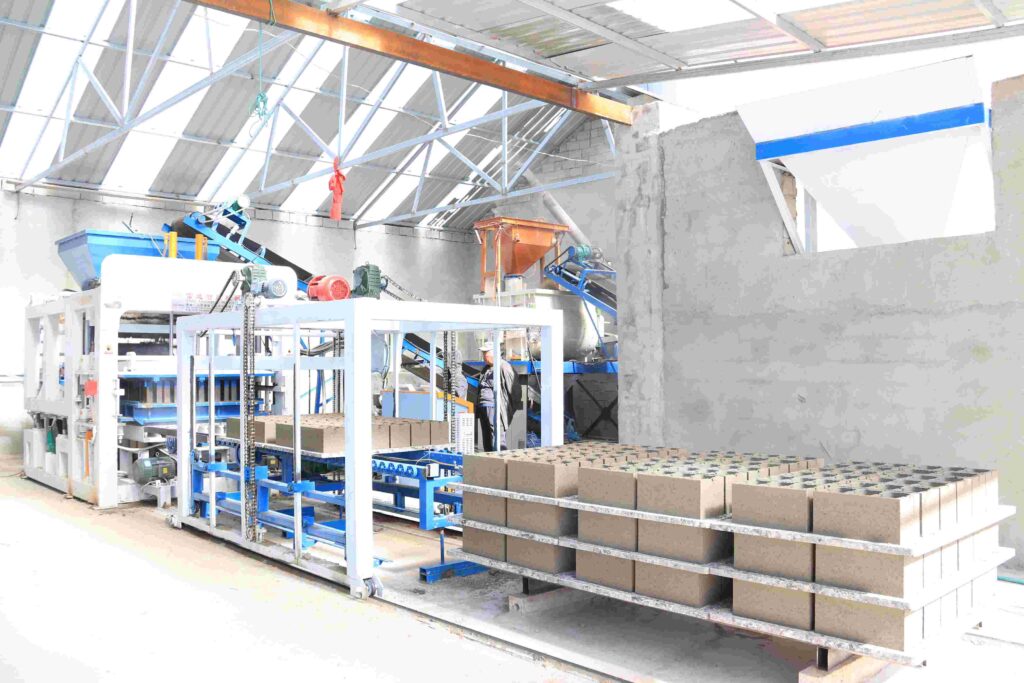
Une machine à blocs est conçue pour produireBlocs de maçonnerie en béton (BMB)communément appelés blocs de béton. Ce sont des unités de grand format, principalement creuses.
- Dimensions typiques :Un bloc complet standard mesure 8 pouces de hauteur, 8 pouces de profondeur et 16 pouces de longueur (dimensions nominales, incluant un joint de mortier). Les machines produisent également une gamme d'unités plus petites, comme des demi-blocs et des blocs de cloison.
- Fonction principale :Construction structurelle. Les blocs sont utilisés pour les murs porteurs, les murs de fondation, les cloisons et les structures de soutènement. Leur taille et leur conception à âme creuse offrent une résistance, permettent l'insertion de barres d'armature verticales et de coulis de renforcement, et procurent une résistance au feu inhérente ainsi qu'une masse thermique.
1.2. La machine à briques : Précision pour le surfaçage et la maçonnerie esthétique
Une machine à briques fabrique des briques pleines ou creuses.Briques d'argile ou de bétonCe sont des unités plus petites et plus denses.
- Dimensions typiques :Une brique modulaire standard mesure approximativement 2 ¼ pouces de hauteur, 3 ⅝ pouces de profondeur et 7 ⅝ pouces de longueur (nominal). Il existe de nombreuses autres normes de taille.
- Fonction principale :Finitions de surface et esthétiques. Les briques sont principalement utilisées comme matériau de parement (placage) sur un support structural, pour des murs d'accent intérieurs et dans des cloisons non porteuses. Leur valeur découle de la consistance des couleurs, de la texture de surface et de l'attrait architectural.
2. Divergences mécaniques et opérationnelles fondamentales
Les machines elles-mêmes sont conçues différemment pour répondre aux exigences spécifiques de leurs lignes de produits.
2.1. Échelle de la machine et pression de moulage
- Machines à blocs :Il s'agit de systèmes industriels robustes. Ils doivent appliquer une pression hydraulique considérable — souvent de 500 à plus de 2 000 tonnes — pour compacter un grand volume de béton à faible affaissement. Les moules (palettes) sont de grande taille, et l'ensemble du châssis est conçu pour résister à ces contraintes cycliques intenses. Les systèmes de vibration sont à haute amplitude pour stabiliser les gros granulats dans la cavité du moule.
- Machines à briques :Bien qu'encore robustes, elles fonctionnent avec des plages de pression nettement inférieures, généralement de 50 à 400 tonnes, suffisantes pour densifier le mélange de matériaux plus fins et plus plastiques. L'accent est mis sur la précision et la finition de surface à une échelle plus réduite. La vibration est souvent de fréquence plus élevée et d'amplitude plus faible pour obtenir une texture de surface très serrée et lisse, sans repousser les agrégats de la face.
2.2. Matières premières et conception du mélange
- Mélange pour machine à blocs Utilizes a “dry-cast” or “no-slump” concrete. The aggregate is coarse (e.g., 3/8″ pea gravel or crushed stone), and the water-to-cement ratio is very low—just enough for hydration. The mix must be cohesive enough to hold its shape immediately after the high-pressure mold is removed, relying on “green strength.” Supplementary materials like fly ash are common.
- Brick Machine Mix (Concrete): For concrete pavers and bricks, the mix is a “wet-cast” or semi-dry mix with finer sand aggregates and slightly higher moisture content to achieve a denser, less porous finish. For clay bricks, the machine processes plastic, extrudable clay with controlled moisture, which is then wire-cut and fired in a kiln—a fundamentally different process from concrete consolidation.
2.3. The Molding and Curing Process
- Block Molding Cycle: The process is one of compactage à haute pression. Concrete is fed into a mold, subjected to simultaneous vibration and massive downward pressure from a hydraulic head, and then the mold rises to eject the block onto a pallet. Curing is achieved through controlled, low-pressure steam curing in kilns for 18-24 hours to accelerate strength gain.
- Brick Molding Cycle (Concrete): The process emphasizes precision filling and surface finishing. For pavers, a “press and lift” action is common, where the mold cavities are filled, compressed, and then the product is stripped. For clay, an extruder forces the plastic clay through a die, and a wire cutter slices it to size, followed by drying and high-temperature firing (over 1,000°C) in a kiln for several days.
3. Resulting Product Characteristics and Performance Metrics
The machinery differences manifest directly in the performance profile of the end product.
3.1. Structural Properties and Application
- Block Output: High compressive strength (e.g., 1,500 – 3,000+ psi) but lower tensile strength. Engineered as a system with grout and rebar for composite structural performance. Its large format builds wall area quickly.
- Brick Output: High compressive and tensile strength, especially for fired clay bricks. However, bricks are used as a veneer or finish layer. Their structural role in modern construction is typically limited to low-rise, non-load-bearing applications unless part of a reinforced brick masonry system.
3.2. Physical and Aesthetic Properties
- Density and Weight: Blocks are lighter per unit volume due to their hollow cores. A standard CMU weighs 28-35 lbs. Solid concrete or clay bricks are significantly denser and heavier per unit.
- Absorption d'eau High-quality fired clay bricks have very low absorption (<5%). Concrete blocks have higher absorption (though controlled by mix design) but are often used in conjunction with surface sealants or as a backup wall behind a veneer.
- Surface Finish and Variety: Brick machines, especially for clay, offer an immense variety of colors, textures (rustic, smooth, sand-struck), and finishes (glazed, unglazed). Block machines focus on functional textures (split-face, ribbed, smooth) but with less chromatic variation unless pigments are added to the concrete mix.
4. Commercial and Supply Chain Implications
Understanding these differences guides critical business decisions for distributors and buyers.
4.1. Market Segmentation and Client Advisory
A distributor must guide clients based on project needs:
- Recommend Block Machine Products For: Foundation walls, structural partitions, sound barrier walls, fire-rated assemblies, and large-scale commercial/infrastructure projects where speed of erection and structural integration are key.
- Recommend Brick Machine Products For: Architectural facades, residential exteriors, interior accent walls, pedestrian paving, landscaping features, and any application where aesthetic permanence, color fidelity, and traditional craftsmanship are the primary drivers.
4.2. Inventory, Logistics, and Supplier Partnerships
- Inventory Strategy: Blocks are bulky but lighter per piece and often sold in large, strapped cubes. Bricks are dense, heavy per piece, and require careful handling to avoid chipping. Storage and handling solutions differ.
- Supplier Specialization: Manufacturers often specialize in one domain. A block plant is a capital-intensive concrete operation. A brick plant (especially clay) is a ceramics operation with expertise in kiln firing and glaze chemistry. Partnering with the right specialist is crucial for product quality.
- Services à valeur ajoutée : For bricks, distributors may need to manage complex samples for color approval. For blocks, technical support may revolve on structural data, reinforcing details, and fire rating specifications.
Conclusion
The block machine and the brick machine are not interchangeable; they are complementary pillars of the masonry supply chain, each optimized for a distinct segment of the built environment. The block machine is the workhorse of structural efficiency, delivering large-format, engineered units through immense force and process control. The brick machine is the artisan of architectural expression, delivering smaller, denser units where surface aesthetics, color, and detail are paramount. For the astute distributor or procurement professional, this distinction is a strategic lens. It informs product knowledge, shapes marketing narratives, and dictates partnership strategies. By clearly articulating the “why” behind each machine’s design and output, you move beyond selling commodities to providing expert material solutions, ensuring that every project is built on a foundation of both strength and beauty, with the right machine-made component for the task.
FAQ (Frequently Asked Questions)
Q1: Can one machine ever produce both high-quality bricks and blocks?
A : While some multi-purpose machines exist, they are typically compromises. A machine powerful enough to properly compact a block lacks the finesse for a perfect brick surface finish, and vice-versa. For commercial-scale production requiring consistent, specification-grade quality, dedicated machinery is the industry standard. A “combo” machine might suit a niche, small-batch market but is unlikely to meet the volume or quality demands of major distribution.
Q2: Which product type generally has a higher production cost per unit area of wall?
A : Direct cost comparison is complex. While an individual block costs more than an individual brick, it covers far more wall area. Installed cost depends on material price, laying speed, and labor. Block walls can be erected faster due to the larger unit size but may require finishing. Brick veneer has a lower material cost per unit but higher installation labor due to the number of units and precision required. The true cost is project-specific, factoring in structural needs, aesthetics, and local labor rates.
Q3: How do sustainability profiles compare between machine-made blocks and bricks?
A : Both have strong sustainable attributes, but differently. Block Machines excel at incorporating industrial by-products (fly ash, slag) and recycled concrete aggregate, reducing embodied carbon. Their thermal mass also contributes to building energy efficiency. Brick Machines (Clay): Clay is a natural, abundant material. Fired clay bricks are incredibly durable (100+ year lifespan), require minimal maintenance, and are fully recyclable. The energy intensity of the kiln firing is the primary environmental focus, with manufacturers increasingly using alternative fuels and heat recovery.
Q4: From a procurement perspective, what key specifications should I request from a block supplier vs. a brick supplier?
A :
- For Block Suppliers: Request Résistance à la compression (ASTM C90), Moisture Absorption (ASTM C140), Fire Rating (UL/ULC listing), Dimensions (ASTM C90), and Weight. Also inquire about mix design (e.g., % of SCMs like fly ash).
- For Brick Suppliers: Request Résistance à la compression (ASTM C67), Absorption d'eauetSaturation Coefficient (for freeze-thaw durability), Efflorescence Potential, Size Variation tolerances, and Color Consistency data (from production runs). For clay brick, the Type (SW, MW, NW for weathering) is critical.
Q5: Are there hybrid products that blur the line between block and brick?
A : Yes, and they represent growing market segments. Thin Brick Veneer Units are brick faces produced by brick machinery but used as a cladding. Autoclaved Aerated Concrete (AAC) Blocks are lightweight, insulating blocks produced in a chemical process, not by a standard block machine. Large-Format Clay Masonry Units are essentially clay blocks. When dealing with these hybrids, it is essential to focus on the performance specification (structural, thermal, aesthetic) rather than the generic name to ensure correct application.