
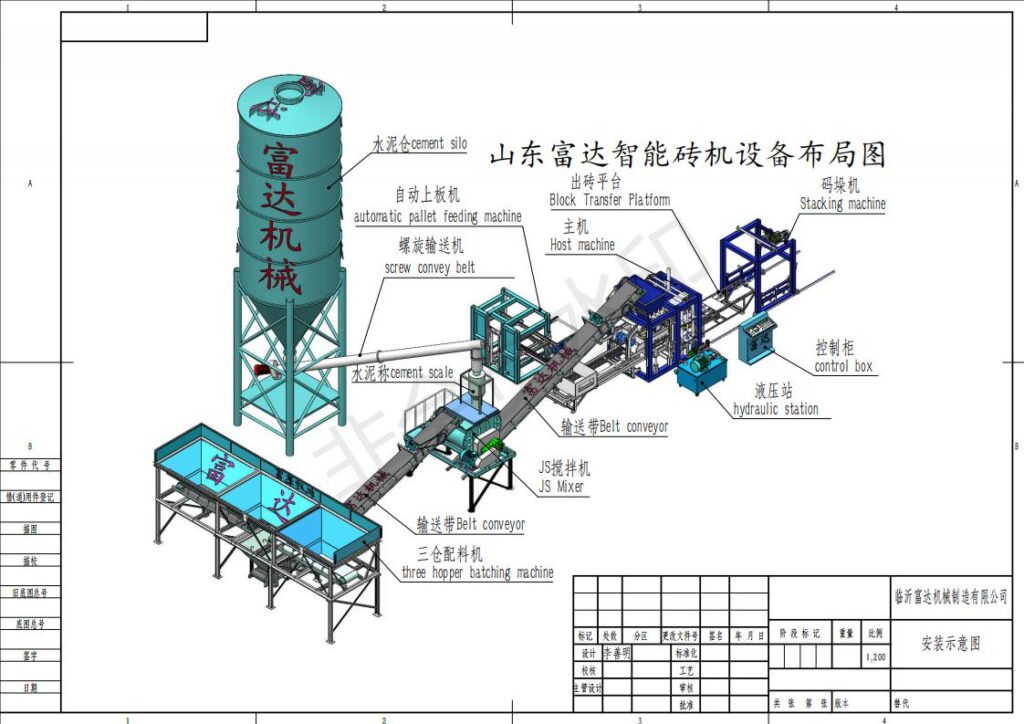
Calcul du plan spatial pour une usine de blocs de béton
La superficie totale requise est la somme de plusieurs zones interconnectées. Une usine bien conçue facilite un flux linéaire et fluide des matières, depuis l'entrée des matières premières jusqu'à l'expédition des produits finis.
1. Zone de production principale : le cœur des opérations
Cette zone abrite la machinerie principale et les processus immédiats.
1.1. Empreinte au sol des machines et dégagement opérationnel
Commencez par les spécifications du fabricant pour la machine à blocs elle-même, y compris la longueur, la largeur et la hauteur. Crucialement, vous devez ajouter des éléments significatifs.Autorisation opérationnellede tous les côtés. Cet espace est nécessaire pour :
- Accès d'entretien à toutes les parties de la machine.
- Déplacement sécuritaire du personnel et des petits outils.
- Espace suffisant pour le mouvement du convoyeur de produits ou du système de transfert.
En règle générale, la zone consacrée à la machine et à son espace de travail immédiat devrait être au moins 2,5 à 3 fois plus grande que l'empreinte de la machine elle-même.
1.2. Zone d'alimentation et de mélange des matières premières
Adjacent à la machine se trouve la station de dosage et de mélange. L'espace doit pouvoir accueillir :
- Baies d'agrégation Separate, walled compartments for storing different grades of sand and aggregate. The number and size depend on daily consumption and delivery frequency.
- Cement Silo: A towering structure requiring a stable foundation and clearance for bulk tanker delivery trucks.
- Water Tank and Additive Storage: Space for tanks and chemical containers.
- Malaxeur à béton : Positioned to easily receive materials and discharge mix to the block machine’s feeder.
2. Curing and Drying Zone: The Critical Patience Chamber
This is often the most space-intensive part of the operation.
2.1. Curing Rack Systems
After molding, blocks on pallets must be stored for initial setting and strength gain. This requires:
- Green Block Storage: Space for racks to hold freshly produced blocks for 24-48 hours.
- Curing Area: If using steam curing chambers or rooms, these enclosed structures require significant floor space and height. If using natural curing, a vast, covered area is needed to protect blocks from sun and rain while allowing air circulation.
Adequate aisle space between racks for forklifts or stackers is non-negotiable for efficiency and safety.
2.3. Drying and Final Storage
After curing, blocks need additional drying time to reach optimal shipping moisture content. This requires another large, covered storage area, logically positioned before the loading bay.
3. Logistics and Ancillary Zones: Supporting the Flow
3.1. Raw Material Reception and Storage (External)
Adequate yard space is required for delivery trucks to maneuver, dump aggregates, and for the front-end loader to operate. This includes space for a backup stockpile of aggregates.
3.2. Finished Product Storage Yard
This is the staging area for orders ready for dispatch. It must be organized to allow efficient loading of customer trucks. The required size is a direct function of production capacity and sales volatility; a plant building to stockpile inventory will need a much larger yard than one operating on strict just-in-time orders.
3.3. Ancillary Spaces
- Power Substation: Dedicated, secure space for electrical panels, transformers, and generators.
- Maintenance Workshop: A small bay for repairing pallets, fixing machinery parts, and storing tools.
- Office and Staff Facilities: Basic administrative space and amenities for workers.
Conclusion: Space as a Strategic Asset, Not Just a Cost
In conclusion, determining the space for a block making factory is an exercise in strategic planning that directly impacts operational efficiency, scalability, and long-term profitability. The guiding principle should be material flow efficiency over mere minimization of square footage. For a distributor or consultant, the goal is to help the client visualize not just a machine in a shed, but a complete ecosystem where raw materials enter one end and finished blocks exit the other with minimal backtracking or congestion. Recommending a layout that includes reasonable space buffers for each functional zone is an investment in the plant’s future resilience. A well-planned factory, with room for an additional curing rack, a future second production line, or expanded raw material storage, provides the agility to capitalize on market growth. Ultimately, the right amount of space is the foundation upon which a safe, productive, and competitive business is built.
Foire aux questions (FAQ)
Q1: What is a realistic total area range for a start-up block plant?
A1: For a semi-automatic to fully automatic plant with a moderate daily output (e.g., 5,000 – 10,000 blocks), a total enclosed and yard space of 8,000 to 15,000 square meters is a common starting point. Smaller, manual operations may function on 2,000-3,000 sqm, while large, fully automated factories with high inventory may require 20,000+ sqm.
Q2: How critical is ceiling height?
A2: Extremely critical, especially in the curing and storage zones. Standard industrial racks can be 4-5 levels high. A minimum clear ceiling height of 6-8 meters is often required to utilize vertical space efficiently with forklifts or stackers. The production hall housing the machine must also accommodate the machine’s height and any overhead conveyors.
Q3: What are the most common spatial planning mistakes?
A3: Key mistakes include: underestimating curing/storage space (which becomes the bottleneck); failing to provide adequate truck maneuvering room; placing raw material storage too far from the mixer; and having no room for maintenance or future equipment. Poor aisle width planning that hinders material handling is also frequent.
Q4: Does the type of block product affect space needs?
A4: Absolutely. Producing large, solid blocks or heavy retaining wall units results in a lower unit count per square meter of storage. Producing small pavers or hollow blocks allows for denser storage. A product mix with long curing times (like certain paving stones) will also increase the need for curing space.
Q5: How should a client approach buying or leasing land based on this?
A5: Advise clients to finalize their core equipment choice and create a preliminary layout avant securing land. Use the calculated total area, then add a 25-35% buffer zone for unforeseen needs, expansion, and ancillary functions like parking. Prioritize sites with room for expansion on at least one side. Securing a slightly larger plot at the outset is almost always more cost-effective than relocating a constrained operation later.
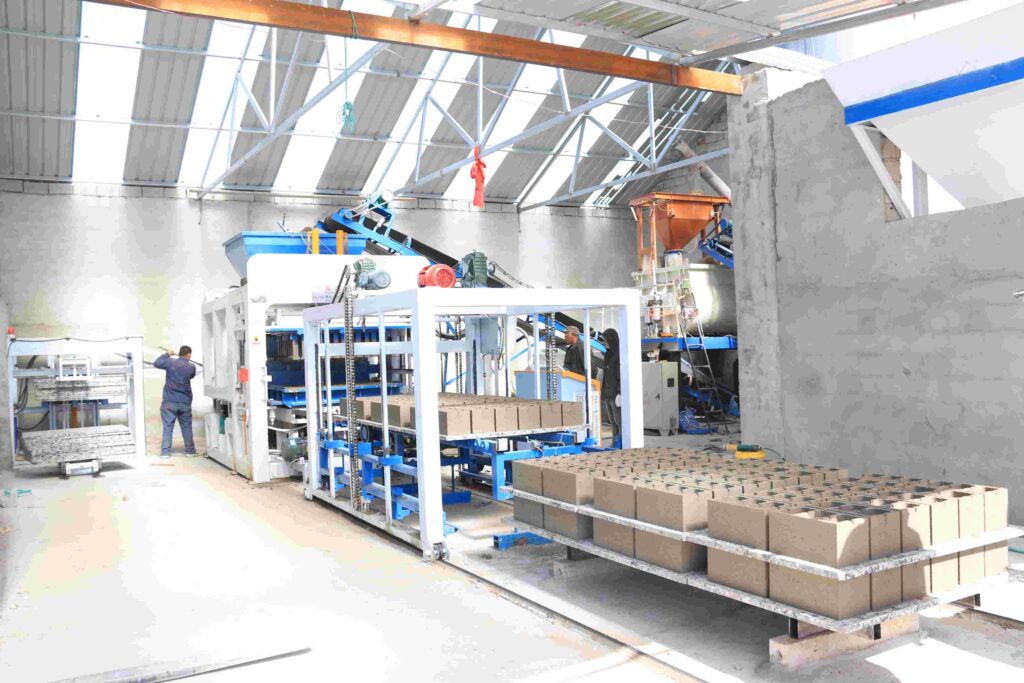
- machine automatique de fabrication de blocs7 products
- Machine à fabriquer des blocs d'argile4 products
- machine à fabriquer des blocs mobiles4 products
- autres équipements de construction5 products
- machine semi-automatique de fabrication de blocs4 products