Introduction à la technologie de production automatisée dans les matériaux de construction
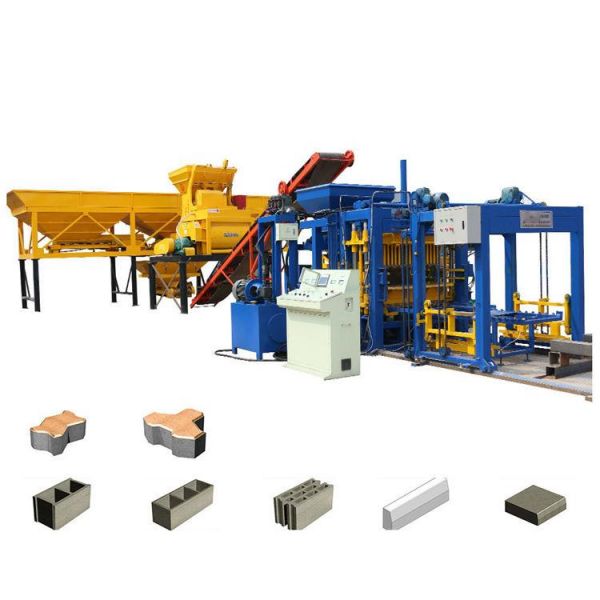
Le paysage contemporain de la construction subit une transformation fondamentale, poussée par des exigences d'efficacité, de précision et d'évolutivité sans précédent. À l'avant-garde de cette révolution se trouvent les machines automatiques de fabrication de blocs de briques, qui représentent l'apogée de la technologie de fabrication dans le secteur des matériaux de construction. Ces systèmes ne sont pas de simples outils ; ce sont des usines de production entièrement intégrées qui fonctionnent avec une intervention humaine minimale, produisant des unités de maçonnerie de haute qualité et constantes 24 heures sur 24. Pour les distributeurs, les responsables des achats et les investisseurs industriels, comprendre cette technologie est essentiel pour tirer parti de l'avenir de la construction.
Analyse complète des systèmes automatisés de production de briques et de blocs
1.1 L'architecture des lignes de production automatisées
Les systèmes entièrement automatiques représentent un écart complet par rapport aux équipements autonomes, fonctionnant plutôt comme des écosystèmes industriels synchronisés où chaque composant opère avec une précision robotique.
- Gestion intégrée des matières premières :Le processus commence par des systèmes automatisés de manutention des matériaux qui reçoivent, mesurent et transfèrent les matières premières avec précision. Ces systèmes comprennent généralement des silos en vrac pour le ciment, des convoyeurs automatisés pour les granulats et des systèmes de mesure d'eau de précision. Le dosage contrôlé par ordinateur garantit des proportions de mélange parfaites de manière constante, éliminant les erreurs humaines et le gaspillage de matériaux.
- Contrôle centralisé et synchronisation :L'intelligence centrale réside dans un contrôleur logique programmable (PLC) de qualité industrielle couplé à une interface homme-machine (IHM) à écran tactile. Ce centre de contrôle orchestre chaque aspect de la production, de la fréquence de vibration et de la pression hydraulique jusqu'à la température de la chambre de durcissement et le cycle des palettes. Les systèmes modernes incluent souvent une connectivité IoT pour la surveillance à distance et l'analyse des données, permettant une maintenance prédictive et l'optimisation de la production.
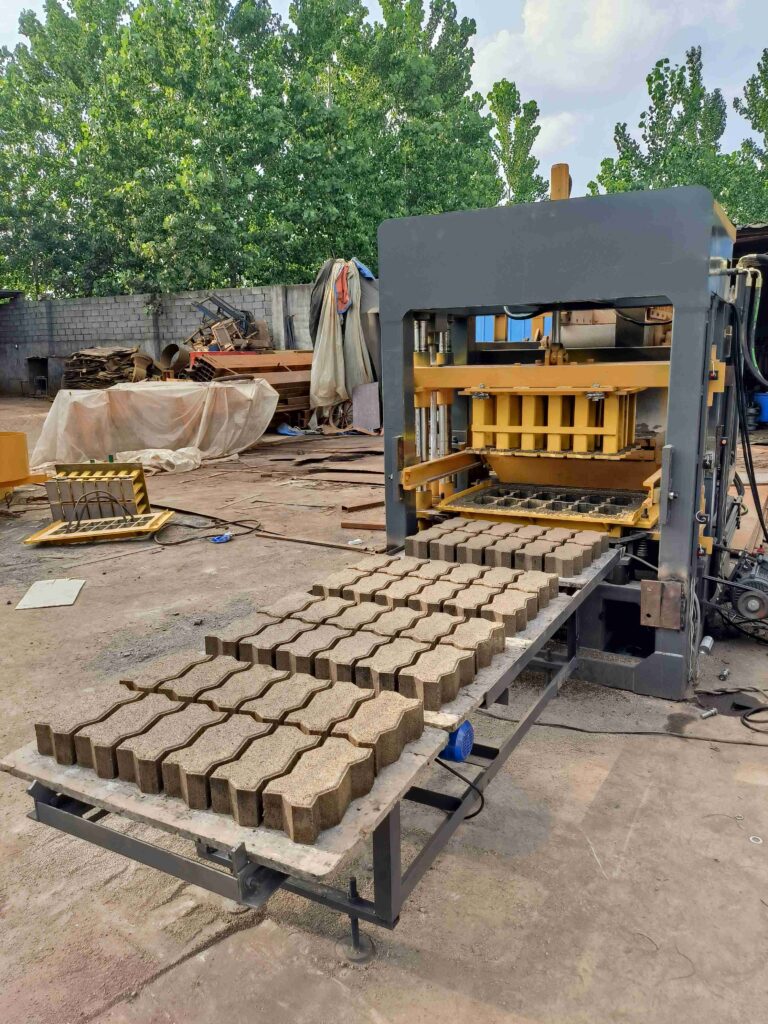
- Moulage et Compactage à Haute Vitesse The heart of the system is a high-speed compression unit that utilizes multi-directional vibration and immense hydraulic pressure to achieve optimal material density. Unlike simpler machines, these systems often feature simultaneous molding of multiple blocks on a single pallet, with cycle times measured in seconds. The precision-engineered mold boxes can be automatically changed in some advanced models to switch production between different block types without downtime.
- Automated Curing and Logistics Handling: Once molded, blocks embark on a fully automated journey through the curing process. Robotic arms or sophisticated cross-transfer cars place green products onto curing racks, which are then transported via automated guided vehicles (AGVs) or conveyor systems through temperature and humidity-controlled curing chambers. The final stage involves automated depalletizing, stacking, and wrapping, resulting in ready-to-ship pallets without manual handling.
1.2 Classification by Production Methodology and Output Scale
Automatic systems can be categorized based on their operational methodology and production volume capabilities.
- Static Pallet System Production Lines: In these configurations, pallets remain stationary during the molding process while the molding head moves between stations. These systems are renowned for their exceptional product quality and density, making them ideal for producing high-strength concrete blocks, paving stones, and specialized masonry units where supreme quality is paramount.
- Mobile Pallet System Production Lines: Characterized by pallets that move in a continuous circuit through various stations—filling, compaction, curing, and destacking. These systems typically offer higher production speeds and are optimized for manufacturing standard hollow blocks, solid bricks, and similar construction elements where volume production is the primary objective.
- Fixed Table Press Systems with Robotic Handling: Featuring a stationary pressing table surrounded by robotic arms for all material and product handling. This configuration provides maximum flexibility for producing complex, specialized products while maintaining high levels of automation, suitable for manufacturers requiring frequent product changeovers and custom designs.
1.3 The Strategic Business Advantages of Automation
The implementation of automatic production systems delivers transformative benefits that extend far beyond basic production.
- Unprecedented Operational Efficiency and Labor Optimization: A single automated line can replace 20-50 manual workers while producing 3-5 times more output. The 24/7 operational capability, with only minimal supervision, fundamentally alters production economics, making large-scale projects feasible and profitable.
- Mathematical Precision and Quality Assurance: Every unit produced is identical in dimension, weight, and density. This level of consistency enables construction projects to proceed with perfect predictability, reducing mortar consumption, simplifying bricklaying, and ensuring compliance with the most stringent international quality standards.
- Total Production Cost Minimization: While the capital investment is substantial, the per-unit production cost reaches unprecedented lows. Savings accumulate from reduced labor costs, optimized material usage, minimized waste, lower energy consumption per unit, and dramatically reduced product damage from automated handling.
- Data-Driven Production Management and Optimization: Modern systems generate comprehensive production data, allowing managers to analyze efficiency, identify bottlenecks, predict maintenance needs, and optimize every parameter of the operation. This data intelligence becomes a strategic asset for continuous improvement and competitive advantage.
1.4 Implementation Scenarios and Market Applications
Automatic systems serve specific, high-volume market segments where scale, consistency, and reliability are non-negotiable.
- Major Infrastructure and Development Projects: These systems are indispensable for supplying the massive quantities of uniform blocks required for large-scale housing developments, industrial parks, commercial complexes, and government infrastructure projects.
- Specialized Product Manufacturing at Scale: The technology enables economically viable production of specialized blocks such as interlocking masonry systems, insulated concrete forms (ICFs), architectural facing stones, and permeable pavers at commercial volumes.
- Export-Oriented Production Facilities: The consistent international quality standards achieved by automated production make them ideal for manufacturers targeting export markets where product certification and uniformity are critical requirements.
- Integrated Industrial Complexes: These systems form the core of comprehensive construction material plants that may also produce ready-mix concrete, precast elements, and other complementary products, creating powerful synergies and market dominance.
1.5 Strategic Procurement and Implementation Framework
The acquisition and implementation of an automatic production system requires meticulous planning and strategic consideration.
- Comprehensive Production Requirement Analysis: Prior to procurement, a detailed analysis must determine the required production capacity, product mix, quality specifications, and future expansion plans. This analysis should project 5-10 year requirements to ensure the system remains viable as the business grows.
- Total Cost of Ownership and Financial Modeling: Beyond the initial investment, a sophisticated financial model must account for installation costs, training expenses, maintenance contracts, energy consumption, spare parts inventory, and expected ROI. Financing options and potential government incentives for industrial automation should be explored.
- Technical Support and Service Level Agreements: The supplier’s technical support capability is arguably as important as the machine itself. Comprehensive service level agreements should guarantee response times, spare parts availability, remote troubleshooting support, and periodic maintenance services.
- Infrastructure and Regulatory Compliance Assessment: The implementation site must be evaluated for adequate power supply, foundation requirements, material storage areas, and environmental regulations. Compliance with industrial safety standards and building codes must be thoroughly addressed before installation.
Conclusion
Automatic brick and block making systems represent the definitive evolution of construction material production, transitioning from a labor-intensive craft to a technology-driven industrial process. For serious players in the building materials supply chain, these systems offer a pathway to market leadership through unassailable efficiency, impeccable quality, and unprecedented scale. The substantial capital investment demands rigorous due diligence and strategic planning, but the回报—in terms of market share, profitability, and long-term business sustainability—can be transformative. As global construction continues to evolve toward industrialization and standardization, automated production technology will increasingly become the benchmark for competitive relevance in the building materials industry.
Frequently Asked Questions (FAQ)
Q1: What is the typical installation and commissioning timeline for a complete automatic production line?
A: The timeline varies based on system complexity but typically spans 4-8 months. This includes: factory foundation preparation (4-6 weeks), machine manufacturing and shipment (8-12 weeks), on-site assembly and installation (4-6 weeks), and commissioning with operator training (2-3 weeks). Pre-installation planning can significantly optimize this timeline.
Q2: How many operators are typically required to run a fully automatic production line?
A: A complete system typically requires 2-3 operators per shift for monitoring, quality control, and managing raw material input. This represents a reduction of approximately 80-90% in direct labor compared to semi-automatic production methods for equivalent output.
Q3: What level of technical expertise is required to maintain these systems?
A: Maintenance requires trained technicians with knowledge of industrial hydraulics, pneumatics, electrical systems, and PLC operations. Most suppliers provide comprehensive training programs, and many systems now feature predictive maintenance alerts that notify technicians of potential issues before they cause downtime.
Q4: Can these systems produce different types of blocks without significant downtime?
A: Modern systems are designed for rapid product changeover. While switching between dramatically different products (e.g., from hollow blocks to paving stones) may require mold changes taking 1-2 hours, many systems can adjust parameters for similar product variations through the control panel in minutes.
Q5: What are the primary power requirements for operating an automatic production line?
A: Most industrial-scale systems require a high-voltage three-phase power supply (typically 380V-480V) with substantial amperage capacity. Total connected power can range from 80kW to over 200kW depending on the system size and configuration, with significant power factor correction capabilities.
Q6: How does the product quality from automatic systems compare to traditional methods?
A: The quality is substantially superior in every measurable aspect. Automatic systems produce blocks with consistent dimensional accuracy (±1mm), uniform density distribution, higher compressive strength (due to optimized vibration and pressure), and perfect surface finish, far exceeding what is achievable through manual or semi-automatic methods.