
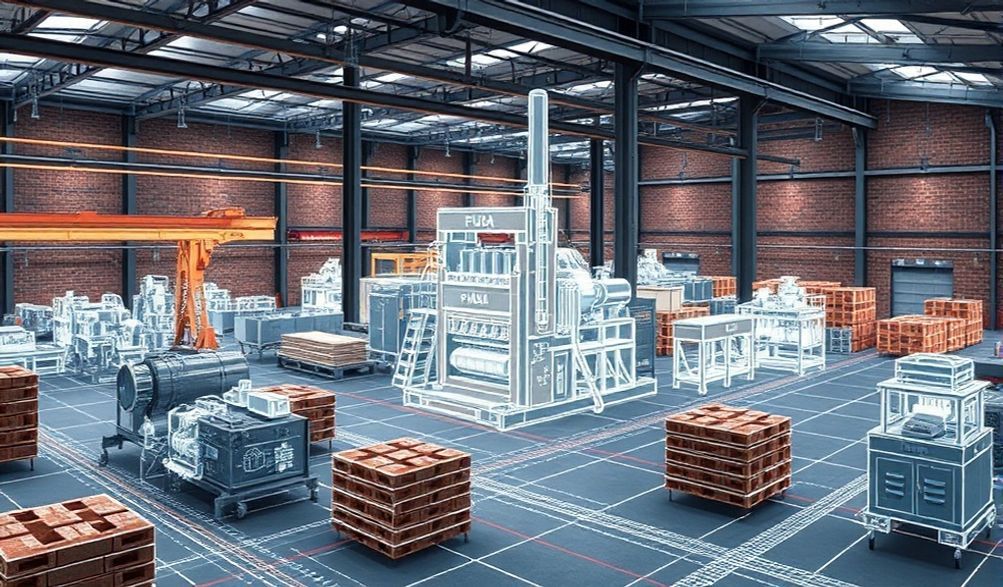
The Ultimate Guide to Factory Machine CAD Blocks: Streamlining Design for Your FUDA Brick Machine Factory
Introduction
Every minute spent searching for a missing or inaccurate component in a digital design is a minute stolen from innovation and production. In the high-stakes world of industrial manufacturing, this inefficiency isn’t just frustrating—it’s costly. For engineers and planners designing or optimizing a brick manufacturing plant, the challenge is magnified by the need for precision in every conveyor, mixer, and press.
This is where the humble CAD block becomes a hero.
Computer-Aided Design (CAD) blocks are the fundamental building blocks of modern factory planning. They are the reusable, standardized digital representations of physical objects—from an entire brick-making machine to a simple electrical panel. For a Usine de machines à briques FUDA, leveraging precise CAD blocks isn’t a luxury; it’s a critical step in ensuring a seamless, efficient, and safe production line from the digital model to the concrete floor.
This guide is crafted specifically for the professionals behind the scenes: the project engineers, factory layout specialists, and procurement managers working with FUDA brick-making machinery. We will move beyond generic advice to provide a targeted roadmap. Our focus is on the strategic sourcing, rigorous verification, and effective implementation of high-quality factory machine CAD blocks.
Built on industry best practices for technical documentation, this guide prioritizes accuracy and reliability above all else. In the spirit of E-E-A-T (Experience, Expertise, Authoritativeness, Trustworthiness), we emphasize that trustworthy digital designs are the foundation of trustworthy physical operations.
Thesis Statement: This post will provide a comprehensive roadmap to finding, evaluating, and implementing precise CAD blocks for FUDA machinery and ancillary factory equipment, ensuring your digital designs are as robust as your physical production line.
Understanding CAD Blocks and Their Critical Role in Industrial Design
Before diving into sourcing, it’s essential to understand what CAD blocks are and why they are indispensable in an industrial context.
What Are CAD Blocks? (Beyond the Basic Definition)
At its core, a CAD block is a named, reusable collection of geometry (lines, arcs, circles in 2D; solids and meshes in 3D) that represents a single object. Think of it as a digital stamp for a machine component.
- They are standardized symbols for common items.
- They promote consistency: Every time you insert a “FUDA QT6-15 block,” it’s identical, ensuring drawing uniformity.
- They drive efficiency: Dragging and dropping a block is infinitely faster than redrawing a complex machine from scratch for every new layout.
Their use extends across critical documents:
* Factory Layout Drawings: For spatial planning and machine placement.
* Piping & Instrumentation Diagrams (P&IDs): For process flow planning.
* Installation & Foundation Plans: For guiding construction crews.
* Maintenance Documentation: For illustrating component locations.
Why Precision CAD Blocks Are Non-Negotiable for a Brick Machine Factory
In a generic office layout, a slightly undersized desk block might cause a minor spacing issue. In a factory, an inaccurate CAD block can lead to catastrophic and expensive failures.
The stakes are particularly high for a brick plant, where machines are heavy, interconnected, and process bulk materials.
Consequences of Inaccurate Blocks:
- Integration Failures: A block for a FUDA extruder that is even 5% undersized might show it fitting in a space where, in reality, it collides with a support column or a conveyor feed. This leads to last-minute, costly rework during installation.
- Safety Clearance Violations: Maintenance spaces, operator walkways, and emergency exits planned with inaccurate blocks can violate safety codes, creating hazards.
- Utility Hookup Errors: Misplaced power inlet or water connection points on a block can mean conduits and pipes are routed to the wrong location, requiring expensive modifications.
For your Usine de machines à briques FUDA, precision means:
* Seamless Line Layout: Ensuring material flows smoothly from the mixer through the extruder, cutter, and stacker without bottlenecks.
* Accurate Material Flow Planning: Correctly sizing and placing conveyor blocks to handle the output of your specific FUDA press model.
* Foolproof Utility Design: Knowing the exact location of every electrical and hydraulic connection to design efficient plant services.
Sourcing Authoritative CAD Blocks for Factory Machinery
Not all CAD blocks are created equal. Your sourcing strategy must prioritize verifiable accuracy over convenience. Here’s a hierarchy of sources, from most to least authoritative.
Primary Source: Official Technical Documentation from FUDA
This is the gold standard and your first, best option.
- E-E-A-T Focus: CAD files obtained directly from the original equipment manufacturer (OEM) carry inherent Authoritativeness and Trustworthiness. They are the digital equivalent of the machine itself.
- How to Access: Official 2D (DWG/DXF) or 3D (STEP, SAT) files are often included in the machine’s purchase documentation package. If not, your primary contact should be:
- FUDATechnical SupportouEngineering Department.
- Your FUDA sales representative, who can request them from the factory.
- À quoi s'attendre : These blocks come in defined formats and detail levels. You might receive:
- Simplified Outline Blocks: Perfect for factory layout drawings, showing only the accurate footprint, height, and major connection points.
- Detailed Assembly Blocks: Useful for creating maintenance manuals or detailed integration studies, showing major sub-components.
Reputable Third-Party CAD Libraries and Platforms
When official files are not immediately available, turn to established professional libraries.
Evaluation Criteria for a Third-Party Source:
- Provider Reputation: Is the platform known for serving professional engineers (e.g., TraceParts, CADENAS, Thomasnet) or is it a generic “free download” site?
- User Reviews & Ratings: Do other professionals comment on the accuracy of the blocks?
- Update Dates: Are the blocks recent, or are they decades old?
- Sourcing Information: Does the listing cite the manufacturer (e.g., “FUDA Brick Making Machinery”) and provide a model number?
A Critical Caution: Be extremely wary of websites offering thousands of “free CAD blocks.” These are often user-uploaded with no verification. The risk of scaling errors, incorrect geometry, and outdated models is exceptionally high—a dangerous gamble for a professional project.
The Role of Professional CAD Communities and Forums
Platforms like Eng-Tips, CADTutor, or specific Autodesk user forums can be valuable resources.
- Community Wisdom: Experienced draftsmen sometimes share verified blocks or tips on where to find them.
- Making Requests: You can post a request for a specific FUDA machine block, but always frame it professionally: “Seeking verified 2D outline for FUDA QMY4-30 block. Willing to cross-verify with official dimensions.”
- Prioritize Cited Sources: Give more credence to a user who provides a link to the manufacturer’s page or references an official manual.
Key CAD Blocks for a Complete Brick Manufacturing Plant Layout
A brick plant is an ecosystem. Your CAD library must reflect the entire production system, not just the primary presses.
Core Production Line: FUDA Brick Machine CAD Blocks
This is the heart of your library. Ensure you have accurate blocks for each stage:
- Préparation des matières premières : Mixers, feeders, and crushers.
- Forming Process: The core FUDA machines—extruders, pressers, and cutters (e.g., models like QT4-15, QT6-15, QMY4-30).
- Handling & Curing: Stackers, palletizers, and transfer cars.
- Critical Details: Blocks must accurately show:
- Footprint & Overall Dimensions.
- Power Inlet & Control Panel Location.
- Material Feed and Discharge Points.
- Operator Access Points.
Ancillary and Support Equipment CAD Blocks
The core line cannot function in isolation. Essential supporting blocks include:
- Conveyor Systems (belt, roller, chain) of various lengths and widths.
- Raw Material Storage: Silos, hoppers, and bulk bag unloaders.
- Manutention des matériaux : Forklifts, wheel loaders, and robotic arms.
- Curing Infrastructure: Racks, chambers, and covers.
- Packaging Stations: Strapping machines, wrapping stations.
Infrastructure and Utility Blocks
These blocks ensure your plant is compliant and operational:
- Électrique : Panel boards, cable trays, transformer outlines.
- Plumbing & Pneumatics: Water lines, air compressors, hydraulic power units.
- Dust & Environmental Control: Dust collection cyclones, ductwork outlines, silencer footprints.
- Safety: Barrier fencing, fire extinguisher stations, eyewash station outlines.
Best Practices for Implementing and Managing Your CAD Library
Sourcing the blocks is only half the battle. Proper implementation turns a collection of files into a powerful, reliable design asset.
Verification and Standards Compliance
Never trust, always verify. Implement this step-by-step check for every new block:
- Scale Check: Insert the block into a blank drawing. Use the
DISTouMEASUREcommand to check a known dimension (e.g., the machine’s length from the official manual). Does it match? - Layer Audit: Check that geometry is placed on logical, standardized layers (e.g.,
EQUIP-FUDA,CONVEYOR). Avoid blocks where everything is on layer “0.” - Standard Adherence: Ensure the block’s line weights, colors, and text styles align with your company’s CAD standards or relevant industry norms (e.g., ISO, ANSI).
Organization for Maximum Efficiency
A disorganized library is a useless library. Implement a system:
- Naming Convention:
Vendor_MachineType_ModelNumber_DetailLevel.dwg- Exemple :
FUDA_Press_QT6-15_Outline.dwgouSIEMENS_Panel_SIVACON_Detail.dwg
- Exemple :
- Folder Structure:
/CAD Library/

    ├── 01_Verified_Core_Equipment/

    │   ├── FUDA/

    │   ├── Conveyors/

    │   └── Material_Handling/

    ├── 02_Verified_Infrastructure/

    ├── 03_Unverified_For_Check/

└── 04_Company_Standards/ - Master “Verified” Library: Maintain a single, controlled location for all checked blocks. This prevents team members from accidentally using old or unvetted files from their personal folders.
Customization and Creation: When You Can’t Find the Right Block
Sometimes, the perfect block doesn’t exist. In this case, creation is necessary.
- Processus : Use the FUDA equipment manual’s dimensional drawings and high-resolution photographs as references. An experienced draftsman should trace or model the key outlines.
- Document the Source: Within the block’s metadata or a readme file, note: “Custom block created from FUDA QT Series Manual, Rev. 2023, page 12. Verified by [Engineer’s Name] on [Date].”
- Expertise is Key: This task should be assigned to personnel with proven experience in technical drafting to ensure the final block is both accurate and useful.
Foire aux questions (FAQ)
Q1: Are free CAD block websites reliable for professional factory planning?
A : While tempting, they carry significant risk. Free sites often host user-uploaded content of unknown origin and accuracy. For a professional Usine de machines à briques FUDA layout, inaccuracies can lead to major installation and operational problems. Always prioritize official sources or reputable, paid professional libraries that vet their content.
Q2: What is the most important thing to check in a FUDA machine CAD block?
A : Scale and Critical Dimensions. Before use, verify the block’s dimensions (footprint, height, connection points) against the official technical datasheet or manual provided by FUDA. An error of a few centimeters in a drawing can mean a machine doesn’t fit in the allocated space.
Q3: Can I use 3D CAD blocks for 2D layout plans?
A : Yes, and it’s often advantageous. 3D blocks can be used to generate accurate 2D plan views, elevations, and sections, ensuring consistency across all your drawings. Most CAD software allows you to easily switch between views.
Q4: Who should be responsible for managing the company’s CAD block library?
A : Ideally, a senior draftsman, project engineer, or a designated BIM/CAD manager. This person ensures all blocks are verified, standardized, and organized, maintaining the integrity and reliability of all digital design work—a core principle of Expertise and Trustworthiness.
Q5: How often should our CAD block library be updated?
A : It should be updated with every new machinery purchase (using the new official files) and reviewed annually. Machinery models change, and improved, more detailed blocks may become available from official sources.
Conclusion
In the journey from concept to a fully operational Usine de machines à briques FUDA, high-quality factory machine CAD blocks are far more than digital conveniences. They are foundational tools for risk reduction, efficiency, and precision. They allow you to simulate, optimize, and validate your entire production line before the first foundation is poured.
This process embodies the E-E-A-T principle. The Expérience of past installation errors teaches us to verify. The Expertise of your engineering team is applied in meticulous sourcing and checking. This diligent practice builds the Autorité of your designs and the Fiabilité of your entire operation. The most reliable factories are built first with verified data.
Your Call to Action:
1. Audit Your Library: Use the verification steps in this guide to review your current CAD block collection.
2. Go to the Source: Proactively contact FUDA to request official CAD files for your existing and planned machinery.
3. Implement a System: Establish the organized, managed library structure outlined here to empower your entire design team.
Bookmark this guide as a reference for your next factory expansion or optimization project. Build with confidence, from the digital block to the finished brick.