
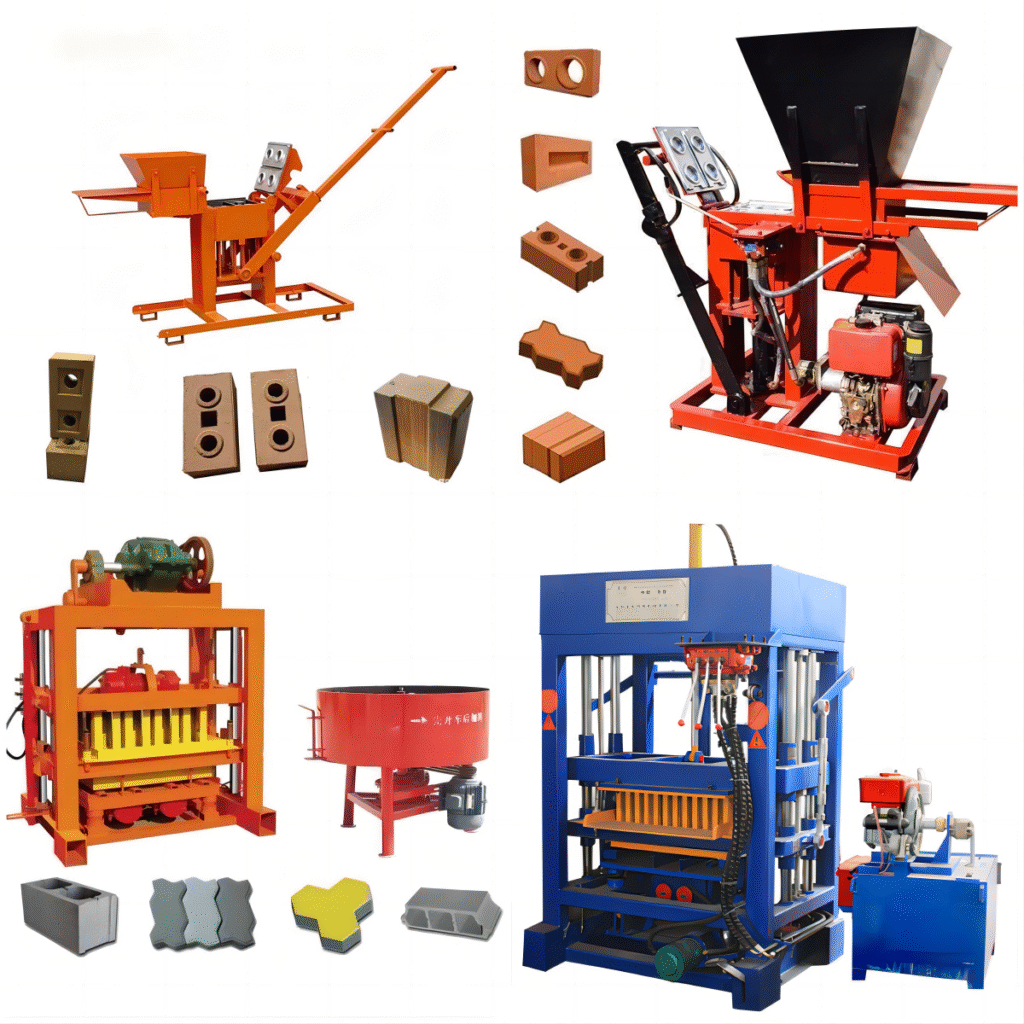
The market presents a diverse and sometimes complex array of equipment, each engineered for distinct production paradigms, raw material inputs, and end-user applications.
I. Classification by Core Process Technology and Material Application
The most critical differentiation lies in the fundamental process employed, which is intrinsically linked to the raw material used and the final product’s characteristics.
A. Hydraulic Press Machines for Concrete Products
This category represents the dominant technology for modern cement-based masonry unit production.
- Principe de fonctionnement : Utilizes high-pressure hydraulic rams to compact a low-moisture, zero-slump concrete mix within a precision mold. Compaction is frequently augmented by synchronized high-frequency vibration to eliminate voids and achieve maximum density.
- Key Product Output: Concrete hollow blocks, solid bricks, paving stones, interlocking retaining wall units, curbstones, and a wide variety of specialized landscaping products. The products gain strength through hydraulic curing (moisture and time) rather than firing.
- Positionnement Stratégique sur le Marché : Offers unparalleled versatility and is the standard for general construction. It is the primary product line for distributors serving markets with established cement and aggregate supply chains. The ability to change molds to produce different products from a single machine is a major selling point for clients seeking business flexibility.
B. Extrusion-Based Machines for Clay Brick and Tile Production
This technology is dedicated to traditional ceramic products, utilizing the plastic properties of clay.
- Principe de fonctionnement : A prepared, plastic clay body is forced under pressure through a rectangular die (the extrusion mouthpiece) by a powerful auger inside a vacuum chamber. The continuous column of clay is then cleanly cut into individual brick units by wires. The process requires subsequent drying and high-temperature firing in a kiln.
- Key Product Output: Solid, perforated, or hollow clay bricks, roofing tiles, and clay pavers. The firing process imparts the characteristic color, hardness, and durability associated with clay masonry.
- Positionnement Stratégique sur le Marché : Serves a specialized, often premium segment. Success depends on local availability of suitable clay deposits. Distributors in regions with a tradition of clay brick architecture or a demand for high-end aesthetic and weathering properties will find this a key, though capital-intensive, technology path. It appeals to clients targeting architectural facing bricks or specific industrial applications.
C. Compaction Presses for Stabilized Earth Blocks (SEBs)
Focused on sustainable and cost-effective building solutions, these machines utilize in-situ or locally available soil.
- Principe de fonctionnement : Mechanically or hydraulically compacts a mixture of soil (with engineered sand/clay/silt ratios) and a low percentage of stabilizer (typically 5-10% cement or lime) into a dense, coherent block. Many models produce interlocking blocks, designed to minimize mortar use in wall construction.
- Key Product Output: Compressed Stabilized Earth Blocks (CSEBs) or Interlocking Stabilized Soil Blocks (ISSBs). They are cured by water sprinkling and are not fired.
- Positionnement Stratégique sur le Marché : Targets the growing markets of affordable housing, sustainable construction, and rural development. It is an ideal product line for distributors operating in areas with high transportation costs for conventional materials or where eco-friendly building practices are incentivized. The value proposition is low embodied energy, excellent thermal properties, and significant mortar savings for the end-user.
II. Classification by Functional Design and Operational Methodology
Beyond the core process, the physical implementation and workflow of the machine define its application in the field.
A. Stationary Production Plants
These are fixed-installation, high-output systems designed for centralized, factory-like production.
- Caractéristiques : Heavy-duty construction, requiring a solid concrete foundation. They are often the central component of an integrated line that may include automated batching systems, mixers, conveyor belts, curing chambers, and robotic palletizers.
- Commercial Implication: Represents the high-value, high-margin segment of a distributor’s portfolio. Targets clients with established market channels, significant land access, and the capital for industrial-scale investment. These clients prioritize maximum output, consistency, and low per-unit labor cost.
B. Mobile “Egg-Laying” or “Traveling” Block Machines
Designed for maximum logistical flexibility, producing blocks directly at the point of use.
- Caractéristiques : The machine is mounted on wheels or rails. After compacting a block on a prepared level surface (a concrete slab or the ground), it moves forward to the next position, “laying” the blocks in neat rows. Production and curing occur in situ.
- Commercial Implication: Caters to the vast contractor and project-specific market. The primary value is the elimination of finished product transportation costs. This is a highly competitive and volume-driven segment for distributors, ideal for clients who move between construction sites or wish to produce on-demand for a specific development.
C. Pallet-Circulation Machines
A common design for medium to high-capacity concrete block production, balancing output with flexibility.
- Caractéristiques : Use a series of metal or wooden pallets as a moving production bed. The block is formed on a pallet, which then circulates through the machine to the ejection point, where the block (on its pallet) is transferred to a curing area. The empty pallet returns to the start of the cycle.
- Commercial Implication: The workhorse of standalone block-making businesses. Offers a strong balance between output rate and the ability to easily move green products for curing. This category is essential for distributors serving small to medium-sized enterprises (SMEs) looking to establish a permanent or semi-permanent production yard.
III. Classification by Degree of Automation and System Integration
The level of automation directly correlates to output, price point, required skill, and target customer profile.
A. Manual and Lever-Operated Machines
Human power is the primary driver of the production cycle.
- Opération : The operator manually fills the mold, engages a lever or mechanism to apply pressure, and then removes the finished product for curing. Highly labor-intensive.
- Target Client & Distributor Strategy: The entry-level price point. Targets micro-entrepreneurs, very small-scale projects, and markets with extremely low labor costs. For distributors, these are often high-volume, low-margin products used to capture first-time buyers and seed the market.
B. Semi-Automatic Machines
Automate the core pressing cycle but require manual intervention for feeding and/or product handling.
- Opération : The operator initiates a cycle (via button or pedal). The machine then automatically performs the sequence of mold filling (often from a hopper), vibration, compaction, and ejection. The operator is responsible for removing the palletized blocks and maintaining raw material supply.
- Target Client & Distributor Strategy: The broadest and most strategically important category. Perfect for growing SMEs seeking to maximize productivity with a manageable capital outlay and operational complexity. This segment offers excellent margins and opportunities for value-added services like training and spare parts supply.
C. Fully Automatic Production Lines
Complete, computer-controlled manufacturing systems with minimal human intervention.
- Opération : Integrated with PLCs, automated material handling from silo to mixer to hopper, robotic pallet handling, and sometimes automated curing and stacking. The operator’s role is supervisory, focused on monitoring, quality control, and maintenance.
- Target Client & Distributor Strategy: The high-end, project-based sales segment. Targets large investors, industrial producers, and suppliers to major infrastructure projects. Sales involve long cycles, high stakes, and require deep technical expertise and the ability to offer comprehensive after-sales support packages. Margins are significant but so are support responsibilities.
IV. Specialized and Niche Machine Types
Beyond the primary categories, several specialized machines address specific market needs.
A. Interlocking Block Machines (for Concrete or Soil)
A feature-focused sub-category where the mold design is paramount.
- Mise au point : Produces blocks with engineered protrusions and recesses that lock together vertically and sometimes horizontally. This can be a feature of hydraulic concrete presses or dedicated soil block presses.
- Market Value: Appeals to clients emphasizing construction speed, mortar reduction, and structural performance in applications like retaining walls or disaster-resistant housing.
B. Paver and Curbstone Specialized Machines
Optimized for the high-volume production of specific landscape and road products.
- Mise au point : Often feature multiple cavities and fast cycle times to produce the large quantities required for paving projects. May include specialized texturing or color-feeding systems.
- Market Value: Serves the municipal, commercial landscaping, and road construction sectors. Requires distributors to understand public tender processes and bulk supply logistics.
Conclusion
A strategic and nuanced understanding of brick machine types is not an academic exercise for the B2B professional; it is the very foundation of effective market engagement. The classification by process technology (hydraulic, extrusion, compaction) identifies the core material and product market. The classification by functional design (stationary, mobile, pallet) aligns with the client’s operational and logistical model. Finally, the classification by automation level directly maps to the client’s capital capacity, labor strategy, and growth trajectory.
For distributors and dealers, success lies in curating a portfolio that strategically addresses the key segments within their regional market, rather than attempting to offer every possible variant. By leveraging this taxonomic framework, you can conduct more insightful client consultations, accurately diagnose needs, and recommend solutions that genuinely fit. This positions your organization not as a mere order-taker, but as a knowledgeable consultant and strategic partner, capable of guiding clients through a critical capital investment to build a more profitable and resilient business. Ultimately, in the business of building with blocks, the first and most important structure to build is a robust framework of knowledge.
Foire aux Questions (FAQ)
Q1: What is the key deciding factor between recommending a concrete block machine and a clay brick extruder to a client?
A: The decision hinges on three pillars: Raw Material Availability, Product Market, and Capital. If suitable clay is locally abundant and there is demand for premium facing bricks or specific industrial tiles, clay extrusion is viable but requires major kiln investment. For general-purpose construction blocks where cement and aggregates are readily available, and the client seeks faster setup and lower upfront cost for the core machine, concrete hydraulic press technology is almost always the recommended and lower-risk path.
Q2: Can a single machine be both stationary and mobile, or both semi- and fully-automatic?
A: These are generally mutually exclusive design philosophies. A stationary plant is fundamentally fixed for high-volume flow. A mobile machine is designed for movement and on-site production. Similarly, automation level is a core engineering design; a semi-automatic machine cannot be “upgraded” to full automation without a complete redesign of its control and material handling systems. However, some pallet-based systems can be made more efficient with add-ons like automatic feeders, blurring the line between semi- and full-automation in the mid-range.
Q3: For a distributor new to this sector, which two machine types offer the best balance of market size and manageable complexity?
A: 1) Semi-Automatic, Pallet-Circulation Concrete Block Machines: This addresses the massive SME and contractor market with a product that is versatile, teachable, and serviceable. 2) Mobile “Egg-Laying” Concrete Block Machines: This captures the on-site production market, a distinct segment with clear value propositions. These two types cover a significant majority of commercial demand without the extreme technical support demands of full plant lines or the material-specialization of clay extruders.
Q4: How does the Stabilized Earth Block (SEB) machine market differ commercially from the concrete block machine market?
A: The SEB market is often project-driven and value-led rather than pure volume-supply. Clients are frequently NGOs, government housing programs, or eco-conscious developers. The sales cycle involves education on soil testing and stabilization. The competition is less on pure machine output and more on the total solution (training, soil analysis, architectural support). Margins can be good, but market volume is typically smaller and more niche than the general concrete block market.
Q5: When a client asks for “the best” machine, how should a distributor frame the response using this typology?
A: The correct response is: “The ‘best’ machine is the one that is optimally engineered for vous specific conditions. To identify it, we need to determine: What raw materials will you use? What specific products do you want to sell? What is your target daily output? And what is your operational model—centralized factory or on-site production? The ‘best’ machine is a perfect match of technology to these business fundamentals.” This reframes the conversation from a subjective preference to an objective consultative process.

