
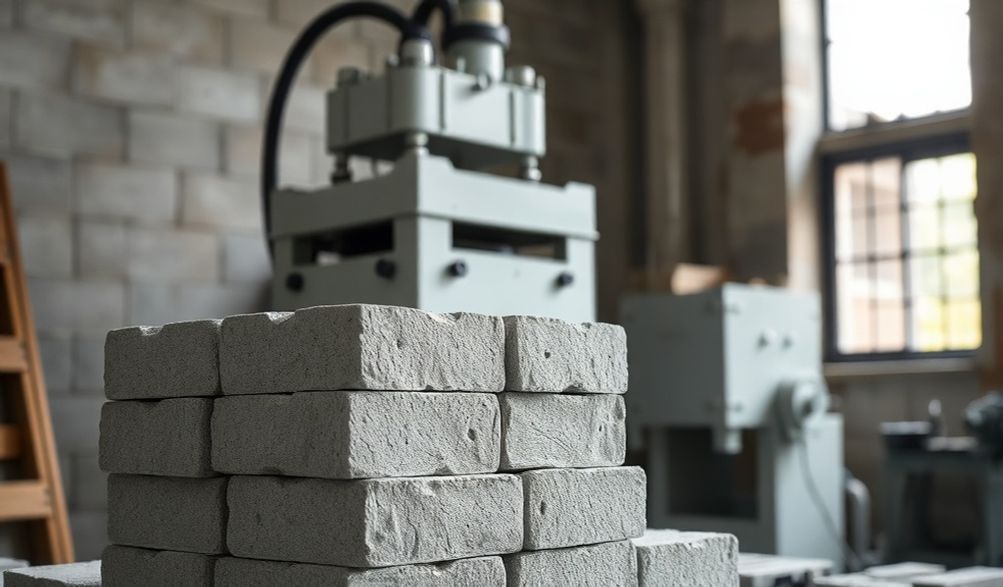
The Complete Guide to Small Cement Brick Machines: Choosing, Using, and Profiting
Introduction
Imagine you’re a local contractor, tired of the fluctuating costs and inconsistent quality of delivered bricks. Or perhaps you’re a determined homeowner, ready to build that garden wall or backyard patio yourself and want to control every aspect. Maybe you’re an entrepreneur, spotting an opportunity in your community’s constant need for affordable building materials. For all of you, the search likely leads to one powerful solution: the small cement brick machine.
This comprehensive guide is designed to be your definitive resource. Drawing on years of industry observation, technical analysis, and practical insights, we’ll cut through the marketing hype. Whether your goal is to start a business, complete a personal project, or simply understand this cost-saving technology, you’ll find clear, actionable answers here. We will walk you through the different types of machines, provide a detailed framework for choosing the right one, explain the entire production process from mix to masonry, and analyze the real costs and profit potential. By the end, you’ll be equipped with the knowledge to make a confident decision, operate safely, and build a solid foundation for your brick-making endeavors.
What is a Small Cement Brick Machine and Who Needs One?
At its core, a small cement brick machine is a compact device designed to transform a simple mixture of cement, sand, and aggregates into precise, solid building units. It automates and standardizes the most critical step: compression. By applying significant pressure to the damp mix within a mold, it creates bricks or blocks that are dense, uniform, and structurally sound, ready for curing and use.
Définition du Cœur et Son Fonctionnement
While designs vary, the fundamental operation follows a consistent sequence:
- Hopper : The prepared dry or wet mix is loaded into a feed hopper.
- Mold Cavity: The mix is directed into a mold cavity, which defines the brick’s shape (solid, hollow, paver, etc.).
- Mécanisme de Compression : A ram, piston, or press applies high pressure to the mix, compacting it and forcing out air pockets. This can be achieved via a manual lever, a mechanical flywheel, or a hydraulic system.
- Éjection : The newly formed, compacted brick is ejected from the mold onto a pallet or the ground.
This cycle repeats, allowing for the production of multiple identical units in a relatively short time.
Utilisateurs Idéaux et Applications
This machinery isn’t just for large factories. Its versatility makes it ideal for:
- Small & Medium Construction Contractors: Produce bricks on-demand, on-site, reducing material transport costs and delays. Perfect for remote projects.
- DIY Homeowners and Landscapers: Create custom pavers, retaining wall blocks, or bricks for small extensions, sheds, or garden features.
- Entrepreneurs in Building Material Production: Start a small-scale brick manufacturing business to supply local builders, hardware stores, or community projects.
- Community Development and NGOs: Facilitate affordable, sustainable housing projects by producing low-cost building materials locally.
The machines can typically produce a variety of products, including:
* Solid Cement Bricks
* Blocs de béton creux
* Paving Slabs and Interlocking Stones
* Bordures et Blocs Paysagers
Types of Small Cement Brick Machines: A Detailed Comparison
Choosing the right type of machine is your first critical decision. The market offers three primary categories, each balancing cost, labor, and output differently.
Manual (Hand-Operated) Brick Press Machines
These are the simplest and most fundamental type of brick-making machines.
- Opération & Sortie : Operated entirely by human force via a lever or screw mechanism. Output is low, typically ranging from 200 to 500 bricks per 8-hour dayfortement dépendant de l'endurance de l'opérateur.
- Avantages :
- Coût le plus bas :Le point d'entrée le plus abordable.
- Dépendance Zéro Puissance : Can be used anywhere.
- Haute Portabilité : Lightweight and easy to move.
- Simplicité : Easy to understand, maintain, and repair.
- Inconvénients :
- À forte intensité de main-d'œuvre :Nécessite un effort physique important.
- Incohérence : Brick quality can vary with operator fatigue.
- Low Throughput: Not suitable for commercial-scale production.
- Idéal pour : Individuals with very tight budgets, DIY enthusiasts with small, intermittent projects, or testing the waters before a larger investment.
Machines semi-automatiques de fabrication de briques
This category represents the sweet spot for many small businesses, automating the most strenuous part—compression.
- Opération & Sortie : Operators manually feed the mix into the machine, but compression and ejection are powered mechanically, often by an electric motor or diesel engine. Output ranges from 800 to 2,500+ bricks per day.
- Avantages :
- Improved Efficiency: Significantly higher output than manual presses.
- Better Consistency: Powered compression ensures uniform density and strength.
- Réduction de la charge de travail : Operators focus on feeding and stacking, not pressing.
- Inconvénients :
- Higher Investment: Costs 3-10x more than a manual machine.
- Exigence de puissance : Needs a reliable electricity connection or fuel supply.
- Formation de Base Requise : Requires understanding of machine operation and safety.
- Idéal pour : Small businesses, serious contractors, and community projects needing reliable, daily production for commercial purposes.
Fully Automatic Small Scale Block Machines
These are compact, self-contained production units designed for maximum efficiency with minimal manual intervention.
- Opération & Sortie : Feature automated material feeding (often via a conveyor), compression, and brick stacking. Some are programmable for different block types. Output can range from 4,000 to 10,000+ bricks per day.
- Avantages :
- Highest Output & Consistency: Ideal for meeting steady market demand.
- Minimal Labor: Often requires just 1-2 people for oversight and pallet management.
- Programmability: Easy switching between brick sizes and styles.
- Inconvénients :
- Significant Investment: The highest cost category.
- Infrastructure Complexe : Requires stable, high-capacity power and more space.
- Higher Maintenance: More moving parts necessitate stricter maintenance routines.
- Idéal pour : Established small-to-medium enterprises (SMEs) aiming to supply retailers or larger construction projects, where volume justifies the capital expenditure.
How to Choose the Right Machine: 7 Critical Factors
Selecting a machine isn’t about buying the “best” one—it’s about buying the droite one for vous specific situation. Use this framework to guide your decision.
1. Assess Your Production Needs (Bricks/Day)
Be brutally realistic. Are you making bricks for a single house (maybe 5,000 total)? Or do you plan to sell 1,000 bricks daily? Your peak daily requirement is the single biggest determinant of machine type.
2. Understand Your Raw Material Availability
The machine is just one part of the equation. You need consistent access to:
* Ciment : The binder. Fluctuations in price and availability can impact your business.
* Sand & Aggregates: Should be clean, well-graded, and locally sourced to keep costs down.
* Eau : A reliable supply is non-negotiable.
3. Evaluate Available Power Sources
- No reliable grid? A manual or diesel-powered semi-automatic may be your only option.
- Stable single-phase electricity? Many semi-automatic machines run on this.
- Three-phase power? Required for most fully automatic and larger semi-automatic models.
4. Consider Brick Type and Size Versatility
Do you need to make multiple products? Some machines offer interchangeable molds for hollow blocks, solid bricks, and pavers. If your market demands variety, prioritize a machine with this flexibility.
5. Total Budget: Machine Cost + Operating Costs
Look beyond the sticker price. Factor in:
* Capital Cost: The machine itself.
* Frais d'exploitation : Power/fuel, raw materials, labor, and maintenance.
* Coûts Cachés : Transport, foundation preparation, and spare parts.
6. Space and Portability Requirements
Do you have a dedicated workshop, or will you move the machine between job sites? Manual and some semi-automatic machines are highly portable. Fully automatic units are generally stationary installations.
7. After-Sales Service and Supplier Reputation
This is paramount. A machine is a long-term investment. Prioritize suppliers who offer:
* Clear warranty terms.
* Availability of spare parts.
* Technical support (phone, online, or in-person).
* Positive reviews and a verifiable track record. A cheaper machine with no support can become a very expensive paperweight.
The Step-by-Step Process: From Raw Material to Finished Brick
Understanding the full workflow is key to success, no matter which machine you choose.
Step 1: Sourcing and Proportioning Raw Materials
A standard mix ratio might be 1 part cement : 3 parts sand : 5 parts aggregate (by volume), but this can vary. The key is consistency. Use buckets or weigh-batches to ensure every mix is identical.
Step 2: The Mixing Process for Optimal Consistency
Mix thoroughly until the ingredients are uniformly distributed and the mixture achieves a “plastic” consistency—it should hold its shape when squeezed but not be soupy. A mechanical pan or drum mixer is highly recommended for anything beyond the smallest manual projects.
Step 3: Operating Your Machine – A Safety-First Guide
- Read the Manual: It seems obvious, but it’s the most skipped step.
- Wear PPE: Safety glasses, gloves, and sturdy boots are essential.
- Start Slow: Get a feel for the machine’s rhythm before aiming for maximum speed.
- Never Bypass Safety Guards: They are there for a reason.
Step 4: Curing and Drying for Maximum Strength
Curing is not just “drying.” Bricks need to retain moisture to allow the cement to fully hydrate and gain strength.
* Keep Bricks Damp: Cover them with plastic sheeting or spray them with water 2-3 times a day for at least 7 days.
* Avoid Direct Sun & Wind: This causes rapid moisture loss and leads to weak, cracked bricks.
* Allow Full Cure: While they gain most strength in 7 days, a full 28-day cure is ideal for maximum load-bearing capacity.
Step 5: Quality Control Checks
Regularly test your bricks:
* Visual Check: Look for cracks, chips, or distortions.
* Dimensional Check: Use a caliper to ensure consistent size.
* Sound Test: Two good bricks struck together should produce a clear, ringing sound, not a dull thud.
Cost Analysis and Profit Potential
Let’s translate this into numbers. (Note: Figures are illustrative; conduct local research).
Breaking Down the Initial Investment
- Manual Machine: $500 – $2,000
- Machine Semi-Automatique : $3,000 – $15,000
- Machine entièrement automatique : $18,000 – $50,000+
- Ancillary Costs: Mixer, pallets, tools, site preparation: $1,000 – $5,000+
Operational Cost Per Brick Calculation
For a standard 4″x8″x16″ hollow block:
* Cement, Sand, Aggregate: $0.50 – $0.80
* Power/Fuel: $0.02 – $0.05
* Labor (amortized): $0.05 – $0.15
* Estimated Total Production Cost: $0.57 – $1.00 per block
Market Price vs. Production Cost: Understanding Margins
If the local market price for a similar block is $1.50, your potential gross margin per block is $0.50 – $0.93. This margin must cover your machine depreciation, overhead, and profit.
Realistic ROI Timelines for Different Models
- Manual Machine: Can pay for itself on a single large DIY project by saving on purchased materials.
- Machine Semi-Automatique : With consistent sales, a well-run business could see ROI in 6 to 18 months.
- Machine entièrement automatique : Due to higher investment, ROI may take 1.5 to 3 years, dependent on high and steady volume.
Essential Maintenance and Troubleshooting Tips
Proper care extends your machine’s life and prevents costly downtime.
Daily and Weekly Maintenance Checklist
- Daily: Clean all mix residue from the hopper, mold, and press head. Lubricate all moving joints as per the manual.
- Weekly: Check for loose bolts and nuts. Inspect hydraulic hoses (if applicable) for leaks. Clean the electrical cabinet (if present) of dust.
Common Problems and Solutions
- Problem: Bricks are crumbling or lack strength.
- Solution: Check mix proportions (likely not enough cement). Ensure proper compaction pressure. Improve curing methods.
- Problem: Bricks are sticking in the mold.
- Solution: The mix is too wet. Apply a thin, recommended mold release agent. Ensure the mold is clean and smooth.
- Problem: Inconsistent brick height.
- Solution: The mix quantity per brick is not uniform. Ensure consistent feeding. Check for wear on the mold or compression plate.
Maximizing the Lifespan of Your Machine
- Use only the recommended raw material sizes (avoid oversized aggregate).
- Never force the machine if it jams; stop and diagnose the issue.
- Store the machine under cover when not in use.
- Build a relationship with your supplier for genuine spare parts.
FAQ Section
Q1: What is the average cost of a small cement brick machine?
Prices vary wildly. You can find basic manual presses for under $1,000, while robust semi-automatic machines start around $3,000-$5,000. Fully automatic systems begin at $18,000 and go up from there.
Q2: Can I use a small brick machine for a home project?
Absolutely. A manual or small semi-automatic machine is perfect for producing bricks for a garden wall, patio, or small outbuilding. It gives you control and can be very cost-effective.
Q3: What is the strength of bricks made with small machines compared to industrial ones?
A properly operated small machine using the correct mix design and curing process can produce bricks that meet standard strength requirements (e.g., 7-10 MPa for non-load-bearing, 15+ MPa for load-bearing). The key is process control, not just the machine size.
Q4: How many workers are needed to operate a semi-automatic machine?
Typically, 2-3 people: one to feed the mixer and manage materials, one to feed the machine, and one to stack and manage the freshly made bricks.
Q5: Where can I find reliable suppliers or brands?
Research online industry directories (e.g., for construction machinery), attend local trade fairs, and seek recommendations from other builders. Look for companies with physical addresses, detailed documentation, and responsive pre-sales communication.
Q6: What are the most common mistakes beginners make?
1. Skipping proper curing.
2. Using inconsistent or poor-quality raw materials.
3. Overlooking daily maintenance.
4. Underestimating the space and labor needed.
5. Buying a machine based on price alone, without considering support.
Q7: Is formal training required to operate these machines?
Not formal certification, but comprehensive training from your supplier is crucial. Understanding setup, operation, basic troubleshooting, and safety protocols is non-negotiable for efficiency and safety.
Conclusion
The journey to selecting and operating a small cement brick machine is one defined by aligning technology with your specific goals, resources, and scale. There is no universal “best” machine—only the one that best fits your production needs, budget, and operational context.
Start with a clear plan. Define your output targets, scrutinize your budget to include all hidden costs, and, most importantly, choose a supplier who will be a partner, not just a vendor. Never compromise on safety or the fundamental principles of good concrete practice: consistent mix, proper compaction, and patient curing.
Your next step? Reach out to shortlisted suppliers with your specific requirements. Ask for video demonstrations, customer references, and detailed quotations. If you’re new to this, consider starting with a manual machine to learn the process intimately before scaling up. The world of small-scale brick making is accessible, practical, and full of potential—your foundation for building something great starts with the right knowledge.
<