
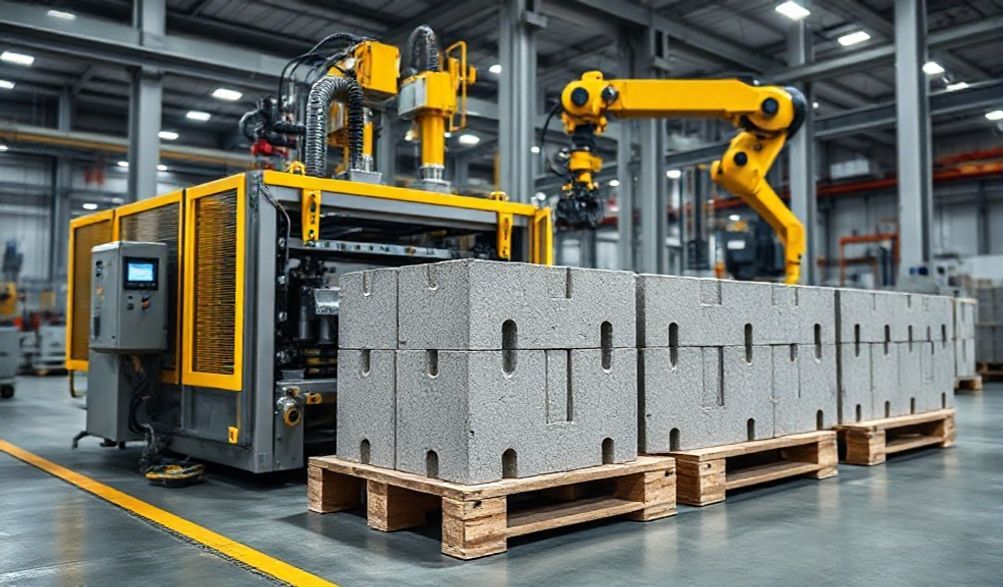
The Ultimate Guide to China’s Automatic Paver Block Machines: Quality, Innovation & Value
Introduction
The world is building. From urban sprawl to rural infrastructure projects, the global construction boom shows no signs of slowing. At the very foundation of this growth—quite literally—is paving. Roads, driveways, parking lots, walkways, and public plazas all demand high-quality, durable pavers. For businesses supplying these essential components, the pressure is on to deliver more, faster, and at a competitive cost. This has triggered a decisive shift away from labor-intensive, inconsistent manual production toward the precision and power of automation.
The core challenge for entrepreneurs and construction firms is clear: sourcing reliable, high-output machinery that doesn’t break the bank. Profit margins are squeezed by rising labor costs, material waste, and the relentless demand for consistent quality. Investing in the wrong equipment can mean project delays, substandard products, and a devastating blow to your bottom line.
Enter the solution: China automatic paver block machines. China has solidified its position as the world’s undisputed manufacturing hub for construction machinery. Its ecosystem for block making equipment, in particular, offers a compelling proposition—a fusion of increasingly sophisticated technology, robust engineering, and exceptional value that is reshaping global supply chains. But navigating this market requires insight.
This ultimate guide is built on a foundation of industry analysis, a review of technical specifications from leading manufacturers, and an understanding of modern Chinese manufacturing standards. Our goal is to provide you with the expertise and trustworthy information needed to make a confident, informed purchasing decision. Let’s delve into why a China automatic paver block machine might be the strategic investment that propels your business forward.
Why Choose an Automatic Paver Block Machine?
Moving from manual or semi-automatic processes to a fully automatic system is a transformative step. It’s not merely an equipment upgrade; it’s a fundamental change in your business’s operational capabilities.
Efficacité Inégalée et Rendement Élevé
- Production Power: Modern automatic machines are productivity powerhouses. Depending on the model and block type, outputs can range from 2,000 to over 10,000 standard blocks per 8-hour shift. High-end models can operate 24/7 with minimal supervision, multiplying that output dramatically.
- Labor Revolution: Where a manual operation might require 6-8 workers for mixing, feeding, molding, and stacking, a fully automatic line often needs just 1-2 personnel to monitor the system and manage raw material input. This translates to direct, substantial labor cost savings and reduces dependency on scarce skilled labor.
- Fonctionnement en Continu : With integrated pallet circulation and automatic stacking systems, the production cycle is seamless. There’s no stopping to remove blocks or reset molds manually, ensuring every minute of operation is productive.
Superior Product Consistency and Quality
- Ingénierie de Précision : Automation removes human variability. Every block is subjected to identical vibration pressure, compaction time, and hydraulic force. This results in uniform dimensions, density, and compressive strength across every single unit.
- Quality as Standard: This consistency is critical for meeting engineering specifications for large-scale projects. It ensures proper interlock, even surfaces, and long-term durability, directly enhancing the quality and reputation of your finished work.
- Réduction des déchets : Consistent production means a drastically lower reject rate. You use raw materials more efficiently, saving costs on cement and aggregate that would otherwise end up as cracked or sub-standard blocks.
Long-Term Cost-Effectiveness and ROI
While the initial investment is higher than a semi-automatic machine, the total cost of ownership tells a different story.
* Réduction des coûts opérationnels : Savings on labor, reduced material waste, and higher efficiency directly cut the cost per block produced.
* Accélération de l'achèvement des projets : The ability to produce vast quantities on-demand allows you to take on larger contracts and complete them faster, improving cash flow and market competitiveness.
* Investment Payback: For many businesses, the return on investment (ROI) for an automatic machine can be achieved in 12-24 months through these combined savings and increased revenue potential.
The Chinese Manufacturing Advantage for Block Making Machinery
Choosing a machine from China isn’t just about finding a lower price. It’s about tapping into a uniquely powerful manufacturing ecosystem.
A Hub of Technological Innovation and R&D
- Rapid Advancement: Chinese manufacturers are not mere copiers. They invest heavily in R&D, continuously integrating advanced Programmable Logic Controller (PLC) systems, precision hydraulics, and energy-efficient vibration motors.
- Smart Manufacturing: Leading factories now incorporate IoT (Internet of Things) features for remote machine monitoring, predictive maintenance alerts, and production data analytics, bringing “Industry 4.0” capabilities to block making.
Unbeatable Scale and Supply Chain Efficiency
- Industrial Clusters: The concentration of machinery manufacturers, component suppliers, and mold makers in regions like Fujian, Shandong, and Guangdong creates incredible efficiency. This scale drives down costs for high-quality parts like steel plates, hydraulic cylinders, and electrical panels.
- Complete Ecosystem: Sourcing from China means access to a full support network. Need a custom mold, a spare part, or a technical upgrade? The entire supply chain is interlinked, simplifying logistics and reducing lead times for everything you need.
Rigorous Quality Standards and Certifications
The outdated notion of “cheap and low-quality” no longer applies to the top tier of Chinese manufacturers.
* International Compliance: Reputable companies operate with ISO 9001 quality management certifications and often carry CE marks for export to international markets, indicating adherence to safety and environmental standards.
* Composants de qualité : To ensure reliability, leading brands use high-grade, wear-resistant steel for frames and molds. Critical electrical and hydraulic components are frequently sourced from internationally recognized brands like Siemens, Schneider, or Omron, ensuring performance parity with Western machines.
Key Features to Look for in a Top-Tier Machine
Not all automatic machines are created equal. Discerning buyers must look beyond the basic specifications to these critical features.
Core Mechanical Design and Durability
- Cadre et Structure : The machine’s skeleton must be made from heavy-duty, reinforced steel plates with robotic welding. A weak frame will flex under load, leading to misalignment and rapid wear.
- Système de Vibration : This is the heart of the machine. Look for powerful, frequency-convertible vibration motors mounted on a sturdy vibration table. A strong, well-distributed vibration is essential for producing dense, strong blocks.
- Système Hydraulique : The system should be robust, with reliable pumps and valves. Sealed, integrated hydraulic units are preferable for cleanliness and maintenance. Consistent hydraulic pressure is key for mold filling and block ejection.
Niveau d'Automatisation et Systèmes de Contrôle
- PLC & Touchscreen Interface: A user-friendly, color touchscreen PLC is non-negotiable. It should allow for easy programming of block types, layer counts, and production parameters, storing recipes for different products.
- Manutention Automatisée des Matières : A true automatic system includes a fully automated mixer feeder, a precise material distribution system, and an automatic pallet return circuit. The pinnacle is the “egg-layer” or “static” type with automatic stacking and product transfer.
- Mold Changing: While not instantaneous, the process of changing molds for different block types should be designed for relative ease to maximize machine versatility.
Versatility in Production Capabilities
- Gamme de produits : Ensure the machine can produce the block types your market demands: standard interlocking pavers, hollow blocks for construction, grass pavers, curbstones, and garden tiles.
- Compatibilité des moules : Verify that the manufacturer offers a wide range of standard mold designs and has the in-house capability to engineer and produce custom molds for unique designs.
After-Sales Support and Service
This is arguably the most critical factor for a successful purchase and directly impacts your confiance in the supplier.
* Assistance technique : What are the support hours? Do they offer remote assistance via video call? A supplier with a strong technical team is invaluable for troubleshooting.
* Documentation: Comprehensive, clear English manuals (both paper and digital) for operation, maintenance, and parts are essential.
* Warranty & Spares: Understand the warranty period and scope. Crucially, confirm the availability and pricing of a spare parts kit and the logistics for ordering future parts.
Navigating the Selection Process: A Buyer’s Checklist
A structured approach is your best defense against poor decisions.
Évaluation de vos besoins de production et de votre budget
- Output Requirement: Calculate your current and projected future daily block needs.
- Mix de Produits : List all the block types and sizes you plan to produce.
- Site Audit: Verify you have the necessary factory space, 3-phase electrical power, and compressed air supply.
- Budget Framework: Establish a realistic budget that includes the machine, shipping, import duties, and installation.
How to Vet Chinese Manufacturers Effectively
- Vérifier la légitimité d'une entreprise : Check for Alibaba “Gold Supplier” or “Verified” status, but go further. Request their official business license (营业执照).
- Request Factory Evidence: Ask for recent, unedited videos of the factory floor and the specific machine model in operation. A legitimate manufacturer will gladly provide this.
- Seek Independent Proof: Ask for 2-3 customer references in your region or a similar market. Contact them to ask about machine performance and after-sales service.
- Communicate with Engineers: Insist on having a video call where you can speak directly to a technical engineer, not just a salesperson, to discuss your specific needs.
Understanding Quotes: Beyond the Sticker Price
A quote should be a detailed document, not just a single number.
* Incoterms: Know the difference between FOB (you pay shipping/insurance) and CIF (seller arranges to your port). FOB is more common and often more transparent.
* Specification Sheet: The quote must include a detailed technical specification sheet listing every component brand, motor power, production capacity, and machine dimensions.
* Total Landed Cost: Factor in sea freight, insurance, import duties and taxes in your country, and inland transportation to your factory. This is your true cost.
Common Concerns Addressed (Building Trust)
“Is the Quality Comparable to European Brands?”
This is a fair question. The landscape is nuanced. Top-tier Chinese manufacturers now produce machines where the core components—hydraulics, PLCs, electrical systems—are often the same brands used by European makers. The engineering design and assembly quality of these leading Chinese machines can rival European counterparts. The primary difference often lies in the depth of historical brand prestige and a price premium that may not reflect a proportional difference in core functionality or output for many businesses.
“How Do I Handle Maintenance from Overseas?”
- Remote Support: Reputable suppliers offer robust remote support via WhatsApp, Zoom, or TeamViewer to guide your local technician through issues.
- Comprehensive Manuals: Detailed maintenance schedules and troubleshooting guides are provided.
- Local Partnership: It’s wise to identify a local mechanical/electrical workshop familiar with industrial machinery for hands-on repairs. Your supplier can often provide guidance and diagrams to assist them.
“What About Language Barriers and Communication?”
This challenge has diminished significantly. Established exporters specializing in heavy machinery employ sales and technical staff with strong English (or other language) capabilities. The key is to ensure all critical agreements, specifications, and warranty terms are documented in clear, written English. Avoid relying solely on verbal promises.
Foire aux Questions (FAQ)
Q1: What is the average price range for an automatic paver block machine from China?
A: Prices vary widely based on automation level and output. A basic automatic machine may start around $25,000 – $35,000, while high-output, fully automated lines with advanced stacking can range from $60,000 to well over $100,000. Always request a detailed quote based on your specifications.
Q2: What is the typical lead time from order to delivery?
A: For standard models, production typically takes 30-45 days. Shipping via sea freight can add another 20-40 days depending on the destination port. Customized machines or peak season orders will take longer.
Q3: Do manufacturers provide installation and operational training?
A: Most provide detailed installation manuals and video guides. On-site installation and training by a factory engineer are almost always available as a paid service, which is highly recommended for your first automatic machine to ensure optimal setup.
Q4: Can I get a machine customized for a specific block design?
A: Yes, leading manufacturers offer custom mold design and fabrication. They can also adjust machine parameters like vibration and pressure to suit unique block designs or special raw materials. This service incurs additional cost and extends lead time.
Q5: How do I ensure I’m dealing with a reputable supplier and not a trading company?
A: Ask direct questions: “Are you the factory?” Request a live video tour of your machine on their production floor. Ask for their manufacturing license and to speak with their engineering department. Trading companies often hesitate or cannot provide this level of technical access.
Conclusion
The journey to acquiring a China automatic paver block machine is one defined by strategic opportunity. We’ve explored the transformative efficiency and quality gains of automation, demystified the robust innovation and scale of Chinese manufacturing, and outlined the critical features—especially unwavering after-sales support—that separate a good investment from a great one.
The value proposition is clear: access to high-performance, reliable technology at a cost structure that enables aggressive business growth and a faster return on investment. Success hinges on diligent research, a focus on technical specifications over vague promises, and rigorous verification of your supplier.
Now, it’s time to take action. Use the checklist in this guide to systematically evaluate your needs. Start contacting shortlisted manufacturers, ask the hard questions, and request detailed quotes. Your future in automated block production begins with that first informed step.
<