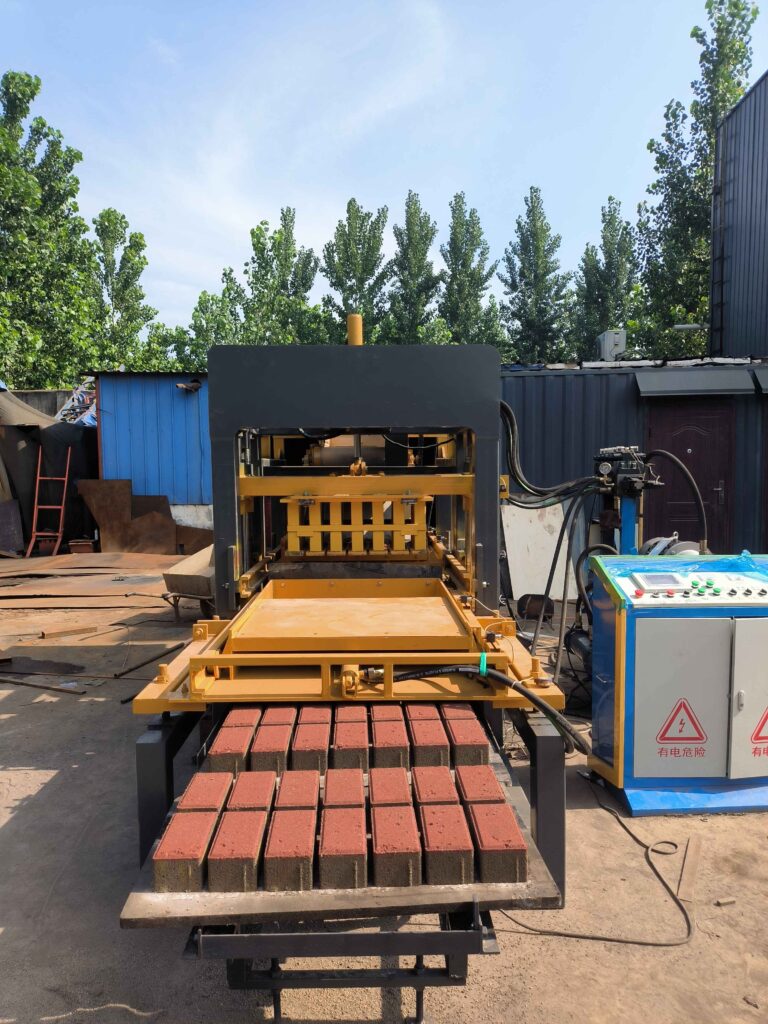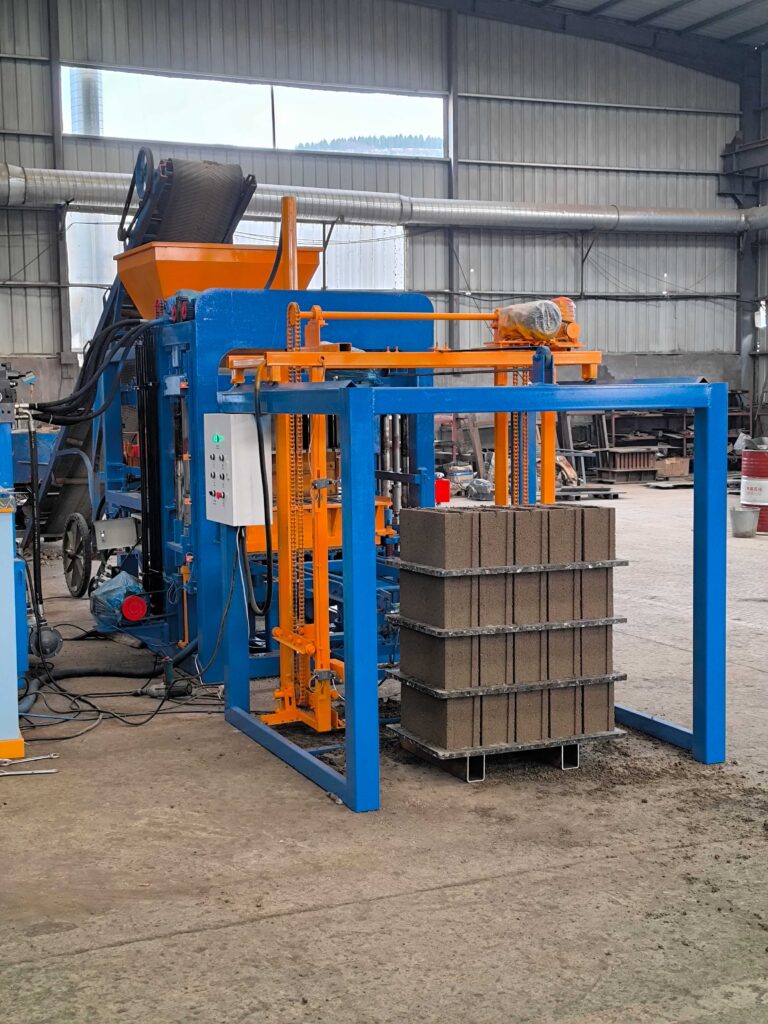
The daily output of a brick machine is not a fixed number but a dynamic result of its design, function, and operating environment.
1.1 Machine Type and Operational Principle
The fundamental architecture of the machine sets the baseline for potential output.
- Presses à emboutissage statiques : These machines operate on a cyclic, batch-processing method. A mold is filled, high pressure is applied to compact the material, and the finished block is ejected. The Cycles Per Hour (CPH) is the key metric. A machine rated for 1200 CPH with a single mold producing 1 brick per cycle has a theoretical hourly output of 1200 bricks. Production is intermittent but often suitable for high-precision products like pavers or interlocking blocks.
- Vibration-Based Machines: Utilizing a combination of vibration and pressure, these machines can process larger volumes of material, particularly beneficial for lightweight aggregate blocks. Their output is often measured in cubic meters of blocks per shift, requiring conversion based on brick size.
- Mobile Production Plants: These are high-output systems designed for on-site, continuous production. They integrate mixing, conveying, molding, and curing into a semi-automated or fully automated line, representing the upper echelon of daily production capabilities.
1.2 The Critical Role of Automation Level
Automation directly translates to higher and more consistent daily yields.
- Machines Manuelles/Semi-Automatiques : Heavily reliant on human labor for feeding raw material, removing finished products, and mold changes. Output is limited by operator speed, endurance, and shift patterns. Production is susceptible to variability and fatigue.
- Machines entièrement automatiques : Incorporate automated material batching, molding, product ejection, stacking, and palletizing. They operate with minimal human intervention, maintaining a consistent, high-speed cycle rate over extended periods, including overnight runs for curing lines.
- Integrated Production Lines: The pinnacle of output, these systems link the brick machine to automated mixers, conveyor belts, curing racks (like steam chambers), and robotic stackers. Downtime is minimized, and the entire process from raw material to palletized, cured bricks is streamlined for maximum daily throughput.
1.3 Product Specification as a Defining Factor
The characteristics of the brick being produced dramatically alter the count per day.
- Brick Size and Volume: A machine producing standard 4x8x16 inch concrete blocks will have a vastly different daily count compared to the same machine producing smaller solid bricks or larger foundation blocks. Output is often better assessed in cubic meters or square meters of coverage.
- Brick Density and Design: Intricately designed bricks (with complex textures, holes, or curves) often require longer vibration or press cycles to ensure proper formation and detail capture, reducing the cycles per hour. The density of the final product also affects material compaction time.
Quantifying Output: From Theoretical to Achievable Capacity
Moving from manufacturer brochures to real-world numbers requires a careful analytical approach.
2.1 Breaking Down the Production Cycle
A single production cycle (T_cycle) includes: Mold filling time (T_fill), Compression/Vibration time (T_compact), Ejection time (T_eject), and Mold return/cleaning time (T_return). The core formula for a static press is:Bricks per Hour = (3600 seconds / T_cycle) x Molds per Cycle
For example, a machine with a 12-second cycle time and a 4-cavity mold produces: (3600/12) x 4 = 1200 bricks per hour.
2.2 Calculating Realistic Daily Output
Theoretical output must be adjusted for operational realities over a standard 8-hour or 24-hour period.
- Factoring in Operational Efficiency: No machine runs at 100% efficiency. Industry standards account for efficiency factors (η) typically between 0.85 and 0.95 for automatic machines, and lower for manual ones. This covers minor stoppages, mold changes, and routine checks.
Realistic Hourly Output = Theoretical Hourly Output x η - Incorporating Daily Operational Hours: A fully automatic line operating 20 hours a day (allowing 4 hours for maintenance and setup) will produce significantly more than an 8-hour shift.
Daily Production = Realistic Hourly Output x Operational Hours per Day - Example Calculation: Consider an automatic machine with a 10-second cycle, a 6-cavity mold, and an efficiency factor of 0.90 running for 20 hours.
- Theoretical Hourly Output: (3600/10) x 6 = 2160 bricks/hour.
- Realistic Hourly Output: 2160 x 0.90 = 1944 bricks/hour.
- Production quotidienne : 1944 x 20 = 38,880 bricks/day.
2.3 Output Ranges by Machine Category
- Small Manual/Semi-Automatic Machines: 1,500 – 8,000 bricks per 8-hour shift.
- Standard Fully Automatic Single Machine: 8,000 – 25,000 bricks per 8-hour shift.
- High-Speed Automatic Machine with Multi-Cavity Molds: 25,000 – 60,000 bricks per 8-hour shift.
- Fully Integrated Automated Production Line: 60,000 – 150,000+ bricks per 20-24 hour operational day.
External and Logistical Factors Influencing Daily Yield
Even the most advanced machine cannot perform optimally without the right conditions.
3.1 Raw Material Quality and Consistency
The properties of the input mix are crucial. An inconsistent mix in grain size, moisture content, or composition can lead to:
- Increased cycle times to achieve proper compaction.
- Higher rates of defective products, requiring reprocessing or disposal.
- Frequent machine jams and cleaning stops, increasing downtime.
3.2 Power Supply and Stability
Industrial brick machines, especially those with high-power vibration motors or hydraulic systems, require a stable, high-capacity power supply. Voltage fluctuations or insufficient amperage can reduce machine speed, cause overheating, or lead to unplanned shutdowns.
3.3 Labor Skill and Maintenance Regimen
Skilled operators who can perform preventative maintenance, quickly troubleshoot minor issues, and optimize machine settings are force multipliers. A rigorous daily and weekly maintenance schedule (lubrication, bolt tightening, wear part inspection) is non-negotiable for sustaining peak output over the long term.
3.4 Curing and Drying Capacity
Production can quickly bottleneck at the curing stage. The daily output of the primary machine must be matched by sufficient space and systems for curing—whether it’s open air, covered racks, or accelerated steam curing chambers. A machine producing 40,000 bricks daily requires the logistics to handle and cure 40,000 bricks daily.
Strategic Considerations for Dealers and Procurement Managers
For the target audience, translating technical data into business value is key.
4.1 Assessing Client Needs and Market Demand
Guide clients to evaluate their true needs. Is their demand steady, requiring a high-output line? Or is it variable and customized, better served by a flexible, semi-automatic system? Oversizing a machine leads to capital tie-up; undersizing leads to missed opportunities.
4.2 Total Cost of Ownership (TCO) vs. Output
A machine with a higher upfront cost but superior reliability and 25% greater output often provides a better return on investment than a cheaper, slower, or less reliable model. Calculate cost per brick produced, factoring in energy consumption, labor, and maintenance.
4.3 Scalability and Future-Proofing
Recommend solutions that allow for growth. Can a semi-automatic system be upgraded with automatic feeders later? Does the manufacturer offer models with higher capacity in the same product family? Investing in a slightly modular or scalable system protects the client’s investment as their business expands.
Conclusion
The daily production capacity of a brick manufacturing machine is a symphony of engineering, operation, and support, rather than a solitary figure plucked from a specification sheet. For distributors and procurement professionals, a deep understanding of the interaction between machine type, automation, product specs, and operational efficiency is essential. By moving beyond simple “bricks per day” claims and adopting a holistic analysis that includes cycle time calculations, efficiency factors, and downstream logistics, you can provide unparalleled value to your clients. The most profitable investment is not necessarily the machine with the highest theoretical output, but the one whose sustainable, real-world production capacity most precisely aligns with the client’s specific production goals, material constraints, and market requirements. Empowering clients with this analytical framework ensures long-term satisfaction and fosters trusted partnerships in the competitive construction materials landscape.
FAQ
Q1: What is the single most important technical specification to look for when comparing daily output?
A: For comparative analysis, focus on the cycle time (in seconds) and the number of molds/cavities per cycle. These two figures allow for the calculation of theoretical hourly output, which forms the basis for all realistic daily production estimates. Always request a live demonstration or video showing a full cycle with your intended raw material mix.
Q2: Can a machine produce different types of bricks in the same day, and how does that impact output?
A: Yes, but with significant impact on output. Changing molds or adjusting machine parameters for a different product (e.g., from solid blocks to hollow blocks) requires downtime for retooling and recalibration. This changeover time, which can range from 30 minutes to several hours, must be deducted from productive operational hours. For operations requiring frequent product changes, a machine with a quick mold-change system is crucial.
Q3: How does the choice between hydraulic and vibration systems affect daily production?
A: Hydraulic systems typically offer very high, consistent pressure, leading to precise and strong bricks, often with excellent surface finish. Cycle times can be slightly longer due to press and release phases. Vibration systems (often combined with some pressure) can have faster compaction times for certain materials like lightweight aggregates, potentially allowing shorter cycles. The optimal system depends on the product range; some high-output machines combine both for speed and quality.
Q4: What are the key questions to ask a manufacturer about their stated daily output figures?
A: Always ask for clarification:
- “Is this output figure based on an 8-hour, 20-hour, or 24-hour operating day?”
- “What standard brick size and type (e.g., solid, 3-hole) is this output based on?”
- “What assumed efficiency factor is included in this estimate?”
- “Can you provide a detailed time-motion study or performance report from an existing installation using a similar raw material mix?”
Q5: For a new factory, what infrastructure is often overlooked that can bottleneck production?
A: Two critical areas are often underestimated:
- Raw Material Handling & Storage: Inadequate silo capacity or conveyor speed from the mixer to the machine can starve the main machine, limiting its output.
- Curing and Storage Space: The production area must have a coordinated system—rollers, forklifts, racks, and ample covered space—to move and store the fresh bricks immediately after production. The machine’s output is only as fast as its slowest downstream link.