1. Introduction
L'industrie mondiale de la construction connaît une révolution silencieuse, portée par le double impératif d'efficacité et de durabilité. Au cœur de cette transformation se trouve un produit qui redéfinit l'assemblage : la brique à emboîtement. Contrairement à la maçonnerie conventionnelle, ces éléments ingénierés forment des structures robustes grâce à un design géométrique précis, éliminant le besoin du mortier traditionnel humide. Pour les distributeurs, les revendeurs et les professionnels des achats, la machine industrielle de fabrication de briques à emboîtement représente bien plus qu'une simple gamme de produits : c'est une porte d'entrée vers des segments de marché à forte croissance. Cette technologie permet aux clients de construire plus rapidement, plus solidement et de manière plus économique, répondant à des défis cruciaux, du logement abordable aux infrastructures résilientes. Cet article offre un aperçu stratégique et technique complet pour les parties prenantes B2B qui cherchent à comprendre, fournir ou investir dans cette technologie de fabrication transformative.
2. L'Ingénierie de la Connexion : La Technologie des Briques à Emboîtement Expliquée
2.1. Au-delà du mortier : Le principe de l'empilage mécanique à sec
L'innovation fondamentale réside dans la conception de la brique. Chaque unité présente des protubérances (bosses) moulées avec précision et des évidements correspondants (alvéoles) sur ses surfaces supérieure et inférieure. Lorsqu'elles sont empilées, ces éléments s'emboîtent, créant une liaison mécanique qui limite le mouvement horizontal (cisaillement) et le déplacement vertical. La stabilité latérale est en outre renforcée par un système breveté de « lèvre » ou « rainure » le long des faces verticales, qui verrouille les assises entre elles. Cette méthode de pose à sec élimine le temps, le coût, le gaspillage de matériaux et la main-d'œuvre qualifiée associés à l'application du mortier, à son durcissement et aux joints.
2.2. Évolution de la conception : des blocs de base aux systèmes intégrés
Les briques d'emboîtement modernes font partie d'un système de construction sophistiqué. Leur conception a évolué, passant de formes simples à des composants intégrés pouvant inclure :
- Blocs d'Interverrouillage Standard :Pour la construction générale des murs.
- Coins et Demi-Blocs :Pour des révélations nettes et des mises en page optimisées.
- Blocs de Chaîne :Pour créer des cavités de renforcement continues pour les barres d'acier verticales et le coulis de béton, augmentant ainsi la capacité sismique et portante.
- Unités de plafonnement :Pour obtenir une surface supérieure finie.
Cette systématisation permet la construction de structures complètes et conformes aux normes, élargissant l'application de la technologie au-delà des murs de clôture jusqu'aux bâtiments principaux.
2.3. Composants essentiels d'une machine moderne de fabrication de briques emboîtables
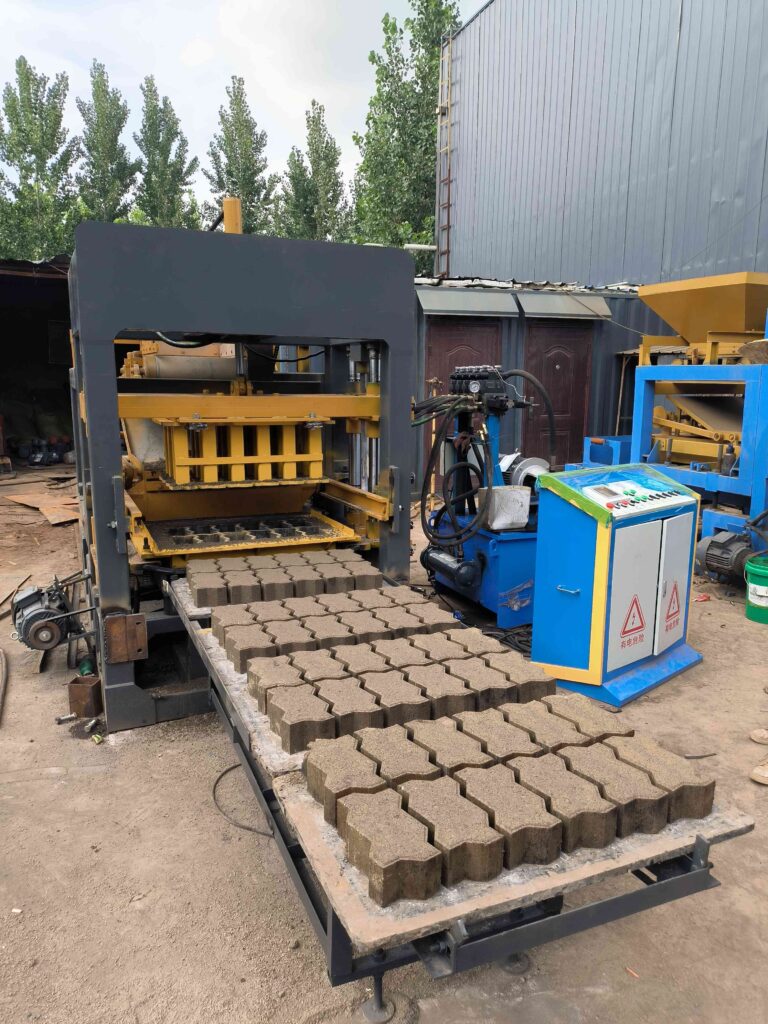
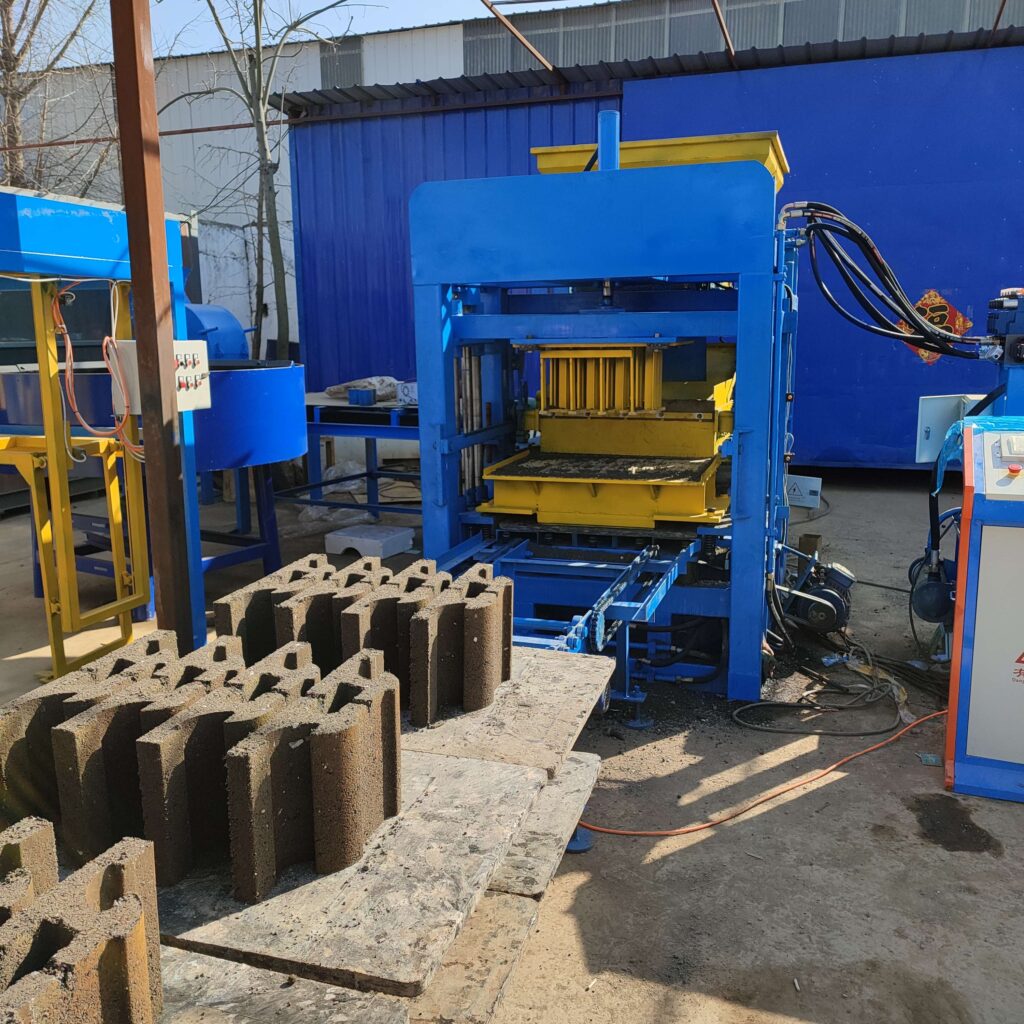
La production de tels composants de précision nécessite des machines spécialisées. Les sous-systèmes clés comprennent :
- Cadre de presse à haute tonnageUne structure rigide pour résister à une pression cyclique extrême, garantissant une précision dimensionnelle sur des milliers de cycles.
- Système hydraulique à double action :Fournit l'immense force contrôlée (souvent 200-1000+ tonnes) nécessaire pour la compaction ultra-élevée des mélanges secs ou semi-secs.
- Outillage de précision (Moules et Palettes)Les moules en acier chromé trempé sont au cœur du processus, usinés avec des tolérances rigoureuses pour former la géométrie complexe d'emboîtement. Des palettes spécifiques fonctionnent en tandem avec le moule.
- Programmable Automation: A central PLC controls the entire cycle—material batching, feeding, pressing, stripping, and product transfer—ensuring consistency and efficiency.
- Vibration and Compression Integration: Many machines combine high-frequency vibration with hydraulic compression to achieve optimal density and surface finish for cementitious mixes.
3. Market Dynamics and Strategic Opportunities
3.1. Drivers of Global Demand
Multiple powerful trends converge to fuel demand:
- Vitesse de Construction : Projects can be completed 30-50% faster due to dry-stacking and simplified alignment.
- Labor Skill Mitigation: Reduces dependence on highly skilled masons, a critical advantage in regions facing labor shortages.
- Material and Cost Efficiency: Elimination of mortar saves 15-20% on overall wall costs; reduced construction time lowers financing costs.
- Disaster Resilience: Properly engineered and grouted interlock systems demonstrate excellent performance in seismic and high-wind events.
- Sustainability Mandates: The process uses less water, can utilize industrial by-products (fly ash, slag), and reduces site waste.
3.2. Applications and End-User Sectors
The market extends far beyond residential walls:
- Projets de logements abordables : Governments and NGOs are major adopters seeking rapid, durable housing solutions.
- Commercial and Industrial Warehouses: For cost-effective, rapid-enclosure perimeter and interior walls.
- Infrastructure : Retaining walls, sound barriers, and flood control structures.
- Disaster Relief and Military Construction: For deployable, rapid-building systems.
- High-End Architectural Projects: For thermally efficient, modern aesthetic designs using specialized finishes.
3.3. Competitive Advantages for Resellers
For the B2B partner, this technology offers a compelling portfolio addition:
- High-Value Solution Selling: Moves the conversation beyond price-per-brick to total project cost savings.
- Differentiation: Establishes the reseller as a provider of innovative, future-ready construction technology.
- Recurring Revenue Streams: Beyond the machine sale, revenue is generated from mold tooling for new block designs, spare parts, and technical service contracts.
- Market Expansion: Opens doors to public sector tenders and large-scale development projects previously inaccessible with conventional brick machinery.
4. Technical Deep Dive: Machine Capabilities and Production Process
4.1. The High-Pressure Compaction Cycle
The production of structurally sound interlocking bricks requires a meticulously controlled process:
- Batching et Mélange Automatisés : Raw materials (cement, sand, stone dust, additives) are batched and mixed to a consistent, semi-dry consistency.
- Precise Mold Cavity Filling: An automated feeder deposits a measured volume of mix into the intricate mold cavity. Uniform filling is critical for block integrity.
- Simultaneous Vibration and Compression: The mold table vibrates at high frequency to settle the material, while the hydraulic ram applies extreme downward pressure, compacting the mix to near-zero porosity.
- Stripping and Ejection: The newly formed block is carefully stripped from the mold and transferred onto a curing pallet without damaging its delicate interlocking features.
- Curing and Quality Testing: Pallets move to a controlled curing chamber. Finished blocks are tested for compressive strength, dimensional tolerance, and water absorption.
4.2. Material Science: Compatibility and Mix Design
These machines are highly versatile but require specific mixes. They can process:
- Cement-Stabilized Soil: For low-cost, on-site production.
- Concrete Mixes: (Cement, sand, aggregates) for high-strength applications.
- Fly Ash & Slag-Based Mixes: For eco-friendly, high-performance blocks.
- Crushed Stone & Quarry Dust: For optimal density and finish.
Expertise in advising clients on locally-sourced, cost-effective mix designs adds immense value to the machinery sale.
4.3. Automation, Output, and Quality Control
Industrial-grade machines are designed for uninterrupted production. Key performance indicators include:
- Temps de cycle : Typically between 10-30 seconds per block, depending on size and complexity.
- Capacité de sortie : Ranges from 1,500 to over 10,000 standard blocks per 8-hour shift.
- Integrated Quality Systems: Modern machines feature sensors that monitor pressure, filling levels, and ejection force, automatically rejecting or flagging sub-standard cycles to ensure near-zero defect output.
5. Investment Analysis and Partner Selection Framework
5.1. Assessing Total Cost of Ownership (TCO) and ROI
A strategic purchase analysis must look beyond the invoice price:
- Capital Expenditure: Machine, tooling, and installation costs.
- Coûts opérationnels : Energy consumption (hydraulic and vibration systems), labor, preventive maintenance, and mold refurbishment.
- Revenue Potential: Based on block output, market price, and demand.
- ROI Horizon: Typically, well-operated plants can achieve full ROI in 1-3 years due to high margins and strong demand for the finished blocks.
5.2. Critical Evaluation Criteria for Equipment
B2B partners must vet machinery based on:
- Press Force and Stability: Determines ultimate block strength and suitability for load-bearing applications.
- Tooling Quality and Availability: The durability and precision of molds are non-negotiable. Assess the supplier’s tooling support.
- Automation Level and Ease of Use: From semi-automatic to fully automatic with robotic pallet handling.
- After-Sales Support Infrastructure: Availability of local service engineers, spare parts inventory, and technical training programs is paramount.
- Compliance and Certification: Does the machine produce blocks that meet or exceed relevant international (ASTM, EN) or local building codes?
5.3. Building a Value-Added Partnership Network
Successful market penetration requires more than a sales transaction. It involves:
- Technical Demos and Sample Production: Providing clients with samples from their local materials is the most powerful sales tool.
- Training and Business Planning Support: Helping clients set up operations, source materials, and market their blocks.
- Creating an Ecosystem: Connecting block producers with architects, engineers, and contractors to drive demand for the interlocking building system.
6. Conclusion
The industrial interlock brick making machine is a catalyst for transformation in the construction supply chain. It addresses pressing global needs for speed, affordability, and resilience, creating significant value for manufacturers and builders alike. For the discerning distributor, dealer, or investor, this technology represents a strategic pivot towards high-margin, solution-oriented equipment with demonstrable market demand. By mastering the technical nuances, understanding the driving market forces, and selecting manufacturing partners based on robust quality and support, B2B professionals can position themselves at the forefront of a constructive revolution, building profitable businesses while enabling better, smarter construction worldwide.
7. Frequently Asked Questions (FAQ) for B2B Decision-Makers
Q1: How does the structural integrity of a dry-stack interlock wall compare to a traditional mortared wall?
A: When designed as a system and optionally grouted, interlock walls meet or exceed the structural standards of conventional masonry. The mechanical interlock provides excellent shear resistance. For full load-bearing or seismic applications, the hollow cores are reinforced with rebar and filled with concrete, creating a monolithic, reinforced concrete structure that is exceptionally strong.
Q2: What is the learning curve for operators transitioning from conventional block machines?
A: The core operation is similar, with a focus on mix consistency and machine maintenance. The primary difference is the heightened need for precision in mold handling and setup. Comprehensive training from the equipment supplier typically enables a skilled team to achieve proficient production within a few weeks.
Q3: Can a single machine produce multiple interlocking block designs?
A: Absolutely. Versatility is a key feature. By changing the mold set (which includes the mold box, head, and stripper shoe), the same press can produce a wide array of interlocking shapes—standard blocks, corners, channel blocks, etc. This allows a producer to offer a complete building system from one machine, maximizing market responsiveness.
Q4: What are the primary maintenance concerns, and how is downtime managed?
A: Key maintenance focuses on the precision tooling (mold wear), hydraulic system (fluid cleanliness, seals), and vibration mechanisms. A proactive, scheduled maintenance plan based on operating hours is essential. Reputable suppliers design for serviceability with easy access to key components and provide detailed maintenance manuals to minimize downtime.
Q5: Is this technology suitable for very small-scale or start-up ventures?
A: The market offers a spectrum of machines. While large, fully industrial models target high-volume producers, there are robust stationary or mobile models with lower output (500-1500 blocks per day) that are ideal for community-scale projects, small businesses, or entrepreneurs. The business model remains viable at smaller scales due to the high perceived value of the finished blocks.