
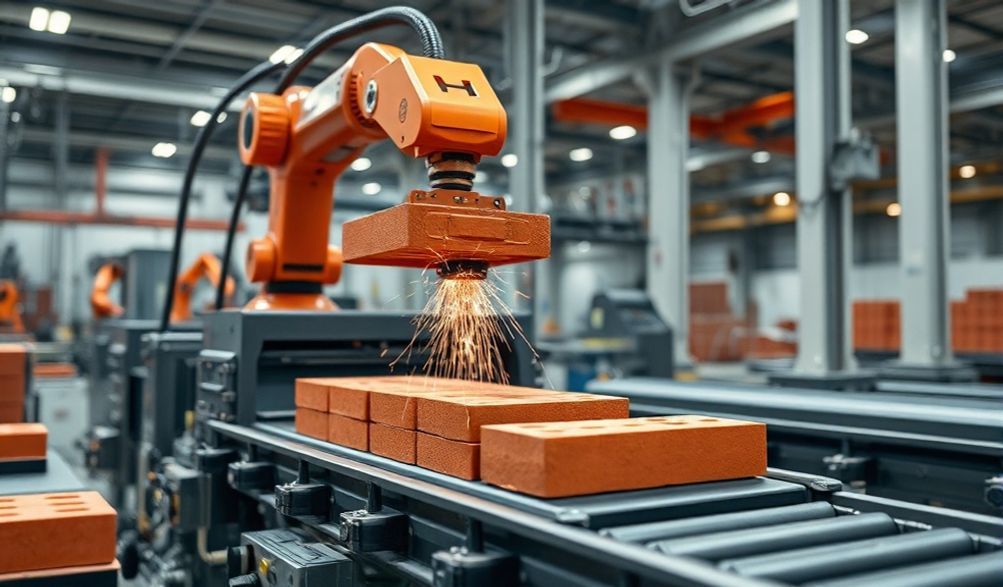
The Ultimate Guide to Auto Brick Making Machines: Efficiency, Cost & How to Choose
Introduction
The global construction industry consumes a staggering 1.5 trillion bricks annually, a demand fueled by relentless urbanization and infrastructure development. For decades, meeting this demand meant relying on labor-intensive, inconsistent, and environmentally taxing manual production methods. Business owners and project managers face a constant battle: scaling production to meet deadlines while controlling spiraling costs and ensuring uniform quality.
Entrez lemachine à fabriquer des briques automatique—the cornerstone of modern, efficient construction material manufacturing. This guide is your definitive resource, crafted from engineering specifications, operational case studies, and direct industry analysis. We’ll move beyond sales pitches to provide you with the unbiased, detailed information needed to make a confident investment. By the end, you’ll understand the technology, the financial implications, and the critical steps to choosing the right machine for your specific business goals.
What is an Auto Brick Making Machine? Core Technology Explained
At its heart, an auto brick making machine is an integrated system designed to automate the entire process of brick manufacturing—from raw material feeding to the ejection of finished, high-density blocks—with minimal manual intervention. It replaces the variability of human labor with the precision and tireless repeatability of engineering.
Basic Definition and Operational Principle
An auto brick making machine is a mechanized unit that mixes, compacts, and molds raw materials (like soil, cement, fly ash, or aggregates) into bricks of precise shape and density. The core operational principle follows a continuous or semi-continuous cycle:
- Alimentation : Raw materials are loaded into a hopper.
- Mélange : Materials are conveyed to a mixing chamber where water is added for uniform consistency.
- Compacting/Molding: The mixture is transferred to a mold box and subjected to intense hydraulic pressure or vibration-press action.
- Éjection : The freshly formed, compact brick is ejected onto a conveyor or pallet for curing and stacking.
Composants clés et leurs fonctions
Comprendre l'anatomie de la machine est essentiel pour évaluer sa qualité.
* Système d'Alimentation et de Trémie : The entry point. A well-designed system ensures consistent material flow, preventing bottlenecks.
* Chambre de mélange : Where raw materials and water are homogenized. The quality of mixing directly impacts brick strength.
* Hydraulic/Pneumatic Compression System: The “muscle” of the machine. High-pressure hydraulic cylinders compact the material, eliminating voids and achieving the required compressive strength.
* Moules/Matrices: Interchangeable components that define the brick’s shape, size, and pattern (e.g., hollow, solid, interlocking).
* Control Panel (PLC/Siemens Systems): The “brain.” A Programmable Logic Controller allows operators to set parameters, monitor cycles, and automate sequences for optimal output.
* Conveyor System & Stacker: Automates the handling of green (unfired) bricks, transporting them to curing areas and stacking them neatly, reducing handling damage and labor.
Types of Auto Brick Making Machines: Finding Your Perfect Match
Not all machines are created equal. The right choice depends entirely on your production goals, budget, and product mix. Industry practice shows that aligning the machine type with your business model is the single most important decision you’ll make.
By Production Output
- Small-scale/Semi-automatic Machines: Ideal for startups or local projects. They require some manual intervention (e.g., feeding raw materials, removing bricks) but significantly boost output over fully manual methods. Output: 1,000 – 4,000 bricks per 8-hour shift.
- Medium-scale Fully Automatic Machines: The workhorse for growing businesses. These are fully integrated systems with automatic feeders, conveyors, and stackers. Output: 5,000 – 15,000 bricks per shift.
- Large-scale Fully Automatic Plant Lines: For industrial-level production. These involve multiple synchronized machines, including automated raw material handling and curing systems. Output: 20,000+ bricks per shift.
By Brick Type Produced
- Machines à fabriquer des blocs creux : Produce lightweight blocks with cavities, used for partition walls and non-load-bearing structures. They offer excellent thermal insulation and material savings.
- Solid/Paver Block Making Machines: Designed for high-density, high-strength bricks used in pavements, driveways, and heavy-duty flooring. They require immense pressure.
- Machines de fabrication de briques de cendres volantes : A sustainable choice that utilizes fly ash, a by-product of coal combustion. These machines produce bricks that are often stronger, lighter, and more eco-friendly than traditional clay bricks.
- Machines à fabriquer des briques imbriquées : Produce bricks with designed ridges and grooves that lock together without mortar, enabling faster, cheaper construction for walls and paving.
By Driving System
- Hydraulic Machines: Use hydraulic pumps and cylinders to apply immense, controlled pressure. They are known for producing bricks with superior strength and smooth finish, and are versatile for different raw material mixes.
- Vibration-Press Machines: Combine vibration (to settle the concrete mix) with mechanical pressure. They are highly effective for producing dense concrete pavers and solid blocks, often with faster cycle times for specific mixes.
The Tangible Benefits: Why Automate Your Brick Production?
Transitioning to automation is a strategic move, not just an equipment purchase. The data-backed advantages translate directly to your bottom line and competitive edge.
Unmatched Productivity & Consistent Quality
A single medium-sized automatic machine can produce the output of 30-40 skilled manual laborers consistently. More importantly, every brick is identical. This dimensional accuracy (aligned with standards like IS 1077ouASTM C90) ensures faster construction with less mortar usage and predictable structural performance. Operators report a dramatic reduction in on-site rejections and client complaints.
Significant Cost Reduction & Labor Optimization
While the initial investment is higher, the long-term economics are compelling:
* Coûts de main-d'œuvre : Reduce dependence on a large, variable workforce.
* Déchets de matériaux : Precise mixing and compaction minimize raw material spillage and waste.
* Efficacité opérationnelle : Faster production cycles and lower energy consumption per brick compared to traditional kiln-fired methods.
Enhanced Operational Safety & Sustainability
Automation removes workers from the most strenuous and hazardous tasks of mixing and molding. Furthermore, modern machines enable the use of eco-friendly materials like fly ash and slag, reducing the environmental footprint. The efficient use of resources and potential for lower emissions per brick position your business as a responsible, modern operator.
Critical Factors for Choosing an Auto Brick Making Machine
This is where due diligence separates a successful investment from an expensive mistake. Look beyond the brochure.
Assessing Your Business Needs
- Projected Demand: Calculate your current and 5-year future brick requirement. Don’t under or over-invest in capacity.
- Brick Type Portfolio: What does your market demand? Hollow blocks for urban housing? Pavers for landscaping? Your product mix dictates the required mold types.
- Raw Material Reality: Analyze the locally available materials—soil composition, fly ash availability, aggregate size. The machine must be suited to process them efficiently.
Plongée approfondie dans les spécifications des machines
- Cycle Time & Capacity: A machine with a 20-second cycle time is fundamentally different from one with a 45-second cycle. Calculate the réaliste daily output, not the theoretical maximum.
- Exigences en matière d'alimentation électrique : Determine if you have reliable three-phase electrical supply or if a diesel-powered option is necessary for your location.
- Hydraulic Pressure & Mold Options: Higher pressure (measured in tons or MPa) generally yields stronger bricks. Ensure the manufacturer offers or can source custom molds for future product diversification.
Manufacturer Evaluation Checklist
Your relationship with the manufacturer is long-term. Prioritize:
* Experience & Reputation: Look for a track record of 10+ years and ask for client references, especially in your region.
* Service après-vente : This is critical. Inquire about the availability of spare parts, the location of service engineers, training programs, and warranty terms. A cheap machine with no support is a liability.
* Certifications : CE, ISO 9001 certifications are strong trust signals, indicating adherence to international manufacturing and safety standards.
Understanding Investment: Cost Analysis & ROI
A transparent financial breakdown is essential for planning and securing financing.
Breakdown of Initial Investment Costs
Costs vary widely based on automation level and capacity.
* Machine Price: Can range from $15,000 for a basic semi-automatic model to $150,000+ for a high-end, fully automatic line.
* Équipement auxiliaire : Budget for a pan mixer, conveyor belts, brick pallets, and a forklift or stacker.
* Installation et Mise en Service : Includes foundation work, electrical connections, and on-site training by the supplier’s technician.
Operational & Maintenance Costs
- Matériaux bruts : Your largest recurring cost. Volume depends on brick size and density.
- Utilities: Electricity/diesel for the machine and water for mixing.
- Travail : Reduced but skilled; at least one trained operator and a maintenance technician.
- Maintenance Préventive : Regular replacement of wear parts like seals, mold liners, and hydraulic oil. Budget 3-5% of the machine’s cost annually for maintenance.
Calculating Your Return on Investment (ROI)
Simplified Framework:
1. Calculate Annual Revenue: (Bricks produced per day) x (Operating days per year) x (Sale price per brick).
2. Calculate Annual Operating Cost: (Raw material cost + Labor + Utilities + Maintenance + Depreciation).
3. Calculate Annual Profit: Revenue – Operating Cost.
4. Determine Payback Period: (Total Initial Investment) / (Annual Profit).
Exemple : A $50,000 machine generating $25,000 annual profit has a 2-year payback period. Key variables are your local brick selling price and your plant’s utilization rate.
Installation, Operation & Maintenance Best Practices
Proper setup and care are non-negotiable for longevity and performance.
Site Preparation and Installation Guide
- Foundation: Requires a strong, level concrete base as per the machine manual to absorb vibrations.
- Espace : Allocate ample space for the machine, raw material storage, brick curing, and finished goods storage.
- Utilities: Ensure correct voltage power supply and a clean water source are at the site before installation.
Daily Operation and Safety Protocols
- Startup/Shutdown: Follow a strict sequence: check hydraulic oil, inspect molds, clear the conveyor area before powering on.
- Safety First: Mandate safety gear (gloves, helmets, safety glasses). Ensure all moving parts and electrical panels have proper guarding. Never perform adjustments while the machine is running.
Preventive Maintenance Schedule
- Daily: Check hydraulic oil levels, clean the mold and feeder, inspect for loose bolts.
- Weekly: Grease all moving joints, check the hydraulic system for leaks, clean sensors.
- Monthly: Replace hydraulic filters, conduct a thorough inspection of wear parts, calibrate the pressure settings.
Frequently Asked Questions (FAQ)
Q1: What is the average production capacity of a standard auto brick making machine?
A: There is no single “standard.” Capacities range from 4,000 to over 20,000 bricks per 8-hour shift for a fully automatic machine. The exact number depends on brick size, cycle time, and machine model. Always ask for a live demonstration or verified site report.
Q2: Can one machine produce different types and sizes of bricks?
A: Yes, this is a key advantage. By changing the mold/die set (which can take 30 minutes to a few hours), the same machine can produce hollow blocks, solid blocks, or pavers of different dimensions. Ensure the manufacturer offers these molds.
Q3: What is the typical lifespan of these machines, and what impacts it most?
A: With proper maintenance, a well-built automatic brick machine can last 10 to 20 years. The factors that most impact lifespan are: adherence to the preventive maintenance schedule, the quality of raw materials (avoid very abrasive mixes without adjustment), and avoiding continuous overloading beyond its rated capacity.
Q4: Are auto brick making machines profitable for small businesses?
A: Absolutely. Semi-automatic models offer an accessible entry point. Profitability hinges on a solid business plan: a reliable local market, control over raw material costs, and efficient operation. Many small businesses start with one machine and scale up.
Q5: How do I ensure the quality of bricks produced?
A: Quality is a process:
* Use consistent, tested raw materials.
* Calibrate the machine’s pressure and mixing time for your specific mix.
* Periodically send brick samples to a construction materials lab for compressive strength testing (e.g., IS 3495).
* Maintain proper curing conditions (adequate moisture and time).
Conclusion
The auto brick making machine represents a fundamental leap forward for construction material production. It is an investment in precision, scalability, and long-term profitability. By automating the core of your production, you gain control over quality, costs, and your ability to meet market demands.
Your final decision should not be based on price alone. Prioritize a thorough needs assessment and rigorous due diligence on manufacturer reputation and support services. The future of this technology points towards greater integration—IoT sensors for remote monitoring and AI-driven adjustments for optimal quality control are already on the horizon.
Take the next step with confidence. Use the insights from this guide to engage with reputable manufacturers. Request detailed quotations, ask for site visits to existing client operations, and perform your ROI calculation with your own local numbers. Your journey towards efficient, modern brick production starts with informed action.
<