
中国免烧制砖机制造终极指南:聚焦富达工厂
Dans la course mondiale vers une construction plus verte et plus efficace, une révolution silencieuse redéfinit littéralement les fondations de notre monde. La demande de matériaux de construction durables et économiques a propulsé les technologies innovantes au premier plan, et à la pointe de cette avancée se trouve la machine à fabriquer des blocs sans cuisson. Pour les entrepreneurs, promoteurs et chefs d'entreprise souhaitant se doter d'un avantage concurrentiel, le choix de la bonne machine est une décision cruciale. Ce guide complet explore les rouages de cette technologie, en mettant particulièrement l'accent sur la puissance manufacturière chinoise qui en accélère l'adoption. Nous vous offrons une analyse approfondie et experte deChine machines de fabrication de blocs de boulangerie gratuitesaboutissant à un profil détaillé de l'éminentUsine de fabrication de blocs FUDANotre objectif est de vous doter des connaissances nécessaires pour naviguer sur ce marché, comprendre la véritable proposition de valeur et réaliser un investissement qui corresponde à vos objectifs économiques et environnementaux.
Qu'est-ce que les machines de fabrication de blocs sans cuisson ? (Comprendre la technologie de base)
Avant d'évaluer les fabricants, il est essentiel de saisir la technologie fondamentale. Les machines à fabriquer des blocs sans cuisson, également appelées machines à blocs non cuits ou presses hydrauliques, représentent un écart significatif par rapport aux techniques de fabrication de briques vieilles de plusieurs siècles.
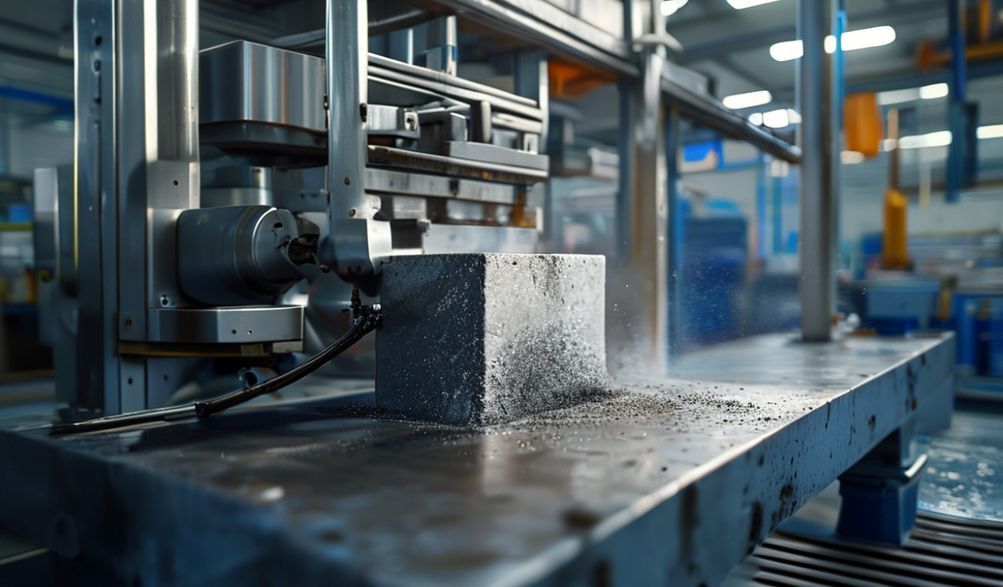
Au lieu de dépendre de fours énergivores, ces machines fabriquent des blocs de construction à haute résistance grâce à un processus de compactage à haute densité.
La Science derrière la Technologie sans Cuisson
Le processus est élégant par son efficacité. Les matières premières—généralement un mélange précis de ciment, de cendres volantes (un sous-produit des centrales électriques au charbon), de laitier, de gravillons et de sable—sont chargées dans la trémie de la machine.
- Un système hydraulique exerce alors une pression immense (mesurée en tonnes) sur le mélange à l'intérieur d'un moule.
- Cette compression extrême déclenche une réaction de liaison hydraulique au sein des matériaux cimentaires, formant un bloc dense et cohérent.
- Les blocs fraîchement pressés sont ensuite durcis, soit naturellement pendant 7 à 28 jours, soit de manière accélérée dans des chambres de cure à vapeur. Cette « cure » permet aux blocs d'acquérir de la résistance par hydratation, éliminant ainsi totalement le besoin de cuisson à base de combustibles fossiles.
Principaux avantages par rapport aux briques cuites traditionnelles
Les avantages de cette méthode sont substantiels et multiples :
- Efficacité énergétique et durabilité :L'élimination du processus de cuisson au four réduit la consommation d'énergie jusqu'à 70-80%. Elle utilise également activement les déchets industriels (cendres volantes, laitier), contribuant ainsi à une économie circulaire.
- Empreinte carbone réduite :La réduction significative de la combustion de carburant se traduit directement par des émissions de CO2 nettement plus faibles par bloc produit.
- RentabilitéeLes économies proviennent de factures d'énergie réduites, de matières premières moins chères (grâce à l'utilisation de sous-produits) et d'une main-d'œuvre réduite en raison d'un potentiel d'automatisation plus élevé.
- Cycles de production accélérésLes blocs sont prêts à être empilés peu après le pressage, et avec le durcissement à la vapeur, ils peuvent atteindre une résistance à la manutention en quelques heures, accélérant ainsi les délais des projets.
- Propriétés supérieures des matériaux : The blocks often exhibit higher compressive strength, better sound insulation, and improved fire resistance compared to traditional clay bricks.
Common Applications of Non-Fired Blocks
The versatility of these blocks has led to widespread use in:
* Load-bearing and non-load-bearing walls in residential, commercial, and industrial buildings.
* Pavés for roads, walkways, and parking lots.
* Landscaping and retaining walls.
* Specialty blocks for sound barriers and thermal insulation facades.
Why Source from China? The Global Hub for Block Machinery
China has cemented its position as the world’s workshop for construction machinery, and block making equipment is no exception. There are compelling reasons for this global dominance.
Scale, Expertise, and Supply Chain Advantages
China’s manufacturing ecosystem is unparalleled. The concentration of specialized component suppliers, steel fabricators, and hydraulic system manufacturers creates a synergistic network.
- This results in competitive pricing that is difficult to match elsewhere, without necessarily sacrificing quality.
- Decades of focus on this sector have bred deep technical expertise and continuous incremental innovation in machine design and automation.
- The sheer scale allows manufacturers to maintain extensive inventories and offer a wider range of models and customization options.
Navigating the Market: Quality Spectrum and Due Diligence
It is, however, crucial to acknowledge the spectrum within the market. Not all suppliers are created equal.
* The range spans from premium OEMs (Original Equipment Manufacturers) with robust R&D departments to basic assembly workshops and pure trading companies with no manufacturing capability.
* The key for a buyer is effective due diligence. The adage “you get what you pay for” often holds true; an unusually low price can signal compromises in component quality, durability, or after-sales support.
Profil Approfondi : Usine de Fabrication de Briques FUDA
Amidst the vast landscape of Chinese manufacturers, FUDA Block Making Factory has established itself as a prominent and reliable name. Let’s examine what makes them a noteworthy contender for your investment.
Héritage de l'Entreprise et Philosophie de Fabrication
FUDA positions itself as a dedicated manufacturer, not a middleman. With a history spanning years in the heavy machinery sector, they have focused on evolving their block making technology.
* Their philosophy typically centers on providing “value-engineered” solutions—balancing performance, durability, and cost.
* A commitment to in-house production of core components like welding frames and assembly ensures better quality control.
* While specific certifications should always be verified directly with the factory, manufacturers of their stature often hold relevant international standards like ISO for quality management and CE for machine safety.
Core Product Line: A Look at FUDA’s Baking-Free Machines
FUDA’s catalog generally caters to small, medium, and large-scale operations, offering flexibility. Their product line often includes:
- Machines entièrement automatiques : High-output models with automatic material feeding, pressing, pallet return, and block stacking. Ideal for large-scale commercial block yards.
- Machines semi-automatiques : A popular choice for mid-sized businesses, where some steps like feeding or stacking are manual, offering a great balance of productivity and affordability.
- Machines à blocs mobiles : Smaller, often manual or semi-automatic machines that can be moved around a site, perfect for producing blocks directly where they are needed.
Typical specifications to expect across their range include pressure from 800 to 2000+ tons, cycle times of 10-20 seconds, and outputs ranging from 3,000 to over 20,000 blocks per 8-hour shift, depending on the model and block size.
The FUDA Advantage: What Differentiates Them?
Based on industry analysis and user feedback, FUDA’s value proposition often hinges on several practical strengths:
- Orientation vers la Durabilité : Emphasis on using robust materials for key stress points like the mold, press head, and hydraulic system to ensure longevity.
- Comprehensive Solution: They frequently provide not just the machine, but also a suite of standard molds for different block types (hollow, solid, paving, interlocking) as part of the package.
- Structure de Support Après-Vente : They typically offer a clear warranty (e.g., 1-2 years on core parts), provide detailed operation and maintenance manuals, and maintain accessibility for online technical support.
- Training and Guidance: Reputable suppliers like FUDA often supply production formula guidance and basic operational training videos or documentation.
Critical Factors for Buyers: A Pre-Purchase Checklist
Arming yourself with the right questions is the most important step before any purchase. This checklist will help you evaluate both the machine and the supplier.
Assessing Your Needs: Project Scale, Output, and Block Types
Begin internally. Answer these questions:
* What is my daily or monthly block production requirement?
* What types of blocks will I be producing (solid, hollow, paving, specialty shapes)?
* What are the standard block sizes in my target market?
* What is my available factory space and power supply (voltage, phase)?
Spécifications clés des machines à examiner attentivement
When reviewing a machine’s specs, go beyond the headline output number:
* Pression (Tonnage) : Higher tonnage generally produces denser, stronger blocks.
* Temps de cycle : The time to complete one press cycle directly impacts maximum output.
* Niveau d'automatisation : Match this to your available labor and desired efficiency.
* Puissance du Moteur & Système Hydraulique : Indicates capability and potential energy consumption.
* Qualité de construction : Request close-up photos/videos of the welding, paintwork, and component brands (e.g., hydraulic pumps, PLC controllers).
Beyond the Machine: Evaluating Supplier Credibility
Your relationship with the supplier is a long-term commitment. Verify the following:
* Audit d'usine : Can they provide a recent, unedited video walkthrough of their production workshop?
* Références clients : Ask for contactable past clients in a region similar to yours.
* Operational Proof: Request a video of the exact model you’re interested in, running and producing blocks.
* Logistics Clarity: Understand their standard Incoterms (FOB, CIF), and get a detailed breakdown of shipping and estimated customs duties for your country.
* Politique des Pièces Détachées : Ask for a spare parts price list and confirm lead times for critical components.
The Investment & Operational Economics
A transparent look at the numbers ensures no surprises and helps build a solid business case.
Understanding the Total Cost of Ownership
The machine’s price tag is just the beginning. Factor in:
1. Machine Cost: Base price of the equipment.
2. Shipping & Insurance: Freight costs, marine insurance.
3. Customs & Import Duties: Varies significantly by country; consult a local agent.
4. Installation et Mise en Service : Potential costs for a technician’s travel or local installation help.
5. Matériaux bruts : Cost of cement, aggregates, fly ash in your locality.
6. Labor & Utilities: Costs for operators and electricity.
7. Maintenance: Annual budget for wear parts and preventative maintenance.
Calculating Potential Return on Investment (ROI)
A simplified framework for estimation:
1. Calculate Total Investment: Sum of all initial costs (points 1-4 above).
2. Estimate Operational Cost per Block: (Raw Material + Labor + Utility + Maintenance cost) per block.
3. Determine Your Selling Price per Block: Based on local market rates.
4. Calculate Gross Profit per Block: Selling Price – Operational Cost.
5. Project Annual Gross Profit: (Gross Profit per Block) x (Annual Production Volume).
6. Estimate ROI Period: Total Investment / Annual Gross Profit.
This provides a clear picture of the machine’s payback period and long-term profitability.
FAQ: Your Questions on China Baking-Free Machines & FUDA Factory Answered
Q1: What is the main difference between a baking-free block machine and a traditional brick machine?
A: The core difference is the curing process. Baking-free machines use high-pressure compaction and natural/steam curing, while traditional machines require fossil-fuel-fired kilns, making the former far more energy-efficient and eco-friendly.
Q2: Is the quality of blocks from a non-fired machine comparable to fired bricks?
A: Yes, for many applications. High-pressure baking-free blocks achieve excellent compressive strength, durability, and dimensional consistency. They often outperform fired clay bricks in strength and offer better thermal and acoustic insulation.
Q3: Why should I consider FUDA factory specifically?
A: FUDA has built a reputation for robust engineering, reliable after-sales support, and offering a balance of automation and affordability. Their focus on core manufacturing (not just trading) and providing comprehensive solutions (machine + molds + guidance) adds significant value for buyers.
Q4: What kind of after-sales support can I expect when importing from China?
A: Reputable factories like FUDA typically offer online technical support, detailed operation manuals, video guides, and a warranty (1-2 years is common). They should also provide accessible spare parts lists and support for finding local technicians if needed. Always confirm these details in your contract.
Q5: What are the logistical steps involved in importing a machine from FUDA?
A: The general process includes: 1) Finalizing specifications and contract (Incoterms like FOB or CIF), 2) Payment (often a deposit + balance before shipment), 3) Production and pre-shipment inspection, 4) Shipping and customs clearance in your country (you may need an agent), 5) Delivery and installation.
Conclusion
The shift towards machine à fabriquer des blocs sans cuisson technology is more than a trend; it’s a logical step forward for sustainable and economically sound construction. China, as the manufacturing epicenter, offers access to this technology at compelling value points. As we have explored, success in this venture hinges on informed decision-making. Manufacturers with a proven track record like the Usine de fabrication de blocs FUDA distinguish themselves through tangible commitments to engineering quality, customer support, and providing a complete production solution. By meticulously defining your requirements, conducting rigorous supplier due diligence, and planning for the full lifecycle of your investment, you can secure a piece of machinery that will reliably build the foundation of your projects—and your profits—for years to come.
Authoritative Note & Disclaimer:
This guide is compiled based on extensive industry research, analysis of manufacturing trends, and publicly available data on block making technology and leading manufacturers. It is intended for informational purposes to aid in the preliminary research phase. We strongly recommend that potential buyers conduct their own due diligence, request factory audits, verify all certifications directly with suppliers, and consult with trade and logistics experts before finalizing any purchase. Specifications, support terms, and company details should always be confirmed with the manufacturer.