
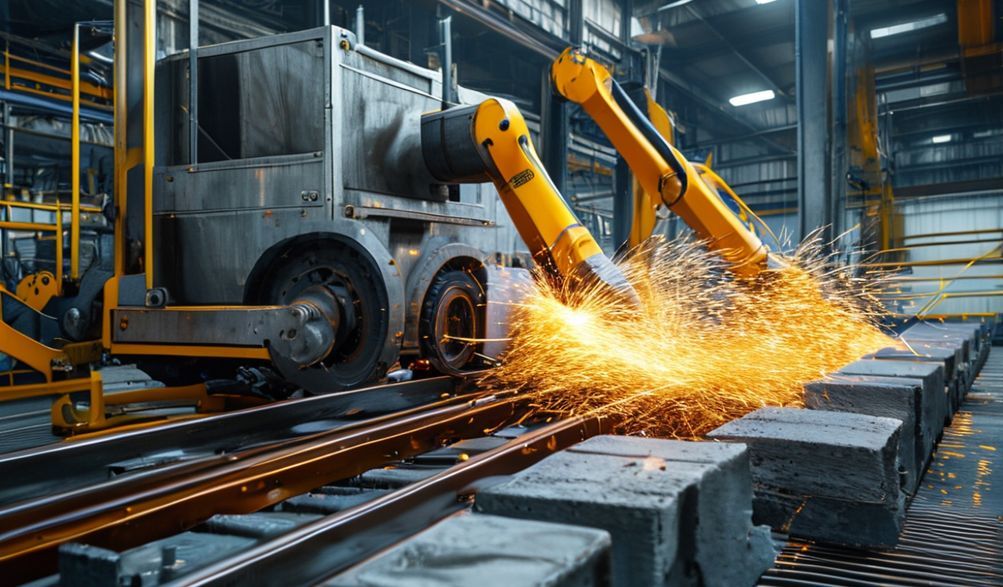
Votre Partenaire de Confiance : Trouver le Bon Fournisseur de Machine à Blocs de Béton Automatique
Dans le monde concurrentiel de la construction et de la fabrication, l'efficacité de votre chaîne de production dépend de la qualité de vos machines. Choisir la bonnefournisseur de machine automatique de fabrication de blocs de bétonCe n'est pas seulement un achat ; c'est un partenariat stratégique qui influence votre productivité, la qualité de vos produits et votre rentabilité.
Ce guide est conçu pour aider les propriétaires d'entreprise, les directeurs d'usine et les responsables des achats à naviguer dans cette décision cruciale. Nous allons approfondir les facteurs clés qui distinguent un fournisseur fiable commeUsine de fabrication de blocs FUDAse distinguer des autres, en se concentrant sur les capacités des machines, l'expertise du fournisseur et la valeur à long terme qu'ils offrent. Nos analyses s'appuient sur une connaissance approfondie du secteur pour vous aider à réaliser un investissement éclairé et en toute confiance.
Qu'est-ce qu'une machine automatique à fabriquer des blocs de béton ?
Une machine automatique de fabrication de blocs de béton est le cœur d'une usine de production moderne à grand volume. Elle transforme les matières premières en blocs de construction précis et durables avec une intervention humaine minimale, garantissant une cohérence et une échelle que les méthodes manuelles ou semi-automatiques ne peuvent égaler.
Fonction principale et principe opérationnel
La magie de ces machines réside dans leur flux de travail automatisé et fluide. Le processus suit généralement ces étapes :
- Alimentation & Mélange :Les matières premières – ciment, granulats (comme le sable ou la pierre concassée) et eau – sont automatiquement dosées et introduites dans un malaxeur pour créer un mélange de béton homogène.
- Moulage :Ce mélange est ensuite acheminé dans un moule placé sur une table vibrante. Les vibrations à haute fréquence compactent le béton, éliminant les poches d'air et assurant sa densité.
- Guérison :Les blocs fraîchement moulés, encore sur leurs palettes, sont automatiquement transférés dans une chambre de cure (comme un hammam ou une zone climatisée) où ils acquièrent une résistance initiale.
- Palettisation et empilage :Une fois durcis, les blocs sont dépallettisés, empilés et préparés pour le stockage ou l'expédition, souvent à l'aide de bras robotisés ou de systèmes de convoyage.
Cette automatisation de bout en bout représente un changement significatif, maximisant la production tout en minimisant les coûts de main-d'œuvre et les erreurs humaines.
Composants clés et leurs rôles
Comprendre l'anatomie de la machine aide à évaluer sa qualité :
- Système Hydraulique :Le groupe électrogène. Il fournit l'immense pression nécessaire pour compacter le béton et éjecter le bloc fini. La fiabilité à ce niveau n'est pas négociable.
- Table de Vibration :Équipé de moteurs puissants, il fluidifie le mélange de béton dans le moule, garantissant un compactage parfait et une finition lisse.
- Assemblage du moule :L'élément déterminant. Les moules interchangeables définissent le type de bloc (creux, pleins, pavés). L'usinage de précision est essentiel pour l'exactitude dimensionnelle.
- Panneau de Commande (PLC) :Le cerveau. Un Automate Programmable Industriel permet aux opérateurs de définir des paramètres, de surveiller l'ensemble du processus et de diagnostiquer les problèmes, garantissant ainsi une qualité reproductible.
- Systèmes de Convoyeurs et de Palettes :Le système circulatoire. Ils synchronisent le mouvement des palettes et des blocs entre les stations, dictant le rythme global de production.
Types de Blocs Produits
La polyvalence est un avantage majeur. Avec un simple changement de moule, une seule machine peut produire :
* Blocs Creux et Pleins
* Pavés et bordures de trottoir
* Briques imbriquées pour l'aménagement paysager
* Blocs de formes spéciales pour les caractéristiques architecturales
Cela permet à une seule ligne de production de desservir plusieurs segments de marché.
Pourquoi le choix du fournisseur compte plus que le prix seul
Le devis initial n'est qu'une ligne dans votre coût total de possession. Le fournisseur que vous choisissez façonne fondamentalement votre réalité opérationnelle et financière pour la prochaine décennie.
Impact sur l'efficacité de production et la disponibilité opérationnelle
A machine from a reputable supplier is engineered for relentless performance. It’s built with quality components to withstand 24/7 operation, maximizing your asset utilization.
Conversely, a cheaper machine from an unknown source often carries hidden costs:
* Frequent breakdowns and unplanned downtime.
* Production of sub-standard blocks that cannot be sold.
* Constant repair expenses that eat into profits.
Your machine’s reliability directly dictates your ability to meet orders and deadlines.
Access to Genuine Expertise and Support
You’re not just buying hardware; you’re buying knowledge. A top-tier supplier provides:
* Formation Complète : Empowering your team to operate and perform basic maintenance.
* Assistance technique : Access to engineers who can troubleshoot issues remotely or on-site.
* Pièces de rechange authentiques : Ensuring replacements fit perfectly and don’t compromise the machine’s integrity.
This support network is your safety net, ensuring long-term, smooth operation.
Long-Term ROI and Total Cost of Ownership
Think in terms of a 10-year investment. A higher initial cost with a trusted partner like FUDA often translates to a lower total cost due to:
* Durabilité : Machines that last longer without major overhauls.
* Efficacité énergétique : Modern designs that reduce power consumption.
* Valeur de revente plus élevée : Well-known, reliable brands hold their value.
* Temps d'arrêt minimisé : Consistent production protects your revenue stream.
The true ROI is measured in years of profitable, hassle-free production.
Evaluating an Automatic Block Machine Supplier: A Step-by-Step Guide
Navigate the selection process with a structured, critical approach.
Évaluation de l'Expertise et de l'Expérience en Fabrication
Look for a supplier with deep roots in the industry. Longevity suggests resilience and accumulated knowledge.
- Question clé : “How long have you been manufacturing these specific machines?”
- Experience Indicator: Prioritize suppliers who are fabricants, not just traders. A factory like FUDA has direct control over quality, welding, assembly, and R&D, ensuring accountability.
Verifying Machine Quality and Technology
Request detailed specifications and, if possible, a video inspection or factory visit.
- Qualité de construction : Inspect the grade of steel used, the quality of welding, and the robustness of the frame.
- Systèmes de base : Scrutinize the brand and specifications of the hydraulic pumps and the PLC controller. Are they from reputable manufacturers?
- Expertise Indicator: Ask about their R&D department. A supplier that invests in innovation is committed to improving efficiency and product performance.
Analyzing After-Sales Service and Support Structure
The warranty document is a critical piece of the puzzle. Read it carefully.
- Non-Negotiables: Clear warranty terms (12-24 months on core parts), provision for installation supervision, and a readily available spare parts catalog.
- Trustworthiness Indicator: Always ask for client references or case studies, preferably from projects in your region or with similar production goals. Contact them directly.
Understanding Customization and Solution Offering
Your needs are unique. A true partner will listen.
- Solution Mindset: They should ask about your local raw materials, target block types, production goals, and site conditions.
- Authoritativeness Indicator: They should be able to advise on mix designs, recommend system layouts, and offer customization—like special mold designs or feeding systems—rather than just offering a standard catalog model.
Spotlight on FUDA Block Making Factory: A Supplier Analysis
Let’s apply the above evaluation framework to a specific industry player to understand what excellence looks like.
Company Heritage and Industry Standing
FUDA Block Making Factory has established itself as a specialist manufacturer with a focus on block production technology. Their long-term commitment to this niche has built a reputation for Autorité. Look for indicators like:
* Years of dedicated operation in machinery manufacturing.
* Possession of relevant industry certifications.
* Patents on specific machine components or processes.
This heritage signifies a deep, focused understanding of the block making process.
Product Range and Technological Innovation
A strong supplier offers solutions for different business scales. FUDA typically provides a range, such as:
* High-Output Stationary Plants: For large-scale, fixed-location production.
* Machines à blocs mobiles : Offering flexibility for on-site production.
* Conceptions Écoénergétiques : Incorporating features that reduce power consumption per block.
* Systèmes de Contrôle Intelligents : User-friendly PLC interfaces that allow for precise control and data monitoring.
This range demonstrates their capability to address diverse client needs.
Global Client Support and Project Execution
An export-oriented manufacturer like FUDA has systems for global support.
* Project Execution: They manage the process from design to delivery, often providing layout drawings and foundation plans.
* Training & Installation: Comprehensive training programs for operators and technicians, supported by detailed manuals and video guides.
* Testimonials: A portfolio of successful international projects serves as tangible proof of their expérience and reliability.
Why FUDA Embodies E-E-A-T
In the context of Google’s E-E-A-T (Experience, Expertise, Authoritativeness, Trustworthiness) framework, a supplier like FUDA exemplifies these qualities:
* Expérience : Gained through decades of designing, building, and refining machines based on real-world client feedback.
* Expertise : Demonstrated by deep technical knowledge in concrete technology, mechanical engineering, hydraulic systems, and automation software.
* Autorité : Established as a recognized manufacturer within the block machine industry, often cited by clients and peers.
* Fiabilité : Built on transparent contracts, honoring warranties, and fostering long-term relationships to ensure client success.
Foire aux Questions (FAQ)
Q1: What is the average production output of a fully automatic block making machine?
A: Output varies significantly by model and block size. A standard single machine can produce anywhere from 2,000 to over 10,000 standard blocks (e.g., 8-inch hollow block) per 8-hour shift. Always request a detailed output sheet from your supplier for your specific mold configuration.
Q2: How important is after-sales service, and what should it include?
A: It is arguably as important as the machine itself. Comprehensive service must include detailed installation guidance (preferably on-site supervision), thorough operator and maintenance training, a clear and fair warranty (typically 1-2 years on core parts), and prompt access to technical support and genuine spare parts.
Q3: Can the machine be adapted to use local raw materials?
A: A competent supplier will design for versatility. You should provide samples of your local sand, aggregate, and cement. They can then recommend the optimal mix design and potentially adjust machine settings or components to ensure optimal performance with your materials.
Q4: What are the key differences between a stationary and a mobile automatic block machine?
A: Stationary plants are installed on a fixed foundation for high-volume, continuous production at a factory site. Mobile machines are mounted on a trailer, allowing you to produce blocks directly at a construction site, eliminating transport costs for large projects. Your business model dictates the choice.
Q5: Why choose a manufacturer like FUDA over a general equipment trader?
A: Choosing a manufacturer ensures direct access to engineering expertise, guaranteed quality control from the source, more competitive pricing (no middleman margins), and reliable long-term support for parts and technical upgrades. Manufacturers have an intrinsic stake in the performance and reputation of their product.
Conclusion
Selecting your fournisseur de machine automatique de fabrication de blocs de béton is a decision that will resonate through your business for years. It requires looking beyond the price tag to evaluate the supplier’s experience, expertise, authoritativeness, and trustworthiness.
A partner like Usine de fabrication de blocs FUDA, which combines manufacturing prowess with a client-centric approach, offers more than just equipment—it offers a foundation for sustainable growth and profitability. By prioritizing quality machinery and robust support, you invest in the reliability of your production and the strength of your finished products.
Begin your journey by defining your needs, asking the right questions, and partnering with a supplier who demonstrates a proven commitment to your success.
<