
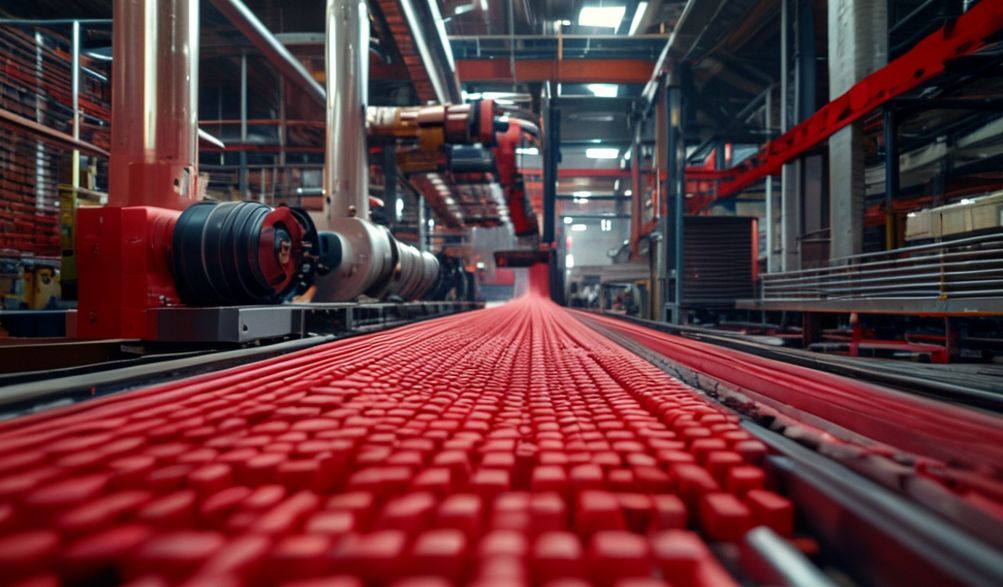
The Ultimate Guide to Buying a Wholesale Hollow Bricks Machine (2026)
Gabatarwa
The global construction industry is at a crossroads. With rising demand for affordable housing and sustainable infrastructure, the pressure is on to find building materials that are cost-effective, durable, and environmentally conscious. Enter the hollow brick: a lightweight, insulating, and material-efficient building block that is rapidly becoming a preferred choice worldwide. However, for manufacturers and construction entrepreneurs, the challenge lies in sourcing the production power to meet this demand reliably and profitably.
The cornerstone of meeting this challenge is the wholesale hollow bricks machine. For a brick plant owner or a startup, this isn’t just a piece of equipment; it’s the engine of your business. A poor purchasing decision can lead to crippling downtime, inconsistent product quality, and a return on investment (ROI) that never materializes.
This guide is designed to be your definitive resource. Built on years of industry observation, direct feedback from plant managers, and a synthesis of technical and market data, it aims to provide authoritative, trustworthy, and practical advice. Our goal is to empower you with the knowledge to navigate the complex wholesale machinery market, avoid common and costly pitfalls, and make a purchase decision with confidence.
We will walk you through every critical aspect—from understanding the core technology and different machine types, to evaluating key features, performing a rigorous financial analysis, and, most importantly, selecting a supplier you can trust for the long haul.
Understanding Hollow Bricks Machines: Types and Core Technology
Menene Injin Bulo Mai Rami?
A hollow bricks machine is a specialized piece of manufacturing equipment designed to automate and streamline the production of hollow concrete or cement-stabilized soil blocks. Its primary function is to compress a mixture of raw materials (like cement, sand, fly ash, or soil) into a mold (die) under high pressure, forming a brick with precisely designed hollow cavities.
The advantages of producing hollow bricks are significant:
* Mai Sauƙi: Reduces the overall dead load of structures, allowing for lighter and often less expensive foundations.
* Rufi da Rufe Sauti: The air pockets within the bricks provide excellent insulation properties, leading to energy-efficient buildings.
* Ingantaccen Kayan Aiki: Uses less raw material than a solid brick of the same dimensions, lowering material costs and environmental impact.
* Ease of Construction: Easier to handle and transport, and channels within the bricks can facilitate plumbing and electrical work.
Main Types of Machines for Wholesale Operations
Choosing the right type of machine is your first and most crucial decision. Your choice will dictate your capital outlay, operational scale, and labor model.
- Matsarori Masu Sarrafa Kansu Gabaɗaya: These are the pinnacle of production efficiency. Computer-controlled via PLC systems, they handle the entire process—from raw material feeding to brick stacking—with minimal human intervention. Ideal for large-scale plants with high, consistent demand.
- Matsin Injin Mai Ƙaramin Gudanarwa: This balanced option offers the best of both worlds for medium-scale operations. Core processes like compression and ejection are automated, but tasks like feeding raw materials or removing pallets may be manual. They offer higher output than manual machines with a more manageable investment than fully automatic lines.
- Manual / Injin Yin Kwai: These are mobile, entry-level machines perfect for small-scale production, rural projects, or on-site brick manufacturing. They require manual operation for most steps but have a low upfront cost and are highly portable.
| Feature | Fully Automatic | Semi-Automatic | Manual (Egg-Laying) |
| :— | :— | :— | :— |
| Ƙarfin Fitarwa | Very High (10,000+ bricks/8hr) | Medium (3,000 – 8,000 bricks/8hr) | Low (1,000 – 2,500 bricks/8hr) |
| Matakin Sarrafa | Computer-controlled, hands-off | Partial automation, some manual labor | Primarily manual operation |
| Bukatar Wutar Lantarki | High (needs robust 3-phase connection) | Medium to High | Low (often single-phase) |
| Space Needed | Large, fixed factory setup | Moderate factory space | Small, can be used outdoors |
| Investment Range | High ($80,000 – $500,000+) | Medium ($25,000 – $100,000) | Low ($5,000 – $20,000) |
The Production Process: From Raw Material to Finished Brick
Understanding the process highlights the importance of each machine component:
- Ciyarwa & Haɗawa: Raw materials are fed into a mixer (pan or planetary) where they are blended with water to achieve a homogeneous, semi-dry consistency.
- Matsalawa & Ƙirƙira: The mixture is conveyed to the machine’s hopper and fed into the mold box. A hydraulic ram applies intense pressure (often measured in tons) to compact the material into the precise shape of the hollow brick.
- Fitowa & Warkewa: The freshly formed, “green” brick is ejected onto a pallet. In automatic systems, a pallet feeder and stacker organize the bricks. The bricks then undergo a critical curing process, where they gain strength over days through hydration, often in a controlled environment.
Key Components to Note:Thetsarin na'urar motsa ruwa is the heart (reliability is key). The mold/die defines your product (precision is critical). The tsarin sarrafawa (PLC or manual) is the brain governing consistency.
Key Features to Evaluate in a Wholesale Machine
Beyond the basic type, scrutinizing these features will separate a good investment from a great one.
Ƙarfin Samarwa & Ƙayyadaddun Abubuwan Samarwa
- Don’t just look at “bricks per day.” Ask for the lokacin zagayowar (seconds per brick) and calculate based on a realistic operational day (e.g., 20 hours).
- Versatility is profit. Can the machine produce different brick sizes (e.g., 4″, 6″, 8″ hollow blocks) or even pavers? Adjustable or interchangeable molds are a valuable feature, though additional molds are an extra cost.
Machine Durability and Build Quality
This is where cost-cutting by suppliers hurts you most.
* Ginin Firam Look for heavy-duty, welded steel frames (grade Q235 or better). A flimsy frame will warp under constant pressure, leading to misalignment and breakdowns.
* Critical Parts: Inspect the quality of the hydraulic cylinder, pump, and valves (reputable brands like Rexroth or Yuken are good signs). Electrical components should have credible certifications. Molds should be made from hardened, high-chrome steel for longevity.
Power Consumption and Operational Efficiency
- Analyze the motor power (KW/HP) in relation to output. A less efficient machine may use a 30KW motor for an output a better-designed machine achieves with 22KW.
- Look for features that drive down operational costs: automatic lubrication systems, energy-efficient hydraulic circuits, and designs that minimize raw material waste.
Automation and Control Systems
- A Na'urar Sarrafa Ma'ana Mai Tsarawa (PLC) with a touchscreen interface allows for precise control over pressure, cycle times, and vibration. It stores recipes for different products and simplifies troubleshooting.
- Integrated automation like automatic pallet feeders and brick stackers drastically reduces labor costs and improves safety by limiting manual handling of heavy materials.
The Financial Blueprint: Cost Analysis and ROI
Breaking Down the Wholesale Purchase Price
The sticker price is just the beginning. A detailed quotation should be transparent.
* Abubuwan da ke haifar da farashi: Automation level, brand reputation, production capacity, and any customizations (special molds, extra conveyors).
* Inclusions/Exclusions: Crucially clarify: Is the price FOB (Free on Board) or CIF (Cost, Insurance, Freight)? Does it include installation supervision, on-site operator training, a starter set of spare parts, and mold-release oil? Never assume.
Calculating Your Return on Investment (ROI)
A simplified framework:
ROI Time = (Total Machine Investment + Setup Costs) / (Monthly Profit from Brick Sales)
- Estimate Monthly Output Value: (Bricks per month) x (Your selling price per brick).
- Deduct Operational Costs:
- Raw Materials (biggest variable cost)
- Labor
- Amfani da wutar lantarki
- Maintenance & Consumables
- Misali: A $50,000 semi-automatic machine producing 60,000 bricks/month sold at $0.30/brick generates $18,000 revenue. If operational costs are $9,000, monthly profit is $9,000. ROI would be approximately 5.5 months, excluding setup. This is a simplified model; always build a detailed business plan.
Understanding Total Cost of Ownership
The cheapest machine can become the most expensive.
* Kudin Kulawa: High-quality machines need less frequent, less severe repairs. Ask for a recommended maintenance schedule and cost of common spare parts (seals, hydraulic hoses, mold liners).
* Ingantaccen Amfani da Makamashi: A 5KW saving over 20 hours/day, 300 days/year at $0.10/KWh saves $3,000 annually.
* After-Sales Service Value: A supplier who provides prompt technical support and spare parts minimizes costly downtime, directly protecting your profitability.
How to Select a Reliable Wholesale Supplier
This step is arguably more important than the machine specifications themselves.
Supplier Vetting Checklist
- Manufacturer vs. Trader: Prioritize buying directly from the masana'anta. You get better prices, direct technical knowledge, and more control over after-sales support. Traders often act as middlemen without deep expertise.
- Factory Audit & Certifications: Demand evidence. ISO 9001 certification indicates a quality management system. CE marking (for European markets) suggests compliance with safety standards. A virtual or in-person factory tour lets you assess their scale, workshop organization, and quality control processes.
- Technical Support & After-Sales: Ask specific questions: Do you have English-speaking engineers? What is your response time for remote support? What is the warranty period and what does it cover? Do you keep a local inventory of critical spare parts?
The Critical Role of Testing and Raw Materials
Wannan ba za a iya sasantawa ba.
* Insist on a Live Production Test. Provide samples of your local raw materials (soil, sand, fly ash) to the supplier. The machine must be calibrated to work with ka materials’ particle size, moisture content, and composition.
* The test will produce sample bricks that you can then test for compressive strength and dimensional accuracy. It proves the machine’s capability and the supplier’s expertise.
Navigating Logistics, Installation, and Training
Clarify these points before signing any contract:
* Logistics: Who arranges shipping and handles customs clearance? Who is responsible for insurance during transit?
* Installation: Will you send a technician to supervise installation and commissioning? For how long?
* Horarwa: Is comprehensive on-site training for my operators and maintenance staff included? Are manuals and video guides provided?
Tambayoyin da ake yawan yi (FAQ)
What is the price range for a wholesale hollow bricks machine?
Prices vary dramatically based on type and automation. Manual machines can start from $5,000 to $20,000. Semi-automatic models typically range from $25,000 to $100,000. Fully automatic production lines begin around $80,000 and can exceed $500,000 for large, integrated plants. Always obtain detailed, itemized quotations.
Can one machine produce different sizes of hollow bricks?
Yes, but this requires interchangeable molds. Most machines are sold with one standard mold. Additional molds for different brick sizes or patterns (e.g., pavers, solid blocks) are purchased separately and can cost from $1,000 to $5,000+ each, with a lead time for manufacturing.
What are the most common maintenance requirements?
- Kullum: Clean the machine, check hydraulic oil levels and for leaks, ensure all bolts are tight.
- Mako-mako: Lubricate all moving parts as per the manual, inspect mold for wear.
- Monthly/Annually: Change hydraulic oil and filters, perform a comprehensive check of electrical connections and pressure settings.
How do I ensure the machine works with the raw materials in my region?
This is critical. You must send 50-100 kg of your representative raw materials (soil, sand, ash) to your shortlisted supplier. They should conduct a lab analysis and a live production test, providing you with the resulting brick samples and strength data.
What after-sales support should I expect from a wholesale supplier?
Expect a comprehensive package: detailed operation and maintenance manuals, video tutorials, a warranty (typically 12 months on core parts), access to remote technical assistance via phone/video, and a reliable supply chain for genuine spare parts. The best suppliers offer optional annual service contracts.
Ƙarshe
Purchasing a wholesale hollow bricks machine is a significant capital decision that forms the foundation of your manufacturing business. The journey involves understanding the technological landscape, scrutinizing machine features with a critical eye, performing rigorous financial due diligence, and, above all, meticulously selecting a supplier whose reliability matches your ambition.
Remember, the most cost-effective choice is rarely the cheapest machine. It is the most robust, suitable, and efficient machine, backed by a trustworthy partner who will support your operation for years to come. This investment is not just in metal and motors; it’s in the future scalability and profitability of your enterprise.
Ready to move forward with confidence?
* Primary CTA: Ready to Get a Personalized Quote? Contact our industry specialists today for a free consultation and raw material analysis to match you with the ideal machine.
* Secondary CTA: Download our comprehensive checklist for visiting a machinery factory or evaluating supplier proposals to ensure you cover every critical point.
Armed with this knowledge, you are now positioned as an informed buyer, ready to make a strategic investment that will build not just bricks, but a sustainable and profitable business for the future.
<