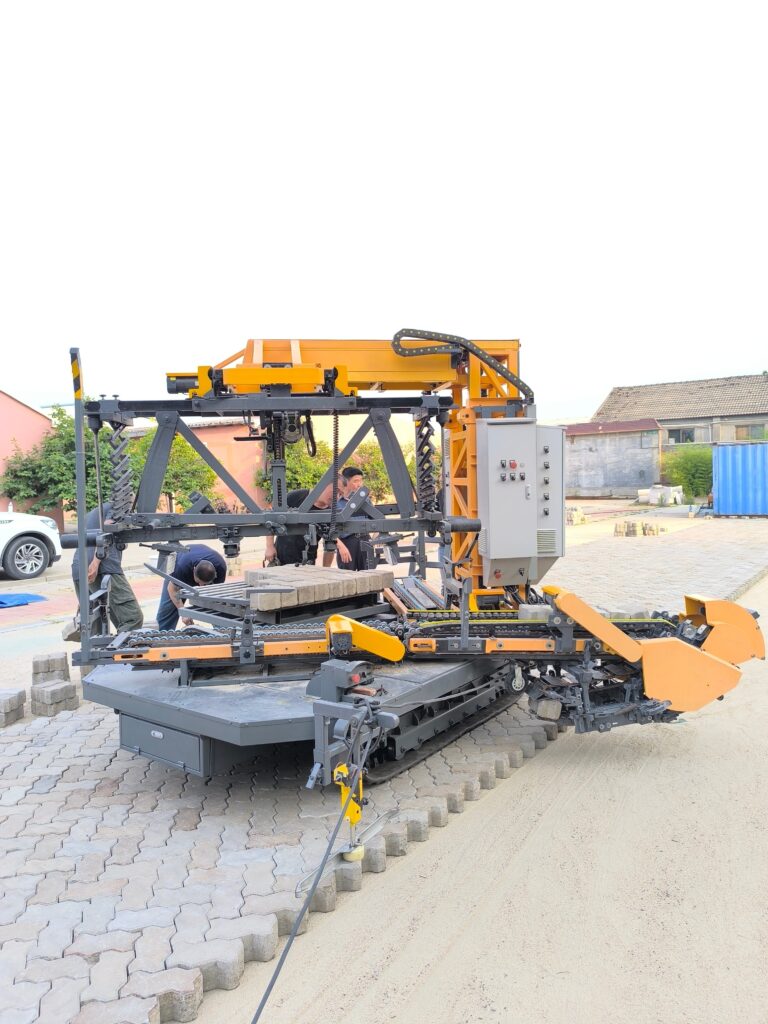
1. Gabatarwa
A cikin masana'antu na gine-gine da kuma tsara shimfidar wurare, ingantacciyar aiki, daidaito, da tsadar farashi na shimfidar tituna sun daɗe suna zama muhimman abubuwan da ke tasiri ribar aikin da kuma gamsuwar abokin ciniki. Ga masu rarrabawa, masu rarrabawa, da masu sayayya da ke aiki a cikin wannan fanni, gano kayan aikin da za su iya haɓaka ƙwarewar aiki yayin da suke ba da sakamako mai maimaitawa yana da mahimmanci. Injunan shimfida bulo sun fito a matsayin kayan aiki masu canzawa da aka ƙera don magance gazawar hanyoyin shimfida na hannu na gargajiya. Wannan labarin yana da nufin ba da cikakken bayani game da waɗannan injunan, tare da rufe ainihin ayyukansu, ƙayyadaddun fasaha, fa'idodin aiki, yanayin aikace-aikace, da ƙimar saka hannun jari. Ta hanyar zurfafa cikin ƙayyadaddun injunan shimfida bulo, muna nufin ba ƙwararrun masana'antu ilimin da ake buƙata don yin yanke shawara na saye da rarrabawa cikin ilimi, a ƙarshe haɓaka ci gaban kasuwanci da fa'idar gasa a cikin kasuwa mai ƙarfi.
2. Ayyuka na Asali da Tsarin Aiki
2.1 Ka'idojin Aiki na Asali
Injinonin shimfiɗa tubalin ƙetare suna da ƙira don sarrafa aikin sanya tubalin ƙetare cikin daidaitaccen tsari, tare da kawar da buƙatar aikin hannu mai cike da wahala. Babban ƙa'idar aikin ta ta'allaka ne akan matakai guda uku masu mahimmanci: ciyar da kayan, sanya wuri, da sanyawa. Da farko, ana ɗora tubalin ƙetare a cikin ma'ajiya ko tsarin majigi, wanda ke ciyar da su ɗaya bayan ɗaya a kan na'urar jigilar kaya. Wannan tsarin jigilar kaya, sau da yawa yana sanye da jagorori masu daidaitawa, yana tabbatar da cewa kowane tubalin yana daidai daidai kafin ya isa kan shugaban sanyawa. Shugaban sanyawar, wanda aka sarrafa ta tsarin injinan ruwa ko na lantarki mai ci gaba, sai ya sauke tubalin a kan ginshiƙin da aka shirya—kamar yashi, tsakuwa, ko turmi—tare da matsi da daidaito iri ɗaya.
Abin da ya bambanta waɗannan injinan shi ne haɗewar su da fasahar ayyana wuri, wanda zai iya haɗa da jagorar Laser, GPS, ko tsarin na'urori masu auna firikwensin. Waɗannan fasahohin suna ba da damar injin ya bi tsararrun tsare-tsare da aka riga aka shirya, ya kiyaye layi madaidaiciya, kuma ya tabbatar da daidaiton tazara tsakanin tubalan bene, wanda aikin ne mai ɗaukar lokaci kuma mai saukin kuskure idan aka yi shi da hannu. Bugu da ƙari, yawancin injunan ɗora tubalan bene na zamani suna da saitunan da za a iya daidaitawa don girman tubalin bene, kauri, da tazara, wanda ya sa su zama masu sassauƙa don ɗaukar nau'ikan girma da buƙatun aikin tubalan bene iri-iri.
2.2 Mahimman Sassa na Aiki
Don fahimtar ingancin aiki na injinan shimfida tubalin bene, yana da mahimmanci a bincika ainihin sassansu da kuma rawar da suke takawa.
- Tsarin Hopper/MujallaWannan ɓangaren yana adana tubalan bulo kuma yana ciyar da su cikin tsarin jigilar kaya a ƙayyadadden adadi. Ƙarfin hopper ya bambanta bisa ƙira, inda manyan na'urori ke iya ɗaukar ɗaruruwan tubalan, wanda ke rage buƙatar cika su akai-akai da kuma rage lokutan dakatarwar aiki.
- Tsarin IsarwaYawanci ya ƙunshi bel, sarƙoƙi, ko na'urorin mirgina, tsarin jigilar kaya yana ɗaukar fayafai daga tulun ajiya zuwa kan shigarwa. An ƙera shi don ɗaukar fayafai a hankali don hana lalacewa da tabbatar da daidaitaccen jeri.
- Shugaban Sanya AikiZuciyar na'ura, kai na sanyawa yana da alhakin daidaitawa da sanya kowane dutsen dutse daidai. Yana amfani da masu sarrafa ruwa ko na'urorin lantarki don saukar da dutsen dutse a kan tushen kayan tare da matsi daidai, yana tabbatar da mannewa da daidaitawa daidai. Wasu samfura suna da kawunan sanyawa masu juyawa waɗanda ke ba da damar shigar da zane-zane na madauwari ko masu lankwasa.
- Tsarin JagorarKamar yadda aka ambata a baya, wannan tsarin yana amfani da Laser, GPS, ko na'urori masu auna firikwensin don jagorantar na'urar ta hanyar da ake so. Tsarin jagorar Laser ya dace da layi madaidaici da manyan wurare masu buɗe ido, yayin da tsarin da ke da GPS yana ba da sassauci mafi girma don ƙirar rikitattun ayyuka da ayyukan waje.
- Naúrar WutaInjinin shimfidar bulo ana iya tafiyar da su ta hanyar injin dizal ko kuma motar lantarki. Na'urorin da ke amfani da dizal suna da sauƙin motsi kuma sun dace da ayyukan waje waɗanda ba su da wutar lantarki, yayin da na'urorin lantarki suke da surutu, sun fi dacewa da muhalli, kuma sun fi dacewa da ayyukan cikin gida ko na birni inda surutu da hayaki ke damun mutane.
- Kwamitin GudanarwaNa'urar ta na'urar, allon sarrafawa yana ba da damar masu aiki su daidaita saitunan kamar tazarar tasha, saurin kwanciya, da zaɓin tsari. Samfuran zamani suna da nunin fuska mai saurin fahimta, yana sauƙaƙawa masu aiki su tsara da kuma lura da aikin na'urar.
3. Bayanan Fasaha da Ma'aunin Aiki
1.1 Daidaitawar Paver
Ɗaya daga cikin mahimman abubuwan da masu rarraba da masu siye za su yi la’akari da su shine iyawar injin wajen ɗaukar nau’uka da girman tubalin shimfida. Injinan shimfida tubalin an tsara su ne don ɗaukar nau’in tubalin da yawa, inda yawancin samfuran ke tallafawa tsayin tubalin daga 100mm zuwa 300mm, faɗin daga 100mm zuwa 200mm, da kaurin daga 50mm zuwa 100mm. Suna iya ɗaukar nau’ukan tubali daban-daban, da suka haɗa da siminti, laka, da dutse, muddin tubalin suna da daidaito cikin girma da siffa. Wasu samfuran masu ƙarfi suna iya ɗaukar manyan tubali, har zuwa 400mm tsayi, wanda ya sa su dace da ayyuka masu nauyi kamar shimfidar masana’antu ko manyan wuraren kasuwanci.
3.2 Saurin Shimfidawa da Ingantacce
Gudun shimfidar bulo shine mahimmin ma'aunin aiki wanda yake shafar lokutan aikin gini da kuma farashin ma'aikata kai tsaye. Injinan shimfidar bulo suna ba da gudun shimfida da ya fi na hanyar hannu sosai. A matsakaita, inji ɗaya na iya shimfida bulo tsakanin 500 zuwa 2,000 a kowace awa, ya danganta da nau'in injin, girman bulo, da rikitarwar tsarin. Sabanin haka, ma'aikacin hannu ƙwararren zai iya shimfida bulo 100 zuwa 200 ne kawai a kowace awa. Wannan yana nufin haɓaka aiki sau 5 zuwa 10, yana ba da damar kammala ayyuka cikin ɗan gajeren lokaci idan aka kwatanta da aikin hannu. Misali, aikin shimfidar fili mai murabba'in mita 1,000 wanda ƙungiyar ma'aikata 10 za su yi a hannu cikin kwanaki 5, ana iya kammala shi da injin shimfidar bulo ɗaya a cikin kwana 1 zuwa 2 kawai.
3.3 Precision and Accuracy
Precision is another key advantage of brick paver laying machines. The integration of advanced guidance systems ensures that pavers are laid with consistent spacing and alignment, with a typical accuracy of ±2mm. This level of precision is difficult to achieve with manual laying, where human error can result in uneven spacing, misalignment, and unsightly gaps. Consistent precision not only improves the aesthetic quality of the pavement but also enhances its structural integrity, as uniform spacing and alignment reduce the risk of pavers shifting or cracking over time. Additionally, precise laying minimizes the need for rework, further reducing project costs and delays.
3.4 Mobility and Maneuverability
Brick paver laying machines are designed to be highly mobile and maneuverable, allowing them to operate in a variety of job site conditions. Most models feature wheeled or tracked chassis, with tracked models offering better traction on uneven or soft terrain. The machine’s size and weight also vary by model, with compact units suitable for narrow spaces or indoor projects and larger, more powerful units designed for large-scale outdoor applications. Many models also feature adjustable steering and speed controls, making it easy for operators to navigate around obstacles and maintain consistent laying speed.
3.5 Durability and Maintenance Requirements
Durability is a key consideration for any industrial equipment, and brick paver laying machines are built to withstand the rigors of construction sites. They are typically constructed with high-quality steel frames and components, designed to resist wear and tear from heavy use and exposure to the elements. The machine’s moving parts, such as the conveying system and placement head, are often equipped with protective covers and lubrication systems to minimize friction and extend their lifespan.
In terms of maintenance, brick paver laying machines are relatively low-maintenance compared to other construction equipment. Routine maintenance tasks include cleaning the machine after use, checking and replenishing lubricants, inspecting for wear and tear, and replacing damaged parts as needed. Most manufacturers provide detailed maintenance manuals and offer spare parts support, ensuring that distributors and purchasers can keep their machines in optimal working condition with minimal downtime. Additionally, many models feature easy access to key components, making maintenance tasks quick and straightforward.
4. Advantages for Distributors, Distributors, and Purchasers
4.1 Cost Savings and Return on Investment (ROI)
One of the most significant advantages of brick paver laying machines is the cost savings they offer. By automating the laying process, these machines reduce the need for manual labor, which is often one of the largest expenses in pavement installation projects. For example, a project that requires 10 manual workers can be completed with just 1 to 2 operators and one machine, resulting in substantial labor cost savings. Additionally, the increased laying speed means that projects are completed faster, reducing overhead costs such as equipment rental, site management, and insurance.
For distributors and purchasers, investing in brick paver laying machines can deliver a strong return on investment. While the initial purchase price may be higher than traditional tools, the cost savings from reduced labor and faster project completion quickly offset this investment. For example, a mid-range brick paver laying machine costing \(50,000 can save a company up to \)100,000 per year in labor costs, resulting in a payback period of just 6 months. Additionally, the machine’s durability and low maintenance requirements mean that it can provide reliable service for many years, generating consistent cost savings and revenue for the business.
4.2 Market Demand and Competitive Advantage
The demand for brick paver laying machines is growing rapidly, driven by the increasing focus on efficiency and quality in the construction and landscaping industries. As more contractors and construction companies recognize the benefits of automation, the market for these machines is expanding, creating significant opportunities for distributors and purchasers. By offering brick paver laying machines, distributors can tap into this growing market, attract new customers, and differentiate themselves from competitors who only offer traditional manual tools.
For purchasers, investing in brick paver laying machines can give them a competitive edge in the market. By being able to complete projects faster and with higher quality, they can win more contracts and command higher prices for their services. Additionally, the ability to handle a wider range of projects, from small residential driveways to large commercial plazas, expands their business opportunities and increases their market share.
4.3 Versatility and Application Flexibility
Brick paver laying machines are highly versatile, making them suitable for a wide range of applications. They can be used for installing pavements in residential areas (driveways, patios, walkways), commercial spaces (shopping centers, office parks, plazas), industrial sites (warehouses, loading docks), and public areas (parks, sidewalks, bike paths). Additionally, they can handle various laying patterns, including straight lines, herringbone, basketweave, and circular designs, allowing contractors to meet the unique aesthetic requirements of each project.
This versatility makes brick paver laying machines a valuable asset for distributors and purchasers, as they can cater to a diverse customer base and adapt to changing market demands. Whether a customer needs a small residential project or a large-scale commercial development, a brick paver laying machine can handle the job, increasing the machine’s utility and marketability.
4.4 Improved Safety and Worker Satisfaction
Manual brick paver laying is a physically demanding task that involves bending, lifting, and repetitive movements, which can lead to musculoskeletal injuries and fatigue. Brick paver laying machines eliminate the need for these repetitive tasks, reducing the risk of workplace injuries and improving worker safety. By automating the laying process, operators can control the machine from a safe, ergonomic position, minimizing physical strain and creating a safer working environment.
Improved safety not only reduces the risk of costly workplace accidents and workers’ compensation claims but also enhances worker satisfaction and retention. When employees are not subjected to physically demanding work, they are more likely to be satisfied with their jobs, leading to lower turnover rates and a more productive workforce. For distributors and purchasers, this translates to a more reliable and efficient team, further improving project outcomes and business performance.
5. Application Scenarios and Case Studies
5.1 Residential Pavement Installation
Residential projects, such as driveways, patios, and walkways, are ideal applications for brick paver laying machines. These projects typically require precise laying and an attractive finish, which the machine can deliver with ease. For example, a residential driveway installation that would take a team of 2 to 3 workers 2 days to complete manually can be finished by one machine in just 4 to 6 hours. The machine’s ability to handle small pavers (100mm x 100mm) and intricate patterns (such as herringbone or basketweave) makes it perfect for enhancing the curb appeal of homes.
A case study from a residential construction company in the United States found that using a brick paver laying machine reduced their driveway installation time by 75% and labor costs by 60%. The company also reported higher customer satisfaction rates, as the machine-delivered pavements were more uniform and aesthetically pleasing than those installed manually. This led to an increase in referrals and repeat business, helping the company grow its customer base and revenue.
5.2 Commercial and Industrial Projects
Commercial and industrial projects, such as shopping center parking lots, office park walkways, and industrial warehouse floors, require large-scale pavement installation with high durability and efficiency. Brick paver laying machines are well-suited for these applications, as they can handle large volumes of pavers and lay them quickly and accurately. For example, a shopping center parking lot covering 5,000 square meters can be installed by one machine in just 3 to 4 days, compared to 2 weeks with manual labor.
A case study from a commercial construction firm in Europe showed that using a brick paver laying machine for a large office park project reduced the project timeline by 60% and saved the company over $200,000 in labor costs. The machine’s ability to lay pavers with consistent spacing and alignment also improved the pavement’s structural integrity, reducing the risk of damage from heavy traffic. This resulted in lower maintenance costs for the client and a higher level of satisfaction with the project outcome.
5.3 Public Infrastructure and Landscaping
Public infrastructure projects, such as park walkways, sidewalks, and bike paths, often require pavement installation in high-traffic areas with strict quality and safety standards. Brick paver laying machines are ideal for these projects, as they can deliver precise, durable pavements that meet the requirements of public authorities. For example, a city park walkway project covering 1,000 square meters can be installed by one machine in just 1 day, minimizing disruption to park visitors and reducing the project’s environmental impact.
A case study from a municipal government in Asia found that using brick paver laying machines for sidewalk renovations reduced the project’s duration by 80% and saved the city over $50,000 in labor costs. The machine’s ability to lay pavers with uniform spacing and alignment also improved pedestrian safety, as the pavement was less likely to have tripping hazards. Additionally, the machine’s low noise and emissions made it suitable for use in urban areas, minimizing disturbance to nearby residents and businesses.
6. Conclusion
Brick paver laying machines represent a significant advancement in the construction and landscaping industries, offering distributors, distributors, and purchasers a range of benefits, including increased efficiency, cost savings, improved quality, and enhanced safety. By automating the brick paver laying process, these machines eliminate the limitations of manual labor, allowing projects to be completed faster, more accurately, and at a lower cost. Their versatility and adaptability make them suitable for a wide range of applications, from small residential driveways to large-scale commercial and public infrastructure projects.
For distributors, brick paver laying machines present a lucrative business opportunity, as the growing demand for efficient and high-quality pavement installation creates a strong market for these machines. By offering these machines, distributors can attract new customers, differentiate themselves from competitors, and generate consistent revenue. For purchasers, investing in brick paver laying machines can deliver a strong return on investment, improve project outcomes, and give them a competitive edge in the market.
As the construction and landscaping industries continue to evolve, brick paver laying machines will play an increasingly important role in driving efficiency and innovation. With their advanced technology, durable construction, and user-friendly design, these machines are poised to become an essential tool for any business involved in pavement installation. By understanding the core functions, technical specifications, and advantages of brick paver laying machines, distributors, distributors, and purchasers can make informed decisions that drive business growth and success.
7. FAQ
7.1 What types of brick pavers can the machine handle?
The machine is designed to handle a wide range of brick paver types, including concrete, clay, and stone pavers. It supports paver dimensions ranging from 100mm x 100mm x 50mm to 400mm x 200mm x 100mm, as long as the pavers are uniform in size and shape. For non-standard paver sizes, custom adjustments can be made to the machine’s hopper, conveying system, and placement head to ensure compatibility.
7.2 How long does it take to train an operator to use the machine?
Most brick paver laying machines feature intuitive control panels and user-friendly designs, making operator training relatively quick. A new operator can typically learn the basic functions of the machine in 1 to 2 days, including loading pavers, programming patterns, and adjusting settings. For more complex operations, such as laying curved or circular patterns, additional training may be required, but this usually takes no more than a week. Manufacturers often provide on-site training and instructional videos to help operators get up to speed quickly.
7.3 What is the average lifespan of a brick paver laying machine?
With proper maintenance, a brick paver laying machine can have an average lifespan of 8 to 10 years. The machine’s durability depends on factors such as usage frequency, operating conditions, and maintenance practices. Regular cleaning, lubrication, and inspection can significantly extend the machine’s lifespan, while timely replacement of worn parts ensures optimal performance. Most manufacturers offer warranties ranging from 1 to 3 years, covering defects in materials and workmanship.
7.4 Can the machine be used in wet or cold weather conditions?
Brick paver laying machines are designed to operate in a variety of weather conditions, but some precautions should be taken in extreme environments. In wet weather, the machine’s chassis and moving parts should be protected from water damage, and the base material should be properly drained to prevent slipping. In cold weather, diesel-powered machines may require winter-grade fuel and engine heaters to ensure reliable startup, while electric models should be protected from freezing temperatures. It is also important to ensure that the pavers and base material are not frozen, as this can affect the machine’s laying accuracy and the pavement’s structural integrity.