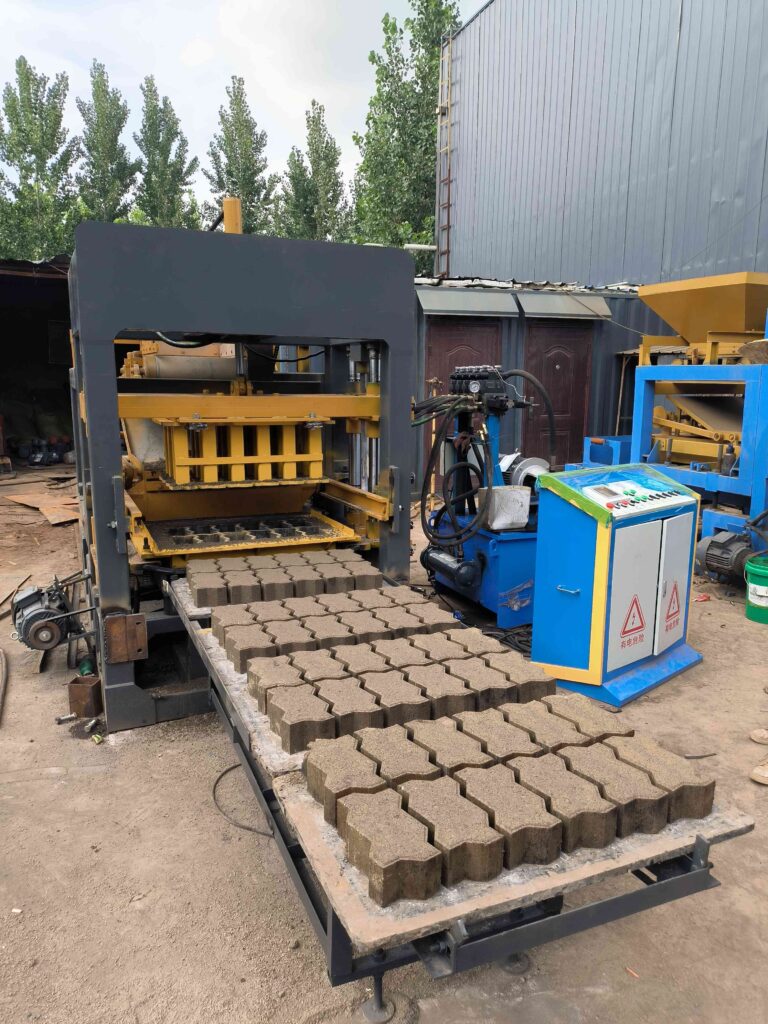
Rarraba Kayan Aiki na Sarrafa Kansa: Cikakken Bincike na Injin Tubalin Hannu da na Kansa
Ma'anoni na Asali da Makanikai na Aiki
Babban bambanci ya ta'allaka ne a matakin sa hannun ɗan adam da ake buƙata don kammala zagayen samarwa guda ɗaya—tun daga ciyar da albarkatun ƙasa har zuwa fitar da gunkin da aka gama.
Na'urar Toshewa ta Hannu: Daidaitaccen Aiki ta Hannun Mutum
Na'urar yin tubali ta hannu wata na'ura ce mai taimakon inji ko na'urar ruwa inda mai sarrafa ita ce babbar mai gudanar da kowane mataki na samarwa.
- Rushewar KekeMa'aikacin yana ɗora ƙayyadadden adadin siminti a hannu a cikin akwatin ƙirar, wanda galibi yana buɗe sama. Daga nan sai ya ja lever, ƙafar hannu, ko kuma famfo na hydraulics mai sauƙi don sauke kan matsi, yana yin matsi. Girgiza, idan akwai, ana kunna ta ta wani maɓalli na daban. Bayan matsi, ma'aikacin yana buɗe kulle da ɗaga akwatin ƙirar ko kuma ya buɗe bangon gefe, sannan ya cire sabon bulo "kore", yawanci yana sanya shi a kan pallet ko ƙasa don ya yi curing. Kowane aiki—auna, danna, cirewa, da sarrafawa—ma'aikacin ne ke yin su.
- Matakin FasahaWaɗannan injinan suna da sauƙin aiki, galibi suna amfani da haɗin fil da ɗamara, bawuloli na hannu, da maɓallan lantarki na asali. Sarrafa gaba ɗaya ya ta’allaka ne da taɓawa da gani, dogaro da yanayin da hukuncin ma’aikaci.
Na'urar Tashi Kaimamari: Samar da Shiryaƙa
Na'urar block ta atomatik wani tsari ne na haɗe-haɗen lantarki- ruwa- injina inda mai sarrafa ma’ana na shirye-shirye (PLC) ke tsara dukkan tsarin samar da kayayyaki bayan an fara aiki.
- Rushewar KekeAna fara zagayen da umarni ɗaya (misali, danna maɓalli ko siginar firikwensin atomatik). Sai injin ɗin ya aiwatar da kansa: akwatin ciyarwa ko mai ɗaukar kaya yana auna gauraya daga bututun haɗaɗɗen cikin ƙirar; ƙirar tana motsawa zuwa tashar matsa; injunan jijjiga suna kunnawa; silinda mai ɗaukar ruwa na hydraulic yana amfani da matsa lamba da aka riga aka saita na wani "lokacin zama" da aka ayyana; ƙirar tana tube; kuma tsarin fitarwa yana ɗaukar tubalin da aka gama akan pallet ɗinsa daga injin. Matsayin ma'aikaci yana canzawa daga mai shiga tsakani na zahiri zuwa mai kulawa da saka idanu.
- Matakin FasahaWaɗannan tsarin sun ƙunshi na'urorin ruwa masu rikitarwa tare da bawuloli masu daidaita gwargwado, sarrafawa na servo, na'urorin girgiza masu yawan mita, matattarar na'urorin ganowa (don gano matsayi, matsin lamba, da gano pallet), da kuma PLC ta tsakiya. Ma'auni na samarwa suna shigar da dijital, suna tabbatar da maimaitawa.
Nazari Kwatantawa: Kimantawa Mai Girma Da Yawa
Zaɓin tsakanin waɗannan tsare-tsare ya bayyana ta fannoni da yawa masu mahimmanci na kasuwanci.
Ƙarfin Samarwa da Daidaiton Fitarwa
- Injin Hannu
- Sakamako:Yana dogara sosai ga gwanintar ma'aikaci, ƙarfin jiki, da saurin aiki. Yawan abin da ake samu bai wuce tubalan 300-500 ba a cikin aikin awa 8 a kowace na'ura, tare da bambance-bambance masu yawa.
- Daidaito:Nauyin samfur, yawa, da girma suna canzawa bisa ga daidaiton ma’aikaci wajen cike kwaf da kuma matsa lamba. Inganci yana da sauyi a asali.
- Mashin ta atomatik:
- Sakamako:Domin da lokacin injin ya tsara, wanda yake tsayayye kuma mai maimaitawa. Fitar zai iya zuwa daga 1,000 zuwa sama da 5,000 tubalan a kowane shifi akai-akai, ba tare da la’akari da lokacin rana ko gajiyar ma’aikaci ba.
- Daidaito:Kowane zagaye shine ainihin kwafin dijital na na ƙarshe. Wannan yana tabbatar da daidaitaccen ingancin tubali, nauyi, da ƙarfi, wanda ke da muhimmanci don saduwa da ƙayyadaddun ƙa'idodi da lambobin gini.
2. Bukatun Ma’aikata da Dabaru na Albarkatun Mutane
- Injin Hannu
- Role: Requires physically strong laborers for constant, repetitive tasks. The work is arduous and can lead to high turnover.
- Matsayin Ƙwarewa: Basic training is sufficient, but a skilled, motivated operator can significantly improve output and quality.
- Staffing Model: Business scaling is linear: to double output, you essentially need to double machines and operators.
- Mashin ta atomatik:
- Role: Requires a technically minded operator for monitoring, basic troubleshooting, and data input. Physical labor is minimal.
- Matsayin Ƙwarewa: Requires higher technical literacy to understand machine interfaces, basic mechanics, and hydraulics. Training is more intensive.
- Staffing Model: One operator can often supervise multiple automatic machines or an entire production line, leading to exponential gains in labor productivity.
3. Financial Investment and Economic Model
- Capital Expenditure (CAPEX):
- Injin Hannu Very low initial investment. This low barrier to entry is its primary advantage, allowing micro-enterprises to start production.
- Mashin ta atomatik: High initial investment, often 5 to 20 times the cost of a manual machine. This represents a significant commitment.
- Operational Expenditure (OPEX) & Total Cost of Ownership (TCO):
- Injin Hannu Low direct energy costs but very high and variable labor costs per block. Maintenance is simple and cheap, but wear parts may fail more frequently due to inconsistent operation. The true cost is hidden in low, inconsistent output and high per-unit labor expense.
- Mashin ta atomatik: Higher energy costs but dramatically lower labor cost per block. Predictive maintenance is crucial but leads to higher planned spare parts costs. The per-unit production cost plummets at scale, offering superior margins.
4. Product Range and Flexibility
- Injin Hannu Limited flexibility. Mold changes are slow and cumbersome, discouraging short runs of specialty products. Best suited for one or two standard block types produced in long runs.
- Mashin ta atomatik: High flexibility, especially with Quick Mold Change (QMC) systems. Switching between different block, paver, or kerbstone profiles can be done in under 30 minutes, enabling a “batch-on-demand” model that serves diverse market segments from a single machine.
5. Quality Control and Market Positioning
- Injin Hannu Inherently produces a commodity product with acceptable but variable quality. Suitable for low-cost, informal, or self-build markets where absolute precision is not critical. Difficult to supply large contractors or government tenders requiring certified, consistent specifications.
- Mashin ta atomatik: Capable of producing a premium, specification-grade product. Enables a supplier to meet the stringent demands of large-scale commercial projects, architectural specifications, and export markets. Builds brand reputation based on reliability and quality.
Strategic Alignment: Matching Technology to Business Vision
The decision is not about which machine is “better,” but which is appropriate for a specific stage and vision.
The Manual Machine: Foundational and Niche Utility
- Ya Dace Da: The true micro-entrepreneur with severely limited capital; on-site production for a specific, limited-scope project; markets with very low labor costs and minimal quality expectations; production in regions with unreliable electricity.
- Strategic Path: Can serve as a low-risk proof-of-concept to validate a local market. However, it typically represents a business ceiling rather than a growth platform.
The Automatic Machine: The Engine of Growth
- Ya Dace Da: Any serious entrepreneur aiming to build a commercial manufacturing business; supplying the formal construction sector; businesses planning to scale; markets where labor costs are rising or skilled masons are scarce.
- Strategic Path: Represents a commitment to industrial-scale manufacturing. It is a vehicle for capturing market share, building a brand, and achieving economies of scale. The higher CAPEX is an investment in lower long-term OPEX and higher revenue potential.
The Evolving Landscape: The Semi-Automatic Middle Ground
A critical third category, the semi-automatic machine, often serves as a strategic compromise. It automates the core pressing cycle (feed and press are automated) but requires manual pallet feeding and block removal. This offers a meaningful step up in consistency and output from a manual machine without the full capital outlay of a fully automatic system. It is a viable “stepping-stone” technology for businesses in transition.
Ƙarshe
The difference between manual and automatic block machines is a chasm that separates artisanal production from industrial manufacturing. It is a choice between a tool that extends human labor and a system that replaces and amplifies it through programmed precision. For the distributor or advisor, the most critical service is to guide the client beyond the immediate allure of low capital cost towards a clear-eyed analysis of their total operational economics and strategic ambition.
Selling a manual machine is often a transactional sale based on affordability. Selling an automatic machine is a consultative partnership, where you help the client build a business case based on unit economics, market demand, and growth modeling. In an increasingly competitive and quality-conscious global construction market, automation is not merely an option; it is the definitive pathway to scalability, profitability, and longevity. Understanding this divide in all its dimensions allows you to become an architect of your clients’ success, helping them lay the right foundation—not just for a block, but for an enduring enterprise.
FAQ
Q1: Can a business profitably start with a manual machine and then upgrade to an automatic one?
A: Yes, this is a common and often prudent pathway. The manual machine allows for market validation, initial cash flow generation, and learning the fundamentals of production and sales with minimal risk. The key is to plan for this transition from the outset. Entrepreneurs should reinvest profits deliberately, choose a manual machine from a manufacturer that also produces automatic systems (for potential trade-in), and use the initial phase to build customer relationships that will demand the higher, consistent output of an automatic machine.
Q2: How significant is the electricity requirement for an automatic machine, and can it operate in areas with poor grid power?
A: The requirement is significant. A medium-sized automatic machine may require a stable three-phase power supply of 30-75 kW. In areas with poor grid power, operation is challenging but not impossible. Solutions include investing in a powerful diesel generator set (which adds to CAPEX and OPEX for fuel) or utilizing hybrid systems with power stabilizers and battery buffers. This infrastructure cost must be factored into the business plan. Manual machines, in contrast, often run on single-phase power or minimal three-phase, making them more adaptable to weak grids.
Q3: Is the maintenance for an automatic machine too complex for a small business owner?
A: While more complex, it is manageable with proper training and discipline. Modern automatic machines are designed for serviceability. The complexity is offset by predictability—maintenance is scheduled and planned. The risk with a manual machine is that its simple components, while easy to fix, are subject to more erratic wear and catastrophic failure due to operator inconsistency, leading to unplanned downtime, which is more damaging to a business than planned maintenance.
Q4: For a given product, will the block from an automatic machine be structurally stronger than one from a manual machine?
A: Almost invariably, yes. The automatic machine applies a precise, repeatable, and typically higher compaction pressure for an exact duration, coupled with controlled vibration. This results in optimal and consistent density. A manual machine’s pressure is variable (based on the operator’s force and technique), leading to lower and inconsistent density, which directly correlates to lower and variable compressive strength. For any structural application, the certified consistency of the automatic machine’s output is a major advantage.
Q5: How does the choice impact a business’s ability to secure loans or investment?
A: This is a crucial but often overlooked differentiator. A business plan centered on automatic machinery is typically viewed more favorably by banks and investors. It demonstrates a commitment to scale, presents a clearer projection of costs and output (lower risk), and is based on asset-backed financing (the machine itself is collateral). A manual machine-based model is often seen as a subsistence or informal sector activity, with higher perceived risk due to its dependency on variable human labor and unproven scalability, making it harder to secure formal financing.