
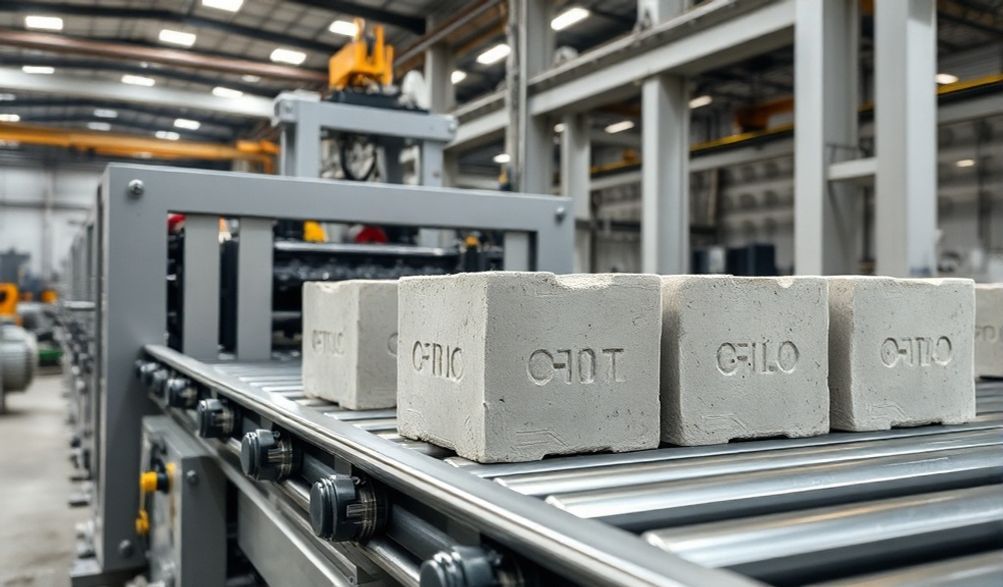
Your Ultimate Guide to Block Production Machines from China’s FUDA Factory
Gabatarwa
In the world of construction and manufacturing, the pressure to deliver projects on time and on budget is relentless. A critical bottleneck often lies in the supply chain for building materials. Sourcing high-quality, affordable concrete blocks consistently can be a logistical and financial headache. What if the solution wasn’t just buying blocks, but producing them yourself with precision and efficiency?
If you’re searching for “block production machine china” and have come across the “FUDA brick making machine factory,” you’re likely a business owner, project manager, or procurement specialist at a crucial decision point. You’re not just looking for a machine; you’re investing in the future productivity and profitability of your operation. Navigating the vast landscape of Chinese manufacturing requires more than just comparing price tags—it demands insight, due diligence, and a trusted source of information.
This comprehensive guide is designed to be that resource. We will provide an unbiased, expert analysis of block production machinery, with a specific lens on the FUDA factory. Our goal is not to sell you a FUDA machine, but to arm you with the knowledge to evaluate them—and any other supplier—against your precise needs. We’ll dissect machine types, decode the realities of sourcing from China, and outline a step-by-step framework for vetting manufacturers. By the end, you’ll know the right questions to ask and the critical factors that separate a reliable partner from a risky purchase.
Understanding Block Production Machines: Types and Applications
Before evaluating any specific factory, it’s essential to understand the machinery itself. This foundational knowledge will allow you to communicate effectively with suppliers and match the right equipment to your project scope.
Menene Injin Samar da Bulogi?
A block production machine, commonly called a brick making machine, is a piece of industrial equipment designed to manufacture concrete blocks, bricks, and pavers from raw materials like cement, sand, aggregate, and water. The core function is to automate and standardize the process of molding and compacting this mixture into precise, durable shapes.
The basic process involves three key stages:
1. Haɗawa: Raw materials are combined in specific ratios.
2. Gyarawa & Matsawa: The mixture is fed into a mold and subjected to high vibration and pressure to remove air pockets and achieve density.
3. Maganin Ciwon Ciki: The freshly formed (or “green”) blocks are set aside to gain strength, often in a controlled environment.
Major Types of Block Making Machines
The right machine for you depends entirely on your required output, budget, and labor model.
-
Na'urorin Wucin Gadi/Na'urorin Wucin Gadi na Rago-Rago:
- Ya Dace Da: Startups, small-scale projects, rural construction, or businesses with low capital expenditure budgets.
- Aiki: Require significant manual labor for feeding materials and removing finished blocks. The compaction may be mechanical or hydraulic.
- Sakamako: Lower production capacity, suitable for outputs of a few hundred to a couple thousand blocks per day.
-
Layin Samar da Kayan Masana'antu na Cikakken Kwarar da Kai:
- Ya Dace Da: Large-scale commercial block yards, industrial construction projects, and businesses focused on high-volume supply.
- Aiki: Integrated systems with automated material batching, conveying, molding, stacking, and sometimes palletizing. Controlled by a central PLC (Programmable Logic Controller).
- Fadada: Exceptional efficiency, minimal manual labor, superior consistency in block quality, and the lowest cost-per-block at high volumes.
-
Na'urorin Tura Tubalin na Wayar Hanka:
- Ya Dace Da: On-site production for large construction projects (e.g., housing developments, remote infrastructure).
- Muhimman Fa'ida: Eliminates the cost and logistical challenge of transporting heavy blocks over long distances. You produce exactly where you build.
-
Injin Tukin Tsayayyen Tubali:
- Ya Dace Da: Established factories with a fixed, dedicated production space.
- Characteristic: These are heavy-duty, high-capacity machines designed for continuous operation. They form the heart of an automatic production line and are not meant to be moved.
Abubuwan da ake fitarwa: Bayan Tubalin da aka saba da su
Modern block machines are highly versatile. By simply changing the mold, a single machine can produce a diverse product line, opening multiple revenue streams:
* Tubalan Hollow (kala daban-daban na kauri)
* Solid Concrete Blocks
* Dutsen Shinge da Kayan Shinge Masu Haɗuwa
* Curbstones and Landscape Edging
* Tubalin Haɗin Kai don bangon riƙewa
* Special Shapes for architectural design
This versatility is a key value proposition, allowing a business to adapt to market demands.
Why Source from China? Evaluating the FUDA Brick Making Machine Factory
The decision to source machinery from China is strategic. Let’s examine the landscape and place FUDA within it, maintaining a balanced and objective perspective.
The Chinese Manufacturing Landscape for Construction Machinery
China has earned its reputation as the “world’s factory” for heavy machinery, including block production equipment. The advantages are clear:
* Tasiri Mai Tsada: Competitive pricing due to economies of scale, mature supply chains, and lower manufacturing overheads.
* Manufacturing Scale & Speed: The ability to produce, customize, and ship machinery rapidly.
* Ƙaddamar da Fasaha: Many Chinese manufacturers have quickly integrated advanced hydraulic and control systems into their designs.
An Essential Caveat (Our Duty to Inform You): This vast market has a wide spectrum of quality. For every reputable, established factory, there are countless trading companies and sub-par workshops. The most critical step in your journey is rigorous supplier vetting—a process we will detail in the next section.
Introducing FUDA: A Closer Look at the Factory
Based on publicly available information, FUDA is presented as a professional manufacturer of brick and block making machinery located in China’s industrial heartland. They typically highlight:
* Kwarewa: Multiple years (often decades) of operation in the machinery sector.
* Isharar Duniya: Exporting to markets in Africa, Southeast Asia, the Middle East, and South America.
* Kewayon Kayayyaki: They generally offer a catalog spanning from semi-automatic to fully automatic machines and production lines, aligning with the types discussed earlier.
* Authoritativeness Claims: It is common for factories like FUDA to display certifications such as ISO (for quality management systems) and CE (indicating conformity with European health, safety, and environmental standards). They may also hold patents for specific machine designs or mold technologies. Always verify these claims by requesting certificate numbers and checking them.
Potential Advantages of Choosing FUDA
If vetted successfully, a factory like FUDA could offer several benefits:
* Farashin Gasar: Direct-from-factory prices that undercut many Western or local distributors.
* Customization Flexibility: Willingness to modify machine dimensions, pressure, or control systems to suit specific raw materials or product requirements.
* Comprehensive Range: The ability to source everything from a single machine to a complete turnkey production line from one supplier.
* Structured After-Sales: Many established factories offer a defined after-sales package, including installation supervision, operator training, and a warranty period.
Critical Factors for Vetting a Block Machine Supplier in China
This is the heart of a wise purchasing decision. Apply this framework to FUDA and every other supplier on your list.
Verifying Manufacturer Expertise and Legitimacy
Don’t take a website at face value.
* Business Licenses: Request a copy of their official business license. A legitimate manufacturer will have one.
* Factory Audits/Tours: Insist on a live video tour of the factory floor. Look for organized production lines, quality control checks, and inventory of raw materials (like steel). An in-person visit is ideal.
* Abokan Kasuwanci: Ask for contact information for 3-5 clients in regions similar to yours. Actually call or email them. Ask about machine performance, reliability, and the quality of after-sales support.
Assessing Machine Quality and Performance (Beyond Spec Sheets)
Specifications tell part of the story; component quality tells the rest.
* Scrutinize Critical Components:
* Tsarin Hydraulic: Is it from a reputable brand (e.g., Rexroth, Kawasaki, Yuken)? Cheap, unbranded hydraulics are a primary point of failure.
* Motar Girgiza: This is the engine of block density. Brand and power rating are crucial.
* Tsari & Tsarin: Is it fabricated from heavy-duty, reinforced steel? Lighter frames warp under constant stress.
* Daidaituwar Gyare-gyare: Molds should be made from high-chromium alloy steel for longevity and precise block dimensions.
* Request Material Certificates: Ask for certification documents for the steel and other critical materials used in construction.
* Demand Performance Data: Ask for verified reports on cycle time, blocks per hour, and the consistent compressive strength of blocks produced.
Understanding Total Cost and Value
The machine price is just the beginning.
* Complete Cost Breakdown: Get a detailed FOB (Kyauta akan Jirgi)koCIF (Cost, Insurance, and Freight) quote that includes:
* Machine Price
* Shipping & Logistics to your nearest port
* Marine Insurance
* Estimated Import Duties & Customs Clearance in your country
* Costs for Installation & Commissioning by their technicians (flights, accommodation, daily rate)
* Operator Training
* After-Sales Service Analysis:
* Warranty: What is covered (parts, labor)? For how long? What is the process for a claim?
* Kayan Gyara: What is the pricing and availability? What is the typical shipping time for a critical spare part?
* Tallafin Fasaha: Is it available via phone/email? Is there a local agent or partner in your region?
* The Contract is King: Every promise—from delivery date to warranty terms to spare parts pricing—must be detailed in a clear, enforceable contract. Never proceed without one.
Making an Informed Decision: Is FUDA the Right Partner for You?
Now, synthesize the information. Use this framework to determine if FUDA, or another supplier, aligns with your goals.
Key Questions to Ask FUDA (or Any Supplier)
Arm yourself with this direct questionnaire:
1. “Can you provide a real-time video of the exact machine model I’m interested in, running in your factory or at a client’s site?”
2. “What is your detailed protocol if a critical component fails under warranty? Who pays for shipping?”
3. “Can you provide the contact details for three recent clients in [Your Country/Region]?”
4. “What is the lead time for the most commonly replaced spare parts to reach [Your City]?”
5. “Will your installation engineers help us achieve production-ready blocks using our local raw materials?”
Scenario-Based Recommendations
- If you are a startup or small business: Prioritize simplicity and service. A robust semi-automatic machine from a supplier with strong local agent support might be better than a complex automatic line from a factory with no regional presence. Focus on total cost of ownership, not just purchase price.
- If you are scaling an existing business: Your analysis should focus on ROI through automation. Compare the labor savings and increased output of a FUDA automatic line against its higher upfront cost. Negotiate a long-term service agreement and clear spare parts stocking plan.
- If your project requires special blocks: The supplier’s mold-making capability is paramount. Ask to see their mold workshop portfolio. Discuss the cost and timeline for developing a custom mold and testing it with your material mix.
The Essential Next Steps
- Prepare Your Specs: Document your required daily output, block types, available space, and raw material characteristics.
- Shortlist Suppliers: Identify 3-5 potential suppliers, including FUDA.
- Execute Your Vetting Plan: Apply the verification and questioning framework above to each one.
- Visit if Possible: Attending a major trade show like the Canton Fair allows you to see machines from FUDA and competitors operating simultaneously.
- Consider a Pilot: If making a large investment, explore the possibility of a smaller trial order to evaluate performance and service responsiveness before committing fully.
Tambayoyin da ake yawan yi (FAQ)
Q1: What is the typical price range for a FUDA block making machine?
A: Prices vary dramatically. A small manual machine may start around \$5,000-\$10,000, while a high-capacity, fully automatic production line can range from \$50,000 to over \$200,000. You must request a detailed quotation based on your specific configuration for an accurate comparison.
Q2: Does the FUDA factory provide installation and operator training?
A: Most reputable Chinese factories offer this service, but it is often an additional cost (covering engineer travel and time). The scope (number of days, number of trainees) must be explicitly defined and included in your contract.
Q3: How do I handle maintenance and source spare parts for a Chinese block machine?
A: This is a pre-purchase consideration. Before buying, confirm the supplier’s policy: Do they keep an inventory of wear parts? What are the prices? How quickly can they ship? Ideally, negotiate an initial spare parts kit to be delivered with the machine.
Q4: What are the main advantages of a fully automatic block production line from China?
A: The core advantages are scale and efficiency: drastically reduced labor costs per block, extremely high and consistent output (e.g., 10,000+ blocks per shift), and superior product uniformity, leading to a lower long-term cost per unit and greater competitiveness.
Q5: Are there reliable alternatives to FUDA for block production machines in China?
A: Absolutely. The market is competitive with several other established manufacturers. The key is not to find the “best” factory in isolation, but to find the best match for your project. Use the vetting process in this guide to create a shortlist of 3-5 suppliers, including FUDA, and compare them on total value—quality, service, and cost.
Ƙarshe
Selecting a block production machine is a capital investment that will impact your business for years. The path to success is defined less by finding the cheapest option and more by conducting the most thorough due diligence. While factories like FUDA represent the scale and capability of China’s manufacturing sector, their suitability for you is not a given—it is a conclusion you must reach after careful investigation.
This guide has provided you with the framework to become an informed buyer. You now understand the machinery, the market landscape, and the non-negotiable steps for verifying a supplier’s credibility. Use this knowledge as your checklist.
Final Expert Advice: Move forward with confidence. Prepare your project specifications, engage with shortlisted factories (including FUDA) using the pointed questions provided, and insist on transparency at every stage. Your goal is to build a productive partnership, not just purchase a piece of equipment. Do your homework, and you’ll lay a foundation for success that’s as solid as the blocks your new machine will produce.
<