
Economic Indicators and Construction Growth Patterns
Kenya’s construction sector has maintained an average annual growth rate of 6-8% over the past five years, significantly outpacing overall economic expansion. This growth trajectory is underpinned by several key factors including population growth exceeding 2% annually, urbanization rates climbing above 4% per year, and sustained government investment in infrastructure development. The Affordable Housing Program, a cornerstone of Kenya’s Big Four Agenda, aims to deliver over 500,000 housing units, creating substantial demand for standardized construction materials. Concurrently, transportation infrastructure projects including the Nairobi Expressway, Standard Gauge Railway extensions, and numerous road upgrading initiatives require consistent supplies of quality blocks and paving materials. These macro-level developments create a favorable environment for masonry equipment suppliers, though successful market penetration requires understanding nuanced regional variations and customer segmentation.
Regulatory Environment and Compliance Requirements
The Kenyan market operates within an increasingly structured regulatory framework that significantly influences equipment specifications and business operations. The National Construction Authority (NCA) mandates registration and grading of construction professionals and enterprises, creating quality standards that trickle down to material suppliers. The Kenya Bureau of Standards (KEBS) enforces product certification through standardization marks, particularly for materials used in government projects. Environmental regulations administered by the National Environment Management Authority (NEMA) increasingly restrict traditional clay brick production methods, encouraging adoption of alternative technologies utilizing sustainable materials like fly ash and quarry dust. Recent amendments to building codes emphasize earthquake resistance in certain regions, requiring precise block dimensions and consistent compressive strength that only quality machinery can guarantee. Understanding these regulatory drivers is essential for positioning equipment that enables compliance and market access.
Technical Specifications and Operational Considerations
Power Systems and Energy Adaptation
Kenya’s diverse power infrastructure necessitates careful consideration of equipment energy requirements across different operational contexts. While urban centers like Nairobi and Mombasa benefit from relatively stable grid power, rural and peri-urban areas experience frequent fluctuations and outages. Successful equipment configurations typically incorporate multiple power options including:
- Three-phase grid connection capabilities (400V/50Hz)
- Integrated generator compatibility with automatic transfer switches
- Energy-efficient designs featuring variable frequency drives
- Solar hybrid options for remote operations
Machines consuming 15-75 kWh demonstrate optimal operational economics, balancing production capacity against energy costs that average KES 15-20 per kWh for industrial consumers. Equipment with power factor correction and surge protection systems experience significantly lower failure rates and maintenance costs.
Production Capacity and Output Optimization
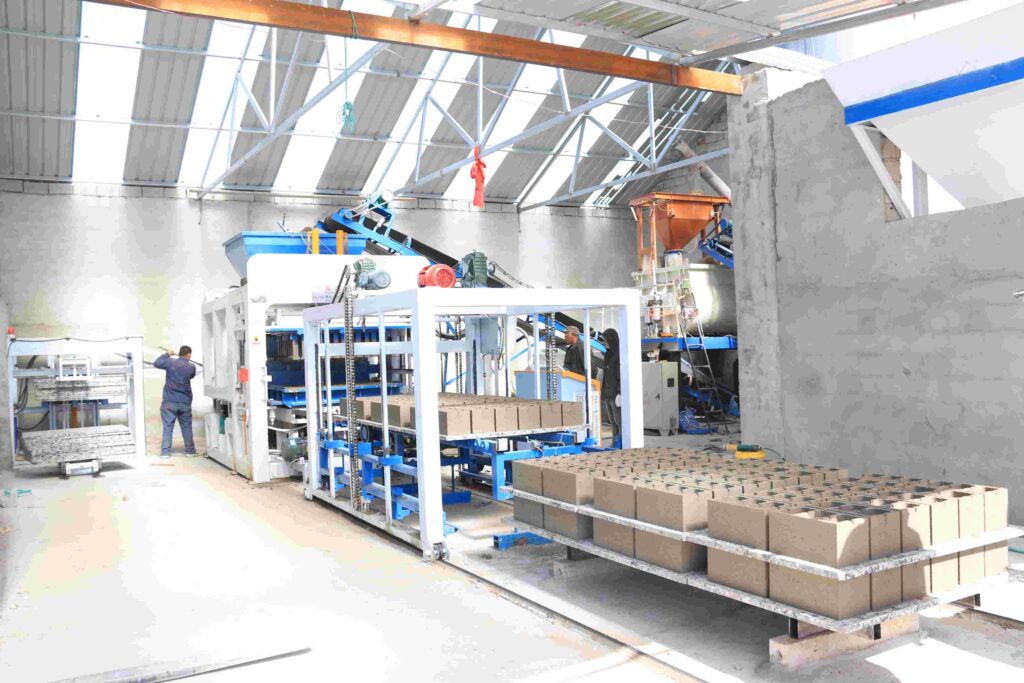
Market analysis reveals distinct production tiers corresponding to different business models and investment levels. Entry-level manual and semi-automatic machines producing 800-3,000 blocks per day serve small-scale contractors and individual entrepreneurs, typically requiring 3-6 operators. Mid-range automatic equipment generating 3,000-12,000 blocks daily caters to established block yards and construction firms supplying multiple projects, often operating with 2-4 personnel. High-capacity fully automatic plants exceeding 12,000 blocks per shift target industrial-scale producers serving major infrastructure projects and export markets, frequently incorporating robotic handling and computerized quality control. The most successful equipment suppliers offer modular designs that allow capacity upgrades as businesses expand, protecting initial investments while supporting growth trajectories.
Distribution Network Development and Market Penetration
Channel Partner Selection and Management
Building effective distribution channels requires systematic evaluation of potential partners across multiple criteria. Successful market entrants typically implement a phased approach beginning with strategic partners in Nairobi and Mombasa before expanding to secondary markets in Kisumu, Nakuru, and Eldoret. Key selection parameters include:
- Demonstrated technical capability and workshop facilities
- Financial stability and creditworthiness
- Existing customer relationships and market reputation
- Service delivery capacity and spare parts management
- Alignment with supplier quality standards and business ethics
Structured partner agreements should clearly define performance expectations, territorial rights, support responsibilities, and exit clauses while allowing flexibility for local market adaptations.
After-Sales Service Infrastructure and Support Systems
The development of robust after-sales support capabilities represents a critical competitive differentiator in the Kenyan market. Service network planning must account for geographic challenges and infrastructure limitations, with strategic placement of service centers within 4-8 hours of major customer concentrations. Comprehensive support systems typically include:
- Central spare parts depot in Nairobi with regional satellite inventories
- Mobile service units equipped for on-site repairs and maintenance
- Technical hotline with multilingual support capacity
- Preventive maintenance contracts with guaranteed response times
- Operator training programs conducted quarterly
Implementation of digital platforms for service request management, parts ordering, and technician dispatch significantly improves service efficiency and customer satisfaction metrics.
Strategic Market Positioning and Competitive Analysis
Value Proposition Development and Customer Education
Successful market positioning requires translating technical specifications into tangible customer benefits aligned with local business priorities. Equipment reliability must be demonstrated through performance guarantees backed by local reference cases showing minimum 85% operational availability. Return on investment calculations should incorporate local cost structures including labor rates (KES 500-1,200 daily), material costs (KES 4,000-8,000 per cubic meter of aggregate), and energy expenses. Customer education initiatives prove particularly effective when combining technical training with business development guidance, covering topics like production costing, quality management, and market identification. Demonstration centers in strategic locations provide powerful platforms for building customer confidence through hands-on experience and visible performance validation.
Financing Solutions and Market Expansion
Addressing the financing challenge dramatically expands the addressable market beyond cash purchasers. Successful suppliers typically develop multiple financing pathways including:
- Partnerships with local banks for equipment loans with 30-40% down payment
- Supplier-supported installment plans with 6-24 month terms
- Leasing arrangements through specialized financial institutions
- Microfinance linkages for small-scale entrepreneurs
- Government program alignments for affordable housing suppliers
Collaboration with development institutions like the Kenya Industrial Estates and Youth Enterprise Development Fund creates additional channels for reaching underserved market segments while supporting social development objectives.
Conclusion
The Kenyan brick and block making machinery market presents substantial opportunities for suppliers who combine quality equipment with deep market understanding and sustainable business practices. Success requires balancing technical excellence with practical adaptability, addressing both immediate production needs and long-term business growth requirements. The convergence of infrastructure development, urbanization trends, and regulatory evolution creates favorable market conditions that will likely persist through the medium term. Equipment suppliers who invest in developing strong local partnerships, robust support infrastructure, and flexible business models will be best positioned to capitalize on these opportunities. The market’s ongoing maturation towards higher quality standards and more sophisticated production methods ensures continued demand progression from basic equipment to comprehensive production solutions. Strategic market entry and systematic expansion, guided by local intelligence and customer-centric approaches, will yield sustainable growth in this promising East African market.
Frequently Asked Questions (FAQ)
Q1: What are the typical installation and commissioning requirements for block making machines in Kenya?
A: Professional installation requires a level concrete foundation of specified thickness (usually 150-300mm), adequate power connection with proper earthing, and compressed air supply where applicable. Commissioning typically takes 3-5 days including machine assembly, power connection, test runs, and operator training. Suppliers generally provide detailed site preparation guidelines and conduct pre-installation inspections. Most reputable suppliers include basic installation in equipment pricing while complex foundations and special power requirements may incur additional costs.
Q2: How does equipment performance vary with Kenya’s diverse raw material qualities?
A: Equipment performance is significantly influenced by raw material characteristics including aggregate hardness, moisture content, and particle size distribution. Machines with adjustable vibration frequency (40-70 Hz) and pressure settings (100-300 kN) handle material variations most effectively. Successful operations typically implement strict material screening and consistent mix proportions. Equipment with wear-resistant components and easy adjustment mechanisms maintains better performance with variable material qualities. Most suppliers offer material testing and machine calibration services during commissioning.
Q3: What warranty and service level agreements are typical in the Kenyan market?
A: Standard warranties typically cover manufacturing defects for 12 months from commissioning, excluding wear parts and damage from improper operation. Comprehensive service agreements usually guarantee 48-hour response times for major breakdowns and include quarterly preventive maintenance visits. Emergency support contracts with 24-hour response commitments are available in major urban centers. Many suppliers offer extended warranty options covering specific components for up to 36 months, with pricing typically ranging 5-15% of equipment value annually.
Q4: How does Kenyan climate and altitude affect equipment operation and maintenance?
A: High altitude locations (1,500-2,500 meters above sea level) may require adjustments to combustion engines and compression ratios. Coastal regions with high humidity necessitate enhanced corrosion protection, particularly for electrical components and hydraulic systems. Dusty conditions in arid areas demand improved filtration systems for hydraulics and enhanced bearing protection. Equipment designed with tropicalized components, UV-resistant materials, and adequate cooling capacity demonstrates superior performance across Kenya’s diverse climatic conditions.
Q5: What training and knowledge transfer do successful equipment suppliers provide?
A: Comprehensive training programs typically include 5-7 days of initial training covering operation, routine maintenance, basic troubleshooting, and safety procedures. Advanced technical training for maintenance staff extends 10-14 days focusing on hydraulic systems, electrical controls, and mechanical adjustments. Many suppliers now offer mobile-based learning modules for ongoing skill development. Successful knowledge transfer programs combine theoretical understanding with practical hands-on experience using actual production materials, with competency assessment and certification upon completion.
