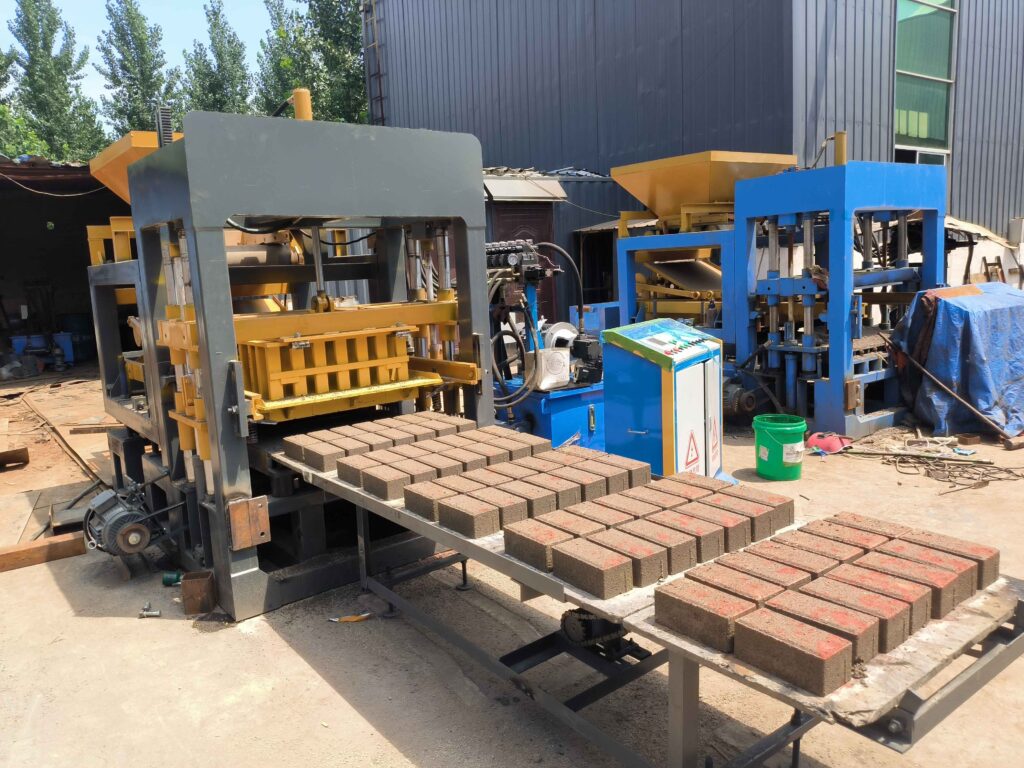
Nazarin Fasaha na Manyan Nau'in Injina
Filin masana'antu ya kasance bisa wasu fasahohi daban-daban, kowannensu ya dace da takamaiman albarkatun ƙasa, ƙayyadaddun samfura, da ma'aunin kasuwanci. Zaɓin fasahar yana ƙayyade tarin samfuran, ingantaccen samarwa, da kuma jarin farko na babban kuɗi.
1. Injinan Matsi na Tsaye: Ma'aikatan Aiki na Samarwa mai Yawan Ƙarfi
Matsatsun matsi na tsaye suna wakiltar fasaha mafi gama gari da kuma mai sassauƙa don samar da tubalan siminti masu yawan ƙima, duwatsu na shimfidawa, da tubalan haɗin kai.
- Ka'idar Aiki:Waɗannan injunan suna aiki bisa ka'idar "girgiza-ƙarfafa". Ana shirya wani siminti mai ƙanƙanta, sannan a cika shi a cikin akwatin ƙirar da ke kan wani ƙaƙƙarfan tebur na samar da ƙarfe. Kan matsi na hydraulic yana sauka don matsawa simintin yayin da ƙaƙƙarfan na'urori masu girgiza na lantarki ko na hydraulic ke ƙarfafa kayan. Wannan matsi da girgiza lokaci guda suna tabbatar da mafi kyawun yawa da ƙarfi. Daga nan sai akwatin ƙirar da aka ɗaga ya fitar da sabon samfurin a kan pallet ko rack na gyarawa.
- Maɓuɓɓuka da Bambance-bambancen Maɓuɓɓuka:
- Tsarin Ciyarwa: Can be volumetric (simple) or electronic batch-feeding (precise) for consistent product quality.
- Tsarin Ƙirƙira: Interchangeable mold boxes allow a single machine to produce a wide array of product dimensions and profiles (solid, hollow, insulated).
- Tsarin Gudanarwa: Ranges from basic relay logic for manual operation to full PLC (Programmable Logic Controller) automation, controlling press force, vibration time, and pallet indexing.
- Product Output and Suitability: Ideal for standard construction blocks, lightweight blocks, and landscaping products. Output can range from 1,000 to over 5,000 standard blocks per 8-hour shift, depending on model automation.
2. Extrusion Machines: Masters of Continuous Clay Brick Production
Extrusion is the dominant technology for manufacturing fired clay bricks and certain types of hollow clay blocks, prized for their durability and aesthetic qualities.
- Ka'idar Aiki: This process involves forcing a prepared, plastic clay body through a shaped die under high pressure using an auger system. As the continuous column of clay exits the die, it is cut into individual units by wires or blades. This “column” can be solid for bricks or complex for hollow blocks. The green (unfired) products are then dried and fired in a kiln.
- Maɓuɓɓuka da Bambance-bambancen Maɓuɓɓuka:
- Pugmill (Clay Preparation): A critical component that mixes, homogenizes, and de-airs the clay to ensure plasticity and eliminate defects.
- Extrusion Auger and Die: The heart of the machine. Hardened steel dies define the product’s cross-sectional shape. Vacuum chambers within the extruder remove air pockets, increasing green strength.
- Cutter and Handling System: Automated systems cut the column to precise length and gently transfer green products to drying racks.
- Product Output and Suitability: The definitive solution for high-volume clay brick and tile production. Suited for large-scale plants supplying regional markets with facing bricks, pavers, and structural clay products.
3. Mobile Block Making Machines: Flexibility for On-Site and Small-Scale Production
These self-contained, often trailer-mounted units bring production directly to the construction site or to small, localized markets.
- Ka'idar Aiki: Typically smaller static presses or egg-layer-type machines. “Egg-layers” work by molding a block and then depositing (laying) it directly onto a level ground surface or a concrete slab before the machine indexes forward to make the next block. They require minimal foundation and can be operated with a small crew.
- Maɓuɓɓuka da Bambance-bambancen Maɓuɓɓuka:
- Mobility Frame: Built on a trailer or skid frame for easy transport.
- Tushen Wutar Lantarki: Often equipped with a diesel engine for complete site independence.
- Sauƙi: Designed for robustness and ease of operation over high automation.
- Product Output and Suitability: Perfect for remote projects, producing blocks for local housing directly where they are needed, reducing transport costs. Output is lower, typically from 500 to 2,000 blocks per day, but offers unparalleled logistical advantages.
Market Dynamics and Strategic Investment Considerations
The selection of manufacturing technology is a strategic decision influenced by target market, raw material availability, and financial capacity.
Analyzing the Target Product and Market
- Geographic Material Preferences: Concrete block machines dominate in regions where aggregate is plentiful. Extrusion machines are key in areas with rich clay deposits. Understanding local building codes and aesthetic preferences (e.g., demand for clay facades) is crucial.
- Scale of Operation: A large-scale stationary plant supplying a city requires a high-automation static press line with palletizers and curing systems. A entrepreneur serving a rural community may start with a single mobile egg-layer machine.
- Diversification na Samfura: Static presses offer the easiest route to a diverse catalog. A single machine with multiple molds can produce everything from standard blocks to decorative pavers and garden edging, allowing a manufacturer to respond to various market demands.
Comprehensive Cost Structure and Pricing Tiers
The price of machinery is a direct reflection of its automation level, build quality, and output capacity. Investment must be viewed as a Total Cost of Ownership (TCO).
- Capital Expenditure (CapEx) Breakdown:
- Matakin Farko (Na Hannu/Na Ƙaramin Kayan Aiki): Includes basic mobile machines and small static presses with manual feed and product handling. Price Point: Comparable to a mid-range heavy truck or van. Focus is on affordability and low-volume production.
- Mid-Range (Fully Automatic Standalone): Encompasses fully automatic static presses with automatic feeders, mixers, and pallet dispensers. These are turnkey stations for serious SMEs. Price Point: A significant industrial investment, often requiring financing. Offers the best balance of output and cost for growing businesses.
- High-End (Fully Integrated Production Lines): Includes complete plants with robotic handling, automated curing systems, and sophisticated extrusion lines with dryers and kilns. Price Point: Represents a major capital project, akin to establishing a full-scale factory. Justified by massive, continuous output.
- Operational Expenditure (OpEx) and Hidden Costs:
- Raw Material Processing: Costs for crushers, screens, and mixers for concrete, or pugmills and dryers for clay.
- Amfani da Wutar Lantarki: Hydraulic systems and vibrators are energy-intensive. High-efficiency drives are a selling point.
- Labor and Training: Higher automation reduces direct labor but requires more skilled technicians for maintenance.
- Mold and Wear Parts: Mold boxes, extrusion dies, and wear parts for the auger are recurring costs that vary by material abrasiveness.
- Curing and Handling: Costs for pallets, racking, and forklifts for concrete, or kiln fuel and maintenance for clay.
Conclusion: Building a Profitable Supply Chain Partnership
For distributors and dealers, success in the brick and block machinery market hinges on moving beyond transactional sales to become consultative partners. This requires a deep understanding of a client’s business model, local market conditions, and growth aspirations. The right machine is not the most expensive one, but the one that perfectly aligns with the client’s production goals, raw material access, and financial roadmap.
The future of this sector is tied to sustainable construction. Machinery that can efficiently utilize fly ash, slag, recycled aggregates, or produce highly insulating blocks is increasingly valuable. Furthermore, offering comprehensive packages—including machine installation, operator training, mold supply, and reliable after-sales service—creates indispensable, long-term client relationships. By providing the correct technology and support, you empower your clients to build the literal foundations of their communities, securing your position as a cornerstone of the construction supply chain.
Tambayoyin da ake yawan yi (FAQ)
Q1: What is the main difference between a machine for concrete blocks and one for clay bricks?
A: The core difference lies in the process and raw material. Concrete block machines use a vibro-compaction process with a semi-dry concrete mix in a static mold. Clay brick machines typically use an extrusion process, forcing wet, plastic clay through a die to form a continuous column which is then cut. The technologies are not interchangeable.
Q2: What level of technical expertise is required to operate and maintain these machines?
A: It varies by type. Basic mobile or semi-automatic presses require practical mechanical skill for routine maintenance. Fully automated lines and extrusion systems demand knowledge of hydraulics, electronics, PLC controls, and, for clay, thermodynamics (kilns). Quality distributor support includes thorough training and clear technical documentation.
Q3: How do we determine the right production capacity (blocks per day) for a client?
A: Conduct a detailed market analysis with the client. Key factors include: local annual construction volume, the client’s target market share, availability of raw materials, and investment budget. It is often wiser to start with a machine that can be run for two shifts to meet growing demand, rather than an oversized, underutilized machine.
Q4: Beyond the machine itself, what other equipment is needed for a complete setup?
A: A full production line requires supporting equipment. For concrete: a mixer (pan or planetary), conveyor belts, a cement silo, pallet handling equipment (forklift, stacker), and a curing area. For clay: a clay crusher, pugmill, dryer, and a tunnel or chamber kiln for firing. The “balance of plant” costs can be substantial.
Q5: What are the key factors affecting the final quality and strength of the produced blocks?
A: Machine performance is only one factor. Quality depends on: Raw Material Consistency (gradation of aggregates, clay composition), Mix Design (correct cement/water ratio, additives), Proper Compaction (achieved by the machine’s vibration and pressure), and Adequate Curing (controlled moisture and temperature for concrete; precise drying and firing cycles for clay).
Q6: What is the typical payback period for an investment in a medium-capacity automatic block making machine?
A: The payback period is highly sensitive to local block pricing, production costs, and machine utilization. A well-managed operation with a good market can often see a return on investment within 18 to 36 months. This is calculated by comparing the profit margin per block against the daily output and the total capital and operating costs. A detailed financial projection is essential before purchase.