
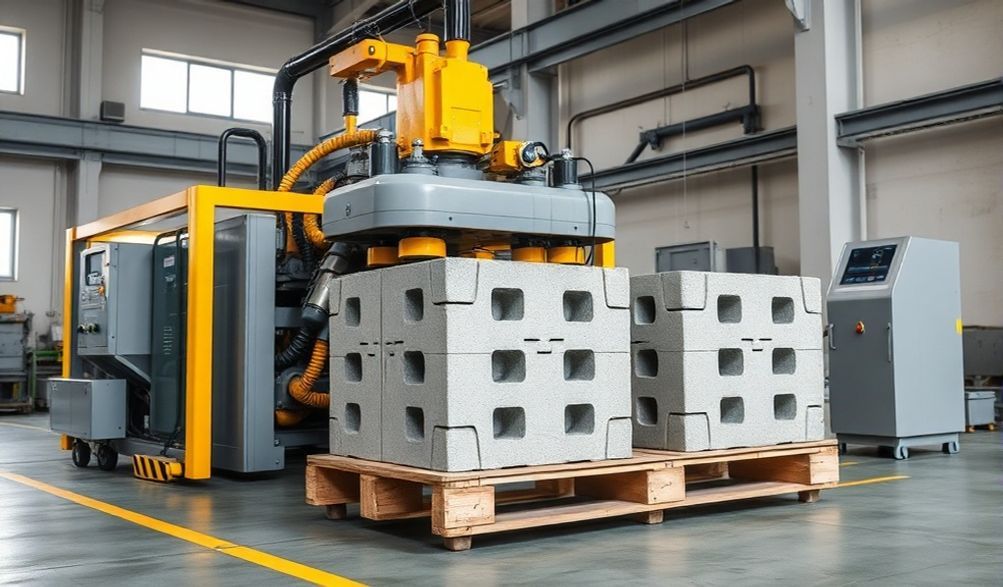
Babban Abokin Aiwatar da Gina: Jagorar Ƙarshe ga Masu Samar da Injin Kera Bulogi na China da Masana'antar FUDA
Gabatarwa
Yanayin gine-gine na duniya yana kunshi ne da neman inganci, dorewa, da kuma rahusa. A cikin ayyukan gine-gine na zamani da yawa—daga shirye-shiryen gidaje masu araha zuwa manyan ayyukan kasuwanci—akwai wani muhimmin kashi: bulo mai rami. Wadannan bulo masu dacewa, karfi, da kuma kariya daga zafi da sanyi suna da mahimmanci, amma samar da su ya dogara ne da wani kayan aiki mai mahimmanci: na'urar yin bulo mai rami.
Ga masu kasuwanci, masu kula da ayyuka, da 'yan kasuwa da ke neman kafa ko inganta filin samar da bulo, samo na'urar da ta dace yana da matukar muhimmanci. Kasuwar duniya, musamman Sin, tana ba da zaɓuɓɓuka da yawa, amma wannan yalwar tana zuwa da ƙalubalen ta. Masu siye galibi suna fuskantar damuwa game da ingancin na'ura, magance matsalolin sadarwa, tabbatar da amincin mai samarwa, da samun tallafi na bayan siye mai dogaro daga dubban mil mil.
Wannan shi ne inda tsarin dabarun ilimi ya zama babban abin da kuke da shi. Kasar Sin ta tabbatar da matsayinta a matsayin babbar cibiyar kera injunan gini a duniya, tana ba da haɗin kai mara misaltuwa na girman, ci gaban fasaha, da farashi mai dacewa. A cikin wannan tsarin, gano wani mai samar da kaya da ya wuce zama mai sayarwa kawai don ya zama abokin tarayya na dogon lokaci yana da mahimmanci."Kamfanin samar da injin toshe ƙura mai sassaƙa a China - masana'antar injin toshe ƙura ta FUDA"yana nuna matakin ƙwarewar masana'anta wanda zai iya biyan wannan buƙata.
Wannan jagorar cikakkiya ita ce tushen ku na hukuma, wanda ya dogara da gogewa. Za mu fayyace dalilan sayo kayayyaki daga China, mu samar da tsarin tantance masu samar da kayayyaki, kuma mu zurfafa bincike kan abin da masana'anta mai daraja kamar FUDA ke bayarwa. Manufarmu ita ce mu ba ku hanyoyin da ake buƙata don yanke shawarar siyan kayayyaki wanda zai tabbatar da inganci, dogaro, da kuma samun riba mai ƙarfi na dogon lokaci.
Me yasa za a samo Injin Yin Hollow Block daga China?
Choosing to import machinery is a significant decision. Understanding the fundamental advantages of the Chinese manufacturing sector provides the context for a successful sourcing journey.
The Global Manufacturing Hub
China’s dominance in heavy machinery is not accidental. It is the result of decades of focused industrial development, creating a concentrated, efficient, and deeply integrated supply chain.
- Maɗaukakiyar Girma & Haɗawa: Entire regions are dedicated to specific industries. For construction machinery, this means access to specialized component manufacturers, raw material suppliers, and skilled labor pools all within a cohesive network. This clustering drives efficiency and reduces lead times.
- Cikakken Sarrafa Tsarin Samar da Kayayyaki: From steel plate and hydraulic components to electrical systems and precision molds, Chinese manufacturers often have streamlined access to all necessary inputs. This vertical integration enhances quality control and cost management.
- Proven Export Infrastructure: Chinese ports and logistics companies are exceptionally experienced in handling heavy machinery exports. They offer standardized processes for crating, documentation, and shipping worldwide, simplifying a complex part of the procurement process.
Inganci Ba tare da Yin Sakaci ba
The competitive pricing of Chinese machinery is its most cited advantage, but it’s crucial to understand me yasakumayaya to differentiate value.
- Tattalin Arzikin Sikel: Massive production volumes allow factories to spread fixed costs (R&D, tooling, factory overhead) over more units, reducing the cost per machine.
- Direct-to-Buyer Models: Many factories, including FUDA, engage in direct sales, eliminating intermediary markups. This allows for more competitive pricing while maintaining healthy margins for reinvestment into quality and innovation.
- “Cost-Effective” vs. “Cheap”: A truly cost-effective machine offers a superior lifetime value through durability, higher output, and lower maintenance costs. The initial price is just one factor. The goal is to identify suppliers who use quality components (e.g., reputed brand hydraulics like Siemens or Schneider electrics) to build a reliable machine, not those who cut corners to achieve the lowest possible ticket price.
Ci Gaba da Fasaha da Kirkire-kirkire
The outdated stereotype of Chinese manufacturing as purely imitative is just that—outdated. The sector is now a hotbed of innovation.
- Significant R&D Investment: Leading manufacturers invest heavily in research and development to improve automation, energy efficiency, and user interface.
- Adoption of Smart Technology: Modern machines feature PLC (Programmable Logic Controller) systems with touchscreen interfaces, allowing for precise control over vibration frequency, pressure, and cycle times. Some advanced models offer IoT capabilities for remote monitoring and diagnostics.
- Focus on Sustainability: Innovations in design are leading to machines that consume less power, utilize recycled materials more effectively in the block mix, and reduce waste during production.
Critical Factors in Choosing a Hollow Block Machine Supplier in China
Navigating the supplier landscape requires a structured evaluation. Focusing on these core areas will separate credible partners from risky prospects.
Assessing Manufacturing Expertise & Experience
A factory’s history and capabilities are the foundation of trust.
- Tsawon Kasuwanci: A supplier with 10+ years of operation has likely navigated market cycles, iteratively improved its products, and built a track record. Verify business licenses and registration details.
- Production Capacity & Facility: Request a virtual factory tour. A modern, organized workshop with dedicated assembly lines, quality testing areas, and a clean environment is a positive indicator.
- Technical Team & R&D: Inquire about the engineering team. Do they have in-house design and R&D capabilities to offer customization or troubleshoot complex issues?
- Kundin Abokin Ciniki: A diverse portfolio of clients across different countries suggests adaptability and proven performance in various market conditions.
Machine Quality & Technical Specifications
Move beyond glossy brochures. Scrutinize the technical details that dictate performance.
- Samar da Kayayyaki: Understand the output in blocks per 8-hour shift under optimal conditions. Compare models based on your project’s demand.
- Matsi (Tona): This directly impacts block density and strength. Higher tonnage (e.g., 1,000 tons vs. 800 tons) generally produces stronger, more durable blocks suitable for load-bearing walls.
- Matsayin Sarrafa Kansa: From manual feed/semi-automatic to fully automatic with robotic pallet feeders, the level of automation affects labor costs, consistency, and output.
- Amfani da Wutar Lantarki: Calculate the operational cost. Energy-efficient motors and well-designed hydraulic systems can lead to significant long-term savings.
- Mold Versatility & Customization: Can the supplier provide molds for the specific block sizes (e.g., 4″, 6″, 8″ hollow blocks) and designs (e.g., interlocking, paving) you require? Mold quality (hardened steel) is critical for longevity.
After-Sales Service & Support Network
This is the single most critical factor for long-term success and directly builds Aminci. A machine is a long-term asset, not a one-time purchase.
- Warranty Policy: A clear, comprehensive warranty (typically 12-24 months on core components like the hydraulic system and mainframe) is essential. Understand what is covered and the process for claims.
- Tallafin Fasaha: What channels are available? Look for suppliers offering detailed English manuals, remote video support (e.g., via WhatsApp or Zoom), and a responsive technical hotline.
- Samun Kayan Gyara: Ensure the supplier maintains an inventory of commonly worn parts (seals, cylinders, vibration motors) and can ship them promptly. Prolonged downtime waiting for a spare part is a major operational risk.
- Shigarwa & Horarwa: Will they provide detailed installation drawings and foundation plans? Do they offer on-site technician dispatch (at an additional cost) or comprehensive video training for your operators?
Communication & Compliance
Smooth communication ensures your requirements are met and mitigates risks.
- Responsive & Clear Communication: Evaluate their responsiveness during the inquiry stage. A professional supplier will have English-speaking sales and technical staff.
- Takaddun Shaida na Ƙasashen Duniya: Certifications like CE (for the European market) or ISO 9001 (Quality Management Systems) indicate adherence to international standards in manufacturing processes and safety.
- Export Logistics Expertise: The supplier should be proficient in preparing all necessary export documents (Commercial Invoice, Packing List, Bill of Lading, Certificate of Origin) and familiar with Incoterms like FOB (Free on Board) or CIF (Cost, Insurance, and Freight).
Deep Dive: FUDA Block Making Machine Factory – A Case Study in Reliability
Let’s apply the evaluation framework to a concrete example. Examining a specific entity like FUDA Block Making Machine Factory allows us to translate general principles into a detailed, factual analysis, establishing Matsayin Iko.
Company Profile & Industry Standing
FUDA Block Making Machine Factory is an established manufacturer specializing in concrete block making machinery. Based in a key industrial region of China, the company operates from a sizable manufacturing facility equipped with modern CNC machinery, welding stations, and assembly lines. With over a decade of focused operation, FUDA has built its reputation on manufacturing robust equipment designed for the rigorous demands of block production. Their business model emphasizes direct engagement with international clients, allowing for closer collaboration and control over the customer experience.
Core Product Range & Technological Edge
FUDA’s product lineup typically encompasses a range of models to suit different scales of operation:
- Semi-Automatic Models: Ideal for startups or smaller yards, offering a balance of output and manual intervention for feeding and block removal.
- Fully Automatic Models: These are the workhorses for medium to large-scale production. They feature automatic material feeding, block molding, curing pallet circulation, and stackers, often controlled by a user-friendly PLC system.
- Na'urorin Tura Tubalin na Wayar Hanka: For on-site production or projects with space constraints.
Their technological edge often lies in the design of the vibration system (using multiple high-frequency motors for optimal compaction), the rigidity of the weldment frame to withstand constant high pressure, and the integration of energy-saving hydraulic circuits that reduce heat generation and power use.
Quality Assurance Process
FUDA’s approach to quality is systematic, reinforcing KwarewakumaƘwarewa:
- Samo Kayan Aiki: They source structural steel and hydraulic components from certified suppliers, with material certificates available for review.
- Bincike a cikin Tsari: Welding is checked for integrity, machined parts are measured for precision, and hydraulic lines are pressure-tested for leaks.
- Pre-Delivery Testing (PDT): Every machine undergoes a comprehensive running test at the factory before disassembly for shipping. This “hot test” verifies all functions—hydraulics, vibration, electrical controls—under simulated working conditions. Buyers are often encouraged to witness this test in person or via live video stream.
- Paint & Protection: A multi-layer anti-corrosion paint process is applied to protect the machine during sea transit and in humid operating environments.
Global Projects & Client Testimonials
FUDA has exported machinery to diverse markets, including Southeast Asia, Africa, the Middle East, and South America. Their machines are deployed in projects ranging from private block yards supplying local housing developments to larger operations supporting government infrastructure projects. While specific client names are confidential, reputable suppliers can provide generalized case studies or region-specific references upon request, demonstrating their ability to solve real-world production challenges.
The Procurement Process: From Inquiry to Installation
Understanding the standard procurement workflow builds Aminci and prepares you for a smooth transaction.
Initial Consultation and Requirement Analysis
Come prepared. A detailed inquiry gets you a more accurate proposal. Provide:
* Desired block types, sizes, and daily output targets.
* Details of your local raw materials (cement type, aggregate size and hardness).
* Site conditions: available power supply (voltage, phase), space layout, and foundation capabilities.
Quotation, Negotiation, and Contract Clarity
A professional quotation should be itemized and clear. The contract is your safeguard. Ensure it explicitly includes:
* Final Machine PricekumaPayment Terms (e.g., 30% deposit, 70% before shipment).
* Detailed Technical Specifications as an annex.
* Delivery Terms (FOB port or CIF your nearest port).
* Warranty Period & Scope.
* Packing Details (export wooden crate).
* Penalty Clauses for significant delivery delays.
Production, Pre-Shipment Inspection, and Logistics
- Production Updates: A good supplier will provide periodic updates, perhaps with photos.
- Pre-Shipment Inspection (PSI): This is non-negotiable. Either arrange for a third-party inspection company (e.g., SGS, BV) or plan to send your own representative to the factory to verify the machine’s quality and functionality against the contract before it is crated. The cost is minor compared to the risk.
- Logistics Coordination: Your supplier or freight forwarder will handle booking shipping space and preparing customs documentation.
Installation, Commissioning, and Training
Upon arrival:
1. The supplier provides foundation drawings and installation manuals.
2. Your local team assembles the machine (often with remote video guidance from the supplier’s engineer).
3. Commissioning: The supplier guides the first test runs, adjusting parameters for your specific raw materials to produce qualified blocks.
4. Operator Training: Comprehensive training is conducted on operation, daily maintenance, and basic troubleshooting.
Maximizing Your Investment: Operation and Maintenance Tips
Your partnership with the supplier continues through operation. Proper care maximizes machine life and ROI.
Best Practices for Machine Operation
- Raw Material Consistency: Use clean, well-graded aggregates and fresh cement. Inconsistent materials cause block quality issues and machine wear.
- Optimal Mix Ratio & Moisture: Follow the supplier’s recommended mix design. The moisture content is critical—too dry leads to poor compaction; too wet causes block deformation.
- Steady Workflow: Avoid sudden starts and stops. Aim for consistent, continuous production cycles once the machine is warmed up.
Routine Maintenance Schedule
| Frequency | Key Tasks |
| :— | :— |
| Daily | Clean the machine thoroughly. Check hydraulic oil level and for leaks. Lubricate all guide rods and moving parts. Tighten any loose bolts. |
| Weekly | Inspect mold, pallets, and wear plates for damage. Check electrical connections. Clean the vibration table mechanism. |
| Monthly | Change or filter hydraulic oil as recommended. Inspect hydraulic hoses for cracks. Check the tension of drive belts. |
Troubleshooting Common Issues
- Blocks Cracking: Often caused by too much water in the mix, insufficient vibration time, or improper curing (drying too fast).
- Low Block Density/Strength: Check vibration system functionality. Increase vibration time or pressure. Review mix design—insufficient cement or poor aggregate.
- Hydraulic System Overheating: Check oil level and quality. Ensure the oil cooler is functioning and not clogged. The system may be over-pressurized.
Tambayoyin da ake yawan yi (FAQ)
Q1: What is the average lead time for a hollow block machine from a Chinese supplier like FUDA?
A: Standard model lead times typically range from 30-45 days after order confirmation and deposit receipt. For highly customized machines or during peak seasons, this may extend to 60 days. Always get a written confirmation of the production and delivery schedule.
Q2: Can the machine be customized for specific block sizes or designs?
A: Yes, reputable suppliers like FUDA specialize in customization. You can provide drawings for unique block designs (e.g., special interlocking patterns, grass pavers). Custom mold design and manufacturing are standard services, though they may incur additional cost and time.
Q3: What kind of after-sales support can I expect when buying from China?
A: Comprehensive support should include: 1) Detailed operation and maintenance manuals in English, 2) Remote technical support via video call for installation and troubleshooting, 3) A warranty on core components, and 4) Access to a catalog of spare parts with guidance on replacement.
Q4: How do I verify the credibility of a Chinese block machine factory?
A: Conduct due diligence: 1) Request their business license (Unified Social Credit Code), 2) Insist on a live video tour of the factory and running machines, 3) Ask for contactable references in a country near you, 4) Verify international certifications, and 5) Mandate a pre-shipment inspection.
Q5: What are the main hidden costs to consider?
A: Budget beyond the machine price for: International shipping and marine insurance, import duties and customs clearance in your country, construction of a proper machine foundation, local electrical connection (possible transformer needs), and potential costs for optional on-site installation services from the supplier’s technician.
Ƙarshe
Sourcing a hollow block making machine from China is a strategic decision that offers significant advantages in cost, technology, and choice. The journey, however, hinges on meticulous supplier selection. By prioritizing manufacturing expertise, scrutinizing technical quality, and—above all—securing iron-clad after-sales support, you transform a complex international purchase into a valuable long-term partnership.
As we’ve explored through the lens of the "Kamfanin samar da injin toshe ƙura mai sassaƙa a China - masana'antar injin toshe ƙura ta FUDA", the hallmarks of a reliable partner are clear: proven Kwarewa, deep technical Ƙwarewa, a reputable standing of Matsayin Iko in their field, and transparent, dependable Aminci. Use the frameworks and checklists in this guide to evaluate your options. Prepare detailed inquiries, ask the hard questions about support and warranties, and never underestimate the value of a pre-shipment inspection. In the world of heavy machinery, the true cost is measured over the lifespan of the equipment. Choose a partner who is invested in ensuring that lifespan is long, productive, and profitable.
<