
The Ultimate Guide to Automatic Brick Making Machines in 2026
परिचय:
वैश्विक निर्माण उद्योग एक चौंका देने वाले स्तर तक पहुंचने का अनुमान है।२०३० तक १५.२ ट्रिलियन डॉलर, driven by relentless urbanization and infrastructure development. At the heart of every building project lies a fundamental component: the humble brick. Yet, as demand soars, traditional brick production methods are buckling under pressure. Manual and semi-automatic processes—often plagued by labor shortages, inconsistent quality, high operational costs, and severe scalability limits—are struggling to keep pace.
प्रवेश करेंस्वचालित ईंट बनाने की मशीन, the transformative solution redefining manufacturing floors for forward-thinking builders, manufacturers, and entrepreneurs. This guide is crafted from deep industry analysis, technical engineering insights, and practical business considerations. Our goal is to provide you with trustworthy, expert information—grounded in E-E-A-T (Experience, Expertise, Authoritativeness, Trustworthiness) principles—to navigate this significant investment confidently.
By the end of this guide, you will understand the different types of automatic machines, their undeniable benefits, critical selection features, a realistic cost and ROI analysis, and the future trends shaping this industry. Let’s build a foundation of knowledge.
स्वचालित ईंट बनाने की मशीन क्या है?
An automatic brick making machine represents the pinnacle of construction material manufacturing technology. It is a fully integrated, computer-controlled system designed to automate the entire production process—from raw material feeding to the final stacking of finished bricks or blocks—with minimal human intervention.
कोर परिभाषा और कार्य सिद्धांत
At its core, an automatic brick making plant is a symphony of synchronized mechanical systems. It transforms raw materials like fly ash, cement, sand, or clay into precise, high-strength building units. The process typically follows these key stages:
- खिलाना और मिश्रण: Raw materials are automatically conveyed and precisely measured into a mixer, ensuring a consistent homogenous blend.
- संपीड़न और ढलाई: The mixture is fed into a mold cavity. A combination of high-pressure hydraulic force and powerful vibration compacts the material, removing air pockets and achieving optimal density.
- इलाज: In advanced systems, bricks are automatically transferred to a controlled curing chamber (like a steam curing room) to accelerate strength gain.
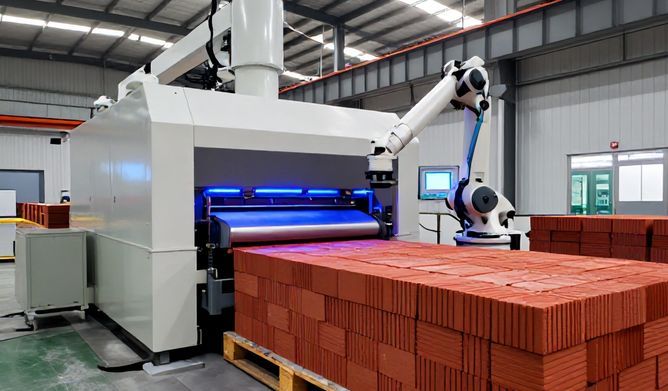
- पैलेटाइज़िंग और स्टैकिंग: The finished, hardened bricks are automatically organized, placed on pallets, and stacked by robotic arms or conveyor systems, ready for shipment.
मैनुअल से पूर्ण स्वचालित प्रणालियों का विकास
The journey from manual to automatic production is a story of revolutionary efficiency gains.
- मैनुअल: Reliant on intense physical labor for mixing, molding, and drying. Output is low, quality is highly variable, and scalability is virtually non-existent.
- अर्ध-स्वचालित: Introduces mechanical assistance (e.g., a hydraulic press) but still requires significant manual labor for feeding, retrieving bricks, and stacking. It’s a step up but retains bottlenecks.
- पूरी तरह से स्वचालित: Eliminates these bottlenecks through complete mechanization and Programmable Logic Controller (PLC) systems. The leap results in exponential gains in output, unwavering quality, and dramatic labor savings.
Key Benefits of Investing in an Automatic Brick Plant
Moving to automation is a strategic business decision with measurable, multi-faceted returns.
Unmatched Productivity and Output Consistency
- उच्च क्षमता: Automatic plants can produce anywhere from 10,000 to over 100,000 bricks per 8-hour shift, depending on model and block size.
- 24/7 संभावना: Designed for continuous operation, maximizing your return on investment.
- Pinpoint Consistency: Every single brick is produced under identical pressure, vibration, and time parameters. This results in uniform dimensions, weight, and compressive strength, critical for modern engineering standards.
श्रम लागत और मानवीय त्रुटि में महत्वपूर्ण कमी
- श्रम बचत: A fully optimized plant may require only 2-4 personnel for monitoring and supervision, compared to 15-20 for equivalent manual output.
- त्रुटि उन्मूलन Automation removes the variability introduced by human fatigue, leading to near-zero defect rates and predictable production schedules.
Superior Brick Quality and Material Efficiency
- बढ़ी हुई ताकत: The controlled, high-pressure compaction creates denser bricks with higher compressive strength and lower water absorption.
- Reduced Waste: Precise volumetric batching ensures minimal raw material spillage or off-spec production, directly boosting your profit margins.
Enhanced Operational Safety and Scalability
- Improved Safety: Workers are removed from high-risk tasks like heavy lifting and close contact with moving press parts.
- Built to Grow: Automatic systems are modular. You can often start with a core production line and add automated palletizers, robotic stackers, or additional mixing stations as your business expands.
Types of Automatic Brick Making Machines
Choosing the right machine depends on your target product and business scale.
By Brick Type: Fly Ash, Clay, Concrete, and Interlocking Block Machines
- फ्लाई ऐश ईंट मशीनें: Utilize fly ash, a thermal power plant byproduct, creating an eco-friendly, high-strength brick. Ideal for sustainable construction projects and regions with easy fly ash access.
- क्ले ब्रिक मशीनें: Fully automate the traditional clay brick process, from extrusion to cutting and stacking, for high-volume production of fired bricks.
- कंक्रीट ब्लॉक मशीनें: The most common type, used to produce solid/hollow concrete blocks, pavers, and kerbstones from a cement-aggregate mix.
- Interlocking Block Machines: Produce special bricks that lock together without mortar. Perfect for landscaping, retaining walls, and low-cost housing projects, offering rapid installation.
By Production Scale: Small, Medium, and Large Fully Automatic Plants
- Small-Scale Plants: (e.g., 10,000-20,000 bricks/day). Suitable for entrepreneurs, local construction companies, or specific project supply. Requires moderate space and investment.
- Medium-Scale Plants: (e.g., 20,000-50,000 bricks/day). Targets established businesses supplying regional markets. Needs robust infrastructure and a steady raw material pipeline.
- Large-Scale Industrial Plants: (50,000+ bricks/day). For major manufacturers supplying cities or large infrastructure projects. Involves significant capital expenditure, large industrial space, and full-time technical staff.
Critical Features to Consider Before You Buy
Look beyond the brochure. These technical details determine long-term success.
Production Capacity and Cycle Time
- Don’t just look at “bricks per hour.” Understand the चक्र समय (time to produce one pallet of bricks) and how it aligns with your business goals. Calculate based on your current and projected 3-year demand.
Automation Level and Control System (PLC vs. Manual Controls)
- दPLC (Programmable Logic Controller) is the machine’s brain. A high-quality, user-friendly PLC touchscreen interface allows for:
- Precise parameter setting (pressure, vibration duration).
- Easy switching between product types.
- Fault diagnostics and production data logging.
- This is non-negotiable for a true “automatic” machine.
Key Components: Hydraulic System, Mold Quality, and Vibration Technology
- हाइड्रोलिक प्रणाली: Seek reputed, energy-efficient brands. It dictates the machine’s pressing power and long-term reliability.
- मोल्ड गुणवत्ता: Molds should be made from high-chromium alloy steel for exceptional wear resistance. Poor molds lead to dimensional inaccuracies and frequent, costly replacements.
- कंपन प्रणाली: A well-engineered, balanced vibration table is crucial for compacting the mix evenly, especially for hollow blocks.
After-Sales Support: Warranty, Spare Parts, and Technical Service
This is where E-E-A-T becomes critical for your supplier choice. A machine is a long-term asset. Prioritize manufacturers who offer:
* A comprehensive warranty (at least 12 months on core components).
* A clear inventory of readily available spare parts.
* Access to responsive, skilled technical support—either remotely or on-site.
* Proof of successful installations and customer testimonials.
The Investment: Cost Analysis and ROI
Understanding the Price Range
The term “automatic” covers a wide spectrum. Prices can range from:
* $50,000 – $100,000+ for a robust small-to-medium scale PLC-controlled plant.
* $150,000 – $500,000+ for large-scale, fully integrated lines with robotic handling.
Price is influenced by: Brand reputation, production capacity, level of automation, customization, and country of manufacture.
Calculating Your Return on Investment (ROI)
A simplified framework:
1. Total Investment: Machine cost + shipping + installation + foundation.
2. Annual Operational Savings: (Reduced labor costs) + (Material waste savings).
3. Increased Annual Revenue: (Higher production output) x (Local market price per brick).
4. Annual Net Profit: (Increased Revenue + Savings) – (Ongoing Operational Costs).
5. ROI Period: Total Investment / Annual Net Profit.
Many businesses achieve ROI within 1.5 to 3 years.
Operational Costs: Power, Maintenance, and Raw Materials
- शक्ति: These are industrial machines. Factor in a consistent, high-capacity electrical supply.
- Preventive Maintenance: Budget 3-5% of the machine’s cost annually for routine parts (seals, filters) and service.
- कच्चा माल: Your largest recurring cost. Secure reliable, quality suppliers for cement, aggregates, etc.
Setting Up and Operating Your Automatic Brick Plant
Site Requirements and Foundation Preparation
- अंतरिक्ष Need ample area for the machine, raw material storage, curing, and finished product yard.
- नींव A massive, level concrete foundation is mandatory to absorb vibrations and ensure machine alignment.
- Utilities: Stable high-voltage power and a water source for mixing.
Raw Material Selection and Preparation
- Consistency is key. Variations in sand moisture content or aggregate size will affect brick quality.
- Implement simple quality checks for your raw material feedstock to ensure stable production.
Basic Maintenance Checklist for Longevity
- दैनिक Lubricate moving parts, check hydraulic oil levels and for leaks, clean sensors.
- साप्ताहिक: Inspect molds for wear, tighten bolts and fasteners, check conveyor belt alignment.
- Monthly: Clean hydraulic filters, inspect electrical connections, perform a full system calibration check.
अक्सर पूछे जाने वाले प्रश्न (एफएक्यू)
Q1: What is the average production capacity of a standard automatic brick machine?
A: There’s no true “standard,” but popular models for small-to-medium businesses often range between 8,000 to 20,000 solid bricks (or 1,500 to 4,000 hollow blocks) per 8-hour shift.
Q2: Can one machine produce different types and sizes of bricks/blocks?
A: Yes, a key advantage of automatic machines is versatility. By using interchangeable molds, a single machine can produce various products—solid bricks, hollow blocks, pavers, grass blocks—simply by changing the mold in the press. The PLC can store settings for each product.
Q3: How much manpower is required to operate a fully automatic plant?
A: For the core production process, typically 2-3 people: one to monitor the control panel and ensure raw material supply, and others for handling pallets/finished stacks. Additional labor may be needed for raw material handling and logistics.
Q4: What is the typical lead time for delivery and installation?
A: After order confirmation, lead times can range from 30 to 90 days for manufacturing, shipping, and installation, depending on machine complexity and customization.
Q5: Are automatic machines suitable for starting a small brick-making business?
A: Absolutely, provided you have a solid business plan and market study. Starting with a smaller-capacity automatic machine offers scalability from day one, giving you a quality and efficiency advantage over competitors using manual methods. It’s a strategic entry point for a serious entrepreneur.
Conclusion:
Automatic brick making machines are more than just equipment; they are a strategic pivot towards unprecedented productivity, impeccable quality, and sustainable profitability. They represent a decisive move away from the constraints of traditional manufacturing.
Our final recommendation is to treat this purchase as a long-term partnership. Thorough research, a clear understanding of your own production needs and market, and, most critically, the selection of a reputable and supportive supplier are the pillars of a successful investment.
Looking ahead, this industry is moving towards IoT-enabled machines for remote monitoring and predictive maintenance, and a greater focus on eco-friendly materials like processed construction waste. Investing in an automatic plant today positions you at the forefront of this evolution.
Call to Action: Before making a decision, consult with multiple suppliers. Request detailed quotations, ask for live video demonstrations or, ideally, visits to existing customer sites. Scrutinize supplier credentials, warranty terms, and spare parts policies. Your due diligence is the most important brick in your new venture’s foundation.
<