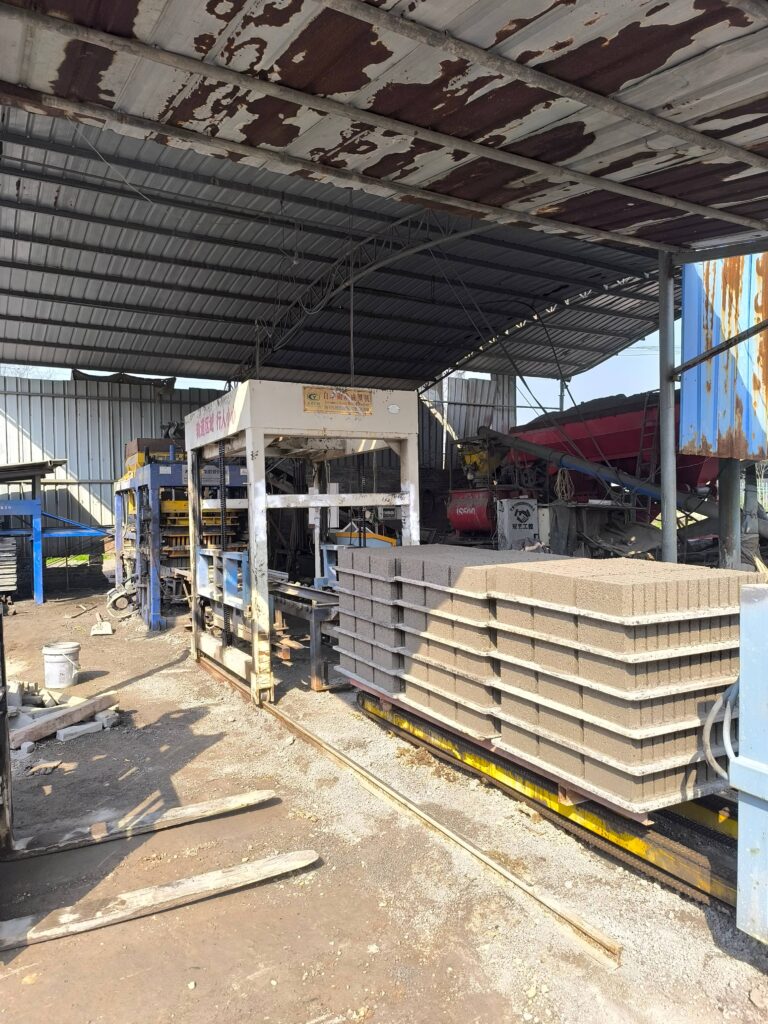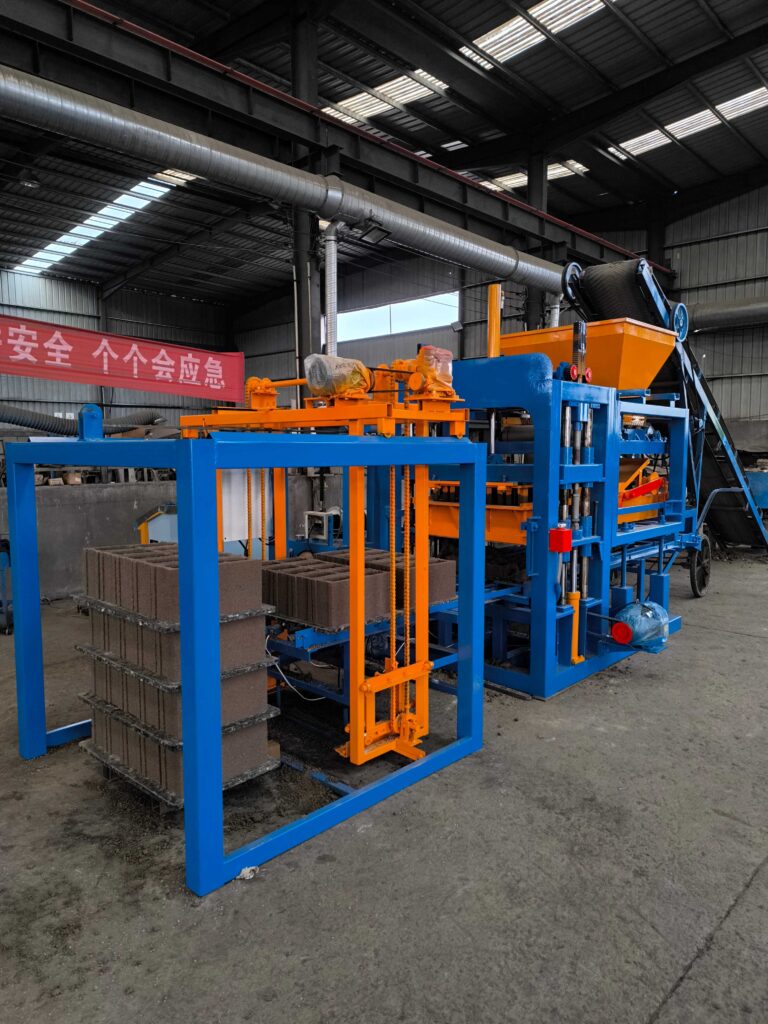
1. Definisyon Machin Otomatik pou Fè Brik ak Blòk
Yon machin otomatize pou fè brik ak blòk se yon sistèm pwodiksyon entegre ki fèt pou fabrike yon gran varyete pwodwi an beton—tankou brik solid, blòk kre, wòch pave, ak blòk antrebloke—nan yon pwosesis ki kontwole pa òdinatè ak kowòdinasyon san pwoblèm. Tèm "otomatize" la vle di yon gwo sote soti nan mekanizasyon, kote operatè imen yo retire nan sik pwodiksyon dirèk la epi yo reassiyne nan wòl sipèvizyon, antretyen, ak kontwòl kalite.
1.1. Prensip Debaz Otomatizasyon Entegre:
Operasyon an se yon sistèm kontinyèl ak fèmen nan yon sik. Li kòmanse avèk dosaj otomatik materyo premyè (siman, agrega, sann volkanik, dlo, ak pigman) ki answit transpòte nan yon melanjwa. Beton melanje a transpòte nan tremi machin nan, ki bay kantite egzak nan kavite moulaj la. Pwosesis fòmasyon nwayo a enplike:
- Vibrasyon Entansite Wo:Tabl vibratè milti-direksyon yo asire ke beton an konpakte byen sere, elimine twou vid yo.
- Pwasyon Idwolik Kontwole:Silinid idwolik ki kalibre avèk presizyon aplike presyon imans, sa ki lakòz pwodwi yo gen yon presizyon dimansyonèl segondè, yon fini sifas siperyè, ak yon fòs konpresif eksepsyonèl.
Blòk ki fèk fòme yo lè sa a otomatikman voye sou palèt, ki transpòte atravè yon konvèyè chèn oswa yon sistèm transfè kwa pou ale nan yon empile otomatik. Empile a ranje pwodwi yo sou charyo pou kwit, pare pou chanm vapè a. Pwosesis konplè sa a jere pa yon Kontwolè Lojik Pwogramab (PLC) santral.
1.2. Sipèyorite Pwodwi Final la:
Pwodwi ki soti nan yon liy otomatik karakterize pa kalite inchanjab yo, ki se yon rezilta dirèk nan presizyon ki enkli nan machin yo.
- Konsistans Dimansyonèl:Chak blòk se idantik, sa ki mennen nan tan konstriksyon pi rapid ak rediksyon nan itilizasyon mòtye.
- Fòs ki wo ak previzibPwosesis kontwole yo asire chak pwodwi satisfè oswa depase estanda fòs espesifye yo (pa egzanp, ASTM C90).
- Versatilite nan Konsepsyon:Sistèm chanjman moul rapid pèmèt yon sèl liy pwodiksyon fabrike yon pòtfolyo pwodwi divès pou satisfè demann mache varye yo.
2. Yon Taksonomi Detaye Otomatizasyon ak Korelasyon Pri li yo
Mache a pou machin otomatize yo stratifye. Konprann kouch sa yo enpòtan anpil pou alinye pwodwi yo ak segman espesifik kliyan yo, depi nan blok ki ap grandi rive nan manifakti endistriyèl yo.
2.1. Machin Semi-Otomatik ak Karakteristik Otomatize: Pon an pou Otomatizasyon Konplè
Sistèm sa yo reprezante yon nivo avanse nan pwodiksyon, men yo kenbe yon eleman kle manyèl, anjeneral nan manyen palèt yo oswa pwodwi fini yo.
- Karakteristik Kle yo:
- Operasyon:Sik la pou fòme brik yo—alimante, konpakte, ak ekspilsyon—se otomatik nèt. Sepandan, retire pale ki fin plen yo ak mete yo sou etajè pou sechaj la, se yon travay ki fèt ak men.
- Kontwòl:Souvan yo genyen yon senp sistèm kontwòl ki baze sou PLC oswa relè.
- Sòti:Yon gwo etap anlè nan machin manyèl, ak pwodiksyon ki soti nan 4,000 a 8,000 blòk estanda pou chak chanèd 8 èdtan.
- Pricing Range: This category serves as the entry point into automated production, with prices typically between $5,000 and $9,000.
- Chofè depans yo:
- Core Machine Robustness: The quality of the hydraulic system and the structural integrity of the machine frame.
- Level of Control: The sophistication of the control panel.
- Included Auxiliaries: Whether a basic mixer and conveyor are included in the price.
2.2. Fully Automatic Single Production Lines: The Standard for Commercial Scale
This is the most prevalent model for serious, high-volume manufacturers. These are turnkey systems where every step from material feeding to product stacking is automated.
- Karakteristik Kle yo:
- Operasyon: Integrated pallet circulation system, automatic product stacking, and often a color feeder for surface-layer coloring of paving stones.
- Kontwòl: A central PLC with a user-friendly Human-Machine Interface (HMI) touchscreen allows for recipe storage and production monitoring.
- Sòti: Designed for continuous operation, with production capacities from 10,000 to 30,000 blocks per 8-hour shift.
- Pricing Range: This is the core of the automated market, with a broad price band of $15,000 to $40,000.
- Chofè depans yo:
- Kapasite Pwodiksyon: The physical size and speed of the machine (cycle time) are primary cost factors.
- Level of Sophistication: Features like an automatic mold change system, robotic pallet brush/oiler, and advanced diagnostics add cost.
- Auxiliary Integration: The cost and scale of the required cement silo, aggregate bins, mixer, and conveyor network.
2.3. Fully Automatic Plant with Curing System: The Industrial-Grade Solution
For the largest investors, the automation extends beyond production to include the curing process, creating a truly continuous, 24/7 manufacturing operation.
- Karakteristik Kle yo:
- Operasyon: Includes a fully automatic production line integrated with an automated curing system, such as a rack transfer system or a tunnel curing chamber with automatic loading and unloading.
- Kontwòl: A sophisticated industrial computer or SCADA system that manages both production and the curing cycle (temperature, humidity, duration).
- Sòti: Massive output capabilities, from 30,000 to over 100,000 blocks per day.
- Pricing Range: These are multi-million-dollar capital projects. Prices start from $40,000 and can exceed $80,000.
- Chofè depans yo:
- Curing System Technology: The type and capacity of the automated curing system is a major investment.
- Material Handling Scale: The size and automation level of the raw material storage and handling system.
- Overall Plant Footprint and Civil Works: The required building and foundation work.
3. The Investment Rationale: Analyzing Total Cost of Ownership and Return on Investment
The high capital expenditure for an automated line must be justified by a compelling financial return. Distributors must be equipped to articulate this value proposition clearly.
3.1. Deconstructing Operational Efficiency:
- Labor Cost Minimization: A fully automatic line might require only 4-6 personnel for a multi-shift operation, whereas achieving similar output with semi-automatic machines could require 30-40 workers. The labor savings alone can be transformative.
- Optimizasyon Materyèl: Precision batching and mixing eliminate human error, ensuring the optimal mix design is used consistently, reducing cement waste and raw material costs.
- Konsomasyon Enèji: Modern machines are designed with energy-efficient hydraulics and motors. While total power usage is high, the cost per block produced is often lower than in less efficient, fragmented operations.
3.2. Quantifying the Value of Quality and Consistency:
- Rediksyon nan rejè yo: Automated processes ensure a near-zero defect rate, maximizing the yield from raw materials.
- Market Premium: Consistently high-quality blocks can command a higher price in the market and are preferred by large contractors and government tenders.
- Brand Reputation: Supplying a market with uniform, reliable products builds a strong brand, leading to customer loyalty and repeat business.
3.3. The ROI Calculation Framework:
The payback period for an automated line can be surprisingly short—often between 1.5 to 3 years for a well-utilized machine. The calculation hinges on:
- Revni Ogmante: Higher output and potentially higher selling prices.
- Rediksyon Depans Operasyonèl: Drastic cuts in labor, waste, and energy per unit.
- Envestisman Inisyal: The total cost of the machine, auxiliaries, installation, and commissioning.
4. Strategic Procurement and Partnership Considerations
Sourcing automated machinery is a long-term partnership that extends far beyond the initial sale.
4.1. Evaluating the Manufacturer’s Capability:
- Technical Support and Training: The manufacturer must provide extensive training for both maintenance engineers and machine operators. Look for comprehensive documentation and on-site commissioning support.
- R&D and Innovation: A partner with a strong R&D department will ensure the machinery you offer remains competitive and can adapt to new market trends and materials.
- Global Service Network: For high-value equipment, the availability of remote diagnostics and a network of service engineers is critical for minimizing downtime.
4.2. Key Technical Questions for Procurement:
- What is the machine’s “up-time” guarantee? Reliability is more important than peak speed.
- What is the lead time and cost for critical spare parts? This includes hydraulic pumps, PLCs, and specialized sensors.
- How scalable is the system? Can the line be upgraded in the future with additional modules?
Conclusion: Securing a Leadership Position in the Industrialized Construction Era
The transition towards automated brick and block production is an irreversible global trend. For distributors and procurement agents, this category represents not just a product line, but a strategic gateway to serving the most ambitious and profitable segment of the construction materials market. The pricing of these machines is a direct reflection of their transformative potential—their ability to lower the cost per block, ensure unrivalled quality, and create a defensible competitive moat for their owners.
Success in this arena requires a shift from being a simple equipment vendor to becoming a solutions partner. This entails a deep understanding of the technology, a clear-eyed analysis of the financials, and a commitment to providing the lifecycle support that ensures your clients’ factories run at peak efficiency. By mastering the intricacies of automated brick block making machines, your business can position itself at the forefront of the construction industry’s future, driving growth and building lasting value for your partners.
Kesyon yo poze souvan (FAQ)
Q1: What is the single most significant factor that differentiates a $200,000 automated line from a $400,000 one with a similar output claim?
The difference typically lies in durability, precision, and long-term reliability. The higher-priced machine will likely feature a more robust frame construction, industrial-grade hydraulic components from top-tier suppliers, a more sophisticated and user-friendly PLC system, and higher-precision machining for core components like the mold and press head. This translates to lower long-term maintenance costs, higher consistency, and less downtime over a 15-20 year lifespan.
Q2: How critical is the after-sales service and technical support for this level of equipment?
It is absolutely paramount. An automated production line is the heart of a client’s business. Any unscheduled downtime results in significant financial loss. Therefore, the manufacturer’s ability to provide rapid, expert technical support—either through remote diagnostics or by dispatching qualified engineers—is a non-negotiable criterion. The quality of after-sales service is often a more important differentiator than a marginal difference in the initial purchase price.
Q3: What are the typical infrastructure requirements for installing a fully automatic line?
The requirements are substantial. Clients will need a large, covered production hall with a high, clear ceiling. The foundation must be a massive, reinforced concrete slab designed to handle the dynamic loads of the vibrating machine. A reliable and powerful electrical connection (typically 3-phase) is essential, and access to a consistent water supply is necessary. The cost and feasibility of this civil work must be factored into the total project budget.
Q4: Can these automated lines produce different products, and how complex is the changeover?
Yes, product versatility is a key advantage. However, the changeover complexity varies. Switching between similar block heights may be a quick adjustment on the HMI. Changing to a completely different product type (e.g., from a hollow block to a paving stone) requires a physical mold change. Higher-end machines feature quicker mold change systems, but this process still requires trained personnel and can take from 30 minutes to a few hours.
Q5: What is the typical lead time from order placement to commissioning for a large automated plant?
Lead times can be lengthy due to the custom engineering and manufacturing involved. For a standard fully automatic line, expect a lead time of 3 to 5 months. For a complete turnkey plant with an integrated curing system, the lead time can extend from 6 to 9 months or more. Clear communication with the manufacturer about the project timeline is essential.
Q6: Beyond the machine itself, what auxiliary equipment is the client responsible for?
The client must budget for and manage the entire ecosystem. This includes:
- Raw material storage (cement silo, aggregate bunkers).
- Material handling (conveyors, screw feeders).
- A water supply system.
- A powerful mixer (usually a pan mixer for stiff concrete).
- Curing infrastructure (racks, carts, and possibly a boiler for steam curing).
- A substantial generator for backup power is also highly recommended.