Konprann Diferan Kalite Machin Pou Fè Blòk
Klasifikasyon dapre Mèkanis Operasyon Debaz la
Metòd fondamantal kote yon machin konpakte beton an defini kapasite li yo, kalite pwodiksyon an, ak apwoprye li pou diferan materyo premye. Sa a se diferansyasyon prensipal teknik la.
Machin Pres Idwolik
Machin sa yo itilize yon piston idwolik pou aplike yon gwo presyon kontwo lab sou melanj konkrè a andedan moul la, anjeneral ansanm ak vibrasyon.
- Prensip Fonksyonman:Yon inite pouvwa idwolik jenere presyon likid, ki pouse yon piston (tèt konpresyon) anba ak fòs ki sòti ant dis a plizyè santèn tòn. Presyon sa a aplike estatikman oswa pa etap, souvan senkronize ak vibrasyon soti nan tab mwazi an.
- Karakteristik Kle yo:
- Dansite ak Fòs Pwodwi SegondèKapab pwodui blòk ak anpil fòs konpresyon trè wo (depase 15-20 MPa) akòz konpakte entans.
- Ekselan Finisman SifasPresyon estatik la kreye yon sifas lis epi dans sou blòk la.
- Fleksibilite Materyèl:Kapab trete yon pakèt melanj konsepsyon avèk efikasite, tankou sa ki gen agregasyon fèb oswa resikle, akòz aksyon fòs la fò.
- Plis Konsomasyon Enèji:Sistèm idwolik la opere kontinyèlman pandan sik la, sa ki lakòz yon gwo konsomasyon enèji, men sistèm modèn yo ak ponp deplasman varyab amelyore sitiyasyon sa a.
- Aplikasyon Tipik :Blòk kre yo ki gen gwo fòs, wòch pave, wòch twotwa, ak pwodwi achitekti kote fini siperyè ak dirabilite yo enpòtan anpil.
Machin vibro-konpresyon
This category relies primarily on high-frequency, high-amplitude vibration to densify the concrete, with mechanical or limited hydraulic pressure playing a secondary role.
- Prensip Fonksyonman: Powerful eccentric mass vibrators are mounted directly on the mold table or frame. The vibration fluidizes the concrete mix, allowing it to settle densely into the mold cavity. A mechanical lever system or a low-pressure hydraulic cylinder may then apply a final compaction or “hold-down” stroke.
- Karakteristik Kle yo:
- Efficiency for Standard Mixes: Highly effective and energy-efficient when used with well-graded, high-quality concrete mixes.
- Simpler Mechanics: Often has fewer complex hydraulic components than full press machines, potentially reducing maintenance needs and initial cost.
- Mix Sensitivity: Product quality and strength are highly dependent on optimal aggregate grading and consistency. Performance can diminish with poor-quality or non-standard mixes.
- Vibration Transmission: Can generate significant noise and vibration, requiring robust foundations.
- Aplikasyon Tipik : Standard hollow and solid blocks for general construction in markets where consistent, high-quality raw materials are readily available.
Egg-Layer or Mobile Block Machines
A distinct type designed for on-site production, focusing on mobility and simplicity over high volume.
- Prensip Fonksyonman: The machine is positioned on a prepared sand or concrete base. After filling the mold and applying vibration (and sometimes a small amount of pressure), the machine is lifted or “walks” forward, depositing (laying) the freshly formed block directly onto the ground, reminiscent of a chicken laying an egg. The blocks cure in place.
- Karakteristik Kle yo:
- Ultimate Mobility: Designed for easy towing and setup directly at construction sites.
- Minimal Handling: Eliminates the need for pallets, curing racks, and complex material handling systems.
- Lower Output and Labor Intensity: Production is slower and requires manual feeding and machine repositioning.
- Foundation-Dependent Quality: The finish and levelness of the block depend heavily on the quality of the laying bed.
- Aplikasyon Tipik : Low-cost housing projects, remote infrastructure, farm construction, and small-scale entrepreneurial production where transport costs of finished blocks are prohibitive.
Classification by Level of Automation and Integration
This categorization addresses the human labor required and the machine’s position within a production workflow, directly impacting labor costs and output scale.
Machin Manyèl ak Semi-Otomatik
- Machin Manyèl: Every step—feeding mix, inserting pallets, activating the cycle, removing finished blocks—is performed by the operator. Lowest capital cost, highest labor intensity, and variable output quality.
- Machin Semi-Otomatik: The core compaction and molding cycle is automated (initiated by a button or pedal), but the operator is responsible for feeding raw materials and removing/palletizing the finished products. Offers a balance between investment and productivity improvement.
Machin Otomatik Konplèt Estasyonè
The industry benchmark for commercial production. Once loaded with raw material and pallets (which can also be automated), the machine executes the complete cycle—feeding, compaction, molding, and ejection—autonomously under PLC control. These systems offer high, consistent output (e.g., 1,000-5,000 blocks per 8-hour shift), reduce labor to a supervisory role, and ensure uniform product quality. They form the core of a block production yard.
Fully Integrated Production Lines
This represents the apex of industrial manufacturing. The block making machine is seamlessly synchronized with upstream and downstream automation:
- Anwo Automated batching plants and mixers supply a continuous flow of concrete.
- Anba kouran: Robotic pallet feeders, block stackers, curing rack conveyors, and de-palletizing/splitting systems handle the product without manual intervention.
- Central Control: A master control system oversees the entire line. These lines are custom-engineered for specific plants, offering the lowest cost per unit at the highest possible volume, but requiring very significant capital investment and technical infrastructure.
Classification by Specialized Product Output
Some machines are engineered from the ground up for specific, high-value product categories.
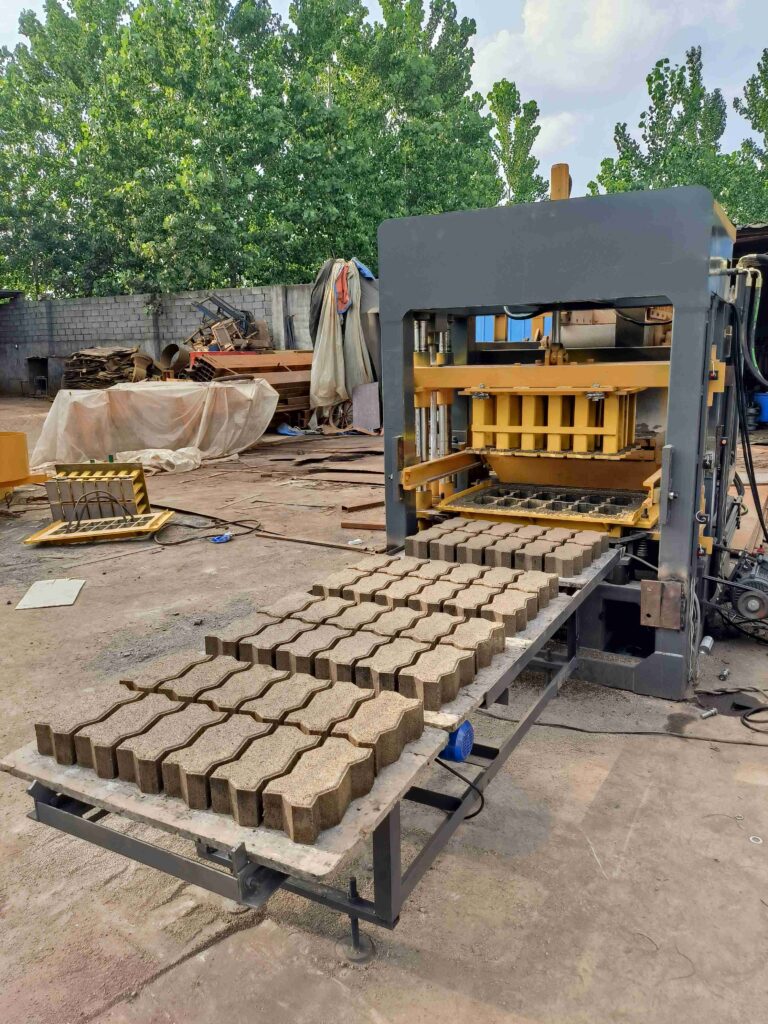
Paver and Slab Making Machines
Optimized for producing thin, high-precision products with superior surface finish.
- Karakteristik: Often employ multilayer or multideck technology (multiple mold boxes stacked vertically) to produce a whole pallet of pavers in a single cycle. Use specialized vibration patterns to ensure color consistency and surface uniformity without fracture.
Interlocking Block Machines
Designed to produce dry-stack block systems for load-bearing walls.
- Karakteristik: Molds create complex positive and negative features (knobs and grooves) on the top, bottom, and sides of the block with extreme precision to ensure secure, mortarless alignment. Critical for rapid, cost-effective construction systems.
Insulated Concrete Form (ICF) Block Machines
Manufacture complex pre-formed units with integrated insulation.
- Karakteristik: Handle the simultaneous forming of concrete and the precise insertion or molding of expanded polystyrene (EPS) foam panels. Require sophisticated mold technology and handling systems for the dual materials.
Strategic Implications for Distribution and Procurement
Understanding this taxonomy is not an academic exercise but a commercial imperative.
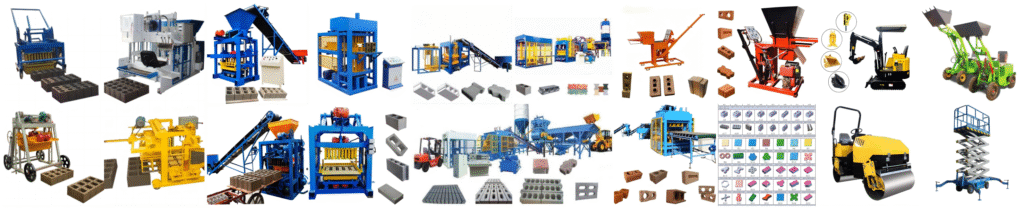
- Portfolio Strategy: A distributor should curate a portfolio that addresses distinct market segments: entry-level (egg-layers, manual/semi-automatic), core commercial (fully automatic vibro-compression and hydraulic presses), and premium industrial (integrated lines, specialized machines).
- Client Consultation: The first step in advising a client is a diagnostic of their market, capital, labor cost, and raw material access. A rural entrepreneur needs an egg-layer or small semi-automatic machine; a contractor bidding on city pavements needs a hydraulic paver machine; an investor building a supply plant needs an automated hydraulic press with a quick mold-change system.
- Value Proposition Articulation: Selling a hydraulic press over a cheaper vibro-machine requires explaining the value of material flexibility and higher strength. Selling automation requires a clear ROI model based on labor savings and quality consistency.
Konklizyon
The world of block making machinery is characterized by a purposeful and sophisticated diversity. Each type—from the mobile egg-layer to the titanic integrated line—occupies a specific niche in the global construction value chain, addressing unique combinations of scale, quality, mobility, and investment threshold. For the professional in the equipment supply chain, mastery of this taxonomy is the foundation of competence. It enables the critical task of technology alignment: ensuring that the machinery solution fits the commercial problem like a key fits a lock. In an industry where capital decisions are consequential and long-lasting, the ability to accurately navigate and explain these different types of block machines transforms a supplier from a mere vendor into an indispensable strategic partner. The right classification leads to the right machine, which in turn builds the foundation for a client’s successful and profitable enterprise.
FAQ
Q1: Can a hydraulic press machine also function as an effective paver machine?
A: Yes, many standard hydraulic press machines are excellent platforms for paver production when equipped with the appropriate multilayer mold system, specialized vibration table for surface finish, and color feed system. In fact, due to the need for high density and excellent surface quality in pavers, hydraulic presses are often the preferred choice for high-end paver manufacturing. The key is the machine’s capability to accept the necessary specialized tooling and auxiliary systems.
Q2: What is the main operational difference between a stationary plant and an egg-layer machine beyond mobility?
A: The core operational difference is the production process and curing method. A stationary plant produces blocks on individual pallets, which are then transported to a controlled curing area (racks, chambers) where they gain strength before being stored or shipped. An egg-layer deposits blocks directly onto a prepared surface where they remain to cure in ambient conditions. This eliminates the need for pallets and handling equipment but ties production to the curing schedule and weather, and typically offers lower dimensional precision.
Q3: Is a fully integrated production line only for making one type of block?
A: Not necessarily. While some high-volume lines are dedicated to a single product, the most advanced integrated lines are built around versatile, high-speed hydraulic presses with automated mold change systems. Robots can swap entire mold pallets in minutes, allowing the line to produce different blocks, pavers, or specialty products in sequence, all managed by the central computer. This represents the pinnacle of flexible, large-scale manufacturing.
Q4: For a new market with low labor costs, is a manual machine always the best entry point?
A: Not always. While low labor costs make manual operation economically feasible, other factors must dominate the decision. A semi-automatic or basic automatic machine delivers vastly superior consistency, output volume, and product quality. These factors determine market competitiveness. If the goal is to build a brand known for reliable, standard-sized blocks and to achieve scale, investing in a higher level of automation from the outset, even in a low labor-cost environment, is often the faster path to market leadership and long-term profitability.
Q5: How does the choice between vibro-compression and hydraulic press impact the raw material supply chain?
A: This choice has significant upstream implications. A pèses idwolik is more forgiving and can compact a wider variety of mixes, including those with less ideal aggregate grading or higher content of fines/recycled materials. This can provide flexibility and lower cost in raw material sourcing. A vibro-compression machine typically requires a consistently well-graded, high-quality aggregate mix to achieve full density and strength. This may lock the producer into a more expensive or less flexible supply chain but can offer energy savings if the ideal mix is locally and reliably available.