
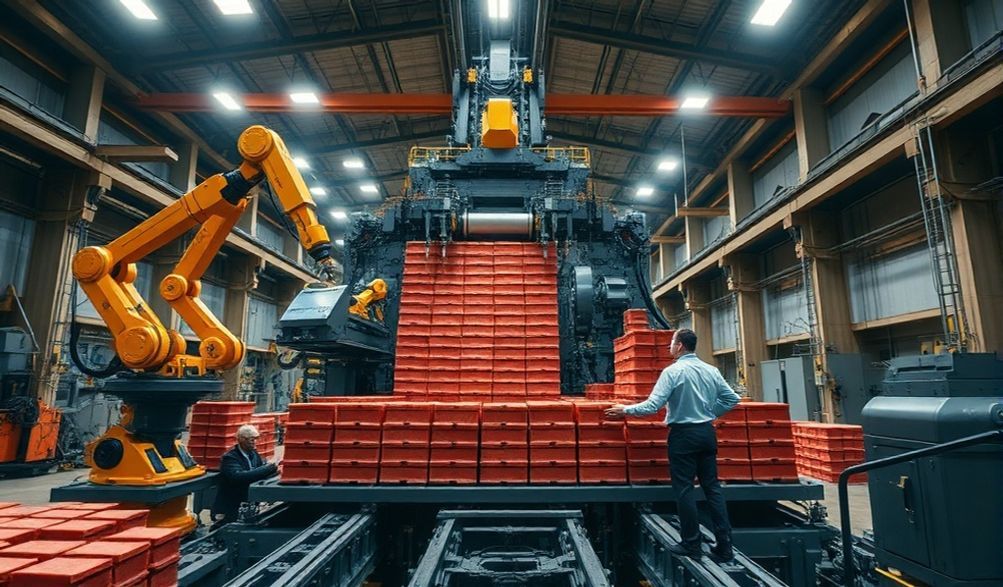
Gid Konplè sou Machin Fè Brik Otomatik: Efikasite, Kalite & Ki Jan Pou Chwazi
Endistri konstriksyon mondyal la se yon motè k ap grandi san rete, ki mande dè milya de brik ak blòk chak ane. Men, pandan plizyè deseni, pwodiksyon brik, ki se fondasyon pou ofri materyèl sa yo, te bloke nan pwosesis manyèl ki te mande anpil travay, ki pa t konstan, epi ki te chè. Biznis yo te fè fas ak defi konstan pou ogmante pwodiksyon, jere depans travay k ap monte, epi kenbe estanda kalite ki satisfè espesifikasyon jeni modèn yo.
Antre nan pouvwa transfòmatè otomatizasyon an. Machin otomatik pou fè brik la reprezante yon chanjman paradig, deplase fabrikasyon brik soti nan yon metye ale nan yon syans endistriyèl presi ak gwo pwodiksyon. Gid sa a fèt espesyalman pou pwopriyetè biznis, manadjè plant, ak envestisè k ap chèche plis pase yon sèl machin; yo ap chèche yon avantaj estratejik. Nan sentèz done jeni endistri, etid ka operasyonèl, ak analiz ekonomik, resous sa a bay konesans ekspè, aksyonab ki nesesè pou pran yon envestisman ki enfòme ak pwofitab nan lavni biznis materyèl konstriksyon ou an.
Kisa yon Machin Otomatik pou Fè Brik?
Yon machin otomatik pou fè brik se yon sistèm pwodiksyon konplètman entegre ak pwogramab ki fèt pou otomatize tout pwosesis fabrikasyon brik—depi materyo premyè yo ap manje ak melanje, rive nan mwazi, sechaj, ak anpilman final—ak minim entèvansyon imen. Nan nwayo li, li se yon senfoni senkronize nan konpozan mekanik, idwolik, ak elektwonik ki dirije pa yon òdinatè santral.
Pwen kle ki fè diferans ant li ak machin semi-otomatik la se nivo otonomi li genyen. Pandan ke yon machin semi-otomatik ka otomatize etap peze oswa moulaj la, li mande pou yo manuelman mete materyo anvan epi retire pwodwi fini yo. Yon machin konplètman otomatik...machin otomatik pou fè briksistèm yo gen karakteristik tankou dosaj otomatik ak konveyè, manyen pale ak wobo, ak operasyon santralize kontwolè lojik pwogramab (PLC), ki pèmèt yon sik pwodiksyon kontinyèl ak fèmen ki ka fonksyonne 24/7 ak yon ekip minim.
Core Benefits of Automating Your Brick Production
Investing in automation is a strategic business decision with profound operational and financial implications. Here’s how it transforms your production floor.
Efikasite Pwodiksyon ak Pwodiksyon San Parèy
Automatic machines operate on precise, high-speed cycles. Where manual output is measured in hundreds of bricks per worker per day, an automatic brick plant measures output in thousands of bricks pa èdtan.
* 24/7 Capability: These systems are built for continuous operation, maximizing your return on investment by producing through shifts without fatigue.
* Predictable Metrics: Output is consistent and quantifiable (e.g., 15,000 solid blocks per 8-hour shift), making supply chain management and project bidding significantly more reliable.
Superior Product Consistency & Quality Control
Human variability is eliminated. Every brick is produced under identical, digitally controlled conditions.
* Jeni Presizyon Hydraulic pressure (in tons), vibration frequency, and material mix ratios are set and maintained by the PLC.
* Uniform Results: This leads to bricks with consistent dimensions, density, and compressive strength, reducing waste from rejects and ensuring compliance with stringent building standards.
Diminye Siyifikatif nan Depans Travay ak Depandans
Automation fundamentally changes your labor structure.
* Shift in Roles: A large team of manual laborers is replaced by a small, skilled team of machine operators, monitors, and maintenance technicians.
* Ekonomi nan depans: This dramatically reduces long-term wage bills, management overhead, and vulnerability to labor shortages.
Enhanced Operational Safety
The factory floor becomes a safer environment.
* Risk Mitigation: Automation minimizes direct worker exposure to the most hazardous areas: heavy lifting, repetitive motion injuries, and proximity to high-pressure hydraulics and moving parts.
* Controlled Access: Integrated safety guards and interlocks ensure protection is built into the system.
Long-Term Cost Savings & ROI
While the capital outlay is higher, the total cost of ownership often favors automation.
* Reduced Waste: Consistent quality means fewer defective bricks.
* Higher Throughput: More saleable product is generated per square foot of factory space and per kilowatt-hour of energy.
* Kad Ranmase sou Envestisman (ROI) A proper ROI calculation must factor in reduced labor costs, lower waste rates, increased sales capacity, and the machine’s lifespan, often paying back the investment in a few years.
Types of Automatic Brick Making Machines
Choosing the right type is critical. Machines are categorized by their operation method, mobility, and core technology.
By Operation Method: Fully Automatic vs. Semi-Automatic
| Feature | Fully Automatic Brick Making Machine | Semi-Automatic Machine |
| :— | :— | :— |
| Control Level | Central PLC controls the entire cycle. | Operator controls key stages (e.g., start/stop). |
| Labor Need | Minimal (3-5 for operation/monitoring). | Significant (6-10 for material handling & product removal). |
| Kapasite Pwodiksyon | Very High (10,000 – 30,000+ bricks/shift). | Moderate (4,000 – 10,000 bricks/shift). |
| Ideal Use Case | Large-scale commercial plants, 24/7 production. | Medium-scale businesses, varied product runs, lower capital. |
By Brick Output Type: Stationary Block Machines vs. Mobile Brick Plants
- Stationary Automatic Block Machines: These are the powerhouses of the industry. Installed in a fixed location within a factory, they are designed for maximum output and integration with conveyor systems, curing racks, and automated pallet return systems. They are the core of a dedicated brick manufacturing plant.
- Mobile Brick Making Plants: Mounted on a trailer, these bring production directly to the construction site. This is a game-changer for large, remote projects like dams, roads, or rural housing developments, as it eliminates the massive cost and breakage associated with transporting finished bricks over long distances.
By Production Process: Hydraulic Pressure vs. Vibration Compression
- Hydraulic Pressure Machines: Use immense, controlled hydraulic force to compact the raw material (like concrete or stabilized earth) within a mold. They are renowned for producing extremely dense, high-strength products like solid concrete blocks, paving stones, and kerbstones with a smooth finish.
- Vibration Compression Machines: Combine vibration (to settle the mix) with compaction pressure. They are exceptionally well-suited for producing hollow blocks, interlocking bricks, and fly ash bricks, where a certain porosity and precise shape are required. Many modern fully automatic brick plants use a hybrid of both technologies for optimal results.
Key Components and How an Automatic Machine Works
Understanding the workflow demystifies the machine’s capabilities.
The Integrated Workflow: From Raw Material to Finished Brick
- Aggregate Batching & Mixing: Sand, cement, aggregate, and water (or fly ash, clay) are precisely measured and mixed in an automated pan mixer.
- Automated Material Feeding: The mixed material is conveyed via bucket elevator or conveyor belt directly into the machine’s feed hopper.
- Moulaj & Konpresyon: The heart of the operation. Material is fed into the mold box, where it is subjected to intense vibration and/or hydraulic pressure to form the brick.
- Curing & Pallet Return: The green brick on its pallet is ejected onto a conveyor chain system. It may travel through a curing chamber or be stacked for air curing. The empty pallet is automatically cleaned and returned to the mold area—a critical feature of a closed-loop system.
- Robotic Stacking & Packaging: Once cured, bricks are automatically stacked by a robotic stacker, banded, and prepared for shipment.
Heart of the System: The PLC Control Panel
This is the brain of the machin otomatik pou fè brik. The PLC (Programmable Logic Controller) is a rugged industrial computer that:
* Orchestrates the timing of every cylinder, conveyor, and motor.
* Monitors pressure, cycle counts, and faults.
* Stores Recipes for different brick types, allowing quick changeovers.
* Provides Data for quality assurance and production efficiency analysis.
Critical Factors for Choosing the Right Machine
Navigating the purchase requires a methodical assessment of your needs and the market.
Evalye Kondisyon Pwodiksyon Ou
Start by answering these questions:
* Rezilta Vle What is your target in bricks per day or shift? Be realistic about both current needs and future growth.
* Kalite ak Gwosè Brik yo: Will you produce solid blocks, hollow blocks, pavers, or interlocking bricks? Ensure the machine supports interchangeable molds for your product range.
* Matyè Premye: What is your primary material? Concrete, fly ash, clay? The machine must be optimized for your mix.
Power Source & Plant Infrastructure
The machine is just one part of the ecosystem.
* Pouvwa Most heavy-duty machines require a robust 3-phase electrical supply.
* Espas: Account for the machine’s footprint, raw material storage, curing area, and finished product storage.
* Foundation: A massive, level concrete foundation is non-negotiable to absorb vibrations and ensure alignment.
Manufacturer Credibility & After-Sales Support
Sa se koteE-E-A-T (Experience, Expertise, Authoritativeness, Trustworthiness) becomes paramount in your decision.
* Verify Experience: How long has the manufacturer been building these machines? Request client references and, if possible, visit an existing installation.
* Inspect Component Quality: Are key parts (hydraulic pumps, PLCs, motors) from reputable, branded suppliers?
* Evaluate Support: What does the after-sales package include? Insist on clear terms for installation supervision, operator training, warranty (at least 12 months), and the availability of genuine spare parts.
Analiz Pri Total Posede
Look beyond the sticker price. The true cost includes:
* Initial Price + Shipping & Insurance
* Installation & Foundation Costs
* Training
* Estimated Energy Consumption
* Annual Maintenance & Spare Parts Budget
Maintaining Your Automatic Brick Making Machine for Longevity
A well-maintained machine is a profitable machine. Adhere to a strict regimen.
Daily, Weekly, and Monthly Maintenance Checklists
- Daily: Check hydraulic oil levels, lubricate all guide rails and bearings, visually inspect for leaks or loose parts, clean the mold and pallets.
- Weekly: Clean the entire machine, check electrical connections for tightness, inspect wear parts like mold liners and feeder scrapers.
- Monthly: Perform a full oil analysis, check and tighten all bolts to specified torque, calibrate sensors.
Common Operational Issues and Troubleshooting
- Brick Cracking: Often caused by incorrect moisture content in the mix or excessive vibration pressure.
- Dimensional Inaccuracy: Can result from a worn mold, misaligned pallets, or incorrect feed volume.
- Hydraulic Issues (Slow Cycle, Weak Pressure): Check oil level, filters, and for possible pump or valve faults.
The Importance of Genuine Spare Parts
Using counterfeit or off-brand parts is a false economy. They can lead to:
* Catastrophic machine failure and prolonged downtime.
* Voided warranty.
* Safety hazards for operators.
* Poor brick quality. Always source parts from your original manufacturer or their authorized distributor.
The Future of Brick Making: Automation and Sustainability
The evolution continues, driven by digitalization and green building demands.
Integration with Industry 4.0
The next generation of automatic brick making machines will be smarter:
* IoT Sensors: Monitor component health in real-time, enabling predictive maintenance before a failure occurs.
* Production Analytics: Cloud-connected dashboards provide insights into Overall Equipment Effectiveness (OEE), helping optimize every aspect of production.
* Smart Factory Integration: Machines will communicate with raw material feeders and logistics systems for a seamless, data-driven operation.
Eco-Friendly Production Trends
Automation is aligning with sustainability:
* Waste Material Utilization: Modern machines are expertly engineered to use high percentages of industrial by-products like sann volan, slag, and recycled construction aggregate.
* Energy-Efficient Products: They enable the production of bricks with better thermal insulation properties, contributing to energy-efficient buildings.
Kesyon yo poze souvan (FAQ)
Q1: What is the average production capacity of a fully automatic brick making machine?
A: Capacity varies widely by model and brick type. A standard range for a commercial machine is between 10,000 to 30,000+ bricks (standard equivalent) per 8-hour shift. Specific output for hollow blocks or pavers will differ, so always review the manufacturer’s detailed specification sheet.
Q2: How much manpower is required to operate an automatic plant?
A: A dramatic reduction from manual methods. A typical fully automatic line can be efficiently operated and monitored by a team of 3-5 personnel, handling machine operation, quality checks, and basic maintenance.
Q3: Can one machine produce different types and sizes of bricks?
A: Yes, this is a key advantage. By changing the mold box and adjusting the parameters on the PLC control panel, a single machine can produce a variety of products. The speed and ease of this changeover is a feature to discuss with your supplier.
Q4: What is the typical lead time for delivery and installation?
A: After order confirmation, lead times generally range from 30 to 90 days for manufacturing, shipping, and delivery. Crucially, site preparation (foundation, power) should be completed during this period to avoid costly installation delays.
Q5: How do I ensure I’m buying from a reputable manufacturer?
A: Conduct thorough due diligence. Visit their factory to see production quality. Request and verify certifications (ISO, CE). Scrutinize the warranty terms. Most importantly, speak directly to their existing customers about machine performance and after-sales service responsiveness.
Konklizyon
The transition to an machin otomatik pou fè brik is more than an equipment purchase; it is a strategic investment in efficiency, quality, and long-term business profitability. By automating the core of your production, you gain control over costs, scale, and product consistency in a way manual methods cannot match.
We urge you to approach this decision with thorough due diligence. Focus on your specific production goals and partner with a manufacturer whose expertise, support network, and commitment to quality promise a true long-term partnership. The right machine is the foundation upon which a smarter, more competitive, and more profitable business is built.
Ready to calculate the precise ROI for your project? Contact our engineering team today for a free, customized production analysis tailored to your raw materials and output goals.
Want to dive deeper? Download our comprehensive specification sheet and maintenance guide for automatic brick making machines to inform your planning.
We are committed to providing the expert, transparent information you need to build better, smarter, and more efficiently.
<