Dekonstriksyon Matris Materyèl laNan Fè Blòk
Konpozisyon yon blòk beton se yon sistèm ki byen enjenyè kote chak eleman jwe yon wòl espesifik nan karakteristik inite fini an.
1. Sistèm Lian: Siman ak Materyòl Siplemantè Simantè (SCMs)
Binder a kole matris agrega yo ansanm, li detèmine fòs final la, direbilite, ak enpak anviwònman an.
- 1.1. Siman Pòtland (Tip I/II):Liyan prensipal ak esansyèl la. Kalite ak konsistans li yo pa negosyab. Siman tip II, ki gen rezistans modere nan sulfat, se souvan pi pito pou pèfòmans balanse li yo, espesyalman nan anviwònman ki gen potansyèl ekspoze imidite.
- 1.2. Materyèl Sipò Simentè (SCMs):Sa yo se pa sèlman aditif, men ranplasman pasyèl ki amelyore pèfòmans pou siman Pòtlann.
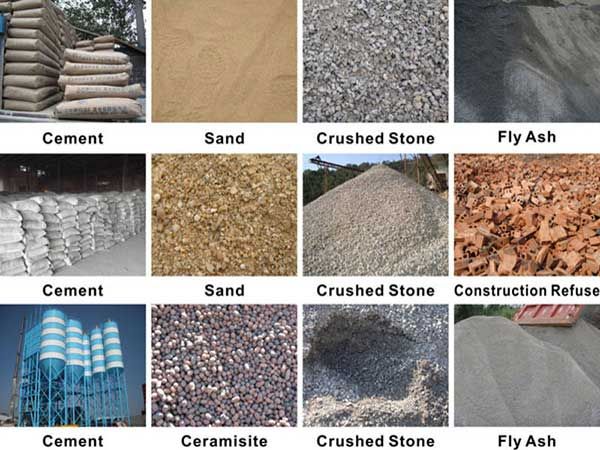
- Sann volan (Klas C oswa F):Yon pwodwi segondè pozzolanik ki soti nan konbistyon chabon. Li amelyore fòs alontèm, diminye pèmeyabilite (anmelyore dirabilite), epi kreye yon fini pi lis. Li tou diminye bezwen dlo melanj la ak chalè idratasyon, sa ki redi risk fann.
- Gwo Granilè Slag Founo Soufle (GGBFS):Yon lòt pwodui endistriyèl ki amelyore siyifikativman dire, espesyalman kont atak sulfat ak reyaksyon alkali-silica (ASR). Li kontribye nan pi gwo fòs final ak yon koulè pi klè.
- Silica Fume: Itilize nan melanj pèfòmans segondè pou fòs ekstrèm ak enpermeabilite, byenke li ogmante bezwen dlo ak pri.**
Apwòch "Pi Bon" la: The optimal binder is often a blended system (e.g., 70% Portland Cement, 25% Fly Ash, 5% Lime). This leverages SCMs to reduce cost, lower embodied carbon, and improve specific performance properties, all while meeting or exceeding strength targets.
2. The Aggregate Skeleton: Providing Bulk and Strength
Aggregates constitute 75-85% of the block’s volume, providing the structural skeleton and influencing weight, thermal properties, and texture.
- 2.1. Normal Weight Aggregates: Natural sand, gravel, and crushed stone (limestone, granite).
- Crushed Stone: Angular particles provide excellent mechanical interlock, resulting in higher compressive strength compared to rounded gravel.
- Sab Fine aggregate fills voids, improves workability, and contributes to surface finish. A well-graded blend of coarse and fine aggregates is critical for achieving maximum density and minimal voids.
- 2.2. Lightweight Aggregates: Expanded clay, shale, or slate, and industrial by-products like bottom ash.
- Avantaj: Dramatically reduce block weight (easing handling and reducing structural dead load), and offer superior thermal and fire resistance.
- Konsiderasyon: They are generally more expensive and can be more fragile during mixing and compaction, requiring careful process adjustments. They produce blocks with lower compressive strength (though often still meeting code requirements) compared to normal weight aggregates at the same density.
- 2.3. Recycled Aggregates: Processed construction and demolition waste (crushed concrete).
- Strategic Value: Lowers material cost, appeals to sustainable building programs (LEED), and supports circular economy goals.
- Quality Imperative: Must be rigorously processed to remove contaminants (wood, metal, gypsum) and controlled for consistent grading and absorption rates. Higher absorption can affect water-cement ratio and require mix adjustments.
3. The Modifiers: Water, Admixtures, and Pigments
These components fine-tune the production process and final product attributes.
- 3.1. Water: Quality is paramount. It should be potable, free from impurities, oils, or organic matter that could interfere with hydration or cause staining.
- 3.2. Chemical Admixtures:
- Water Reducers/Plasticizers: Allow for a lower water-cement ratio while maintaining workability, directly increasing strength and durability.
- Accelerators: Speed up early strength gain, crucial for fast stripping cycles and high-throughput production, especially in cooler climates.
- Air-Entraining Agents: Introduce microscopic air bubbles that dramatically improve freeze-thaw resistance, a must for blocks in exposed or cold-weather applications.
- 3.3. Integral Pigments: Synthetic iron oxides are the standard for colored blocks. Quality pigments are UV-stable, finely ground for even dispersion, and used at precise dosages to ensure batch-to-batch color consistency—a key aesthetic and commercial requirement.
Conclusion: The Alchemy of Strategic Selection
There is no single “best” material for all block production. The optimal mix is a purpose-driven formulation. For high-strength, load-bearing commercial blocks, a blend of Portland cement, high-quality crushed stone, and targeted admixtures is paramount. For energy-efficient or fire-rated walls, lightweight aggregates become the best choice. For a producer targeting green building markets, a high-SCM, recycled-aggregate mix defines excellence.
Therefore, the “best” materials are those that: 1) Reliably meet the target performance specifications (ASTM strength, durability); 2) Are available locally and consistently to ensure supply chain security and cost control; 3) Align with the desired product positioning (commodity vs. premium architectural); and 4) When blended and processed correctly, produce a block with optimal production characteristics (good flow, fast demolding, consistent finish). Mastery lies not in sourcing exotic materials, but in scientifically combining and processing the right local materials to create a superior, cost-effective, and market-ready product.
FAQ
Q1: Can we use river sand instead of manufactured sand (crushed stone fines)?
A: River sand (natural sand) is often rounded and smooth, which can reduce the mechanical interlock and final strength compared to angular manufactured sand. However, it can improve mix workability. The “best” practice is often to blend both to achieve an optimal particle size distribution and packing density. River sand must be checked for silt and organic content.
Q2: How do we determine the right percentage of SCMs like fly ash to use?
A: This requires a methodical testing program. Start with the maximum replacement level allowed by your target ASTM standard (e.g., up to 25% for some applications). Conduct trial batches and test for early (3-7 day) and ultimate (28-day) compressive strength, set time, and water demand. Adjust based on results, climate, and curing method. The goal is to maximize benefits without compromising early strength needed for production handling.
Q3: Are there cheaper alternatives to synthetic pigments for colored blocks?
A: While mineral oxides can be less expensive, they often lack the color consistency, intensity, and UV stability of high-quality synthetic iron oxides. Inconsistent color is a major reason for product rejection in architectural work. For a professional product, the reliability and performance of proven synthetic pigments usually justify their cost, as they protect your brand reputation.
Q4: What is the most overlooked material quality issue?
A: Consistent aggregate moisture content. If the sand and gravel arriving at the mixer have variable moisture levels, the effective water-cement ratio of the mix fluctuates wildly. This is the single biggest cause of inconsistent block strength, poor finish, and production problems like sticking in molds. Implementing a simple, regular aggregate moisture testing and mix water adjustment protocol is one of the most impactful quality control steps a producer can take.
Q5: How should we source materials to ensure long-term viability?
A: Develop partnerships, not just purchase orders. Establish relationships with multiple, reliable suppliers for key materials (especially cement). For aggregates, if volume justifies it, consider a long-term lease or ownership of a local pit for greater control over quality and cost. For SCMs, work with reputable brokers or directly with power plants. Securing a stable, high-quality material supply chain is a core strategic advantage.