Panduan rinci ini secara sistematis mengeksplorasi dunia mesin bata yang multifaset, menyediakan kerangka kerja yang jelas untuk diferensiasi berdasarkan prinsip operasional inti, teknologi proses, dan paradigma otomatisasi.
I. Klasifikasi Inti berdasarkan Proses dan Fondasi Material
Perbedaan paling mendasar dalam mesin bata terletak pada proses produksi dan sifat bahan baku yang dibentuk, yang secara langsung menentukan desain mesin, kebutuhan energi, dan aplikasi produk akhir.
Mesin Berbasis Ekstrusi untuk Produk Tanah Liat
Kategori ini mencakup mesin-mesin yang dirancang untuk produksi tradisional dan luas dari batu bata tanah liat dan genteng. Prosesnya mengandalkan plastisitas tanah liat ketika dicampur dengan air.
- Ikhtisar Proses:Campuran tanah liat homogen dimasukkan ke dalam ruang utama, di mana ia diberi perlakuan vakum untuk menghilangkan udara, yang secara signifikan meningkatkan kepadatan dan kekuatan akhir produk. Tanah liat yang telah dihilangkan udaranya kemudian didorong melalui cetakan (nozzle ekstrusi) dengan profil tertentu oleh sistem auger yang kuat. Kolom tanah liat yang kontinu ini, disebut kolom, kemudian dipotong dengan kawat menjadi unit bata individual.
- Sub-Tipe Utama:
- Ekstruder Lumpur Kaku:Jenis yang paling umum, menggunakan tanah liat dengan kadar air 12-15%. Jenis ini menghasilkan batu bata padat dan berkekuatan tinggi yang cocok untuk berbagai aplikasi struktural dan pelapis.
- Mesin Lumpur Lembut:Gunakan tanah liat dengan kadar air yang lebih tinggi (hingga 30%) dan sering digunakan untuk batu bata dengan tampilan buatan tangan. Tanah liat tersebut dicetak daripada diekstrusi di bawah tekanan tinggi.
- Keluaran & AplikasiMemproduksi batu bata tanah liat padat, berlubang, atau berongga. Hasilnya adalah batu bata "mentah" yang harus melalui proses pengeringan dan pembakaran suhu tinggi di dalam tungku (tungku terowongan, tungku Hoffmann) untuk mencapai kekerasan dan ketahanan akhirnya.
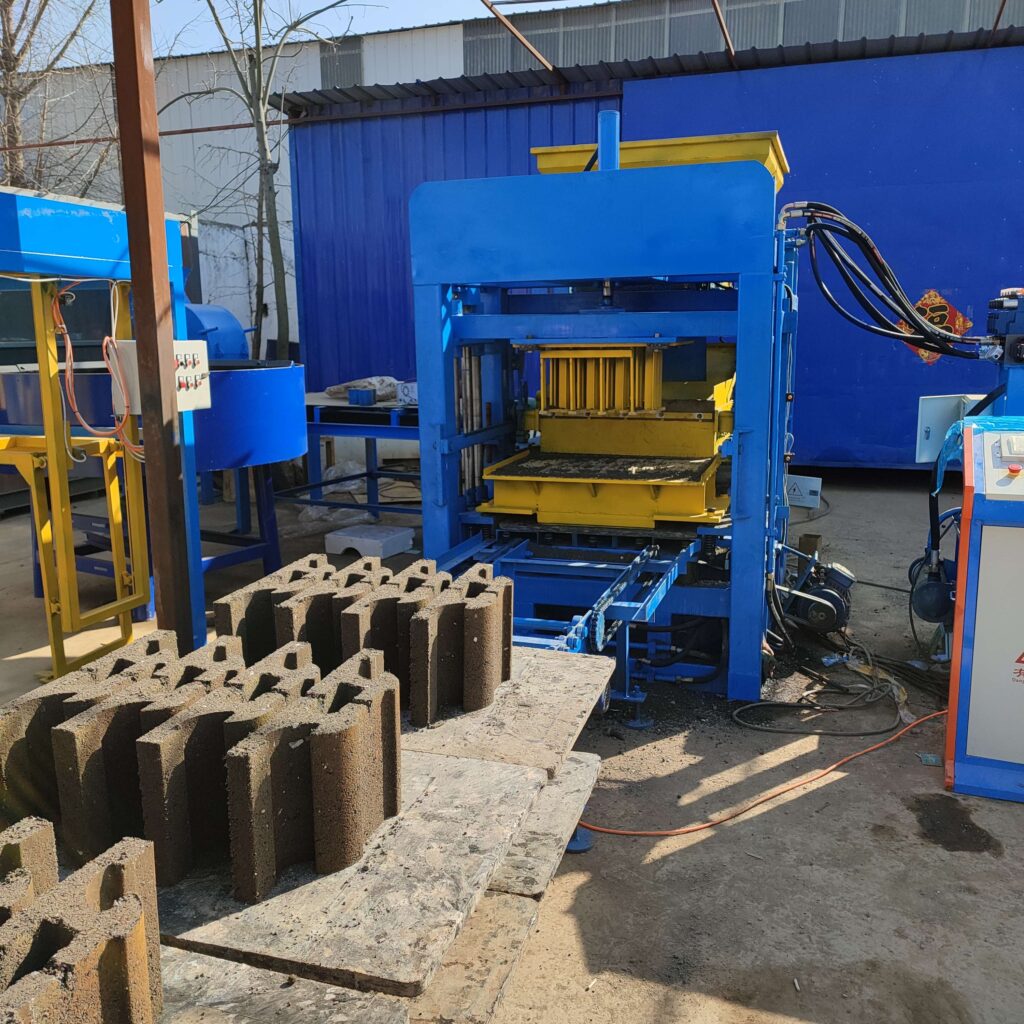
B. Mesin Press Hidrolik untuk Produk Beton & Semen
This dominant technology in modern construction is used for producing concrete blocks, paving stones, interlocking bricks, and similar products from a zero-slump concrete mix.
- Ikhtisar Proses: These machines utilize high-pressure hydraulic rams to compact a dry concrete mix (cement, aggregates, sand, minimal water) within a precision-engineered mold cavity. The process is often accompanied by simultaneous vibration to achieve maximum compaction and eliminate voids.
- Key Operational Principle: The combination of immense static pressure (measured in tons or Mega Pascals) and vibration force is critical. It determines the brick’s immediate “green strength” for handling and its final cured compressive strength, which can rival or exceed that of fired clay.
- Keluaran & Aplikasi Products do not require firing. Curing occurs through controlled hydration over 7-28 days. The technology is exceptionally versatile, allowing for rapid mold changes to produce hundreds of different block, paver, and landscaping product designs from a single machine.
C. Compaction Machines for Stabilized Earth & Interlocking Soil Blocks
These machines address sustainable and cost-sensitive construction by utilizing on-site or locally available soil.
- Ikhtisar Proses: They mechanically compact a mixture of soil (with specific sand/clay ratios) and a small percentage of stabilizer (often cement or lime) into a highly dense block. A defining feature of many in this category is the production of interlocking bricks, which are designed with vertical and sometimes horizontal locks, minimizing or eliminating the need for mortar in wall construction.
- Sub-Tipe Utama:
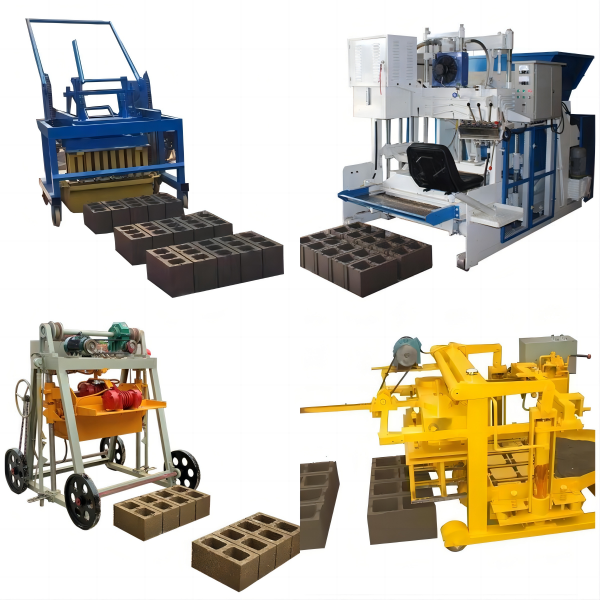
- Mesin Press Manual: Lever-operated or mobile presses suitable for very small-scale, community-led projects.
- Motorized Hydraulic Presses: Offer higher output and consistent pressure for small to medium enterprises (SMEs).
- Keluaran & Aplikasi Produces stabilized or compressed earth blocks (CEBs/SEBs). The blocks are water-cured. This technology is prized for its low embodied energy, thermal insulation properties, and suitability for affordable housing and rural development projects.
II. Classification by Functional Design and Mobility
Beyond process, the physical and operational design of the machine defines its place in the production workflow and market.
A. Stationary Production Plants
These are fixed-installation, high-output systems designed for centralized, large-scale manufacturing.
- Characteristics: They are heavy, installed on a solid foundation, and often integrated into a complete production line including automated batching systems, mixers, conveyors, and sometimes automated curing and stacking/pallettizing robots.
- Advantages for Distributors: Represent high-value orders, promise recurring spare part revenue, and cater to clients with established markets and high volume demands, such as major block yards or precast concrete manufacturers.
B. Mobile or “Egg-Laying” Machines
These units are designed for production directly at the construction site or on a temporary production yard.
- Characteristics: The machine is mounted on a chassis with wheels. After compacting the block, it moves forward, “laying” the produced blocks in rows on a prepared level surface (a concrete slab or the ground itself).
- Advantages for Distributors: Caters to a massive market segment: contractors and entrepreneurs who want to produce on-demand, drastically reducing the logistics cost of transporting finished blocks. They are a key product for clients focused on localized projects and reducing capital outlay on land and fixed infrastructure.
C. Table-Top and Pallet-Based Machines
This is a common design for hydraulic press machines, particularly in the medium to high-capacity range.
- Characteristics: The mold box is mounted on a vibrating table. A pallet (a steel or wooden plate) is positioned underneath. After compaction, the block, resting on the pallet, is ejected and transported via conveyor to a curing area. The pallet cycles back.
- Posisi Pasar: Offers an excellent balance between output and flexibility. They are the workhorses of many standalone block-making businesses and are a core product category for distributors serving the SME sector.
III. Classification by Degree of Automation and Control
Automation level is a primary driver of price, output, and required operational skill, directly impacting the target customer profile.
A. Manual Machines
These require operator involvement at every stage.
- Operasi: Manual feeding of raw material, manual operation of the lever or mechanism for compaction, and manual removal and stacking of finished products.
- Target Market: Entry-level entrepreneurs, very small-scale projects, artisanal production, and markets with very low labor costs. For distributors, they are a low-margin but high-volume entry-point product.
B. Semi-Automatic Machines
They automate the core compaction cycle but require manual assistance for feeding and/or product removal.
- Operasi: The operator initiates a cycle (often with a button or foot pedal), and the machine automatically performs the mold filling, vibration, compaction, and ejection sequence. The operator then removes the block pallet for curing.
- Target Market: The broadest and most diverse market segment. Ideal for small to medium-sized businesses (SMBs) looking to significantly increase productivity over manual methods without the capital expense and technical complexity of a fully automatic system. This is often a distributor’s most strategic product category.
C. Fully Automatic Machines
These are integrated, computer-controlled production systems.
- Operasi: Equipped with Programmable Logic Controllers (PLCs) and automated material handling. They perform the entire process—from receiving raw material from a feeder and mixer, to molding, compaction, ejection, curing stacker placement, and pallet return—with minimal human intervention (primarily for monitoring and maintenance).
- Target Market: Large-scale industrial producers supplying major construction projects, municipalities, or large retail chains. For distributors, these are high-value, high-margin systems that require sophisticated technical sales and support capabilities.
IV. Strategic Selection Guide for B2B Intermediaries
Selecting the right machine type for your portfolio or a client requires a structured analysis.
- Factor 1: Local Market Demand Analysis: Is the demand for low-cost housing (CEB/SEB), standard concrete masonry (vibrated hydraulic press), or high-end architectural clay brick (extrusion)? Analyze infrastructure projects (requiring pavers, kerbstones) versus residential builds (requiring hollow blocks).
- Factor 2: Client Profile Assessment: A rural entrepreneur needs a simple, robust, possibly mobile machine. A growing block manufacturer needs a semi-automatic pallet-based system for scalability. A large investor building a supply plant requires a fully automatic stationary line. Match the machine’s complexity to the client’s operational capacity.
- Factor 3: Raw Material Availability: This is a non-negotiable technical constraint. Promote clay extruders in regions with good clay deposits. Concrete press machines are universal but depend on cement and aggregate supply. Soil block presses require specific soil types. Your advice here builds immense credibility.
- Factor 4: Total Cost of Ownership (TCO): Educate clients on TCO, not just purchase price. This includes energy consumption, expected wear parts (molds, hydraulic seals, vibration motors), maintenance labor, and potential output losses from downtime. A slightly more expensive but more reliable machine often offers a better lifetime value, reducing warranty issues for you.
- Factor 5: After-Sales Ecosystem: Your ability to support a machine type is critical. Can you supply spare parts for hydraulic presses? Do you have technicians trained on PLCs for automatic lines? The machine types you choose to champion should align with your service capabilities.
Kesimpulan
Navigating the diverse terrain of brick making machinery is a critical competency for B2B professionals in the construction supply chain. A clear grasp of the fundamental divisions—between the extrusion of clay, the hydraulic pressing of concrete, and the compaction of earth—provides the first layer of strategic insight. Further differentiation based on mobility (stationary vs. mobile) and, most importantly, automation level (manual, semi, full) allows for precise alignment between technological capability and client business models.
For the distributor or dealer, success is not found in carrying every machine, but in strategically selecting a portfolio that addresses the core segments of your regional market, backed by deep product knowledge and robust after-sales support. By positioning yourself as a consultant who can guide clients through this typology based on their specific raw materials, target output, and growth ambitions, you transition from a mere equipment vendor to an indispensable partner in their business success. Ultimately, understanding these different types of brick machines is the key to unlocking profitable markets and building sustainable partnerships in the ever-evolving construction materials industry.
Pertanyaan yang Sering Diajukan (FAQ)
Q1: What is the single biggest factor determining the choice between a clay brick extruder and a concrete block press?
A: The primary determinant is raw material availability and project specification. Clay extruders are dependent on access to suitable clay deposits and require significant energy for firing. Concrete presses use ubiquitously available cement and aggregates and produce cured (not fired) products. Specifiers often choose clay for its traditional aesthetics and weathering properties, while concrete is favored for structural versatility, insulation options, and often faster, lower-energy production.
Q2: Can one machine produce both concrete blocks and clay bricks?
A: Generally, no. The processes are fundamentally incompatible. Clay extrusion requires a plastic, wet mix and a machine designed to create vacuum and force material through a die. Concrete pressing requires a dry, zero-slump mix and a machine designed for high-pressure compaction with vibration. They are two distinct technology paths.
Q3: What are the main advantages of interlocking soil block machines over traditional brick machines?
A: Their key advantages are reduced construction cost and enhanced sustainability. By minimizing mortar use (often only needing a surface slurry), they save on material and skilled labor. They utilize on-site or local soil, drastically reducing embodied energy and transport costs. The resulting walls often have excellent thermal mass, contributing to energy-efficient buildings.
Q4: For a distributor new to this sector, which automation level is the safest to start with in their portfolio?
A: Mesin semi-otomatis typically represent the most strategic and manageable entry point. They address the vast SME market, offer a compelling balance of productivity, affordability, and relative operational simplicity. They avoid the very low margins of manual machines and the high technical support burdens of fully automatic lines, allowing a new distributor to build market presence, technical expertise, and a service network effectively.
Q5: How does the “curing” process differ between products from these different machine types?
A: The curing processes are distinct:
- Concrete/Soil-Cement Blocks: Undergo hidrasi pengawetan. They must be kept moist and at stable temperatures for periods from 7 to 28 days to achieve design strength. This often involves water spraying and covered storage.
- Batu Bata Tanah Liat: Undergo a two-stage process: first, drying to remove physical water (in drying chambers or yards), followed by high-temperature firing in kilns (900°C – 1200°C), which causes irreversible chemical and physical changes, sintering the clay particles.