
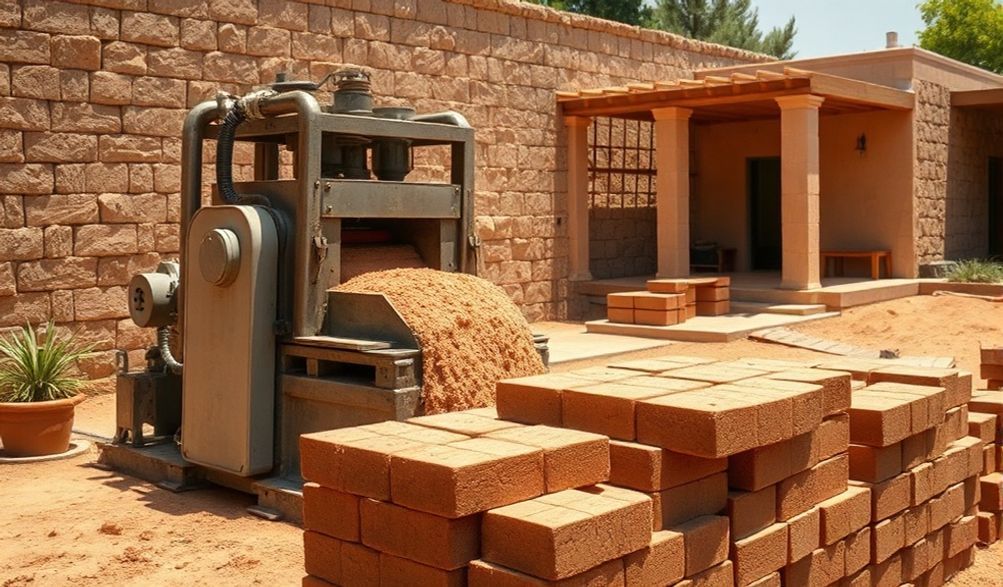
The Complete Guide to Eco Brick Making Machines in Mexico: Sustainable Building Solutions
Pengantar
Mexico’s construction sector is booming, but it faces a monumental challenge. Annually, the country generates an estimated 5 million tons of construction and demolition waste, placing immense pressure on landfills and the environment. Simultaneously, the demand for affordable, dignified housing continues to rise. This tension between development and sustainability calls for a radical rethinking of how we build.
The traditional fired clay brick, a staple of Mexican construction, is part of the problem. Its manufacturing is energy-intensive, relying on wood or fossil-fuel-fired kilns that contribute significantly to air pollution and deforestation. The process also consumes vast quantities of topsoil and water. In an era of climate urgency and resource scarcity, this model is increasingly untenable.
Enter a transformative, yet elegantly simple, solution: the eco brick making machine. This technology offers a path forward, marrying ancient building wisdom with modern engineering. These machines compress locally available earth—soil, sand, and stabilizers—into dense, uniform blocks, all without a single firing. The result is a building material that is strong, sustainable, and uniquely suited to Mexico’s needs and resources.
This guide serves as your comprehensive resource. Whether you are a builder seeking cost-effective materials, an entrepreneur eyeing a green business opportunity, an NGO planning a community project, or a municipal official promoting sustainable development, you will find actionable insights here. Built on technical knowledge, market research, and a deep understanding of Mexico’s diverse landscapes and building codes, this guide aims to equip you with the knowledge to make informed decisions.
What is an Eco Brick Making Machine and How Does It Work?
At its core, an eco brick machine automates and perfects one of humanity’s oldest construction techniques: building with earth. Unlike adobe, which is sun-dried, these machines produce Blok Tanah yang Dipadatkan (CEB) through high-pressure compaction, creating a superior, engineered product.
Core Principles of Compressed Earth Block (CEB) Technology
The science is straightforward but powerful. By applying immense mechanical pressure (typically 500 to 1,500 PSI) to a precisely formulated mix of damp earth, the particles are forced together, creating strong mechanical bonds. This process dramatically increases the block’s density and compressive strength.
- Vs. Fired Clay Bricks: CEBs eliminate the kiln-firing stage, saving over 90% of the embodied energy. No burning means zero direct emissions of CO2 or harmful particulates.
- Vs. Concrete Blocks: While concrete blocks are strong, their production is carbon-intensive due to cement. CEBs use only a fraction (0-10%) of cement as a stabilizer, drastically lowering the carbon footprint and material cost.
Komponen Utama dari Mesin pada Umumnya
Demystifying the machine helps in selection and operation. Most models, from manual to automatic, share these core components:
- Hopper:Ruang tempat campuran tanah yang sudah disiapkan dimuat.
- Ruang Kompresi & Cetakan: The heart of the machine. A hydraulic or mechanical ram compresses the mix into a steel mold, defining the brick’s shape (standard, interlocking, etc.).
- Mekanisme Tekan: The source of power. This can be a manual lever, an electric motor, or a diesel engine, determining the machine’s speed and output force.
- Sistem Pelontaran: Once compressed, the finished block is neatly ejected onto a pallet or rack for curing.
The Raw Materials: What Can You Use in Mexico?
The beauty of this technology lies in its use of hyper-local materials. Success begins with the soil under your feet.
- Ideal Soil Composition: The best results come from a “loam” mix: roughly 30% clay (binder), 40% sand (strength), and 30% silt/silt (filler). Soil from many regions in Mexico, from the central highlands to coastal areas, can be suitable with minor adjustments.
- The Role of Stabilizers: For increased durability, especially against prolonged moisture, small amounts of stabilizers are added. In Mexico, the most common are:
- Semen (Portland): 5-10% by volume. Provides high compressive strength and water resistance quickly.
- Jeruk Nipis: A more traditional and breathable stabilizer, excellent for humidity regulation.
- Sumber Lokal: Using on-site or locally quarried materials slashes transportation costs, supports local economies, and minimizes the project’s overall environmental impact.
Benefits of Using Eco Brick Machines for the Mexican Market
Adopting CEB technology delivers a powerful triple bottom line: planet, profit, and people.
Environmental & Sustainability Advantages
- Drastic Carbon Reduction: Removing the firing process cuts the brick’s carbon footprint to a fraction of its traditional counterpart.
- Zero Waste Production: Excess soil from the construction site can become the primary building material, creating a near-closed-loop system.
- Low Embodied Energy: From extraction to production, the energy input is minimal, especially with manual or solar-powered operations.
- Fully Biodegradable: At the end of its very long life, an unstabilized CEB can simply return to the earth.
Economic Benefits for Builders and Entrepreneurs
- Lower Unit Cost: Production costs can be 30-50% lower than fired bricks, as fuel and expensive raw materials are eliminated.
- Business Creation: A single machine can form the basis of a small-scale brick production yard, supplying local communities and projects.
- Supply Chain Resilience: It reduces dependency on the volatile prices of cement, fired bricks, and long-distance transportation.
Social and Structural Benefits
- Perumahan Terjangkau: The significant cost savings directly translate to more affordable home construction, a critical need across Mexico.
- Superior Thermal Performance: CEB walls have high thermal mass. They absorb heat during the day and release it at night, naturally regulating indoor temperatures. This leads to substantially lower energy bills for cooling and heating.
- Tahan Api & Hama: Compacted earth does not burn and is inhospitable to termites and rodents.
- Daya Tahan: Properly stabilized and protected CEB buildings can last for centuries, as evidenced by historical earth constructions worldwide.
Key Considerations Before Buying an Eco Brick Machine in Mexico
Jumping in without planning is the main cause of project failure. Careful assessment is key to success.
Assessing Your Project Scale and Needs
Your choice of machine dictates your output and labor model.
- Mesin Press Manual: Ideal for small projects, NGOs, and community self-builds. Low cost, portable, no power needed. Output: 300-500 bricks/day.
- Semi-Automatic (Electric/Diesel): Perfect for small-to-medium businesses and housing developments. Higher output with less physical labor. Output: 1,000-3,000 bricks/day.
- Sepenuhnya Otomatis: For large-scale commercial production. High capital cost but maximum output and consistency. Output: 5,000+ bricks/day.
Soil Testing: The Essential First Step
Do not skip this step. The soil is your main ingredient, and its properties are non-negotiable.
- Find a Lab: Contact engineering departments at local universities (e.g., UNAM, IPN, state universities) or private geotechnical labs in major cities.
- Key Tests: Request a particle size analysis (sand, silt, clay percentages) and, if possible, a proctor test to determine optimal moisture content for compaction.
- Interpret for Mix Design: The lab results will guide the exact proportions of soil, sand, and stabilizer needed for strong, durable bricks.
Analisis Total Biaya Kepemilikan
Budget for more than just the machine’s sticker price:
- Machine Purchase Price
- Import Duties & Taxes (if importing)
- Inland Transportation & Installation
- Pelatihan: For operators on mix design and machine maintenance.
- Ancillary Equipment: Sieve, pan mixer, wheelbarrows, curing tarps.
- Spare Parts: Hydraulic seals, mold wear parts.
Navigating Suppliers: Local Manufacturers vs. International Importers
- Local Mexican Manufacturers/Suppliers:
- Kelebihan: Easier communication, faster delivery, lower shipping costs, better understanding of local needs and materials.
- Kekurangan: Possibly fewer model options. Kiat: Search for “máquina para hacer bloques de tierra comprimida” or “fabricantes de ladrillos ecológicos en México.”
- International Importers:
- Kelebihan: Access to a wide range of global brands and technologies.
- Kekurangan: Higher logistics costs, potential language barriers, complicated after-sales support and parts procurement.
- Due Diligence: Always ask for customer references in Mexico, verify warranty terms, and confirm the availability of technical support and spare parts.
Successful Applications and Case Studies in Mexico
This is not theoretical technology; it’s already building a better Mexico.
- Eco-Housing in Oaxaca: NGOs like EcoSurdanCATIS have facilitated the construction of entire communities using CEBs, providing affordable, seismically-resistant, and thermally comfortable homes for indigenous families.
- The “Casa de Tierra” in Chiapas: Various projects demonstrate how CEBs can be used for modern, beautiful, and sustainable single-family homes that stay cool in the tropical heat.
- Educational & Institutional Buildings: Schools and community centers in Yucatán and Hidalgo have been built with CEBs, showcasing their suitability for public infrastructure.
- Eco-Tourism: High-end eco-lodges in Baja California and Quintana Roo use CEBs for their natural aesthetics and passive cooling properties, offering guests a truly sustainable experience.
- Landscaping: Retaining walls, garden beds, and perimeter walls are excellent, low-cost applications for CEBs, even in high-humidity areas with proper detailing.
FAQs About Eco Brick Making Machines in Mexico
Q: Are compressed earth bricks strong enough for Mexican building codes (normas técnicas)?
A: Absolutely. When professionally engineered with the correct stabilization and compaction, CEBs can meet and exceed the strength requirements for both non-load-bearing and load-bearing walls in the Normas Técnicas Complementarias del Reglamento de Construcciones. The critical step is to involve a qualified structural engineer with experience in earth construction to design and approve the plans.
Q: How do they hold up against heavy rain and humidity?
A: Like any earthen material, they need a “good hat and boots.” The blocks themselves, when stabilized with cement or lime, have good resistance. Crucially, the building design must include:
* A raised, impermeable foundation (e.g., concrete stem wall).
* Generous roof overhangs (40-60 cm minimum).
* Breathable, water-repellent plasters (lime-based are ideal) to protect walls while allowing moisture vapor to escape.
Q: Is special training required to operate the machines?
A: Basic operation is simple and can be learned in a day. However, training in soil mix design, quality control (checking brick density and moisture), and basic machine maintenance is highly recommended to ensure consistent, high-quality production and avoid costly mistakes. Many reputable suppliers offer this training.
Q: What is the typical payback period for a machine investment?
A: This varies dramatically. A community project may measure payback in social value. For a small business, the period depends on local brick prices, production volume, and operational efficiency. With strong local demand, a semi-automatic machine supplying a housing project can see a financial payback within 6 to 18 months.
Q: Where can I see these machines or buildings in person in Mexico?
A: Start by contacting:
* Universities with architecture or engineering departments focused on sustainability.
* Mexican NGOs specializing in appropriate technology (e.g., Lak’ech A.C., CEDI).
* Visiting eco-parks or sustainable community developments.
* Attending workshops or expos on green building in major cities.
Kesimpulan
The eco brick making machine represents more than just a piece of equipment; it embodies a paradigm shift for construction in Mexico. It directly addresses the intertwined challenges of environmental degradation, high building costs, and the need for resilient, comfortable housing. By turning local earth into durable building blocks, this technology empowers communities, fosters local entrepreneurship, and builds a legacy of sustainable development.
The global trend towards green construction is accelerating, and Mexico, with its rich cultural history of earth building and urgent need for sustainable solutions, is perfectly positioned to lead. The future of building is not about extracting more, but about building smarter with what we have.
Your next step is clear. Begin with a soil test. This foundational data will inform every decision that follows. Then, reach out to reputable suppliers, ask the hard questions about support and training, and if possible, visit an existing project to see and feel the material for yourself. Always consult with local engineers and builders who understand both the technology and the specific conditions of your region. The path to building a more sustainable Mexico starts from the ground up.
<