
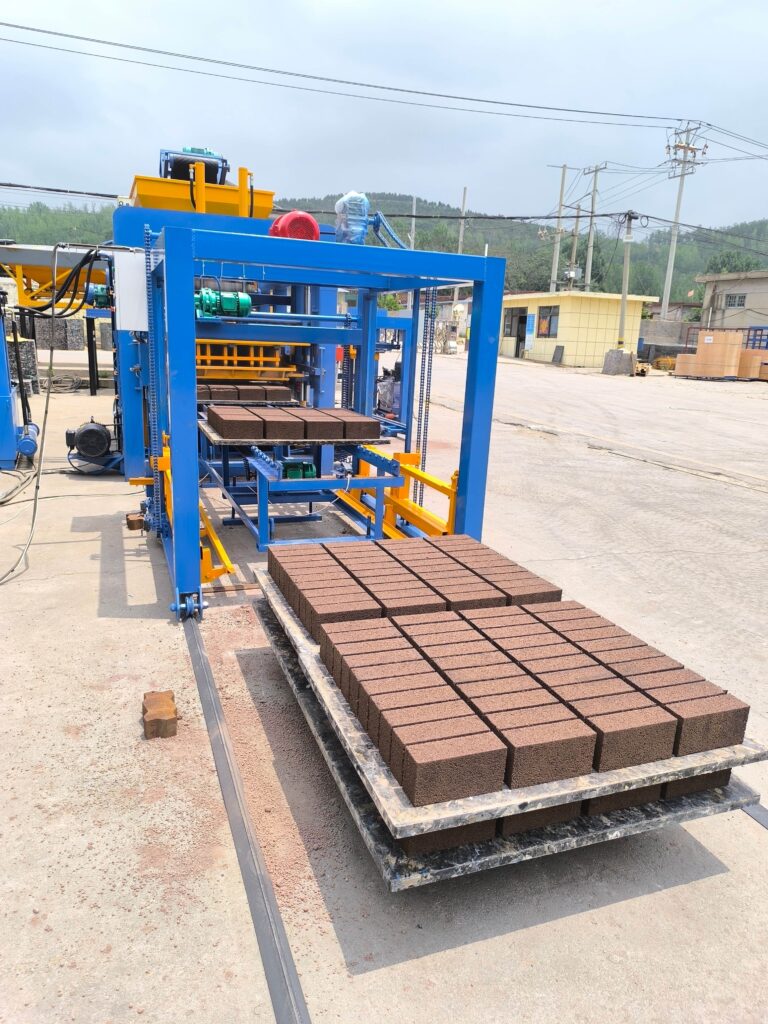
Penentu Kekuatan Blok: Analisis Proses
Kuat tekan satuan pasangan beton tidak melekat pada konsep "mesin" atau "tangan", melainkan merupakan hasil langsung dari proses yang mengatur pembuatannya. Tiga faktor yang paling penting adalah konsistensi campuran, gaya pemadatan, dan pengendalian perawatan.
- 1.1. Konsistensi Integrasi Bahan Baku
- Produksi MesinSistem pencampuran modern memberikan tingkat presisi yang tinggi. Semen, agregat, dan air diukur berdasarkan berat atau volume dengan keakuratan elektronik, memastikan rasio air-semen yang identik—faktor paling kritis untuk kekuatan akhir—pada setiap pencampuran. Hal ini menghilangkan variabilitas yang melekat pada proporsi manual.
- Produksi Buatan TanganBergantung pada proporsi volumetrik (misalnya, sekop, ember), yang rentan terhadap variasi yang signifikan. Kadar air dalam agregat jarang diperhitungkan secara ilmiah, sehingga menyebabkan rasio air-semen yang berfluktuasi. Ketidakkonsistenan ini secara langsung menghasilkan rentang kekuatan potensial yang luas dalam satu proses produksi.
- 1.2. Pemadatan: Penerapan Gaya
- Produksi MesinMenggunakan getaran frekuensi tinggi yang telah dikalibrasi, dikombinasikan dengan tekanan terkendali dari kepala hidrolik atau mekanis. Aksi ganda ini secara menyeluruh memadatkan campuran, menghilangkan rongga udara yang terperangkap dan memaksa pasta untuk melapisi seluruh partikel agregat secara menyeluruh. Hasilnya adalah matriks yang lebih padat dan homogen. Waktu getaran dan tekanan konsisten untuk setiap unit tunggal.
- Produksi Buatan TanganMengandalkan penumbukan manual atau getaran meja. Meskipun pengrajin trampil dapat mencapai pemadatan yang baik, gaya yang diterapkan tidak dapat diukur maupun konsisten sempurna dari satu blok ke blok berikutnya. Kemungkinan adanya area yang tidak padat atau rongga di dalam blok jauh lebih tinggi, sehingga menciptakan titik-titik kelemahan.
- 1.3. Pengawetan dan Jaminan Mutu
- Produksi MesinDiintegrasikan ke dalam sistem di mana balok-balok dipindahkan secara sistematis ke lingkungan pengawetan yang terkendali (ruang uap, ruang kabut, atau halaman tertutup). Hal ini memastikan suhu dan kelembapan optimal untuk pengembangan kekuatan. Yang terpenting, produksi terikat pada produksi formalProtokol Jaminan Kualitas (QA)dengan pengambilan sampel rutin dan pengujian destruktif di laboratorium bersertifikat untuk memverifikasi kepatuhan terhadap standar kekuatan yang dipublikasikan (misalnya, ASTM C90).
- Produksi Buatan TanganProses pengawetan sering kali dilakukan di lingkungan terbuka dan rentan terhadap fluktuasi cuaca—angin kering atau suhu beku dapat secara kritis mengganggu peningkatan kekuatan. Jaminan Kualitas (QA) biasanya bersifat visual dan berdasarkan pengalaman, tanpa data empiris yang dapat diverifikasi pihak ketiga yang mengatur produksi industri.
2. The Verdict: Quantifiable Strength vs. Variable Craft
When analyzing these factors, a clear, technical distinction emerges.
- 2.1. The Benchmark of Minimum Specified Strength
Machine-made blocks are engineered to meet or exceed minimum specified compressive strengths (e.g., 2,000 psi, 2,500 psi, 3,000 psi) as defined by international building codes. Each pallet is part of a lot that has been tested, and the manufacturer provides a warranty of compliance. The strength is a guaranteed, documented characteristic. - 2.2. The Nature of Hand-Made Block Strength
A well-made hand-formed block, produced by a highly skilled worker under ideal conditions, can achieve considerable strength. However, its performance represents a point estimate, not a guaranteed minimum. The average strength of a batch may be lower, and the standard deviation—the range from weakest to strongest block—will be far wider. In structural design, engineers must account for the lowest strength in the batch, a factor that is unknown and unverified without systematic testing.
3. Commercial and Specification Implications for the Supply Chain
This technical analysis has direct consequences for sourcing, sales, and application.
- 3.1. Meeting Engineering and Code Requirements
For any load-bearing application in commercial, industrial, or public infrastructure projects, specifications will mandate compliance with recognized standards (ASTM, ISO, etc.). Only machine-produced blocks with accompanying test reports can reliably meet these contractual and legal requirements. Distributors supplying such projects must provide this documentation. - 3.2. Market Positioning and Value Proposition
- Machine-Made Blocks: The value proposition is predictable performance, code compliance, and structural efficiency. They are the default choice for engineered masonry.
- Hand-Made Blocks: Their value lies primarily in aesthetic character—irregular textures, subtle color variations, and heritage appeal for restoration or high-end architectural projects. Here, they are selected as a finish material, often with their structural role supplemented or validated by other means.
- 3.3. Risk Management for Dealers and Specifiers
Supplying or specifying hand-made blocks for primary structural purposes carries inherent liability risk due to the lack of verifiable, consistent strength data. For a distributor, aligning product type with appropriate applications is a critical aspect of professional responsibility and risk mitigation.
Kesimpulan
The question of strength is decisively answered by the principles of controlled manufacturing. Machine-made blocks are demonstrably and consistently stronger in the context that matters most to construction: guaranteed minimum compressive strength verified by standardized testing. The mechanized process masters the variables of mix design, compaction, and curing, delivering a uniform product that meets precise engineering specifications. Hand-made blocks, while possessing artisan value, cannot guarantee this level of consistent structural performance. Therefore, for load-bearing applications governed by modern building codes, machine-made blocks are not simply stronger on average; they are the only viable choice that provides the verifiable, reliable data required for safe and compliant structural design. For the supply chain professional, this understanding is essential for correct product positioning, accurate technical advising, and effective risk management.
FAQ
Q1: Can a hand-made block ever be as strong as a machine-made block?
A: In a one-off comparison under perfect conditions, a meticulously crafted hand-made block could match the strength of a lower-grade machine-made block. However, this is an exception, not a replicable standard. The core issue is consistency; a machine guarantees a minimum strength for every block, while hand-made production cannot.
Q2: Why do some heritage structures built with hand-made blocks remain standing for centuries?
A: Historical structures often succeed due to significant factors of safety (massive wall thicknesses, robust mortars) and have endured because they are not subject to the same dynamic loads (e.g., high-rise wind shear, seismic codes) as modern buildings. Their longevity is a testament to conservative design and durable materials, not proof of consistent, quantifiable block strength by today’s engineering standards.
Q3: As a distributor, how should I respond if a client asks for hand-made blocks for a structural wall?
A: It is your professional duty to clarify the risks. Explain the lack of verifiable strength data and code compliance. Recommend a hybrid approach: using machine-made blocks for the structural core and a hand-made block veneer or special facing units for aesthetics. Always advise the client to consult with the project’s structural engineer before making a final decision.
Q4: Are there different strength grades within machine-made blocks?
A: Yes. Reputable manufacturers produce blocks in several strength grades (e.g., Normal Weight: 2,000 psi, 2,500 psi; Lightweight: 1,500 psi, 2,000 psi). The required grade is specified by the project engineer based on the structural design loads. This graded system is a further refinement of the precision offered by machine production.
Q5: Does the focus on compressive strength mean other properties are irrelevant?
A: Not at all. While compressive strength is the primary structural metric, other properties like density (affecting thermal and sound insulation), moisture absorption, and fire resistance are also important. Machine production allows for the precise engineering of these properties as well, through controlled mix designs and curing, ensuring a balanced suite of performance characteristics.
