
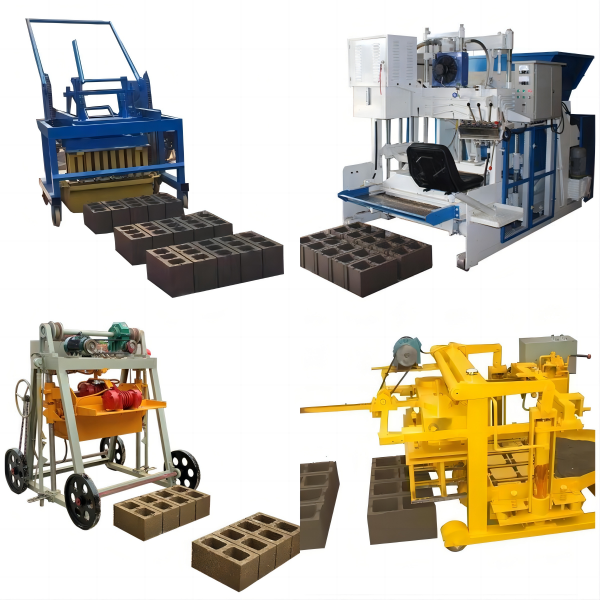
1. Defining the Egg-Laying Block Machine: A Mobile Production Unit
An egg-laying block machine is a self-contained, mobile manufacturing plant designed to produce concrete blocks directly at the point of use. It is not a stationary fixture in a factory but a vehicular or trailer-mounted system that travels to the construction site.
1.1. The Origin of the Name
The term “egg-laying” is a descriptive analogy for its core function. The machine does not eject blocks onto pallets for later transport. Instead, it moves forward under its own power on a prepared level surface, and within its integrated cycle, it deposits (or “lays”) the freshly molded blocks neatly onto the ground or a concrete casting bed in rows behind it, much like a hen laying eggs in a nest. This eliminates the need for separate pallets, extensive handling, and intermediate transportation of the heavy finished product.
2. Core Operational Mechanics and Workflow
The operational sequence of an egg-laying machine is a synchronized ballet of mixing, forming, and placement, distinct from stationary plant processes.
2.1. The Integrated Production Cycle
The machine combines several stages into a single mobile unit:
- On-Board Material Handling: The machine carries bulk bins for cement and aggregates. Water is supplied from a local source. A small, integrated mixer combines these materials into a no-slump concrete mix.
- In-Motion Molding and Compaction: The mix is fed into a molding chamber. Here, similar to a stationary machine, vibration and hydraulic pressure compact the mix into the desired block shape.
- The “Laying” Process: This is the defining step. Instead of a pallet, the mold opens downward or to the rear. The compacted block is gently deposited onto the prepared casting surface directly below or behind the machine. Ejection systems may use a hydraulic pusher or a lowering mechanism to ensure the block is placed without damage to its edges.
- Self-Propelled Advancement: After laying a complete row or set of blocks, the machine inches forward on rails or tracks to the next position, ready to repeat the cycle. This creates a continuous, linear production line on the ground itself.
2.2. Site Preparation and Curing
- Casting Bed Preparation: The site crew prepares a flat, level surface of lean concrete or compacted sand. This serves as the production floor and initial curing bed.
- In-Situ Curing: The blocks cure naturally where they are laid, typically covered with plastic sheeting or curing blankets to retain moisture. There is no steam curing kiln; the blocks gain strength through ambient hydration over days. This process requires careful climatic management but eliminates the energy cost of kiln firing.
3. Key Differentiators from Stationary Block Plants
Understanding the egg-laying machine requires a clear contrast with conventional factory-based systems.
| Aspect | Stationary Block Plant | Egg-Laying Block Machine |
|---|---|---|
| Location | Fixed industrial facility. | Mobile, deployed directly at the construction site. |
| Output Destination | Blocks are palletized, cubed, and shipped to distributors and sites. | Blocks are deposited directly onto the ground at the point of use. |
| Curing Method | Accelerated, controlled low-pressure steam curing in kilns. | Natural, ambient curing on the casting bed. |
| Primary Capital | High investment in factory infrastructure, kilns, and logistics. | Investment is in the mobile machine itself. |
| Logistics Cost | High cost per ton for transporting heavy finished blocks. | Near-zero finished product transport cost; only raw materials are moved. |
4. Strategic Applications and Ideal Use Cases
This technology is not a universal replacement but a superior solution for specific project profiles.
4.1. Large-Scale, Repetitive Projects
Its economics excel where vast quantities of blocks are consumed in a concentrated area.
- Mass Housing Developments: Producing blocks on-site for hundreds of similar housing units.
- Industrial Warehouses and Compound Walls: Long perimeter walls or large floor areas requiring pavers.
- Proyek Infrastruktur: Canal lining, roadside retaining walls, and other linear civil works.
4.2. Remote and Logistically Challenged Locations
Where transportation networks are poor or distances from stationary plants are vast, the egg-laying machine becomes indispensable.
- Rural and Agricultural Construction: Building grain silos, processing facilities, or worker housing in remote areas.
- International Development Projects: Deployable in regions lacking local block manufacturing infrastructure.
4.3. Projects with Extreme Cost Sensitivity to Logistics
When the cost of hauling finished blocks exceeds the cost of the material itself, on-site production offers dramatic savings. The machine essentially transports lightweight raw materials and manufactures the heavy product where it is needed.
5. Commercial Implications for the Supply Chain
The existence of this technology creates alternative sourcing models and requires strategic consideration from distributors.
5.1. A Competitor or a Complement?
For a traditional distributor, an egg-laying machine on a local large project represents a direct bypass of the supply chain for that specific project’s block needs. However, it does not replace the distributor’s role for smaller, diverse, or time-sensitive orders across multiple clients. It is a project-specific solution, not a market-wide one.
5.2. Opportunity for Service Diversification
Forward-thinking distributors or dealers could explore offering egg-laying machine services as a rental or contract production model. This transforms the business from product sales to providing a manufacturing-as-a-service solution, catering to a specific clientele with large, suitable projects.
5.3. Procurement Considerations for Major Contractors
For large construction firms and procurement officers, the egg-laying machine presents a powerful make-or-buy decision. Conducting a total cost analysis—factoring in raw material sourcing, machine mobilization/demobilization, on-site labor, and the value of time—against the delivered price from a stationary plant distributor is essential. It often proves advantageous for projects exceeding a certain scale and duration.
6. Limitations and Practical Considerations
The egg-laying model has inherent constraints that define its niche.
- Product Range Limitation: Typically optimized for one or two standard block types (e.g., solid or hollow blocks of a standard size). Producing a wide variety of special shapes or pavers is often impractical due to mold change complexities on-site.
- Weather and Climate Dependence: Ambient curing is susceptible to temperature and humidity extremes. Production may halt in freezing conditions or require extra measures in very hot, dry climates to prevent cracking.
- Site Space and Management: Requires significant dedicated, prepared space on the construction site for production and curing, as well as disciplined scheduling to ensure blocks have gained sufficient strength before being moved or built upon.
Kesimpulan
The egg-laying block machine is a specialized but potent tool in the construction arsenal, embodying the principle of decentralized production. It is a logistical disruptor that inverts the traditional supply chain by bringing the factory to the feedstock of a project. For distributors and procurement experts, its significance lies in recognizing its domain: it is the optimal solution for large-scale, geographically concentrated projects where the physics and economics of transporting heavy materials dominate the cost structure. Understanding this technology allows supply chain professionals to accurately assess competitive threats, identify potential new service avenues, and provide more holistic counsel to clients weighing different sourcing strategies. It underscores a critical lesson: in construction materials, the greatest value is sometimes unlocked not by moving the product more efficiently, but by fundamentally reimagining where and how it is made.
FAQ (Frequently Asked Questions)
Q1: What are the typical output rates of an egg-laying block machine compared to a stationary plant?
A: Output is considerably lower. A stationary plant can produce thousands of blocks per hour. A typical egg-laying machine might produce 400 to 1,200 blocks per 8-hour shift, depending on model and block size. The trade-off is not in sheer volume, but in the elimination of all downstream handling and transport costs. Its productivity metric is more accurately measured in “blocks laid directly into final position per day.”
Q2: Is the quality of blocks from an egg-laying machine inferior due to natural curing?
A: Not inherently inferior, but different. Without steam curing, the blocks gain strength more slowly. At 28 days, a properly produced block from an egg-laying machine can meet the same ASTM or EN compressive strength standards as a kiln-cured block. The key is rigorous on-site quality control of the mix and curing conditions. The main difference for the contractor is that the blocks cannot be used for load-bearing construction as quickly (often requiring 7-14 days of curing before laying).
Q3: Can these machines produce high-value aesthetic products like split-face or colored architectural block?
A: Generally, no. The process is geared towards functional, structural block production. Applying split-face textures typically requires a secondary process not feasible on a mobile unit. Integral color can be added, but consistency can be harder to maintain with on-site mixing, and the cost premium for pigments may negate some of the logistical savings. This technology is focused on volume and structural utility, not architectural finish.
Q4: Who is the typical owner of an egg-laying machine?
A: Ownership varies. It can be:
- Large Construction Contractors: Who use it exclusively for their own major projects.
- Specialist Rental Companies: Who lease the machine and often provide an operator to client projects.
- Entrepreneurial Block Manufacturers: Who use it to service remote areas without establishing a fixed plant.
It is rarely owned by a traditional brick-and-block distributor focused on multi-client sales from inventory.
Q5: How should a distributor respond if a major client inquires about using an egg-laying machine for an upcoming project?
A: This is a consultative opportunity. A knowledgeable distributor should:
- Perform a Neutral Cost-Benefit Analysis: Help the client model total costs of on-site production (machine rental, raw materials, site labor, curing time) vs. supply from your plant (delivered price, speed of construction, guaranteed quality).
- Highlight Intangibles: Emphasize your value: guaranteed strength on day one, consistent supply regardless of weather, no site space consumed, and the ability to supply a full range of complementary products (lintels, sills, mortar).
- Consider Partnership: If the numbers favor the machine, explore if you can be the supplier of the raw materials (cement, aggregates) or even offer a bundled service.
This transparent approach builds long-term trust, regardless of the immediate outcome.
