
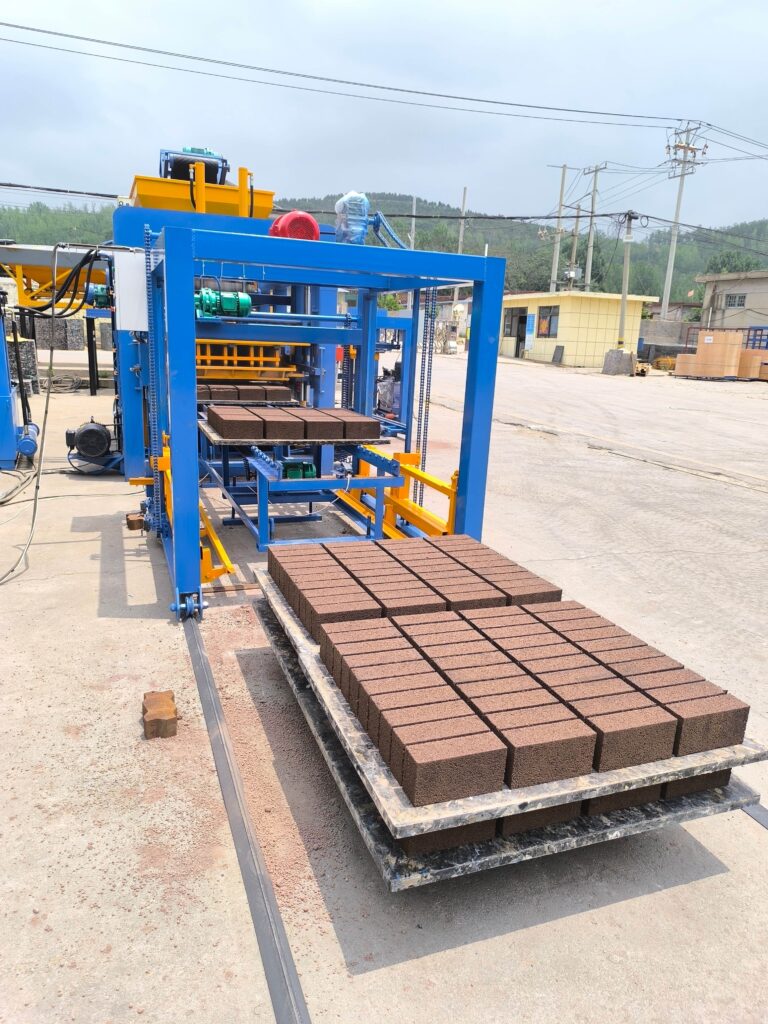
Өндірістік жобаларды жеткізудегі кірпіш құю машиналарының өнімділігі
Үзіліссіз жоғары көлемді өнім шығаруға арналған машиналарды жобалау
Өнеркәсіптік кірпіш өндіру жүйелерінің дизайн философиясына үлкен көлемді жобаларға қызмет көрсетуге арналған негізгі мүмкіндік тікелей енгізілген.
1.1 Өнеркәсіптік деңгейдегі жабдықты стандартты қондырғылардан ажырату
Өнеркәсіптік жүйелер келесі сипаттамаларға ие:
- Берік құрылымдық дизайн:Ауыр жүктемелі болат рамалар, күшейтілген діріл платформалары және 24/7 режимде жұмыс істеуге, минималды шаршау немесе деформацияға арналған өнеркәсіптік гидравликалық немесе электромеханикалық жүйелер қолданылады. Бұл миллиондаған циклдар бойы өнімнің тұрақты өлшемдерін қамтамасыз етеді.
- Жоғары жылдамдықты, көп қуысты өндіріс:Жоба ауқымындағы машиналар жылдам реттілікпен жұмыс істейтін көптеген қалып ұяларымен жабдықталған. Стандартты машина 4-6 ұялы қалыпқа ие болуы мүмкін, ал өнеркәсіптік жүйелерде 10, 15 немесе одан да көп ұялары бар қалыптар қолданылады, цикл уақыты секундқа дейін оңтайландырылған. Өнімділік бір ауысымда ондаған мың данамен өлшенеді.
- Толық интеграцияланған автоматтандыруӨзекше құю блогы тек бір компонент болып табылады. Нақты жоба көлеміндегі жүйелер интеграцияланған өндірістік желілер болып табылады, олар автоматтандырылған шикізат беру, компьютерленген дозалау, роботталған паллетпен жұмыс істеу және автоматтандырылған үймелеу және созу-орау станцияларын қамтиды. Адамның араласуы бақылау және техникалық қызмет көрсету деңгейіне дейін азайтылады, бұл қол еңбегіне байланысты кедергілерді жояды.
1.2 Синхрондандырылған өндірістік желі: Бір ғана машинадан тыс
Ірі көлемді өнім шығару жүйелік синхронизацияның функциясы болып табылады, жай ғана машина жылдамдығы емес.
- Жоғары ағынды интеграцияАвтоматтандырылған бункерлер мен конвейерлер араластырғышқа шикізаттың (құм, цемент, толтырғыш) үздіксіз, сұраныс бойынша жеткізілуін қамтамасыз етеді, бұл өндірістік желінің тоқтап қалуын болдырмайды.
- Downstream Integration: The system manages the flow of green bricks from the mold to curing racks or chambers with precision. Automated conveyor systems, cross-transfer cars, and robotic palletizers handle the product gently and efficiently, maintaining high line speeds without damage.
- Curing Capacity as a Critical Multiplier: The production line’s speed is meaningless without matching curing capacity. Project-scale operations employ high-efficiency, accelerated curing systems—such as controlled steam tunnels or heated humidity chambers—that can process an entire day’s output in 18-24 hours, creating a continuous flow of hardened, ready-to-ship product.
Quantifying Output: From Theoretical Capacity to Guaranteed Delivery
Understanding the translation of machine specifications into reliable project timelines is crucial for procurement planning.
2.1 Calculating Sustainable Project Output
Project planning requires guaranteed minimum output, not peak theoretical numbers.
- The Uptime Imperative: Industrial machinery is designed for an operational uptime of 85-95%. This accounts for planned mold changes, preventive maintenance, and minor adjustments. Calculations must use this sustainable uptime figure, not 100%.
- Output Formula for Project Bidding: A reliable formula for distributors to assess is:
[Daily Project Capacity] = (Machine Cycles per Hour) x (Cavities per Mold) x (Operational Hours per Day) x (System Uptime Percentage)
Example: A line with a 15-second cycle (240 cycles/hr), an 18-cavity mold, running 20 hours/day at 90% uptime yields: 240 x 18 x 20 x 0.90 = 77,760 bricks per day. - Buffer and Scalability: For a project requiring 5 million bricks, a single line at this capacity could fulfill the order in approximately 65 production days. Leading suppliers often have multiple parallel lines or modular systems that can be scaled to further compress the timeline or provide redundancy.
2.2 Consistency as a Non-Negotiable Requirement
For large projects, consistency is as critical as volume. A variance in brick dimension or strength can cause massive delays.
- Process Control Systems: Industrial lines are governed by Programmable Logic Controllers (PLCs) that monitor and control every parameter—vibration frequency, pressure, moisture content, curing temperature—ensuring that the ten-thousandth brick is identical to the first.
- In-Line Quality Assurance: Automated laser dimension checkers and weight scales can be integrated into the conveyor line to continuously sample products, providing real-time data and automatically rejecting outliers, ensuring only specification-compliant bricks proceed to curing and shipping.
Logistical and Supply Chain Mastery
Feeding a massive construction site requires military-grade logistical coordination, which is enabled by predictable, centralized production.
3.1 Enabling Just-in-Time (JIT) Delivery Frameworks
Large construction sites have limited staging area. The predictable output of an industrial plant allows for the implementation of JIT delivery schedules.
- Production-to-Site Synchronization: Project managers can establish a fixed, reliable schedule of daily or weekly deliveries based on the known, unwavering output of the factory. This eliminates the need for massive, costly on-site inventory and reduces material handling.
- Sequenced Manufacturing: For projects using multiple brick types (e.g., standard units, corner units, half-bats), the production line can be sequenced to manufacture and deliver products in the exact ratio required at each phase of construction, further optimizing site operations.
3.2 Economic and Risk Mitigation Advantages
The scale offered by industrial machinery translates into direct project cost savings and risk reduction.
- Bulk Material Procurement: A factory producing for a single large project can procure raw materials in colossal volumes, securing significant discounts and insulating the project from spot-market price volatility for key inputs like cement.
- Elimination of Supply Fragmentation: Sourcing from multiple small producers introduces variability and coordination hell. A single, high-capacity source guarantees uniform color, dimensions, and performance, while simplifying accountability and quality traceability.
- Financial and Schedule Certainty: A fixed production cost per unit and a guaranteed production schedule provide the project’s financial controllers and planners with a level of certainty unattainable with aggregated smaller suppliers, directly contributing to project bankability.
Case in Point: Project-Specific Customization and Technical Support
Industrial brick machinery offers the flexibility to tailor products to specific project needs without sacrificing output.
4.1 Custom Mix Designs and Special Units
Large projects often have unique engineering requirements.
- Tailored Strength and Durability: Mix designs can be engineered for high early strength for rapid wall construction, low permeability for below-grade applications, or enhanced thermal properties for energy codes.
- Special Shape Production: With quick-change mold systems, an industrial line can efficiently produce the required quantity of special shapes—bullnose, arches, coping—needed for the project’s architectural features, all from the same production line and material base, ensuring perfect visual and performance matching.
4.2 Embedded Technical Partnership
A supplier operating industrial-grade equipment becomes a technical partner.
- Project-Specific Quality Documentation: They can provide exhaustive batch test certificates, mill reports for materials, and production logs that satisfy the most stringent project specifications and third-party auditors.
- On-Site Technical Liaison: Leading suppliers provide technical support to the construction team, advising on best practices for handling, storage, and installation of their high-volume product, ensuring optimal performance.
Қорытынды
For the distribution and procurement professional, the question of suitability for large-scale projects is answered by the evolution of the brick machine from a simple molding device into a fully synchronized, industrial manufacturing ecosystem. These systems are expressly engineered to deliver the triumvirate of mega-project success: vast, predictable volume; uncompromising, verifiable consistency; and seamless logistical integration. By partnering with manufacturers who invest in this caliber of production technology, distributors secure more than a supplier; they secure a reliable pipeline capable of turning the most ambitious architectural plans into reality. In the realm of large-scale construction, where risk is magnified and schedules are paramount, the industrial brick production line stands not as a mere option, but as the essential, foundational engine for dependable material supply.
FAQ
Q1: What is the minimum practical project size that justifies sourcing from a dedicated high-volume production line?
A: While there is no absolute threshold, projects requiring 1.5 million standard brick equivalents or more typically begin to realize the full economic and logistical benefits of a dedicated high-volume line. For projects over 5 million units, it often becomes the only practical method. The key consideration is the duration of the project; even a 3-million-unit project with a tight 6-month construction window would necessitate the consistent daily output that only an industrial line can guarantee.
Q2: How does the lead time for initiating production on a large project differ from a standard order?
A: For a standard order, production often draws from general inventory. For a large project, the process is more involved:
- Project Kick-off Phase: This includes finalizing custom mix designs, engineering mold profiles for specials, and establishing the detailed delivery schedule (2-4 weeks).
- Production Ramp-up: The factory will initiate a “project run,” dedicating line time, allocating raw material stockpiles, and producing initial batches for approval samples. This structured approach ensures that when full shipping begins, every unit meets specification from day one.
Q3: What happens if the brick machine breaks down during a critical project phase?
A: This is a primary differentiator of industrial-grade installations. Mitigation strategies are inherent in their design:
- Preventive Maintenance Regimes: These lines operate on strict, predictive maintenance schedules using sensor data to prevent unplanned stops.
- Critical Component Redundancy: Key subsystems (e.g., hydraulic power units, control panels) may have built-in redundancy.
- On-Site Technical Staff: Major suppliers have dedicated maintenance engineers on-site or on-call.
- Strategic Inventory Buffering: A prudent project plan includes a negotiated buffer stock (e.g., a 5-7 day supply) held at the factory to absorb any minor production hiccups without affecting site delivery.
Q4: Can these high-volume lines produce different colors or finishes for a single project?
A: Yes, but with careful planning. Changing colors or surface treatments (e.g., from smooth to textured) requires a production line purge and clean-down to prevent cross-contamination. For project planning, this means batches are produced in monolithic color/finish runs. The project schedule is then synchronized to receive, for example, all “Façade Blend A” bricks in one sequence, followed by “Foundation Gray” in the next. The consistency within each batch is absolute, and the overall project sequencing is managed as part of the integrated supply plan.
Q5: As a distributor, how do I vet a manufacturer’s claim that they can handle my client’s large project?
A: Conduct a thorough capability audit. Require and verify:
- Plant Visit: Observe the scale, integration, and condition of the production line. Assess raw material storage capacity.
- Output Verification: Review historical production logs for similar, sustained periods (e.g., 60 days of uninterrupted output data).
- Curing Capacity: Inspect the curing system. Can it handle the daily output of the press? This is the most common bottleneck.
- Reference Projects: Request and contact references for past projects of comparable scale, inquiring about on-time delivery rates and consistency.
- Logistics Plan: Ask for a detailed draft logistics plan for a hypothetical project, including fleet size, loading times, and delivery scheduling methodology.
